Executive Summary & Key Takeaways
- Water filtration alone cannot protect a pond from White Spot Syndrome Virus (WSSV); wild terrestrial burrowing crabs (Scylla serrata, Uca spp.) and predatory waterfowl (egrets, cormorants) act as primary vectors that transfer pathogens overland and by air.
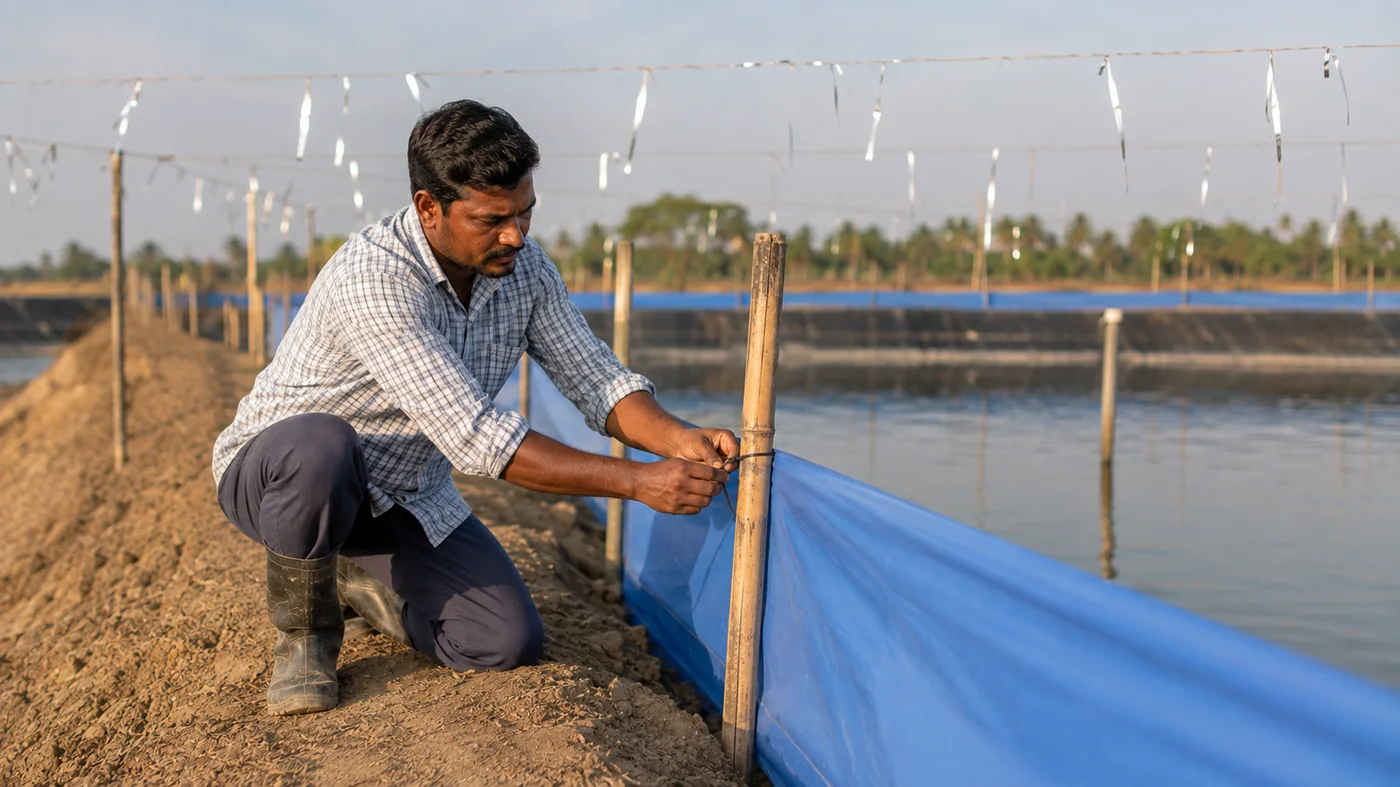
- Crab fences must be constructed from smooth, non-climbable virgin HDPE or PP sheets (500–600 microns thickness); porous shade cloth or thin plastic film are easily climbed or shredded by crab claws.
- Surface installation without sub-soil trenching guarantees failure; crab sheets must be buried in a 15 to 20 cm trench with an outward 90-degree 'L-foot' flange to mechanically block crabs from tunneling beneath the fence.
- Support stakes must be placed on the interior (pond side) of the fence to keep the exterior surface facing wild crabs completely smooth, taut, and obstruction-free.
- Avoid heavy full-canopy netting that snaps poles and collapses during coastal windstorms; install high-tensile 0.8–1.0 mm nylon monofilament lines in a 3m × 3m grid with reflective holographic ribbons to disrupt avian flight paths without wind drag.
- A complete 1-hectare bio-fencing installation costs approximately ₹30,000 to ₹35,000, paying for itself dozens of times over by preventing a single catastrophic ₹20+ Lakh viral crop liquidation.
Field Case Study: 6-Hectare Farm Physical Biosecurity Fortification
A 6-hectare brackishwater farm located 200 meters from mangrove mudflats suffered recurrent WSSV outbreaks at 45–60 DOC. Farm audits revealed that while water intake was chlorinated, wild mud crabs (Scylla serrata) crawled across earthen dykes at night from neighboring creek drains, and flocks of little egrets fed on diseased moribund shrimp in nearby abandoned ponds before bathing in the farm's ponds. Under AquaSangham advisory, the farm invested ₹1.82 Lakhs (₹30,300/ha) to install 500-micron blue HDPE crab fencing (60 cm height, trenched 18 cm deep with bamboo stakes at 2m intervals) and an overhead 2.5m × 2.5m grid of 0.8 mm high-tensile nylon bird scare lines strung between perimeter casuarina poles with reflective holographic ribbons. Crab trap monitoring along dykes recorded zero breaches, and bird landing activity dropped by 98%. Over the subsequent 6 crops, the farm operated completely disease-free, harvesting 41.5 tons of Vannamei annually with a cumulative profit uplift of ₹54 Lakhs.
1. Terrestrial & Avian Vector Epidemiology: The Unseen Vectors of WSSV
Biosecurity in commercial coastal aquaculture is an all-or-nothing discipline. A farm operator may invest lakhs of rupees in high-powered pump stations, multi-tiered 100-mesh intake filtration bags, and deep chemical chlorination protocols, achieving 100% pathogen-free water in the culture pond. Yet, on Day 45 of culture, the pond experiences an explosive White Spot Syndrome Virus (WSSV) outbreak, wiping out standing biomass within 96 hours. When forensic epidemiological investigations are conducted across coastal farming clusters in Andhra Pradesh, Tamil Nadu, Gujarat, and Odisha, the source of viral entry is almost universally traced back to a complete absence of physical perimeter barriers: terrestrial crabs walking over dykes at night or predatory waterfowl landing directly inside the pond.
In coastal estuarine environments, the land and air surrounding aquaculture ponds are teeming with biological vectors. Wild brachyuran crabs—principally the Mud Crab (Scylla serrata), Blue Swimmer Crab (Portunus pelagicus), Fiddler Crab (Uca annulipes), and Burrowing Shore Crab (Sesarma spp.)—inhabit the outer dykes, mangrove fringes, and drainage canals. These crustaceans are natural amplification reservoirs for WSSV, harboring high viral copy numbers without immediately dying. During nocturnal low tides or rainy nights, crabs migrate overland across earthen dykes, entering culture ponds to forage. A single infected crab that slips into a pond and is attacked or scavenged by juvenile Penaeus vannamei will trigger a lethal viral epidemic that spreads horizontally through cannibalism within 48 hours.
Simultaneously, coastal fish-eating birds—such as the Little Egret (Egretta garzetta), Indian Cormorant (Phalacrocorax fuscicollis), Pond Heron (Ardeola grayii), Kingfisher, and Black-Headed Gull—act as hyper-mobile aerial vectors. When neighboring unmanaged farms suffer disease crashes, dead and moribund shrimp float to the water surface. Flocks of wading birds gorge on these infected carcasses, then fly directly to adjacent biosecure farms to bathe and defecate. Viable WSSV virions survive passage through the avian digestive tract for up to 48 hours, and infectious shrimp tissue fragments dropped from bird beaks into clean ponds instantly initiate viral transmission.
Installing physical Crab Fencing (smooth, non-climbable plastic perimeter barriers) and Overhead Bird Netting / Scare-Line Grids provides the physical shield required to close these terrestrial and aerial vectors. This master engineering guide provides the complete blueprint for material specifications, sub-surface trenching, installation mechanics, maintenance SOPs, and financial return on investment (ROI).
Key Terrestrial and Avian Vector Transmission Pathways
1. Overland Mud Crab Migration: Scylla serrata and Uca species crawl over earthen dykes during rainy nights, carrying clinical WSSV into clean ponds.
2. Avian Droppings and Beak Spills: Egrets, cormorants, and herons feed on diseased moribund shrimp in nearby ponds and defecate viable virions directly into culture water.
3. Mechanical Cross-Contamination: Stray dogs, rodents, and wild animals dragging dead diseased shrimp carcasses across open dykes.
Pay special attention to drainage canals and mangrove fringes bordering your farm. Crabs naturally burrow into the soft mud along water discharge channels; install secondary crab fences along the perimeter drainage dyke to intercept migrating crabs before they reach the culture ponds.
2. HDPE Crab Fencing Engineering Specifications: Gauge & Material
Crab fences must be engineered to withstand severe tropical sun exposure, high saline humidity, continuous wind flutter, and mechanical gnawing by rodent and crab claws. Traditional improvised barriers—such as woven agricultural shade cloth, cheap nylon fish netting, or thin plastic film—are useless. Crabs easily climb the rough, porous weave of shade cloth using their pointed dactyls, or shred thin plastic film within days.
Technical Specifications for Commercial Crab Fencing:
- Material Composition: 100% virgin High-Density Polyethylene (HDPE) or high-impact Polypropylene (PP) extruded geomembrane sheet. The surface must be completely smooth and polished on both sides, offering zero frictional grip for crab claws.
- Sheet Thickness (Gauge): 500 to 600 microns (0.50 mm to 0.60 mm). Sheets thinner than 400 microns lack structural rigidity, sag under wind pressure, and are easily chewed through by burrowing crabs. Sheets thicker than 800 microns are unnecessarily heavy and expensive to trench.
- Color: Opaque blue or black with certified 2.5% Carbon Black or Hindered Amine Light Stabilizer (HALS) masterbatch for minimum 3-year ultraviolet (UV) outdoor resistance.
- Sheet Height: Total sheet width must be 60 to 75 centimeters (2.0 to 2.5 feet). This allows 15 to 20 cm to be buried securely underground, leaving a clean, vertical above-ground barrier of 45 to 55 cm that exceeds the maximum climbing and jumping reach of coastal crabs.
Never purchase recycled black plastic film for crab fencing. Recycled polyethylene degrades within 3 to 4 months under intense coastal ultraviolet radiation, becoming brittle and cracking at the soil line, leaving undetectable gaps where crabs enter.
3. Trenching, Installation & Ground-Seal Protocols: The 'L-Foot' Flange
The single greatest point of failure in crab fencing is superficial surface installation. Novice farmers frequently stake the plastic sheet onto the surface of the dyke without trenching, weighting the bottom edge with stones or mud. Mud crabs are aggressive, powerful fossorial excavators; a mature Scylla serrata can excavate a subterranean burrow 30 cm deep within two hours, tunneling effortlessly beneath surface-laid plastic.
The Standard Trenching and Ground-Seal Protocol:
1. Alignment and Trenching: Mark a continuous line along the interior dyke crest or middle berm, positioned approximately 1.0 meter back from the pond waterline. Excavate a narrow, clean trench 15 to 20 centimeters deep and 10 to 15 centimeters wide using narrow trenching spades.
2. The 'L-Foot' Anchoring Flange: Fold the bottom 5 cm of the HDPE sheet at a 90-degree outward angle toward the outside of the dyke (away from the pond water), forming an 'L-shaped' anchor foot in the trench bottom. When a burrowing crab attempts to dig downward at the fence base, its claws hit the horizontal plastic foot, preventing further excavation.
3. Backfilling and Tamping: Backfill the trench with heavy clay soil. Tamp the soil firmly using a hand tamper or wooden rammer, ensuring the buried plastic is compacted tightly without voids.
4. Structural Support Posts: Drive treated bamboo splits (25 mm width, 1.2 m length) or 1-inch rigid PVC electrical conduits into the earthen dyke at rigid 1.5 to 2.0-meter intervals. The support stakes must be positioned on the inside of the fence (pond side) so that the outer sheet facing potential crab migration remains perfectly smooth and obstruction-free.
5. Fastening and Seam Overlap: Fasten the HDPE sheet to the support stakes using heavy-duty, UV-stabilized nylon cable ties (4.8 mm width) or heavy-duty galvanized wire staples threaded through heat-punched eyelets. Adjacent sheets must overlap by at least 15 to 20 centimeters, with the overlapping seam folded double and secured with industrial staples or hot-air spot welds to eliminate gaps.
Mix 5% Quicklime (CaO) powder into the clay backfill soil when tamping the trench. Crabs encountering the caustic lime-infused soil immediately retreat due to sensory irritation, providing double chemical-physical protection.
4. Overhead Bird Scare-Line Architecture: Grid Pitch & Holographic Tape
While installing full-coverage fine-mesh nylon canopy nets over multi-hectare open ponds is common in small hatchery raceways, it is structurally disastrous on large commercial ponds. A 1-hectare pond canopy net acts as a massive sail during coastal windstorms and squalls; strong winds create enormous aerodynamic drag that snaps support poles, tears netting, and collapses into the water, entangling aerators and drowning shrimp.
The Aerodynamic Solution: High-Tensile Monofilament Scare-Line Grids:
- The Engineering Mechanism: Piscivorous birds require a clear flight path and open glide slope to land on pond water. Birds possess keen eyesight but poor depth perception against thin, vibrating monofilament lines. When an egret, heron, or cormorant attempts to land, its wings brush against the taut, invisible nylon grid, inducing immediate panic and causing the bird to abort its landing.
- Grid Pitch and Spacing: A grid spacing of 2.5 meters × 2.5 meters or 3.0 meters × 3.0 meters is the optimal design. Grid openings smaller than 2.0 meters are unnecessarily expensive, while openings larger than 4.0 meters allow agile kingfishers and terns to dive through.
- Line Material and Tensile Strength: Utilize 0.8 mm to 1.2 mm UV-stabilized clear or fluorescent nylon monofilament line (breaking strength > 35 kg). Monofilament lines produce minimal wind resistance, allowing 95% of wind to pass through unimpeded during tropical storms.
- Perimeter Support Framework: Erect treated Casuarina (savukku) poles or 2-inch galvanized iron (GI) pipes (3.0 to 3.5 meters length) at 10-meter intervals along the perimeter dykes, buried 80 cm deep and anchored with diagonal stay wires. String a high-tensile 3.0 mm GI or PVC-coated steel wire around the perimeter at 2.2 meters height to serve as the master tension cable. Grid lines are tied off across the master cable and tensioned with turnbuckles.
- Visual and Acoustic Flashing (Holographic Ribbon): Tie 30 cm strips of metallic holographic bird-scare ribbon (red/silver reflective Mylar tape) to the grid lines at 5-meter intervals. In the slightest coastal breeze, the ribbon flutters rapidly, producing a loud metallic hum and reflecting blinding ultraviolet light flashes that disorient incoming birds.
Keep the center of the bird scare grid elevated at least 2.0 meters above the high-water line. Lines sagging into the water will snag paddlewheel aerators or foul sampling cast nets.
5. Comprehensive Bill of Quantities (BOQ) & Cost Analysis Per Hectare
To assist farm managers in budgeting physical biosecurity infrastructure, the following Bill of Quantities (BOQ) details standard material and labor costs for a 1.0-hectare earthen culture pond (perimeter dimension: 400 linear meters; water spread: 10,000 m²):
| Biosecurity Component | Material Specification | Quantity Required | Unit Rate (INR) | Total Cost (INR) | Expected Lifespan |
|---|---|---|---|---|---|
| Virgin HDPE Crab Fence Sheet | 500-micron, 65 cm width, UV-treated blue/black | 420 Running Meters | ₹ 28 / meter | ₹ 11,760 | 3 – 4 Years (6–8 Crops) |
| Treated Bamboo Stakes | Split seasoned bamboo, 25mm width, 1.2m length | 220 Pieces (at 1.8m spacing) | ₹ 16 / piece | ₹ 3,520 | 2 Years (4 Crops) |
| UV Nylon Cable Ties & Fasteners | 4.8 mm × 200 mm heavy-duty nylon ties | 600 Pieces (3 packs) | ₹ 220 / pack | ₹ 660 | 2 Years |
| Perimeter Master Support Poles | Treated Casuarina (Savukku), 3.2m height, 75mm dia | 42 Poles (at 10m spacing) | ₹ 110 / pole | ₹ 4,620 | 3 Years |
| High-Tensile Master Perimeter Wire | 3.0 mm GI coated wire with turnbuckles | 420 Meters (1 bundle) | ₹ 7.50 / meter | ₹ 3,150 | 4 – 5 Years |
| Overhead Bird Scare Line | 0.8 mm – 1.0 mm UV-stabilized nylon monofilament | 6,500 Meters (3.0m x 3.0m grid) | ₹ 0.45 / meter | ₹ 2,925 | 2 Years (Replace annually) |
| Holographic Metallic Ribbon | Reflective dual-color Mylar scare tape (30m rolls) | 8 Rolls | ₹ 110 / roll | ₹ 880 | 1 Year (Replace per crop) |
| Installation Labor & Trenching | Experienced farm crew (trenching, staking, wiring) | 8 Man-Days | ₹ 750 / day | ₹ 6,000 | One-time initial labor |
| Total Bio-Fencing Capital Investment | Complete 1-Ha Perimeter & Aerial Protection | 1.0 Hectare Enclosure | Turnkey Package | ₹ 33,515 | Average ₹ 4,800 / crop amortized |
Save costs by purchasing virgin HDPE crab sheet rolls directly from extruded geomembrane manufacturers in 100-meter master rolls rather than retail cut lengths; bulk purchasing slashes material costs by 20% to 25%.
6. Operational Maintenance, Daily Perimeter Audits & Cyclone Prep
Perimeter biosecurity requires daily visual audits and prompt preventative maintenance:
- Morning Dyke Patrol: At 06:30 AM daily, the pond supervisor must walk the entire perimeter fence line. Inspect the base of the fence for signs of soil erosion, burrowing crab holes, or tears caused by stray dogs or cattle. Any hole must be excavated immediately, backfilled with clay mixed with quicklime, and reinforced with a patch.
- Managing Crab Accumulation: During wet monsoon nights, migrating crabs congregate along the outer base of the fence, searching for an opening. Place baited wire crab traps along the exterior dyke berm at 25-meter intervals to capture migrating crabs before they can discover an imperfection in the barrier. Captured crabs must be destroyed or frozen for diagnostics; never release them.
- Cyclone and Storm Protocol: When the India Meteorological Department (IMD) issues squall or cyclone warnings (>65 km/h winds), technicians must immediately lower or de-tension the central monofilament scare lines to prevent perimeter pole snapping. Re-tension the lines immediately once the storm passes.
Keep a spare 50-meter roll of 500-micron HDPE sheet and a box of heavy-duty cable ties in the farm biosecurity store at all times. Rapid 15-minute emergency repairs prevent small storm tears from becoming avenues of viral infection.
7. Quantifiable Biosecurity ROI: Cost-Benefit Analysis Against Wipeout
The financial decision to invest in physical bio-fencing is one of the clearest risk-arbitrage calculations in commercial agribusiness:
- Total Capital Expenditure: Installing both HDPE crab fencing and overhead bird scare lines across a standard 1.0-hectare earthen pond (perimeter 400 meters) costs approximately ₹30,000 to ₹35,000 in materials and labor.
- Capital Lifespan: Virgin 500-micron HDPE fencing lasts 3 to 4 years (6 to 8 crop cycles), reducing the effective depreciation cost to less than ₹4,500 to ₹5,500 per crop.
- The Cost of Inaction: A single WSSV outbreak resulting from one infected mud crab crawling into a 60-day-old crop destroys 6 to 8 metric tons of standing biomass. At a conservative farmgate price of ₹380/kg, the direct revenue loss is ₹22.8 Lakhs to ₹30.4 Lakhs, plus wasted feed (₹7.5 Lakhs) and chemical disinfection costs.
- Return on Investment: The biosecurity fence pays for itself more than 50 times over in a single prevented viral outbreak.
Many aquaculture insurance policies and institutional bank loans in India mandate physical crab fencing and bird netting as a prerequisite for premium discounts and disaster claim eligibility. Keep date-stamped photographic documentation of your perimeter installation on file.
Summary Operational Action Checklist
Frequently Asked Questions
Q: Why is agricultural shade net or mosquito netting completely ineffective as crab fencing?
Agricultural shade netting and woven nylon mosquito nets possess rough, porous textures with thousands of thread intersections. Marine crabs (Scylla serrata, Uca spp.) have sharp, pointed dactyl tips on their walking legs that easily grip the net weave, allowing them to scale a 1-meter shade net fence within seconds. Furthermore, crabs and rodents chew through thin woven threads effortlessly. Only smooth, polished extruded HDPE or PP plastic sheets (500–600 microns) provide a completely frictionless surface that denies crabs any mechanical climbing grip.
Q: How does an overhead monofilament line grid deter predatory birds without harming them?
Piscivorous waterfowl (egrets, cormorants, herons) rely on a clear glide slope and unobstructed wing span to land on water surfaces. A 2.5m × 2.5m grid of thin, high-tensile nylon monofilament line is difficult for birds to see clearly from above. When a descending bird attempts to flare its wings to land, the feathers brush against the taut, vibrating nylon lines. The tactile contact disorients the bird and triggers an immediate panic-flight response, causing it to abort its landing and seek alternative open water, without causing physical entanglement or injury.
Q: What is the purpose of the 'L-foot' flange when burying crab fencing in the trench?
Mud crabs are natural burrowing crustaceans. If a plastic fence is buried straight down vertically, a crab that hits the plastic barrier will simply dig downward along the sheet until it reaches the bottom edge (15 cm depth) and tunnels underneath. Folding the bottom 5 cm of the sheet outward at a 90-degree angle creates a horizontal subterranean shelf ('L-foot'). When a crab digs downward at the base of the fence, its claws hit the horizontal plastic flange, blocking further downward excavation and forcing the crab to abandon the burrow.
Q: How does crab fencing and bird netting survive coastal tropical cyclones and squalls?
Unlike full-canopy shade netting that acts as a giant sail and generates destructive aerodynamic drag, thin 0.8–1.0 mm nylon monofilament scare lines offer near-zero wind resistance, allowing hurricane-force winds to pass straight through. Perimeter Casuarina poles must be buried 80 cm deep and anchored with diagonal stay wires. When IMD issues severe cyclone warnings (>65 km/h), farm crews can unhook turnbuckles to lower the monofilament lines in 20 minutes, securing them to dykes until the storm passes.
Q: What is the payback period for investing in perimeter crab fencing and bird netting?
The capital cost to install full crab fencing and overhead bird lines on a 1.0-hectare pond is approximately ₹33,500. This infrastructure has an operational lifespan of 3 to 4 years, amortizing to less than ₹5,000 per crop cycle. A single WSSV outbreak caused by one infected mud crab or bird dropping into an un-fenced 60-day-old pond destroys ₹20 Lakhs to ₹30 Lakhs in crop biomass. Consequently, the biosecurity installation pays for itself in less than half a crop cycle—offering an astronomical return on investment through guaranteed risk elimination.
AquaSangham Technical Advisory
Farm Engineering & Perimeter Biosecurity Desk
Contributing Senior Technical Writer & Aqua Consultant at AquaSangham.
Recommended Farming Guides
Total Ammonia Nitrogen (TAN) Mass Balance Math: Sizing Biofilters in Commercial RAS
Read Article →Farming TechThe Recirculating Aquaculture System (RAS) Master Guide: Design, Hydraulics & Mass Balance
Read Article →Farming TechIndigenous Magur (Clarias batrachus) Induced Breeding & Nursery Rearing SOPs
Read Article →Get Live Farm Advice on AquaSangham Mobile App
Download India's #1 Aquaculture Super App for real-time market prices, precision tools, and community advice.
Download Free Android App