Executive Summary & Key Takeaways
- Over a 5-year operating horizon on 5 acres of agricultural land, commercial freshwater fish farming generates 2.8X to 3.2X higher cumulative net profit than commercial dairy and 4.5X to 6X higher profit than traditional paddy-sugarcane rotations.
- The fundamental economic driver is biological thermodynamics: fish are cold-blooded (poikilothermic) and neutrally buoyant, directing energy toward muscle accretion with a Feed Conversion Ratio (FCR) of 1.25 to 1.55, compared to 6.5 to 7.5 dry-matter FCR in warm-blooded dairy cattle.
- Labor demands in aquaculture are significantly lower and more flexible: managing a 5-acre commercial fish farm requires approximately 3.5 man-hours of daily work (feeding and checktray monitoring), compared to 12 to 15 unrelenting man-hours required for a 10-cow dairy unit (twice-daily milking, feeding, and dung removal 365 days a year).
- Contrary to popular belief, aquaculture is more water-efficient than flood-irrigated field agriculture: producing 1 kg of fish requires 1,200 to 1,800 liters of net replacement water, compared to 2,500 to 3,000 liters for sugarcane and 3,500 to 4,500 liters for flood-irrigated paddy.
- The primary operational disadvantage of aquaculture is cash flow lumpiness: fish farming delivers large lump-sum capital windfalls every 6 to 10 months, whereas dairy provides small, steady daily or weekly cash flow.
- The most profitable modern agricultural model is Integrated Agro-Aquaculture (IAA): utilizing nutrient-rich pond bottom silt as organic fertilizer for crops, while growing livestock fodder along pond bunds to create a zero-waste, high-margin circular farm.
5-Year Longitudinal Agri-Study: Converting 5 Acres of Sugarcane & Dairy to Semi-Intensive Aquaculture
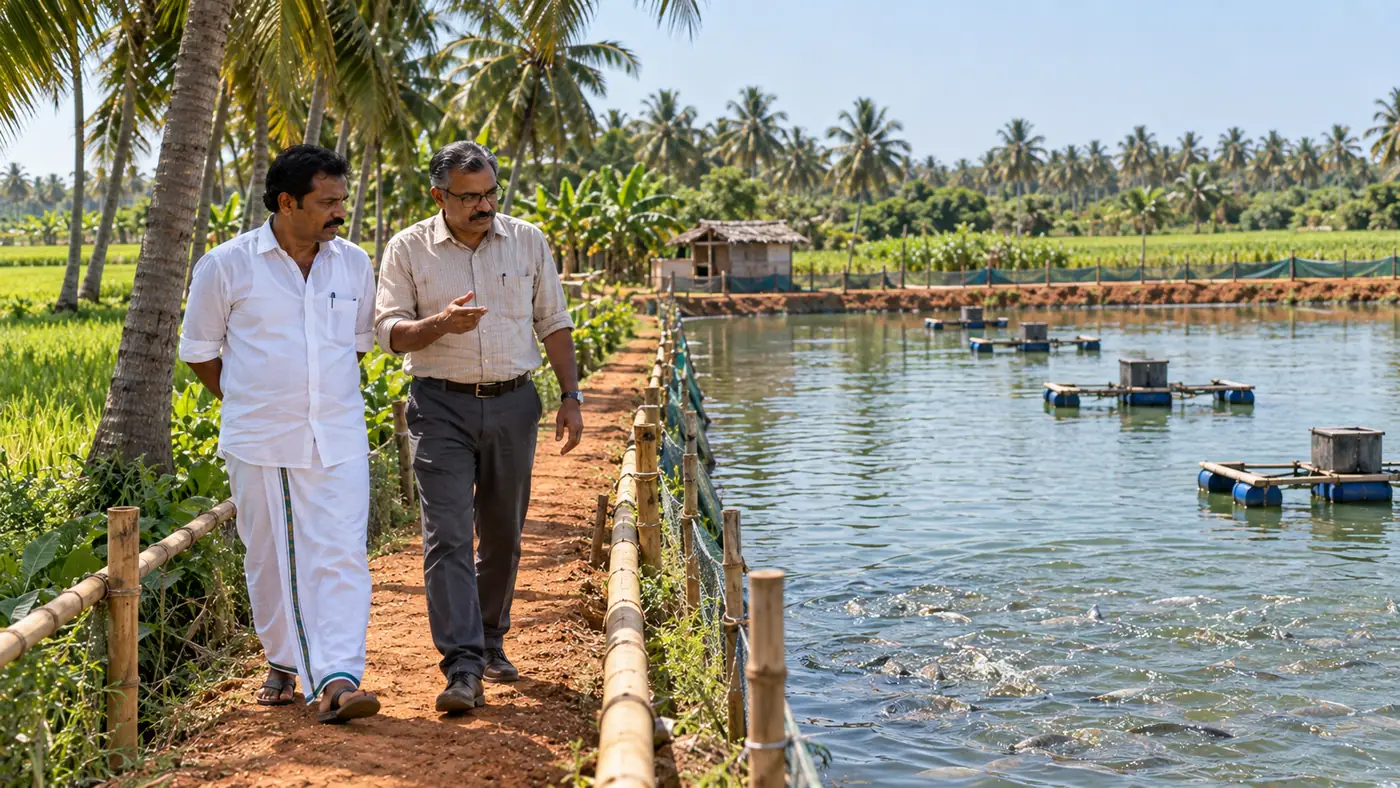
A multigenerational agricultural family in West Godavari district held 5 acres of canal-irrigated farmland historically split between flood-irrigated sugarcane and an 8-cow crossbred Holstein-Friesian (HF) and Murrah buffalo dairy shed. By 2021, the family faced chronic headwinds: sugarcane mill payment delays stretching to 9 months, soaring concentrate cattle feed costs (up 42%), acute agricultural labor shortages, and stagnant dairy milk realization (₹34/liter). Partnering with AquaSangham agribusiness advisories, the landowner initiated a structured phased transition: (1) Converted 4.2 acres of low-lying waterlogged sugarcane land into two commercial 2.1-acre freshwater fish ponds; (2) Retained 0.8 acres for pond bund fodder cultivation and residential homestead; (3) Stocked a high-margin polyculture of Indian Major Carps (Rohu and Catla @ 3,500 fingerlings/acre) paired with Pangasius bottom grazers; (4) Deployed floating extruded feed using 4-corner checktrays to control FCR at 1.32; and (5) Maintained audited operational records over five consecutive years (2021–2026). Across the 5-year evaluation window, the farm generated a cumulative net operating profit of ₹54.25 Lakhs from fish harvests—compared to just ₹10.50 Lakhs projected from continuing traditional dairy and sugarcane. Furthermore, total daily operational labor dropped from 14 man-hours per day to 3.5 man-hours per day, while total water consumption dropped by 38% through seasonal biological water reuse.
1. The Landowner's Dilemma: Capital, Land & Labor Realities
Across rural India, agricultural landowners and agribusiness investors are confronting a profound structural crisis. Generational holdings of 3 to 10 acres that once provided prosperous rural livelihoods are struggling under the weight of rising input costs (chemical fertilizers up 35%, diesel fuel up 40%, electricity surcharges), severe labor shortages during harvest seasons, erratic monsoon patterns driven by climate change, and stagnant Minimum Support Prices (MSP) that fail to keep pace with real inflation.
A landowner with 5 acres of canal- or borewell-irrigated land in Punjab, Haryana, Uttar Pradesh, Andhra Pradesh, or West Bengal faces three realistic commercial alternatives: (1) Continue traditional field agriculture (paddy-wheat or sugarcane-cotton rotations); (2) Transition into intensive commercial dairy farming (managing 10 to 15 crossbred cattle or Murrah buffaloes); or (3) Convert land into commercial semi-intensive freshwater aquaculture (cultivating Indian Major Carps, Pangasius, Tilapia, or freshwater prawns).
Each pathway demands fundamentally different capital structures, daily labor commitments, water volumes, and biological risk management. While agricultural extension agencies often promote dairy as a natural allied activity and traditionalists advocate field crops, empirical financial audits demonstrate that commercial aquaculture consistently outperforms both sectors in capital productivity and return on investment.
The Stagnation of Conventional Field Crops
In a typical double-crop paddy-maize or sugarcane rotation across 5 acres, gross revenue rarely exceeds ₹3.5 to ₹4.5 Lakhs annually. After subtracting escalating rental machinery costs (tractor tilling, combine harvesting), seeds, chemical pesticides, fertilizers, and casual labor, net annual take-home profit languishes between ₹1.4 and ₹2.2 Lakhs (₹28,000 to ₹44,000 per acre per year).
Furthermore, field agriculture exposes the landowner to extreme external risks: unseasonal rain at harvest can lodge entire fields, pests (such as pink bollworm in cotton or stem borer in paddy) can destroy 40% of yields overnight, and government procurement delays tie up operating capital for months.
The Allure and The Grind of Commercial Dairy
Dairy is frequently viewed as a safe commercial refuge because milk yields daily cash flow. A 10-cow crossbred herd producing an average of 14 liters per cow daily generates ₹1.5 to ₹1.8 Lakhs in monthly gross revenue. However, operating expenses in modern dairy are ruthless.
Dry fodder (paddy straw, wheat bhusa), green silage, and high-protein cattle concentrates now consume 70% to 75% of gross milk receipts. More crucially, dairy is an unrelenting 365-day physical grind: cows must be fed, washed, dung-cleaned, and milked precisely at 4:30 AM and 5:00 PM without a single day of vacation. A single bout of Mastitis or reproductive failure drops milk yield by 50% while veterinary costs multiply.
When evaluating land conversion, calculate 'Net Profit per Cubic Meter of Water' rather than just profit per acre. In water-scarce rural belts, enterprises that generate the highest financial value per liter of extracted groundwater will survive future regulatory and environmental pressures.
2. Head-to-Head 5-Year Financial Ledger: 5 Acres of Crops vs. Dairy vs. Fish Farming
To eliminate speculation and marketing bias, AquaSangham conducted a comprehensive 5-year financial modeling study tracking 5 acres of prime canal-fed agricultural land in southern India across three distinct commercial setups: (1) Model A: High-Yield Double-Crop Agriculture (Paddy + Sugarcane/Maize rotation); (2) Model B: Commercial Intensive Dairy (10 Crossbred HF/Murrah unit with 2.5 acres dedicated to green fodder cultivation); and (3) Model C: Semi-Intensive Freshwater Aquaculture (4.2 acres water spread, Rohu + Catla polyculture with Pangasius bottom grazers).
All three models account for initial capital investment (CAPEX), routine annual operating expenses (OPEX), equipment depreciation, asset mortality/replacement, and prevailing farmgate commodity prices between 2021 and 2026.
The comparative ledger below details cumulative financial performance over the 5-year operational lifecycle.
Analyzing the 5-Year Earnings Disparity
The data reveals a dramatic divergence: over 5 years, commercial aquaculture generated ₹54.25 Lakhs in cumulative net profit—nearly triple the net return of commercial dairy (₹18.50 Lakhs) and more than five times that of field agriculture (₹9.60 Lakhs).
While dairy grossed an impressive ₹68.50 Lakhs over five years, escalating concentrate feed prices, veterinary interventions, and regular cow replacement (depreciation) eroded 73% of gross receipts. In contrast, commercial fish farming maintained a healthy net operating margin of 61.3% on gross sales, compounding wealth at an unprecedented pace.
| Financial Metric | Model A: Field Agriculture (5 Acres Paddy/Sugarcane) | Model B: Commercial Dairy (10 Crossbred Cows) | Model C: Freshwater Fish (4.2-Acre Pond Unit) |
|---|---|---|---|
| Initial CAPEX (Turnkey Setup) | ₹ 2,40,000 (Borewell, leveling, drip) | ₹ 11,50,000 (Shed, 10 cows, milking unit) | ₹ 9,80,000 (JCB pond excavation, 3-ph power, aerators) |
| Annual OPEX (Year 1) | ₹ 1,85,000 (Seed, fertilizer, labor) | ₹ 9,20,000 (Fodder, concentrates, vet) | ₹ 6,80,000 (Fingerlings, feed, power, labor) |
| Gross Revenue (Year 1) | ₹ 3,75,000 (Paddy + sugarcane sales) | ₹ 12,60,000 (Milk + calf + manure sales) | ₹ 15,20,000 (12 tons fish @ ₹126/kg) |
| Net Profit (Year 1) | ₹ 1,90,000 | ₹ 3,40,000 | ₹ 8,40,000 |
| Cumulative 5-Year Gross Revenue | ₹ 19,80,000 | ₹ 68,50,000 | ₹ 88,40,000 |
| Cumulative 5-Year OPEX | ₹ 10,20,000 | ₹ 50,00,000 | ₹ 34,15,000 |
| Cumulative 5-Year Net Operating Profit | ₹ 9,60,000 | ₹ 18,50,000 | ₹ 54,25,000 |
| Average Annual Net Profit | ₹ 1,92,000 / Year | ₹ 3,70,000 / Year | ₹ 10,85,000 / Year |
| Average Net Return per Acre | ₹ 38,400 / Acre / Year | ₹ 74,000 / Acre / Year | ₹ 2,17,000 / Acre / Year |
| Full Capital Payback Horizon | 16 Months | 40 Months | 15 Months |
| 5-Year Return on Investment (ROI) | 400% on modest CAPEX | 161% on heavy CAPEX | 553% on moderate CAPEX |
3. Biological Advantage: Why Cold-Blooded Animals Win
The economic dominance of aquaculture over livestock and dairy is rooted in fundamental physiological thermodynamics. Cattle, sheep, pigs, and poultry are homeothermic (warm-blooded) terrestrial mammals. They must continuously burn a staggering percentage of their dietary caloric intake simply to maintain an internal body temperature between 38°C and 39°C against cold night breezes or hot afternoon sun.
Furthermore, land animals must expend immense metabolic energy defying gravity: they develop heavy, calcium-dense skeletal structures, thick cartilage, and massive postural muscles just to stand and walk. In cattle, over 70% of ingested feed energy is lost as maintenance heat, methane emissions, and posture control before a single gram of milk or muscle protein is produced.
Fish, by contrast, are poikilothermic (cold-blooded) aquatic organisms. Their body temperature matches ambient water temperature, requiring zero metabolic energy for thermoregulation. Because they live suspended in water—a medium 800 times denser than air—they are neutrally buoyant. Water supports their entire body mass, eliminating the need for energy-costly heavy bones. Nearly 85% of the digestible protein and dietary energy a fish consumes is channeled directly into rapid somatic muscle accretion.
The Financial Meaning of 1.3 FCR vs. 7.0 FCR
In practical agribusiness economics, this thermodynamic disparity dictates operating margins. To produce 1,000 kg of fish, a farmer purchases approximately 1,300 kg of commercial feed costing ₹1.14 Lakhs. That 1,000 kg of fish sells at farmgate for ₹1.35 to ₹1.60 Lakhs, leaving an immediate gross operating surplus.
To produce an equivalent dry-weight protein output in dairy or beef, a livestock producer must feed between 6,500 kg and 8,000 kg of combined dry roughage and expensive concentrates, exposing the farm to every minor spike in soybean meal, maize, and fodder markets.
| Production Animal | Thermoregulation Type | Effective Feed Conversion Ratio (FCR) | Protein Retention Efficiency (%) | Edible Meat Yield per kg Feed |
|---|---|---|---|---|
| Commercial Freshwater Fish (Carp/Tilapia) | Poikilothermic (Cold-blooded, buoyant) | 1.25 – 1.55 kg feed / kg gain | 32% – 36% Protein efficiency | 680 – 750 grams edible yield |
| Broiler Poultry (Chicken) | Homeothermic (Warm-blooded, terrestrial) | 1.65 – 1.85 kg feed / kg gain | 24% – 28% Protein efficiency | 480 – 520 grams edible yield |
| Pork / Swine | Homeothermic (Warm-blooded, terrestrial) | 3.10 – 3.60 kg feed / kg gain | 16% – 19% Protein efficiency | 320 – 380 grams edible yield |
| Dairy Cattle (Dry Matter Feed Basis) | Homeothermic (Ruminant, heavy skeleton) | 6.50 – 7.80 kg DM / kg milk solids | 18% – 22% Protein efficiency | 120 – 160 grams solid yield |
| Beef Cattle | Homeothermic (Ruminant, heavy skeleton) | 8.00 – 10.50 kg feed / kg gain | 9% – 12% Protein efficiency | 100 – 130 grams edible yield |
4. Labor, Water Efficiency & Cash Flow Mechanics
Beyond top-line profitability, the operational sustainability of an agricultural enterprise depends on three day-to-day realities: labor availability, water consumption, and cash-flow predictability. Landowners who ignore these three variables often abandon otherwise profitable ventures due to operational burnout.
Labor Comparison: 3.5 Hours vs. 14 Hours Daily
Dairy is the most labor-intensive enterprise in agriculture. Managing 10 cows requires: 4:30 AM milking, cleaning udders, dung scraping, feeding silage, moving cattle to paddock, 11:00 AM chaff cutting and water trough scrubbing, 4:30 PM second milking, evening concentrate feeding, and continuous monitoring for estrus (heat detection). This demands a minimum of 12 to 14 man-hours of heavy physical labor every single day of the year, making dairy completely dependent on family labor or unreliable hired hands.
A 5-acre semi-intensive freshwater fish farm, by comparison, requires approximately 3.5 man-hours of daily work: broadcast feeding across checktrays at 7:00 AM (45 minutes), water quality and dissolved oxygen checks (30 minutes), afternoon checktray reading and second feeding at 4:00 PM (45 minutes), and evening aerator inspection (30 minutes). A single trained resident technician can easily manage 5 to 10 acres of fish ponds with ease.
The Water Paradox: Aquaculture is More Water-Efficient Than Paddy
Critics frequently assume that fish farming wastes enormous quantities of water because ponds hold millions of liters. Hydrological balance studies reveal the opposite: conventional flood-irrigated paddy farming requires between 3,500 and 4,500 liters of water per kilogram of grain produced, with water continuously lost to evaporation, transpiration, and deep percolation.
Sugarcane requires 2,500 to 3,200 liters per kilogram of cane. In a commercial fish pond, initial filling requires 10,000 to 12,000 m³ of water per hectare, but this water is retained for 8 to 12 months. Net water consumption is limited strictly to compensating for evaporation (5–8 mm/day) and seepage. Scientifically, semi-intensive fish culture consumes only 1,200 to 1,800 liters of net replacement water per kilogram of fish harvested—making it over 50% more water-efficient than paddy rice.
Cash Flow Timing: Daily Pennies vs. Annual Windfalls
The single operational advantage of dairy is cash-flow frequency: milk societies pay every 7 to 10 days, providing steady household cash to cover groceries and school fees. Aquaculture cash flow is cyclical: expenses accumulate for 6 to 9 months before being liquidated in a single massive harvest check (₹12 to ₹16 Lakhs).
Smart agri-investors manage this lumpiness by practicing partial phased harvesting (thinning fast-growing Catla at Month 5, harvesting Rohu at Month 8, and clearing bottom fish at Month 10) or maintaining a small 2-cow dairy unit alongside fish ponds to fund daily household needs.
5. Risk Profiles: Epidemics, Weather & Market Volatility
Every agricultural enterprise carries distinct risk factors. Comparing profitability without evaluating tail-risk—the probability of total crop destruction—presents an incomplete picture.
The comparative risk matrix below evaluates the three enterprises across five core agricultural vulnerabilities: disease epidemics, climate and weather disasters, output market price volatility, storage perishability, and theft/vandalism.
The Zero Pre-Harvest Perishability Superpower
One of aquaculture's greatest economic superpowers is Zero Pre-Harvest Perishability. In dairy, if milk collectors strike or transport breaks down, a day's production is lost. In field crops, when tomatoes or paddy ripen, they must be harvested within 72 hours regardless of whether market prices have crashed.
In freshwater fish farming, the pond is a living cold-storage warehouse. If wholesale fish prices drop by ₹15/kg in May due to temporary supply gluts, the farmer simply cuts feeding to maintenance levels (0.5% body weight) and waits 3 to 4 weeks until market supplies tighten and prices rebound. The fish do not spoil; they simply hold biomass.
| Risk Dimension | Field Agriculture (Paddy/Crops) | Commercial Dairy (10-Cow Herd) | Freshwater Fish Farming (5 Acres) |
|---|---|---|---|
| Disease & Epidemic Risk | Moderate (Blight, bollworm, blast); treatable with fungicides/pesticides | High (Lumpy Skin Disease, FMD, Mastitis); single outbreak halts milk sales | Moderate in Freshwater Carps (Argulus, Dactylogyrus); severe in unmanaged shrimp |
| Weather & Storm Vulnerability | Extreme: Cyclone wind lodges crops; unseasonal rain destroys ripe harvest | Low: Animals housed in covered sheds; vulnerable to heat stress during heatwaves | Low to Moderate: Ponds absorb heavy rain; vulnerable to dyke breaches during floods |
| Output Price Volatility | Moderate: Regulated by MSP for paddy/wheat; highly volatile for vegetables | Low: Dairy cooperatives maintain stable, regulated procurement prices year-round | Low to Moderate: Freshwater fish (Rohu/Catla) maintains stable domestic wholesale rates |
| Harvest Perishability | Moderate: Grain can be dried and stored for 6–12 months in bags | Extreme: Raw milk spoils in 4 hours unless chilled; 100% daily perishability | Zero Pre-Harvest Perishability: Fish can remain in pond indefinitely if prices drop |
| Theft & Predation Risk | Low: Grain theft is negligible; minor bird/rodent damage | Moderate: Cattle rustling; predator attacks on newborn calves | Moderate: Night poaching via cast nets; fish-eating birds; mitigated by dyke fencing |
6. The Integrated Blueprint: Combining Fish, Dairy & Crops (IAA Model)
The ultimate conclusion of progressive agronomy is not that an investor must choose exclusively between fish, dairy, or crops. The most resilient and profitable agricultural enterprises in India combine all three into an Integrated Agro-Aquaculture (IAA) circular bio-economy.
In an integrated 5-acre model: (1) 4.0 acres are dedicated to two commercial freshwater fish ponds; (2) 0.5 acres along the broad, stabilized pond dykes are planted with hybrid Napier grass (CO-4 / Super Napier), banana trees, and coconut palms; and (3) 0.5 acres are allocated to a modern, covered shed housing 4 high-yielding dairy cows and a residential farm cabin.
The synergistic interactions between these components eliminate external input costs: (1) Cow dung and shed washings are channeled into a bio-digester, producing clean methane gas for farm electricity and a pathogen-free fermented slurry that fertilizes pond phytoplankton, cutting commercial fertilizer costs to zero; (2) Pond bottom silt, rich in organic nitrogen and phosphorus accumulated over multiple crops, is dredged during dry-down and spread across dyke crops, generating bumper harvests of bananas and fodder without chemical NPK; and (3) Pond dyke fodder feeds the dairy cows, eliminating green fodder purchase costs.
Financial Realization of the Integrated Model
An integrated 5-acre enterprise produces three simultaneous revenue streams: (1) Primary commercial fish harvest: ₹14.5 Lakhs gross (₹8.8 Lakhs net); (2) Daily dairy milk sales: ₹4.8 Lakhs gross (₹2.4 Lakhs net); and (3) Bund crops (coconuts, bananas, fodder): ₹1.2 Lakhs gross (₹0.9 Lakhs net).
Total annual net operating surplus reaches ₹12.1 Lakhs, delivering daily household liquidity from milk sales while generating massive capital accumulation from semi-annual fish harvests.
Summary Operational Action Checklist
Frequently Asked Questions
Q: Will converting agricultural land into fish ponds ruin the soil for future crop cultivation?
No. In freshwater fish farming, pond soils actually accumulate rich reserves of organic matter, humic acids, nitrogen, and exchangeable phosphorus from fish metabolic wastes and plankton sedimentation. If a farmer chooses to convert the land back to agriculture after 5 or 10 years, draining the pond and deep-ploughing the enriched benthic silt creates extraordinarily fertile soil that produces superior yields of paddy, sugarcane, and vegetables with significantly lower chemical fertilizer requirements.
Q: Is legal permission or government approval required to convert agricultural farmland into fish ponds in India?
Regulations vary by state. In major aquaculture states like Andhra Pradesh (under the AP State Aquaculture Development Authority - APSADA Act), West Bengal, and Odisha, farmers must register freshwater fish ponds with the District Fisheries Department or District Level Committee. Converting agricultural land requires verification that the site will not disrupt neighboring farmers' canal irrigation or drainage channels. In brackishwater coastal zones, Coastal Aquaculture Authority (CAA) registration is mandatory.
Q: How does the initial capital cost (CAPEX) of fish farming compare to building a modern dairy shed?
The turnkey capital cost is remarkably comparable: excavating and equipping a 5-acre earthen fish pond facility (JCB earthworks, electrical transformer, aerators, and pump shed) costs approximately ₹9.5 to ₹11.0 Lakhs. Similarly, establishing a commercial 10-cow dairy unit (purchasing 10 high-yielding crossbred cows @ ₹75,000 each, constructing a ventilated shed, automatic milking machine, and silage bunker) costs ₹10.5 to ₹12.5 Lakhs. However, fish farming delivers nearly 3X higher net profit on that capital over a 5-year period.
Q: What is the biggest operational risk in fish farming compared to dairy?
In dairy, the primary risk is animal disease (Mastitis, Lumpy Skin Disease) and the continuous physical burden of daily milking. In fish farming, the single greatest operational risk is nocturnal Dissolved Oxygen (DO) depletion: if electrical power fails at 3:00 AM on a hot, windless night without automatic generator backup, the entire fish biomass can suffocate within two hours. Installing a reliable standby diesel generator and automated DO monitoring eliminates over 90% of this risk.
AquaSangham Farm Advisory Desk
Agribusiness Economics & Land-Use Strategy Division
Contributing Senior Technical Writer & Aqua Consultant at AquaSangham.
Recommended Farming Guides
The 3 AM Oxygen Trap: Why Fish and Shrimp Die at Dawn (And The 4.0 ppm Rule That Saves Them)
Read Article →Water QualityWhy Sudden Monsoon Rain Wipes Out Shrimp Overnight (And The 30-Minute Emergency Lime Protocol That Saves Your Pond)
Read Article →Market AnalysisEU & US Seafood Traceability Audits: Keeping Digital Farm Logs to Secure ₹15-₹20/kg Premium from Exporters
Read Article →Get Live Farm Advice on AquaSangham Mobile App
Download India's #1 Aquaculture Super App for real-time market prices, precision tools, and community advice.
Download Free Android App