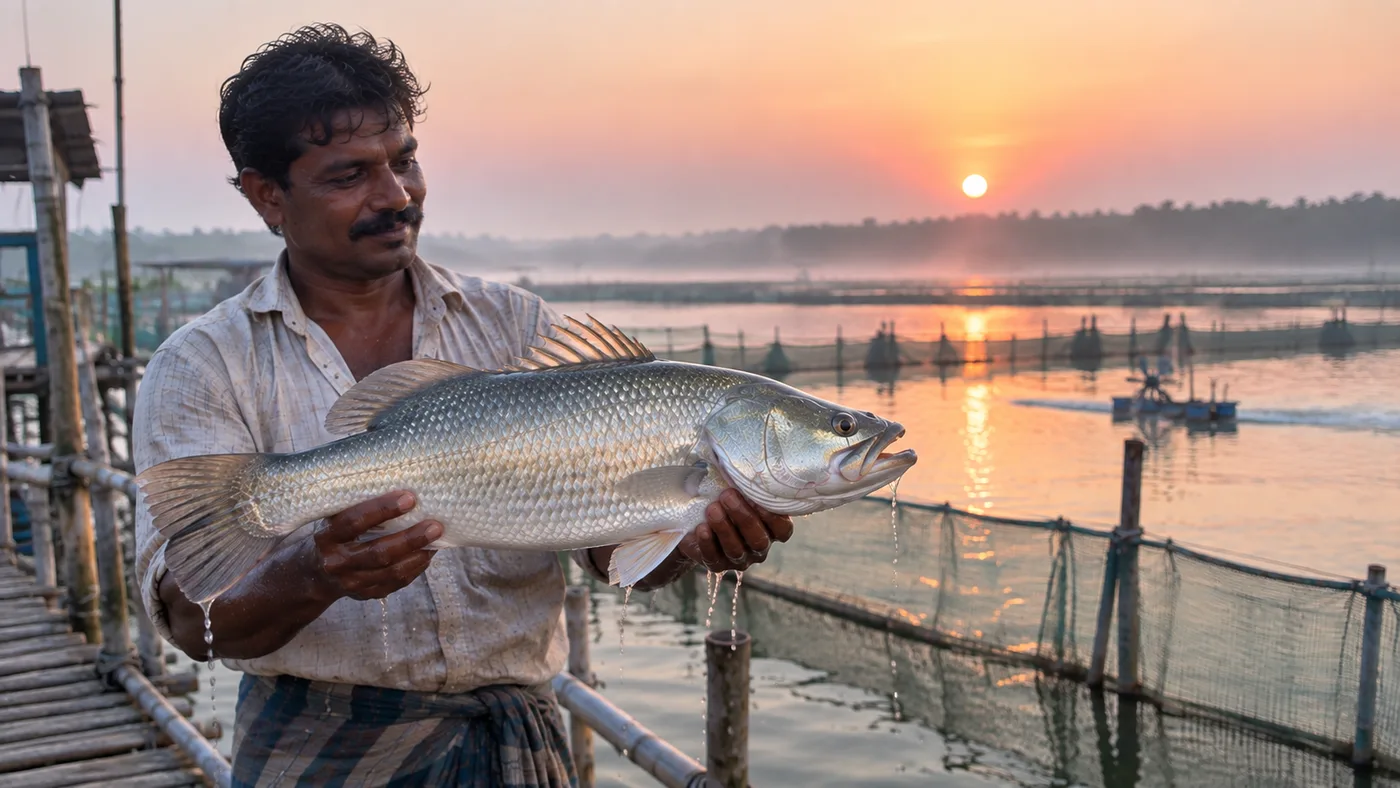
Executive Summary & Key Takeaways
- Asian Seabass (Lates calcarifer / Bhetki) is India's most prestigious culinary finfish, commanding wholesale prices of ₹500 to ₹700/kg in Kolkata, Chennai, Mumbai, and Delhi for luxury fillets and continental catering.
- Bhetki is an extraordinary euryhaline species capable of thriving across salinities from 0 ppt (freshwater borewells and irrigation reservoirs) to 35 ppt (full coastal seawater) without compromising growth.
- The primary cause of beginner failure is nursery cannibalism: seabass possess protractile jaws allowing them to swallow siblings up to 65% of their own length; grading fingerlings through mechanical slot-graders every 4 days is mandatory.
- Transitioning from low-efficiency trash fish (FCR 6:1) to 45%–48% crude protein commercial extruded slow-sinking pellets brings biological FCR down to 1.35–1.50, lowering feed cost per kg produced by over 35%.
- Pond aeration is non-negotiable: while murrel breathe air, seabass are obligate gill-breathing marine predators requiring continuous dissolved oxygen above 4.5 ppm; provide 4 to 6 HP of paddlewheel aeration per acre.
- Freshwater off-flavor control: Seabass cultured in low-salinity or freshwater ponds absorb geosmin and 2-methylisoborneol (MIB) from blue-green algae; executing a 48-hour clear-water depuration hold purges muddy off-flavors.
- A well-managed 1-acre pond stocked with 5,000 weaned fingerlings produces 4.5 to 5.5 tons of marketable 1.0–1.2 kg fish in 9 to 11 months, yielding a net operating profit of ₹10.5 to ₹14.2 Lakhs.
Commercial Mariculture Case Study: Transitioning a Chronic Shrimp Disease Pond to a ₹13.85 Lakh Profit Asian Seabass Monoculture
A commercial brackishwater farmer in South 24 Parganas, West Bengal, suffered two consecutive crop failures in Penaeus monodon due to White Spot Syndrome Virus (WSSV). Seeking a high-value, disease-resistant alternative, the operator converted a 1.0-acre earthen pond to intensive Asian Seabass (Lates calcarifer / Bhetki) monoculture. Partnering with AquaSangham mariculture advisory, the farm executed three technical protocols: (1) Sourced 6,500 hatchery-certified Seabass fry (2.0 cm) from ICAR-CIBA Chennai and reared them inside eight floating knotless nylon hapas (5m x 3m x 1.2m), physically grading every fish through plastic slot-graders every 4 days to segregate cannibalistic 'shooters'; (2) Conducted a 16-day dietary weaning transition, moving fingerlings from minced Acetes shrimp paste to 48% crude protein slow-sinking extruded pellets; and (3) Stocked 5,400 uniform 35g fingerlings into the growout pond at 22 ppt salinity, utilizing four 2.0-HP paddlewheel aerators operating during night hours. Fed twice daily at 3.5% to 4.5% body weight, the fish attained an average weight of 1.15 kg in 310 days. The harvest yielded 5,120 kg of robust, sparkling silver Bhetki with 82.6% overall survival. Dispatched in ice slurry to the Howrah Wholesale Fish Market in Kolkata at ₹585/kg, gross revenue reached ₹29.95 Lakhs against total operating expenditures of ₹16.10 Lakhs (feed ₹10.45 L, seed fingerlings ₹2.60 L, power, labor, and lease ₹3.05 L), securing a record net profit of ₹13.85 Lakhs.
1. The Kolkata Bhetki Market Phenomenon: Why Metros Pay ₹600/kg for Asian Seabass
In the landscape of Indian commercial aquaculture, few aquatic species evoke the prestige, cultural reverence, and economic power of Asian Seabass (Lates calcarifer)—celebrated across eastern India as *Bhetki* (or *Vetki*), in Tamil Nadu and Kerala as *Koduva* or *Kalanji*, in Andhra Pradesh as *Pandu Koppa*, and in Maharashtra and Goa as *Chonak*. While the vast majority of Indian freshwater farmers battle razor-thin margins on common carps (selling at ₹120 to ₹150/kg) and Pangasius (₹85 to ₹105/kg), commercial Bhetki producers operate in a rarefied economic tier where wholesale farmgate prices consistently range between ₹500 and ₹700 per kilogram.
The economic epicentre of this insatiable demand is Kolkata and the greater West Bengal culinary corridor. In Bengali gastronomy, fresh Bhetki is the non-negotiable crown jewel of wedding banquets, festival feasts, and elite catering. Iconic dishes such as *Bhetki Paturi* (fillets marinated in mustard paste wrapped in charred banana leaves) and British colonial-era crumb-fried *Bhetki Fish Fry* require firm, boneless, snow-white fillets with delicate flaky texture and mild sweet fat. A traditional wedding caterer in Kolkata will reject all substitutes—neither Pangasius nor tilapia nor cod can replicate the distinct flakiness and culinary status of authentic Bhetki.
Beyond Kolkata, an equally lucrative market has expanded rapidly across tier-1 metropolitan cities including Mumbai, Bengaluru, Chennai, Hyderabad, and Delhi. High-end continental bistros, Japanese sushi restaurants, and luxury hotel chains market Seabass under its international branding—**Barramundi**—selling single 200-gram pan-seared fillets for ₹900 to ₹1,400. In domestic wholesale fish landing auctions such as Howrah (Kolkata), Kasimedu (Chennai), Sassoon Docks (Mumbai), and Machilipatnam (Andhra Pradesh), whole iced Bhetki weighing 1.0 kg to 2.0 kg is auctioned in high-stakes bidding wars within minutes of arrival.
For coastal brackishwater farmers who have suffered catastrophic crop losses in Litopenaeus vannamei or Penaeus monodon shrimp due to White Spot Syndrome Virus (WSSV) and Enterocytozoon hepatopenaei (EHP), Asian Seabass represents the ultimate salvation crop. Seabass are biologically impervious to crustacean viral epizootics, possess rapid growth rates (attaining 1.0 kg to 1.3 kg in 9 to 11 months), and can be farmed in abandoned shrimp ponds with existing dikes and sluice infrastructure. A single well-managed 1-acre pond producing 5 metric tons of table-size Bhetki generates upwards of ₹28.0 Lakhs in gross sales, leaving the farmer with an audited net operating profit of ₹10.5 to ₹14.2 Lakhs.
However, transitioning from shrimp or carps to Asian Seabass is not a passive investment. Seabass are aggressive, apex visual predators. If you stock un-weaned, un-graded fingerlings into an earthen pond, you will encounter the dark side of seabass biology: vicious juvenile cannibalism that can swallow 80% of your crop before month three.
Target the 1.0 kg to 1.5 kg harvest size. In the Indian hotel and catering trade, fish under 800 grams are discounted because their fillets are too thin for single-portion fish fries, while oversized fish (>3.0 kg) are difficult for retail consumers to purchase whole. The 1.0–1.5 kg bracket commands the absolute peak farmgate rate.
2. Species Biology & Euryhaline Physiology: Culturing Lates calcarifer from 0 to 35 ppt
Asian Seabass (*Lates calcarifer*), belonging to the family Latidae, is a protandrous hermaphrodite (maturing first as males at 2 to 3 years of age, with many individuals reversing sex to become functional females after 4 to 5 years). The species is catadromous in nature: adults migrate from estuaries and rivers downstream into marine coastal waters to spawn near river mouths where salinity is 30 to 32 ppt. Once fertilized, planktonic larvae drift back into mangrove creeks, tidal lagoons, and freshwater rivers.
This natural catadromous life cycle has gifted Asian Seabass with one of the most powerful, flexible osmoregulatory systems in the entire animal kingdom. Seabass are truly euryhaline: they can thrive in hypersaline coastal lagoons (35 to 45 ppt), brackishwater creeks (10 to 25 ppt), and pure inland freshwater reservoirs or borewell-fed earthen ponds (0 to 2 ppt). Their branchial chloride cells (ionocytes) in the gills rapidly upregulate or downregulate Na+/K+-ATPase and cystic fibrosis transmembrane conductance regulator (CFTR) ion pumps, maintaining blood osmolality at approximately 300 mOsm/kg across any external salinity.
For Indian inland farmers in Haryana, Punjab, Rajasthan, Telangana, and Madhya Pradesh, this means Asian Seabass can be cultured successfully in freshwater borewell ponds and inland saline aquaculture clusters, unlocking ₹600/kg prices thousands of kilometers away from the ocean.
However, transferring seabass between salinities requires strict acclimation kinetics. While adult fish can tolerate sudden salinity drops, juvenile fingerlings (under 10 cm) must not be subjected to salinity shocks greater than 5 ppt per 24 hours. When transferring hatchery fingerlings reared in 28 ppt seawater to a freshwater farm (0 ppt), the salinity must be diluted gradually over a 5-to-7 day acclimation protocol in nursery conditioning tanks.
Thermal Tolerance & Feeding Thresholds
Optimum water temperature for Asian Seabass growth is 26°C to 32°C. Within this thermal range, their specific growth rate (SGR) peaks at 1.8% to 2.4% body weight per day.
When water temperatures drop below 20°C (during North Indian winter months), gastric emptying slows drastically, and feed intake declines by 60%. Below 15°C, mortality begins. In northern states, stocking must be timed in February/March to harvest by November before winter chills set in.
Dissolved Oxygen & Respiration Physiology
Unlike air-breathing murrel or catfish, Asian Seabass are obligate gill-breathers with high oxygen consumption rates, especially following a heavy high-protein meal. Ambient dissolved oxygen (DO) must remain strictly above 4.5 mg/L.
If DO falls below 3.0 mg/L, seabass experience acute metabolic acidosis, cease feeding for 48 hours, and become susceptible to secondary bacterial infections by Vibrio anguillarum and Aeromonas hydrophila.
3. The Nursery Cannibalism Trap: The 4-Day Mechanical Grading Protocol
The single greatest biological hazard in Asian Seabass culture is juvenile cannibalism. Seabass possess an expansive, cavernous mouth with a heavily hinged lower jaw and an expandable stomach. During early life stages (between 2.0 cm and 10.0 cm), growth rates vary wildly among individuals. A fingerling that happens to capture a few extra feed morsels experiences rapid somatic growth, quickly becoming a predatory 'Shooter'.
A shooter seabass can easily swallow a smaller sibling measuring up to 65% to 70% of its own total body length. In fact, it is common in unmanaged nursery tanks to see a shooter swimming with the caudal tail fin of its sibling protruding from its mouth for hours while the head is slowly digested in its acidic stomach. If a farmer stocks 10,000 one-inch fry into a pond without grading, shooters will systematically consume 75% to 85% of the population within six weeks, leaving the farmer with barely 1,500 giant fish.
To eliminate this catastrophic loss, commercial seabass farming incorporates an intensive **Phase-1 Nursery Protocol** conducted inside floating knotless nylon hapas (typically 5m x 3m x 1.2m, 2mm to 4mm mesh) installed in a dedicated nursery pond or concrete tanks.
The 4-Day Mechanical Slot-Grading SOP: Every 4 to 5 days, technicians lift each hapa and pass the fingerlings through floating plastic or stainless-steel grading grids. The grids feature calibrated bar gaps (e.g., 3mm, 5mm, 7mm, 9mm, and 12mm). Smaller fish slip through into a receiving hapa, while larger shooters are retained on top. The population is segregated into three distinct cohorts: Small, Medium, and Large. When fish within a single hapa are within 10% of each other's size, cannibalism is physically impossible because no fish can swallow its tankmate's head. Adhering to this 4-day grading schedule across the 45-day nursery cycle guarantees an overall survival rate exceeding 82% to 86%.
The 45-Day Nursery Staging Schedule
Day 1 to 15 (Fry Stage / 2.0 cm to 3.5 cm): Stock 1,500 fry/m² in 2mm mesh hapas; feed live enriched Artemia nauplii and finely minced Acetes shrimp paste 5 times daily; execute 3-day grading.
Day 16 to 30 (Fingerling Stage / 3.5 cm to 6.0 cm): Stock 600 fingerlings/m² in 4mm mesh hapas; execute 4-day grading; transition onto 1.2mm slow-sinking high-protein crumbles.
Day 31 to 45 (Advanced Fingerling / 6.0 cm to 10.0 cm): Stock 250 fingerlings/m²; execute 5-day grading; feed 2.0mm extruded pellets; fish attain 25g to 35g and are ready for growout pond stocking.
Salt & Prophylactic Anti-Stress Dips During Grading
Physical grading removes the protective mucus layer from juvenile skin. Always grade fingerlings in shallow basins treated with 5 ppt non-iodized salt (NaCl) and 2 ppm povidone iodine. This prevents bacterial columnaris and fungal Saprolegnia outbreaks on handling abrasion wounds.
4. The Feed Weaning Master Plan: Moving from Live Biomass to 48% CP Pellets
Historically, Indian coastal seabass farmers fed wild-caught marine trash fish (sardinella, anchovies, ribbonfish, and tilapia offcuts). While seabass grow well on raw trash fish, relying on trash fish in modern commercial farming is an economic and environmental disaster: (1) Trash fish costs ₹35 to ₹50/kg with a dismal biological FCR of 5.5:1 to 7.0:1, inflating feed costs to ₹220+ per kg of fish produced; (2) Raw fish decomposes within 30 minutes, severely fouling pond benthic soils with toxic hydrogen sulfide and ammonia; (3) Trash fish supplies are seasonal and fluctuate during coastal monsoon fishing bans.
The hallmark of modern, high-profit seabass mariculture is **100% Extruded Pellet Feeding**. When weaned onto commercial extruded marine finfish diets, seabass achieve an exceptional commercial FCR of 1.35 to 1.50, lowering feed costs to ₹135–₹155 per kilogram of fish produced while keeping pond water clean.
The 16-Day Feed Weaning Progression: Weaning begins in nursery hapas when fingerlings attain 2.5 cm to 3.0 cm length:
Phase A: Paste Transition (Days 1–4): Fresh marine Acetes paste or minced sardine flesh is combined with 10% fish oil and 5% squid liver meal. The scented paste is dispensed into shallow submerged wire trays.
Phase B: Wet Crumble Blending (Days 5–9): Slowly incorporate 1.0mm micro-extruded high-protein starter pellets (48% crude protein, 12% crude fat) into the fresh fish paste, starting at a 75% fish / 25% dry pellet ratio and progressing to 50:50.
Phase C: Semi-Moist Pellet Transition (Days 10–13): Pellets are lightly sprayed with water and marine fish oil (creating a soft, moist texture that mimics live fish flesh) without adding raw fish mince. Pellets are broadcast into the hapas; fingerlings strike aggressively as pellets slowly sink.
Phase D: 100% Dry Slow-Sinking Pellets (Days 14–16): Withdraw all moisture additives. Broadcast dry 1.5mm slow-sinking extruded pellets. Seabass are visual water-column predators; slow-sinking pellets (sinking at 2 to 4 cm per second) allow fish to intercept the feed in mid-water before it touches the bottom. Once 90%+ of the hapa population feeds aggressively at the surface and mid-water, the cohort is fully weaned.
Nutritional Specifications for Commercial Seabass Diets
Crude Protein: 45% to 48% throughout nursery and early growout (up to 300g size), tapering to 42% to 44% during late growout (300g to 1.2kg). Feeds must utilize high-quality marine fishmeal and krill meal; high plant-protein substitution (soybean meal > 30%) induces enteritis and reduces growth rates.
Crude Lipid: 10% to 14% marine fish oil rich in polyunsaturated fatty acids (EPA and DHA).
Digestible Energy: Minimum 15.5 to 17.0 MJ/kg of feed to fuel predatory metabolic demands.
5. Growout Pond Engineering: Stocking Densities, Aeration Sizing & Depuration
Commercial growout of Asian Seabass is conducted in 0.5 to 2.0-acre earthen ponds, HDPE-lined ponds, or estuarine floating cages. Earthen ponds with firm clay-loam bottoms are the primary production vehicle across coastal India.
Pond Engineering & Stocking Density: Maintain water depth at 1.2 to 1.5 meters. Ponds must feature central drainage sumps to facilitate sludge removal during water exchanges. Stocking density for intensive monoculture on extruded feed is **4,500 to 5,500 weaned fingerlings (35g to 50g size) per acre**. Stocking uniform fingerlings ensures even growth and minimizes social dominance hierarchies.
Aeration Engineering: Because Asian Seabass consume high-protein feeds and possess high metabolic oxygen demands, mechanical aeration is mandatory. Install 4.0 to 6.0 HP of paddlewheel or spiral jet aerators per acre. Aerators should be positioned to create a circular water vortex, sweeping organic feces and uneaten feed into the central drainage pit while maintaining peripheral feeding zones pristine and well-oxygenated. Run aerators continuously from 10:00 PM to 06:30 AM every night, and during overcast, humid afternoons.
The 48-Hour Depuration & Purging Protocol (Eliminating Geosmin): Seabass farmed in low-salinity coastal ponds or freshwater inland reservoirs can absorb earthy, muddy off-flavors caused by geosmin and 2-methylisoborneol (MIB)—secondary metabolic compounds produced by benthic blue-green algae (Cyanobacteria such as Microcystis and Oscillatoria) and Actinomycetes bacteria.
Metropolitan five-star hotel chefs and export buyers will immediately reject Bhetki that tastes of muddy geosmin. To eliminate off-flavors, execute the **48-Hour Clear-Water Depuration SOP**: (1) Harvest fish 48 hours prior to market delivery; (2) Transfer live fish into clean, concrete purging tanks or circular hapas receiving continuous clean, deep borewell water or high-salinity estuarine water (15 to 20 ppt); (3) Cease all feeding for 48 hours. Depuration in clean water allows the fish to metabolize and purge all geosmin compounds from their fat and muscle tissues through branchial gills, guaranteeing a sweet, pristine, restaurant-grade culinary profile.
Feeding Schedulers & Ration Calibration
Feed twice daily: 35% of daily ration at 07:00 AM and 65% at 06:00 PM. Seabass feed voraciously at twilight.
Calibrate feeding rates: 4.5% of body weight daily for 50g–150g fish, tapering to 2.5% for 300g–600g fish, and 1.8% to 2.0% for 600g–1.2kg fish. Always observe feeding vigor; if pellets reach the pond bottom uneaten, reduce the subsequent ration by 20% immediately.
Partial Selective Harvesting Strategy
Commence selective harvesting at Month 8 when the fastest-growing 30% of fish cross 1.0 kg. Using a large-mesh (80mm to 90mm) seine net, harvest the 1.0kg+ fish for immediate sale at peak market rates. Removing the dominant large fish relieves space and feed competition, triggering compensatory growth in the remaining 700g–800g cohorts.
6. Comprehensive 1-Acre Commercial P&L: Turnkey Budget, Feed FCR & Net Realization
To provide a realistic investment blueprint for commercial aquaculture entrepreneurs, we analyze the fully audited 1-acre commercial P&L for an intensive Asian Seabass (Lates calcarifer / Bhetki) crop operating over a 10-month production cycle in coastal India.
The model is based on stocking 5,000 weaned, certified 35g fingerlings in a 1.0-acre earthen pond. With strict 4-day nursery grading and 100% extruded pellet feeding, survival is benchmarked at 82%, yielding 4,100 harvestable table fish. Over 300 days of culture, the fish attain an average harvest weight of 1.15 kg, generating 4,715 kg of prime Bhetki.
Sold at a realistic average wholesale farmgate realization of ₹560/kg to live fish and cold-chain consolidators serving Kolkata, Chennai, and Mumbai, gross revenue reaches ₹26,40,400 (₹26.40 Lakhs). Total operating costs—including weaned fingerlings (₹2.00 L), 45% CP commercial extruded feed (₹9.85 L at 1.45 FCR), electrical power for paddlewheel aeration (₹1.80 L), pond lease, labor, depuration, and harvesting logistics (₹2.45 L)—totals ₹16.10 Lakhs, yielding an audited net operating profit of ₹10.30 Lakhs per acre.
The comparative matrix below benchmarks the commercial performance of Asian Seabass against other prominent Indian mariculture finfish across an identical 1-acre farm footprint.
| Commercial Benchmark | Asian Seabass (Bhetki) | Silver Pompano (T. blochii) | Milkfish (Chanos chanos) | Grey Mullet (M. cephalus) |
|---|---|---|---|---|
| Wholesale Farmgate Price | ₹ 520 – ₹ 680 / kg | ₹ 340 – ₹ 420 / kg | ₹ 160 – ₹ 210 / kg | ₹ 280 – ₹ 360 / kg |
| Target Harvest Size | 1.0 kg – 1.3 kg | 450 g – 600 g | 400 g – 600 g | 500 g – 750 g |
| Culture Duration | 9 – 11 Months | 6 – 7 Months | 5 – 6 Months | 8 – 10 Months |
| Feed Protein Requirement | 45% – 48% CP (Carnivore) | 40% – 44% CP (Carnivore) | 24% – 28% CP (Herbivore) | 26% – 30% CP (Omnivore) |
| Biological FCR (Extruded) | 1.35 – 1.50 | 1.45 – 1.65 | 1.20 – 1.35 | 1.30 – 1.50 |
| Metropolitan Market Demand | Extreme (Kolkata, Delhi, Mumbai) | High (Catering & Retail) | Moderate (Domestic Southern) | High (Kerala & Bengal Festive) |
| NET PROFIT PER ACRE | ₹ 10,30,000 – ₹ 14,20,000 | ₹ 4,50,000 – ₹ 6,80,000 | ₹ 1,80,000 – ₹ 2,90,000 | ₹ 3,50,000 – ₹ 5,20,000 |
Time your harvest around major festive demand peaks: the Bengali Durga Puja and wedding season (October to February) or Christmas and New Year. Farmgate prices at Kolkata's Howrah auction surge by ₹60 to ₹100/kg during these peak festival weeks.
7. Operational Field SOP Checklist & Frequently Asked Questions
To achieve the commercial benchmark of 82%+ survival and ₹10+ Lakhs net profit per acre, farm managers must execute operations with uncompromising technical rigor. Below is the non-negotiable operational checklist for commercial Asian Seabass culture, followed by expert solutions to critical production challenges.
The 6-Rule Field SOP Action Checklist for Seabass Culture
1. 4-Day Nursery Grading: Grade fingerlings through mechanical slot-graders every 4 days throughout the 45-day nursery phase to eliminate predatory cannibalism.
2. 100% Extruded Pellet Weaning: Never stock fingerlings into growout ponds until 100% of the population actively feeds on commercial floating/slow-sinking pellets.
3. 4.5+ ppm Dissolved Oxygen: Maintain continuous night aeration (minimum 4 HP paddlewheels/acre) to satisfy predatory metabolic oxygen demands.
4. Acclimation Velocity Control: When transferring between salinities, never exceed a salinity adjustment rate of 5 ppt per 24 hours.
5. 48-Hour Clean-Water Depuration: Purge harvested fish in clean running borewell water for 48 hours without feed to eliminate geosmin and muddy off-flavors.
6. 1:1 Slurry Ice Chilling: Kill and pack harvested Bhetki immediately in a 1:1 freshwater-slurry ice mix (0°C) to lock in firm flesh texture and prevent melanosis.
Summary Operational Action Checklist
Frequently Asked Questions
Q: Can Asian Seabass (Bhetki) be farmed in pure freshwater borewell ponds?
Yes. While Asian Seabass breeds in marine conditions, it is a catadromous species naturally adapted to living in pure freshwater rivers and reservoirs. Once fingerlings are gradually acclimated from hatchery seawater down to freshwater (reducing salinity by 4 to 5 ppt per day in nursery tanks), they grow exceptionally fast in freshwater ponds. However, freshwater ponds have higher algal geosmin loads; executing a 48-hour clean-water depuration purge before harvesting is mandatory to ensure pristine fillet flavor.
Q: Where can commercial farmers source certified Asian Seabass seed in India?
Certified pathogen-free (SPF) Asian Seabass fry and fingerlings are produced by government research hatcheries including ICAR-CIBA (Central Institute of Brackishwater Aquaculture, Muttukadu, Chennai) and Rajiv Gandhi Centre for Aquaculture (RGCA, Sirkazhi, Tamil Nadu), as well as private commercial marine hatcheries in Andhra Pradesh (Bhimavaram, Kakinada) and Tamil Nadu (Marakkanam). Always procure nursery-reared fingerlings (minimum 2.5 to 3.0 inches) that are certified weaned to dry pellets.
Q: What are the common diseases in Seabass farming, and how are they prevented?
The primary infectious threats are: (1) Viral Nervous Necrosis (VNN), causing abnormal spiral swimming and dark skin in young fingerlings—prevented strictly by sourcing certified VNN-negative PCR-tested seed; (2) Bacterial Fin Rot / Columnaris (Tenacibaculum / Flexibacter), caused by rough grading abrasions—controlled by 5 ppt salt dips and 2 ppm povidone iodine baths during handling; and (3) Monogenean gill and skin flukes (Benedenia / Diplectanum)—treated with 15 ppm formalin baths.
Q: Why should farmers avoid feeding raw marine trash fish to seabass in ponds?
While wild seabass eat fish, feeding raw trash fish in commercial ponds causes severe operational hazards: (1) Trash fish has a terrible FCR (5.5:1 to 7:1) costing over ₹200/kg of fish produced compared to extruded pellets (FCR 1.4:1 costing ₹140/kg); (2) Unconsumed trash fish rots rapidly, releasing toxic hydrogen sulfide and creating lethal ammonia spikes; (3) Trash fish acts as a direct vector introducing wild parasites and bacterial pathogens into your pond.
AquaSangham Commercial Mariculture Desk
Marine Finfish & Estuarine Aquaculture Division
Contributing Senior Technical Writer & Aqua Consultant at AquaSangham.
Recommended Farming Guides
The 3 AM Oxygen Trap: Why Fish and Shrimp Die at Dawn (And The 4.0 ppm Rule That Saves Them)
Read Article →Water QualityWhy Sudden Monsoon Rain Wipes Out Shrimp Overnight (And The 30-Minute Emergency Lime Protocol That Saves Your Pond)
Read Article →Market AnalysisEU & US Seafood Traceability Audits: Keeping Digital Farm Logs to Secure ₹15-₹20/kg Premium from Exporters
Read Article →Get Live Farm Advice on AquaSangham Mobile App
Download India's #1 Aquaculture Super App for real-time market prices, precision tools, and community advice.
Download Free Android App