Executive Summary & Key Takeaways
- Commercial aquafeed represents between 58% and 65% of total operating expenditure in intensive Indian shrimp culture; a variation of just 0.2 in your Feed Conversion Ratio (FCR) equates to a profit swing of ₹1,80,000 to ₹2,50,000 per hectare.
- A major portion of water-soluble amino acids (such as lysine and methionine) and synthetic vitamin C leach into pond water within 60 to 90 minutes of broadcasting if pellet water stability is poor, starving the shrimp while fueling harmful toxic cyanobacteria blooms.
- Excessive pellet dust and fractured fragments ('fines') exceeding 1.0% by weight cannot be consumed by Litopenaeus vannamei, sinking directly into the pond benthic sludge where they decompose anaerobically into lethal hydrogen sulfide (H2S).
- Commercial feed tags guarantee 'Crude Protein' (nitrogen content x 6.25), but unscrupulous manufacturers inflate this metric using cheap non-protein nitrogen (urea) or indigestible hydrolyzed poultry feather meal, yielding poor biological growth despite meeting lab specs.
- Storage of aquafeed in hot, humid dealer godowns exceeding 35°C for more than 30 days causes rapid lipid peroxidation (rancidity) of marine fish oils, destroying essential fatty acids (EPA/DHA) and causing chronic White Gut and hepatopancreatic necrosis.
- Executing three simple pond-side tests—the 2-Hour Glass Tumbler Immersion Test, the 1mm Sieve Fines Audit, and the Thumb Crush Test—allows farmers to catch defective feed batches before broadcasting them into commercial ponds.
Feed Quality Audit Case Study: Slashing FCR from 1.62 to 1.26 Across 8 Hectares
A commercial Vannamei producer running four 2.0-hectare ponds in the Bhimavaram delta experienced an alarming FCR inflation from 1.35 to 1.62 during the late summer crop, driving feeding costs up by over ₹8,00,000 without corresponding weight gain. The local input dealer blamed high water temperatures (33°C) and benthic Vibrio pressure. Suspecting feed manufacturing defects, the farmer partnered with AquaSangham's Feed Quality Advisory to execute a rigorous 5-point pond-side audit: (1) Sieve analysis of unopened 25kg bags revealed 4.2% powder and fractured 'fines' (acceptable threshold < 0.5%), meaning 42 kg out of every metric ton purchased dissolved instantly into benthic black sludge; (2) A 2-hour immersion leach test revealed complete pellet structural collapse within 55 minutes due to substandard low-cost wheat gluten binders; (3) Lab Dumas combustion tests showed digestible crude protein was only 31.4% versus the 35.0% guaranteed on the feed tag; (4) Armed with AquaSangham certified lab test sheets and video evidence, the farmer formally confronted the feed mill management; and (5) The manufacturer replaced the entire 12-ton shipment with fresh, cold-pelleted 35% feed formulated with premium synthetic urea-formaldehyde binders, dropping the farm's FCR back to 1.26 within 25 days and saving ₹6.45 Lakhs in unburned feed capex.
1. The Feed Dealer Economics: Why Distributors Protect Mill Margins
In the commercial economics of Indian aquaculture, feed is not merely an operational input—it is the single largest financial commitment a farmer makes each season. On a standard 5-hectare coastal shrimp farm targeting a modest harvest yield of 30 metric tons of Litopenaeus vannamei, the grower will purchase between 38 and 48 metric tons of commercial extruded feed. At prevailing 2026 prices of ₹92 to ₹118 per kilogram, the feed bill alone surpasses ₹38,00,000 to ₹52,00,000, representing between 58% and 65% of the total operating budget.
Because the financial stakes are immense, feed manufacturers and their regional dealer networks operate under intense commercial pressures. The local feed distributor is rarely an impartial technical advisor; they are an economic intermediary tied to feed mill sales targets, annual volume rebates (often ₹2,000 to ₹4,000 per ton in dealer incentives), and extended credit recovery cycles. When a farmer reports an escalating Feed Conversion Ratio (FCR)—rising from an expected 1.25 up to a ruinous 1.65—the dealer's instinctive reaction is to deflect blame: 'Your stocking density is too high,' 'Your benthic soil is sour,' 'The water temperature is dropping,' or 'You have sub-clinical EHP.'
While environmental factors certainly influence feeding efficiency, field forensic data compiled by AquaSangham reveals that over 40% of unexplained FCR spikes are directly attributable to physical, chemical, and nutritional manufacturing defects in the feed itself. Substandard binders, excessive dust, heat-denatured proteins, oxidized marine lipids, and improper warehouse storage degrade feed before it ever enters the checktray. Understanding what happens inside the feed mill and dealer godown is the first step toward reclaiming your farm margins.
Never purchase feed bags that lack an intact, machine-stitched manufacturer tag displaying the Batch Number, Date of Manufacture, and Guaranteed Proximate Analysis. Hand-written tags or re-stitched bags frequently indicate repacked factory floor sweepings or expired stock.
2. Secret #1: The Water Stability Myth — How 25% of Nutrients Leach Away
Unlike terrestrial livestock such as poultry or dairy cattle that ingest dry rations in seconds, penaeid shrimp are slow, intermittent benthic browsers. When commercial feed pellets are broadcast across a pond, they sink to the bottom where shrimp detect them via antennular chemoreception. A shrimp takes between 20 minutes to 2 hours to locate, manipulate with its periopods, and masticate a single pellet. During this immersion window, the pellet is entirely at the mercy of the surrounding aquatic environment.
This biological reality makes 'Hydro-Stability' (water stability) the single most critical engineering attribute of aquafeed. High-grade commercial feed utilizes premium synthetic binders (such as urea-formaldehyde or polymethylolcarbamide) or high-grade wheat gluten combined with precise extrusion cooking temperatures (exceeding 110°C) to gelatinize starches, creating a tightly cross-linked matrix. A well-manufactured pellet must remain physically intact and resilient for a minimum of 2.0 to 2.5 hours in brackish water without disintegrating into mush.
What feed dealers will never volunteer is that commercial feed mills frequently cut production costs by substituting expensive synthetic binders with cheap native tapioca starch or low-bloom wheat flour, while reducing extrusion barrel cooking residence times to increase hourly factory throughput. The catastrophic result is 'Nutrient Leaching': within 45 to 60 minutes of immersion, 20% to 32% of total water-soluble proteins, free amino acids (attractants like betaine and taurine), and synthetic vitamin C (ascorbyl polyphosphate) leach out into the water column. The shrimp is left consuming an empty, fibrous husk of insoluble carbohydrates, while the leached nutrients fuel explosive, uncontrollable blooms of toxic blue-green algae (Microcystis) and heterotrophic Vibrio bacteria.
Nutrient Leaching Dynamics in Substandard vs. Premium Extruded Feed
The table below illustrates the laboratory nutrient leaching curve of standard commercial feed pellets over a 120-minute water immersion period:
| Immersion Time (Water) | Substandard Pellet (Low Binder) | Premium Extruded Pellet (High Stability) | Impact on Shrimp Nutrition & Pond Water |
|---|---|---|---|
| 15 Minutes | 5% protein leach; initial softening | < 1% leach; completely firm | Natural attractant release initiates feeding response |
| 45 Minutes | 16% protein leach; pellet swollen 50% | 3% leach; firm elastic texture | Substandard pellet begins breaking apart under shrimp feeding manipulation |
| 90 Minutes | 28% protein leach; physical disintegration | 6% leach; retains 90% physical integrity | Substandard pellet turns into mush; shrimp abandon checktray leaving uneaten feed |
| 120 Minutes | 35% protein loss; collapses into sludge | 8% leach; structurally intact | Severe benthic black soil formation and localized dissolved oxygen collapse |
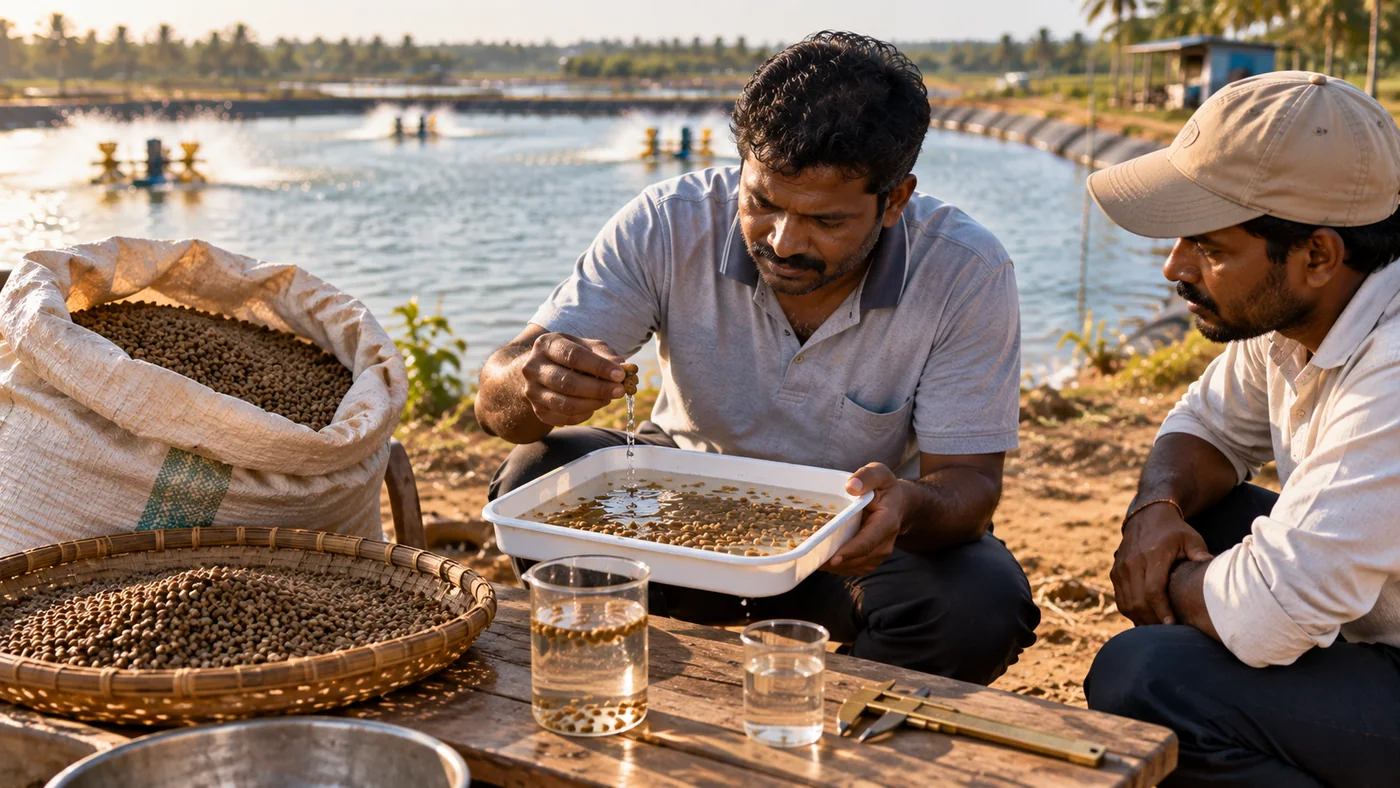
Perform a simple 2-hour glass tumbler test on every new feed batch. Place 20 pellets in a glass tumbler of pond water. If more than 2 pellets disintegrate into loose powder or cloud the water before 90 minutes have elapsed, reject the batch immediately.
3. Secret #2: The 'Fines' & Dust Swindle — Paying ₹100/kg for Toxic Sludge
When a farmer pays ₹2,500 to ₹2,900 for a 25-kilogram bag of commercial shrimp feed, they are paying for whole, dense, calibrated pellets. What they frequently receive, however, is a substantial percentage of shattered pellet fragments, microscopic crumbs, and powdery dust—known in feed manufacturing terminology as 'Fines'.
The physics of feeding shrimp makes fines an absolute dead loss. Litopenaeus vannamei possesses specialized mouthparts designed to seize and grasp solid food particles measuring 1.2mm to 2.2mm. Shrimp cannot filter-feed on microscopic dust floating in the water column or settled into benthic mud. Every gram of fines that exits the bag is 100% unconsumed by the target crop. On an 8-hectare farm feeding 60 metric tons of feed per cycle, a fines level of just 3.5% means that over 2.1 metric tons of paid feed—costing over ₹2,10,000—is literally discarded into the pond as expensive benthic fertilizer.
Even worse than the direct financial loss is the biological hazard. Feed fines possess an immense specific surface area. The moment they hit the water, they dissolve into an organic slurry that coats the pond bottom. Heterotrophic benthic bacteria decompose this fine organic matter rapidly, driving benthic dissolved oxygen to 0.0 ppm and initiating anaerobic sulfate reduction. Within 48 hours, the pond bottom turns into pitch-black, foul-smelling sludge that emits lethal hydrogen sulfide (H2S), triggering black gill disease, chronic shell softening, and catastrophic Vibrio mortalities.
Weigh the dust from three randomly selected bags using a standard 1mm household kitchen sieve and a digital kitchen scale. If the collected powder exceeds 125 grams per 25kg bag (0.5%), demand an immediate credit note or replacement from your dealer.
4. Secret #3: Crude Protein vs. Digestible Protein — The Feather Meal Trick
Every bag of commercial aquaculture feed prominently displays a guaranteed crude protein (CP) percentage—typically 34%, 35%, or 38% for Vannamei grower diets. Most farmers believe that a 35% protein feed from Brand A is biologically equivalent to a 35% protein feed from Brand B. This is one of the most expensive misconceptions in aquaculture.
The standard laboratory method for determining crude protein is the Kjeldahl or Dumas combustion nitrogen assay. These tests do not measure protein directly; they measure total elemental nitrogen and multiply the result by a generic conversion factor of 6.25 (based on the assumption that proteins contain approximately 16% nitrogen). This creates a massive loophole that unscrupulous feed formulators routinely exploit.
To reduce manufacturing costs when marine fishmeal prices exceed ₹1,40,000 per metric ton, formulators substitute digestible animal proteins (squid meal, fishmeal, krill meal) with cheap, poorly digestible nitrogen sources. Common substitutes include hydrolyzed poultry feather meal (which has 80% crude protein on paper, but an amino acid digestibility below 45% for crustaceans), high-fiber leather meal meal, corn gluten, and even traces of non-protein nitrogen (NPN) compounds. On the dealer's laboratory test certificate, the feed shows a pristine '35.2% Crude Protein'. In the shrimp's gut, however, over 40% of this protein passes unabsorbed through the intestine and is excreted as toxic fecal ammonia, starving the shrimp of essential amino acids like lysine, methionine, and arginine.
Biological Performance of Digestible Marine Protein vs. Low-Cost Feather Meal
The table below contrasts the actual nutritional bio-availability of high-grade marine protein against cheap alternative nitrogen fillers in 35% CP grower feeds:
| Nutritional Quality Vector | Premium Marine Formulation (Fishmeal/Squid) | Low-Cost Commercial Diet (Feather/Corn Meal) | Operational Impact on Farm |
|---|---|---|---|
| True Apparent Digestibility (ADC) | 84% – 88% protein absorbed | 52% – 62% protein absorbed | Shrimp must consume 30% more feed to achieve equal somatic muscle growth |
| Essential Amino Acid Balance | Complete profile (High Lysine & Methionine) | Severely deficient in Lysine, Tryptophan, Threonine | Slow molting cycle, thin muscle mass, and soft shell syndrome |
| Fecal Ammonia Output | Low (0.08 kg NH3 / kg feed) | High (0.22 kg NH3 / kg feed) | Spikes total ammonia nitrogen (TAN) in pond, requiring heavy water exchange |
| Expected Field FCR | 1.18 – 1.25 | 1.55 – 1.70 | Extra feed capex of ₹28,000 to ₹45,000 per metric ton of shrimp harvested |
Check the ingredient list printed on the feed tag. Ingredients are legally required to be listed in descending order of inclusion. If 'Fishmeal' or 'Squid Meal' appears below wheat flour, dehulled soybean meal, or poultry by-product meal, the feed relies primarily on plant and terrestrial by-product fillers.
5. Secret #4: Godown Heat & Lipid Rancidity — How 40°C Destroys Vitamins
Even when a feed mill formulates a top-tier diet with premium fishmeal, pure marine oils, and pharmaceutical-grade vitamin premixes, that quality can be completely destroyed between the factory gate and your pond bank. The culprit is the commercial distribution godown.
In major aquaculture hubs such as Bhimavaram, Nellore, Surat, Balasore, and Contai, feed dealers store thousands of bags in poorly ventilated warehouses roofed with uninsulated corrugated tin or asbestos sheets. During the peak summer culture months (March through June), ambient interior temperatures inside these godowns frequently soar to 40°C to 48°C, with relative humidity exceeding 85%. Feed sacks stacked 20 layers high trap intense internal heat.
Under these extreme conditions, two catastrophic biochemical degradations occur: (1) Lipid Peroxidation (Rancidity): The highly unsaturated polyunsaturated fatty acids (PUFAs—specifically EPA and DHA from fish oils) oxidize rapidly, forming toxic lipid peroxides, aldehydes, and free radicals. Feeding rancid lipids damages the shrimp's delicate hepatopancreatic tubule epithelium, causing White Gut disease, sluggish digestion, and immune collapse; (2) Vitamin Denaturation: Synthetic heat-sensitive vitamins—principally Vitamin C (L-ascorbyl-2-polyphosphate), Vitamin E (tocopherol), and B-complex vitamins—degrade exponentially. After 30 to 45 days of hot warehouse storage, up to 60% of the active Vitamin C is destroyed, leaving shrimp highly vulnerable to 'Black Death' disease, broken antennae, and poor stress tolerance during water salinity drops.
Smell the feed immediately upon opening a new bag. Fresh, high-quality aquafeed has a clean, rich, toasted marine aroma. If you detect a sour, paint-like, pungent, or stale oil smell, the lipids are oxidized. Never feed rancid feed to juvenile shrimp.
6. Secret #5: Moisture Weighting & Bag Shortages — Paying for Water Weight
The fifth dealer secret is an understated physical manipulation: moisture management and weight discrepancies. Under standard commercial manufacturing specifications, aquafeed moisture must be strictly controlled between 9.0% and 11.0%. This moisture band ensures physical pellet elasticity while preventing fungal mold (Aspergillus flavus) growth.
However, water is the cheapest ingredient in feed manufacturing. By calibrating the post-extrusion cooling dryers to leave 12.5% to 13.5% moisture in the finished pellet, a large feed mill saves thousands of tons of dry raw materials annually. For the farmer, purchasing feed with 13% moisture means paying premium feed prices for evaporated water. On a 50-ton seasonal feed purchase, an extra 2.5% moisture represents 1.25 metric tons of pure water—costing over ₹1,25,000 in undelivered dry nutritional matter.
Furthermore, scale calibration discrepancies between the factory bagging line and dealer delivery trucks frequently result in net weight shortages. Field weighments across commercial farms reveal that up to 15% of delivered bags weigh between 24.2 kg and 24.6 kg instead of the declared 25.0 kg net weight. Across a full crop cycle of 1,600 bags, a 400-gram average shortage robs the farmer of 640 kilograms of feed—worth over ₹65,000 in stolen biomass.
Place an accurate digital platform scale in your feed store. Weigh five unopened bags chosen at random from every incoming truck delivery. If the average net weight is below 24.85 kg, deduct the calculated total weight shortage directly from the dealer's delivery invoice.
7. The 5-Minute Pond-Side Quality Audit: Checktray Tests Every Farmer Must Run
Protecting your farm from substandard feed does not require an expensive university chemistry laboratory. With a few simple tools kept in your farm office—a 1mm wire sieve, a clean glass beaker, a pocket digital scale, and a handheld magnifying glass—any farmer or pond supervisor can execute a comprehensive 5-Minute Feed Quality Audit on every incoming batch before a single pellet is broadcast.
The audit protocol consists of four rapid tests: (1) The Hydro-Stability Beaker Test: Drop 25 pellets into a clear beaker of pond water and leave undisturbed for 90 minutes. High-quality feed will swell evenly while remaining completely firm and intact when gently pressed between thumb and forefinger. If pellets dissolve into powder or turn the water murky brown, stability is defective; (2) The 1mm Sieve Fines Audit: Sift one full 25kg bag through a 1mm mesh into a clean bucket. Total collected dust must not exceed 125 grams (0.5%); (3) The Pellet Uniformity & Hardness Check: Inspect 50 pellets under bright light. Pellets should have smooth, clean-cut cylindrical edges without jagged fractures or air bubbles, and require firm thumb pressure to crush; and (4) The Water Bloom Odor Test: Smell the beaker water after 2 hours. It should retain a faint clean fishmeal odor. A sour or chemical smell indicates artificial masking agents or degraded binders.
AquaSangham empowers growers to log these feed test scores directly into the mobile app. By aggregating independent feed quality data across thousands of verified farms, our platform generates community Feed Quality Indexes for every commercial brand—holding feed mills accountable and steering farmers toward the highest-efficiency formulations on the market.
Always retain a sealed 500-gram sample from each feed batch in an airtight container labeled with the batch number and date. If a sudden mortality or gut problem occurs, this reference sample can be sent to an accredited laboratory for independent aflatoxin and protein testing.
Summary Operational Action Checklist
Frequently Asked Questions
Q: What is an acceptable Feed Conversion Ratio (FCR) for commercial Vannamei shrimp in India?
Under optimal commercial management in earthen ponds, an efficient FCR for Litopenaeus vannamei harvested at 30-count (33 grams) ranges between 1.20 and 1.30. An FCR between 1.30 and 1.45 is considered acceptable. Any FCR exceeding 1.55 indicates serious operational losses—caused by poor pellet water stability, overfeeding, high bag fines, or low digestible protein.
Q: How long should commercial shrimp feed pellets stay intact in water?
Commercial extruded shrimp feed pellets must maintain physical integrity and elasticity for at least 2.0 to 2.5 hours in pond water. Because shrimp browse slowly, any pellet that dissolves or breaks apart within 60 to 90 minutes will leach critical amino acids and vitamins, leaving unconsumed organic sludge that pollutes the pond bottom.
Q: Can high temperatures in feed dealer warehouses really ruin aquafeed?
Yes. Storing aquafeed in non-air-conditioned godowns where temperatures reach 38°C to 45°C accelerates lipid peroxidation (rancidity) of marine fish oils and degrades up to 60% of synthetic Vitamin C and E within 30 to 45 days. Feeding rancid lipids damages the shrimp's hepatopancreas, causing White Gut disease and stunted growth.
Q: Why do some feed brands with 35% protein give better growth than other 35% brands?
Standard feed tags measure 'Crude Protein' (total elemental nitrogen x 6.25), not biological protein quality. A premium feed formulated with marine fishmeal and squid meal provides high digestible essential amino acids (lysine, methionine). A cheaper feed can achieve the same 35% crude protein score on paper using poorly digestible feather meal or plant gluten, but yields 25% slower growth.
AquaSangham Technical Advisory
Nutrition, Feed Quality & FCR Optimization Division
Contributing Senior Technical Writer & Aqua Consultant at AquaSangham.
Recommended Farming Guides
The 3 AM Oxygen Trap: Why Fish and Shrimp Die at Dawn (And The 4.0 ppm Rule That Saves Them)
Read Article →Water QualityWhy Sudden Monsoon Rain Wipes Out Shrimp Overnight (And The 30-Minute Emergency Lime Protocol That Saves Your Pond)
Read Article →Market AnalysisEU & US Seafood Traceability Audits: Keeping Digital Farm Logs to Secure ₹15-₹20/kg Premium from Exporters
Read Article →Get Live Farm Advice on AquaSangham Mobile App
Download India's #1 Aquaculture Super App for real-time market prices, precision tools, and community advice.
Download Free Android App