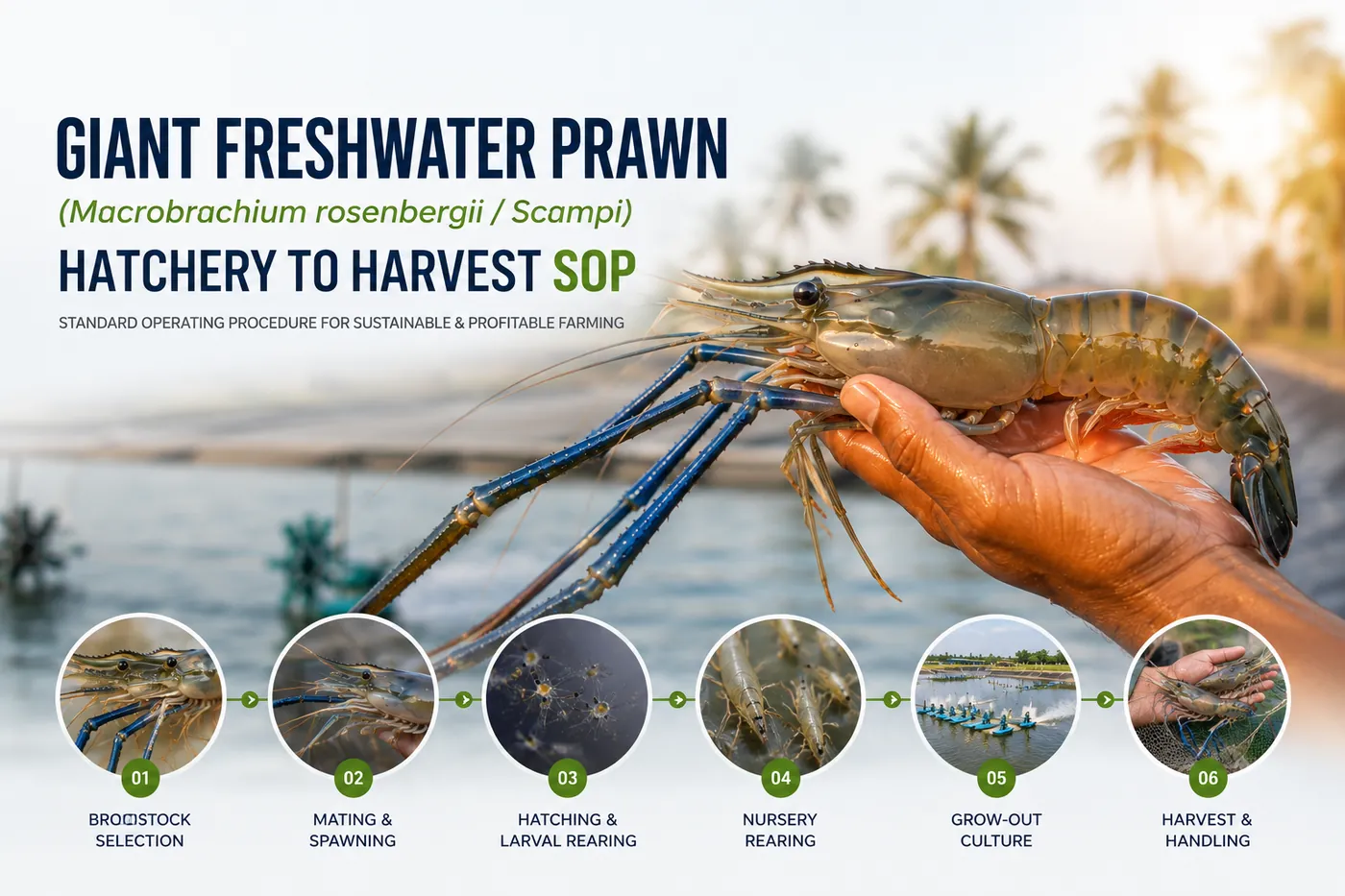
Executive Summary & Key Takeaways
- The Giant Freshwater Prawn (Macrobrachium rosenbergii / Scampi) represents India's highest-value inland aquaculture crustacean, thriving in 0 to 5 ppt freshwater environments and commanding ₹550 to ₹720/kg farmgate prices.
- Hatchery larviculture strictly requires 12 ppt brackishwater salinity, 28°C to 31°C water temperature, and live Artemia nauplii / egg custard feeding across 11 distinct zoeal developmental stages over 22 to 28 days.
- Male Macrobrachium rosenbergii differentiate into three distinct morphotypes: Small Males (SM), Orange Claw (OC), and Blue Claw (BC / Bull Males); managing this social hierarchy through size grading is essential to prevent stunted growth and cannibalism.
- Implementing a mandatory 45-day nursery phase allows farmers to grade juveniles by size, culling slow growers and stocking uniform 3 to 5-gram juveniles into grow-out ponds for > 80% final survival.
- Submerged artificial habitats (PVC pipe clusters, coconut fronds, and plastic mesh bundles) increase benthic surface area by 30% to 40%, providing vital molting shelters that eliminate mortality from conspecific predation.
- Polyculture with Indian Major Carps (Catla catla and Labeo rohita) maximizes pond ecological efficiency: surface-feeding carps consume plankton and column organic matter while Scampi scavenge benthic sediments, doubling net revenue per hectare.
Field Case Study: 15-Acre Freshwater Scampi-Carp Polyculture Enterprise
A commercial freshwater aquaculture enterprise in the West Godavari delta converted 6 earthen ponds into an integrated Macrobrachium rosenbergii and Indian Major Carp (Catla and Rohu) polyculture system. By sourcing genetically superior specific-pathogen-free (SPF) hatchery post-larvae, implementing a dedicated 45-day nursery grading protocol to remove dominant bull males, installing submerged PVC hideouts (120 units/pond), and feeding sinking 32% protein carp-scampi pellets, the farm harvested 1,840 kg/ha of premium 80–110g jumbo Scampi alongside 3,250 kg/ha of carps. The operation generated ₹11,96,000 in gross Scampi sales and ₹4,22,500 in carp revenue, realizing a net profit of ₹8,14,000 per hectare.
1. Hatchery Phase: Broodstock Management, 12 ppt Brackishwater Larviculture & PL Metamorphosis
The Giant Freshwater Prawn (Macrobrachium rosenbergii), commonly known as Scampi, is a catadromous crustacean that inhabits freshwater rivers, lakes, and reservoirs as an adult but requires brackishwater conditions to complete its embryonic and larval life cycles. Successful commercial farming begins with precision hatchery operations designed to mirror this natural coastal migration.
Healthy berried (egg-carrying) female broodstock weighing 50 to 90 grams with bright orange-to-brown egg masses (indicating advanced embryonic development) are selected from freshwater ponds and transferred to a dedicated quarantine and spawning facility. Spawning tanks are maintained in 5 ppt salinity brackishwater at 28°C to 30°C. Within 2 to 4 days, when the egg mass turns dark grey-black, hatching occurs, releasing free-swimming Stage I zoeae.
Newly hatched Scampi larvae are phototactic, obligate marine organisms that cannot survive in pure freshwater. Immediately after hatching, larvae must be transferred to larval rearing tanks (LRT) containing filtered, aged, UV-sterilized seawater diluted with dechlorinated freshwater to a precise salinity of 12 ppt (± 1 ppt). Salinity deviations below 10 ppt or above 14 ppt cause severe osmoregulatory shock, molt arrest, and mass larval mortality.
11 Zoeal Stages & Live Feed Protocol
Scampi larvae progress through 11 distinct morphological zoeal stages over a 22 to 28-day period before metamorphosing into post-larvae (PL). From Stage II onward, feed larvae newly hatched Artemia salina cysts (2 to 4 nauplii per mL) 3 to 4 times daily.
From Stage V onward, supplement Artemia with a prepared micro-particulate egg custard (composed of whole hen egg, squid meal, fish oil, and vitamin premix sieved through 150 to 300-micron mesh). Maintain continuous gentle bottom aeration, total ammonia nitrogen (TAN < 0.2 ppm), nitrite (NO2⁻ < 0.1 ppm), and daily water exchange of 30% to 50% using clean 12 ppt brackishwater.
| Larval Stage | Developmental Days (DOC) | Salinity (ppt) | Primary Feed Type | Feeding Frequency / SOP |
|---|---|---|---|---|
| Stage I (Zoea) | Day 1 – 2 | 12 ppt | Endogenous yolk sac | Gentle aeration; no external feeding |
| Stage II – IV | Day 3 – 8 | 12 ppt | Artemia nauplii (Instar-I) | 4 meals/day @ 3–5 nauplii/mL density |
| Stage V – VIII | Day 9 – 16 | 12 ppt | Artemia + Egg-Squid Custard | Alternate Artemia and 200µ custard meals |
| Stage IX – XI | Day 17 – 24 | 12 ppt | Enriched Artemia + Custard | Increase custard particle size to 350µ |
| Post-Larva (PL1–PL5) | Day 25 – 30 | 12 ppt down to 0 ppt | Starter Crumble #0 / Paste | Gradual 2 ppt / 8 hrs freshwater titration |
Once 80% of larvae complete metamorphosis into benthic-crawling post-larvae (PL1 to PL5), initiate gradual freshwater acclimation: reduce water salinity by 2 ppt every 8 hours until reaching 0 ppt pure freshwater over a 48-hour period.
3. Two-Phase Nursery Culture & Size Grading: Preventing Cannibalism & Bull-Male Suppression
Direct stocking of tiny 0.01 g hatchery post-larvae (PL5–PL10) into large earthen grow-out ponds results in catastrophic mortality (often below 40%) due to dragonfly nymph predation, benthic cannibalism, and feed competition with wild minnows. Commercial operations must enforce a dedicated 45 to 60-day intermediate nursery rearing phase.
Nursery ponds or hapa nets (typically 0.05 to 0.1 ha in size with 1.0m water depth) are stocked with PL10 post-larvae at high densities of 200 to 400 PL/m². The nursery water is conditioned with natural phytoplankton blooms (Secchi depth 30–35 cm) and supplemented with submerged plastic mesh substrates and coconut fronds to expand the available resting surface area.
Feed nursery stock with 35% crude protein crumble feeds 4 times daily @ 8% to 12% body weight. By DOC 45, post-larvae reach a robust juvenile weight of 2.5 to 4.5 grams with survival rates exceeding 85%.
Mechanical Size Grading Protocol
At the conclusion of the nursery phase, juveniles are harvested and passed through bar-graders with 8 mm and 12 mm slot spacings to separate stock into three distinct size cohorts: Jumpers (fast growers > 4.5g), Average Jumpers (2.5 to 4.5g), and Stunted Laggards (< 2.0g).
Stocking these sorted cohorts into separate grow-out ponds eliminates early size hierarchy suppression and prevents large juveniles from cannibalizing smaller, freshly molted peers, boosting final grow-out survival by 20% to 25%.
| Grading Class | Juvenile Weight (g) | Percentage of Crop | Recommended Stocking Strategy | Expected Harvest Size |
|---|---|---|---|---|
| Class A (Jumpers) | > 4.5 g (Top Tier) | 25% – 30% | Stock in dedicated fast-crop pond @ 3 PL/m² | 100 – 130 g (Super Jumbo at 140 DOC) |
| Class B (Average) | 2.5 – 4.5 g (Standard) | 55% – 60% | Stock in commercial polyculture @ 4–5 PL/m² | 75 – 95 g (Jumbo at 165 DOC) |
| Class C (Laggards) | < 2.0 g (Slow Growers) | 10% – 15% | Cull or stock in extensive wetland nursery | 35 – 50 g (Medium grade) |
Discard or sell the lowest 15% stunted laggards to local freshwater ornamental trade rather than stocking them into primary grow-out ponds. These genetically slow-growing juveniles rarely attain commercial export weights and consume expensive feed inefficiently.
4. Earthen Pond Architecture: Benthic Surface Area, Submerged Habitats & Substrate Engineering
Unlike marine penaeid shrimp that swim actively throughout the entire water column, Macrobrachium rosenbergii is strictly a bottom-crawling, territorial crustacean. Its production capacity is limited not by water volume, but strictly by available two-dimensional benthic floor area.
To break visual line-of-sight and prevent aggressive encounters between territorial males, pond architecture must incorporate extensive submerged artificial habitat shelters. Install 100 to 150 artificial habitat clusters per hectare across the pond bottom. Suitable shelters include tied bundles of 50 mm diameter perforated PVC pipes (30 cm length), submerged bundles of coconut fronds, coiled HDPE agricultural drainage pipes, and vertical nylon netting screens.
These artificial habitats effectively expand the usable surface area of the pond by 35% to 50%, providing secluded micro-refuges where newly molted, soft-shelled prawns can hide undisturbed for the 3 to 6 hours required for their new chitinous exoskeletons to calcify and harden.
Earthen ponds should be rectangular with smooth, gradually sloping bottoms (slope 1:300 toward a central drainage trench and harvest pit). Maintain water depth at 1.0 to 1.2 meters. Deeper water columns (> 1.5m) in freshwater ponds tend to form thermal and dissolved oxygen stratification, creating an anoxic bottom layer that Scampi cannot inhabit.
Liming & Calcium Hardness Buffering
Freshwater environments frequently suffer from low calcium hardness. Macrobrachium rosenbergii requires dissolved calcium to build its heavy calcified exoskeleton.
Maintain total water hardness above 100 ppm CaCO3 and total alkalinity between 80 and 120 ppm. Broadcast Agricultural Gypsum (CaSO4 @ 100–150 kg/ha) and Dolomite @ 100 kg/ha monthly to ensure adequate bioavailable calcium without spiking water pH excessively.
Anchor habitat clusters at varying water depths (from 40 cm along shallow dyke margins to 1.0m in central zones). This distributes prawns evenly across the pond and prevents territorial crowding in the deep trenches.
5. Benthic Nutrition & Feeding Protocols: 30–34% Crude Protein, Calcium Fortification & Sinking Diets
Macrobrachium rosenbergii is an omnivorous benthic scavenger with a wide natural diet including aquatic insects, detritus, worms, freshwater snails, and benthic algae. In commercial grow-out systems, formulated feeds must provide 30% to 34% crude protein, 5% to 7% crude lipid, and a rich balance of bioavailable calcium, phosphorus (dicalcium phosphate @ 1.5%), and cholesterol.
Scampi feed predominantly at dusk and throughout the night. Feeding schedules should allocate 25% of the total daily feed ration at 07:00 AM and 75% of the daily ration at 18:30 PM. Broadcast sinking pelleted feed (Pellet size 2.0 mm for juveniles; 3.0 to 3.5 mm for adults) along designated peripheral feeding lanes 2 to 3 meters from the dyke.
Pellets must possess excellent water stability, remaining intact on the pond bottom for at least 3 to 4 hours without disintegrating into fine mush. Scampi hold feed pellets in their maxillipeds and slowly nibble them over extended periods; unstable feeds leach soluble nutrients into the water and accelerate benthic pollution.
Checktray Monitoring & Fresh Feed Supplements
Install 4 checktrays (1.0 m² mesh) per hectare to monitor nightly consumption. Check trays 3.0 hours after the evening feeding. If trays are completely clean, increase the feed ration by 5%; if leftover pellets remain, reduce feed by 15%.
Twice weekly, top-dress pelleted feed with cooked trash fish meal, crushed freshwater apple snails (Pila globosa), or squid oil @ 15 mL/kg feed. These natural chemo-attractants stimulate aggressive feeding and enhance growth rates during the final 60 days before harvest.
| Culture Stage (DOC) | Prawn ABW (g) | Pellet Diameter (mm) | Crude Protein (%) | Daily Feeding Rate (% Biomass) | Checktray Inspection Time |
|---|---|---|---|---|---|
| DOC 1 – 45 (Nursery) | 0.02 – 3.5 g | Crumble / 1.2 mm | 35% CP | 8.0% – 5.0% | 1.5 – 2.0 Hours |
| DOC 46 – 90 (Early) | 3.6 – 25.0 g | 2.0 mm sinking | 32% – 34% CP | 4.5% – 3.2% | 2.5 Hours |
| DOC 91 – 135 (Mid) | 25.1 – 55.0 g | 2.8 – 3.0 mm sinking | 30% – 32% CP | 3.0% – 2.2% | 3.0 Hours |
| DOC 136 – 180 (Finishing) | 55.1 – 100+ g | 3.5 mm sinking | 28% – 30% CP | 2.0% – 1.4% | 3.0 – 3.5 Hours |
Never use floating fish feeds for Macrobrachium rosenbergii. Scampi will not swim to the water surface to feed in daylight; floating pellets are consumed entirely by surface birds or decompose on the water margins.
6. Commercial Polyculture Engineering: Integrating Scampi with Indian Major Carps (Catla, Rohu, Grass Carp)
While Scampi monoculture is commercially viable, integrated polyculture of Macrobrachium rosenbergii with Indian Major Carps (Catla catla, Labeo rohita) and Grass Carp (Ctenopharyngodon idella) represents one of the most profitable, low-risk aquaculture models in freshwater ecosystems.
In a balanced polyculture pond, every ecological niche is effectively utilized: Catla catla (stocked @ 1,000 to 1,500 fingerlings/ha) filters surface zooplankton; Labeo rohita (stocked @ 1,500 to 2,000 fingerlings/ha) grazes on mid-column column algae and detritus; and Scampi (stocked @ 25,000 to 35,000 graded juveniles/ha) scavenges benthic sediments and unconsumed sinking feed particles.
Crucially, bottom-dwelling common carps (Cyprinus carpio) and Mrigal (Cirrhinus mrigala) must be strictly excluded from Scampi polyculture ponds. These benthic-feeding fish vigorously root through bottom sediments, destroying Scampi habitat shelters, competing directly for sinking pellets, and preying upon soft-shelled molting prawns.
Polyculture Stocking Sequence SOP
Always stock graded Scampi juveniles (2 to 4g) into the pond at least 21 days prior to introducing carp fingerlings (size 10 to 12 cm). This head-start allows Scampi to claim bottom territories and establish habitat shelter occupancy.
Feed the polyculture pond using a dual-feed strategy: broadcast floating low-cost carp pellets (20–24% CP) in the morning for fish, and broadcast sinking Scampi pellets (30–32% CP) at dusk across bottom feeding lanes.
Stock Grass Carp (Ctenopharyngodon idella @ 200–300 / ha) to biologically control submerged aquatic weeds (Hydrilla, Najas, and Vallisneria). Grass carp fecal pellets provide rich partially digested fiber that Scampi actively grazes upon as natural supplementary food.
7. Commercial Farm Financial Economics: 1-Hectare Scampi Monoculture vs Carp Polyculture Model
To demonstrate the financial returns of Macrobrachium rosenbergii, below is an authentic economic comparison for a 1.0-hectare earthen freshwater farm operating under two commercial regimes: 1) Intensive Scampi Monoculture (stocked @ 40,000 graded juveniles/ha, 75% survival, 85g average weight at 165 DOC), and 2) Integrated Scampi-Carp Polyculture (stocked @ 30,000 Scampi juveniles + 3,000 Catla/Rohu carps/ha).
In Scampi monoculture, the pond yields 2,550 kg of jumbo freshwater prawns sold at an average farmgate price of ₹620/kg, generating ₹15,81,000 in gross revenue against total OPEX of ₹8,45,000, delivering a net profit of ₹7,36,000 per hectare (ROI: 87.1%).
In the integrated Scampi-Carp polyculture model, the pond yields 1,980 kg of Scampi (worth ₹12,27,600) plus 3,800 kg of fresh table carps sold locally @ ₹145/kg (worth ₹5,51,000). Total gross revenue reaches ₹17,78,600 against operational costs of ₹9,24,000, delivering a record net profit of ₹8,54,600 per hectare (ROI: 92.5%) while significantly diversifying market risk.
Selective Cull Harvesting Strategy
Maximize revenue by executing 3 to 4 selective cull-harvests using large-mesh (60 to 75 mm) seine nets starting at DOC 120. Selectively netting out large Blue Claw males (90g+) every 15 days allows remaining Orange Claw males to rapidly expand, adding 400 to 600 kg of additional high-value jumbo biomass per crop cycle.
| Financial Line Item | Scampi Monoculture (1.0 Ha @ 40k PL) | Scampi-Carp Polyculture (30k Scampi + 3k Carp) | Economic Advantage |
|---|---|---|---|
| Graded Juvenile Seed Cost | 40,000 PLs (@ ₹1.80 = ₹ 72,000) | 30k Scampi + 3k Carp (₹ 68,000) | Lower seed capital requirement |
| Commercial Feed OPEX | 3,952 kg sinking (@ ₹72 = ₹ 2,84,544) | 2,970kg Scampi + 4,200kg Fish (₹ 4,32,000) | Dual feeding utilizes all trophic layers |
| Electricity & Pumping OPEX | ₹ 1,25,000 (Low aeration demand) | ₹ 1,40,000 | 50% lower power cost than Vannamei |
| Habitat Shelters & Liming | ₹ 65,000 (PVC & Dolomite) | ₹ 75,000 | Shelters are reusable for 5+ years |
| Labor & Farm Management | ₹ 1,80,000 | ₹ 2,09,000 | 6-month culture cycle labor |
| Total Operational Cost (OPEX) | ₹ 8,45,000 | ₹ 9,24,000 | + ₹ 79,000 for polyculture feed/labor |
| Gross Commercial Revenue | ₹ 15,81,000 (2,550 kg Scampi) | ₹ 17,78,600 (1,980kg Scampi + 3.8T Carps) | + ₹ 1,97,600 higher gross revenue |
| Net Farm Profit / Hectare | ₹ 7,36,000 / crop (ROI: 87.1%) | ₹ 8,54,600 / crop (ROI: 92.5%) | Polyculture adds ₹ 1,18,600 net profit |
Market live Scampi in aerated transport tanks to high-end metropolitan seafood restaurants and premium live seafood markets in Bengaluru, Hyderabad, Delhi, and Kolkata. Live Scampi commands a premium of ₹80 to ₹120 per kg over iced product.
Summary Operational Action Checklist
Frequently Asked Questions
Q: Why do freshwater Scampi require brackishwater in the hatchery?
Macrobrachium rosenbergii is evolutionary catadromous. Its newly hatched zoeal larvae require a precise salinity of 12 ppt (± 1 ppt) to support osmotic balance, enzyme activation, and nutritional assimilation across their 11 larval stages. Once larvae metamorphose into post-larvae (PL), they migrate naturally into freshwater and thrive in 0 to 5 ppt salinities.
Q: What causes stunted growth and cannibalism in Scampi ponds?
Cannibalism and stunted growth are driven by social hierarchy and territorial aggression between male morphotypes. Dominant Blue Claw (BC / Bull) males inhibit the growth of subdominant Orange Claw (OC) and Small Males. Furthermore, when prawns molt, their soft bodies are vulnerable to predation by hard-shelled peers. Installing submerged PVC habitat shelters and executing periodic size grading solves this problem.
Q: Can Scampi be polycultured with Indian Major Carps?
Yes. Polyculture with surface-feeding Catla catla (1,000–1,500/ha) and column-feeding Labeo rohita (1,500–2,000/ha) is highly profitable and eco-friendly. However, bottom-feeding common carps (Cyprinus carpio) and Mrigal must be excluded because they compete for bottom feed and prey on soft-shelled Scampi.
Q: How does selective cull-harvesting increase Scampi yield?
In Scampi ponds, removing the largest dominant Blue Claw males (which have reached terminal growth at 90–120g) removes the social growth suppression on Orange Claw (OC) males. The largest OC males immediately undergo rapid growth spurts and molt into the next generation of jumbo Blue Claw males, adding 400 to 600 kg/ha of premium biomass.
AquaSangham Technical Advisory
Freshwater Crustacean & Polyculture Systems Division
Contributing Senior Technical Writer & Aqua Consultant at AquaSangham.
Recommended Farming Guides
Western Blue Shrimp (Penaeus stylirostris) Intensive Culture: Lessons from New Caledonia
Read Article →Farming TechGreen Tiger Prawn (Penaeus semisulcatus) Culture Protocols for Gulf of Mannar Coastal Ponds
Read Article →Farming TechKuruma Prawn (Penaeus japonicus) Culture in Sandy Substrates: High-Value Export SOP
Read Article →Get Live Farm Advice on AquaSangham Mobile App
Download India's #1 Aquaculture Super App for real-time market prices, precision tools, and community advice.
Download Free Android App