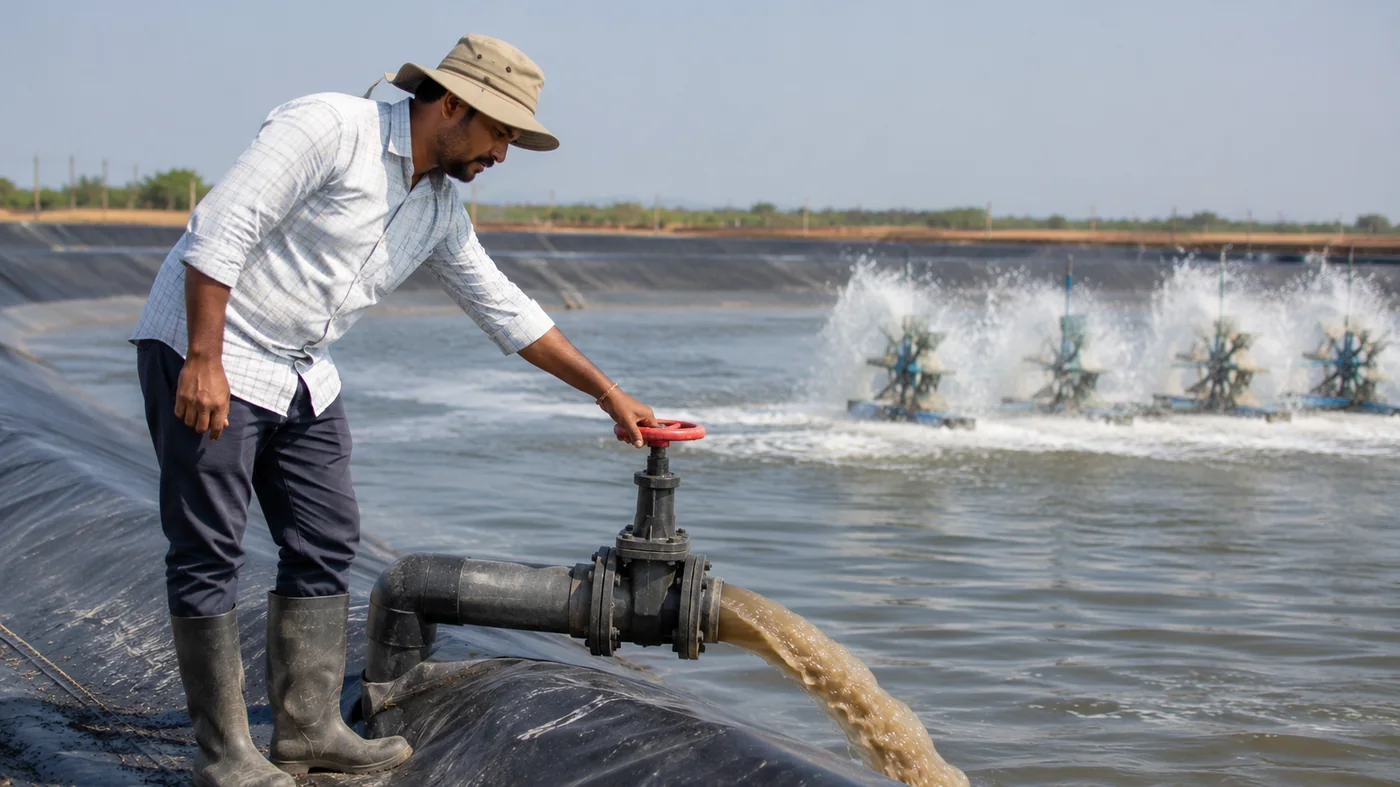
Executive Summary & Key Takeaways
- HDPE geomembrane lining (minimum 1.0 mm floor, 0.75 mm dyke) completely isolates the water column from earthen soil pathogens (EHP, WSSV) and sub-soil acidity, enabling super-intensive stocking densities of 60 to 100 PL/m².
- The frictionless plastic surface allows hydrodynamic waste concentration: grading the pond floor with an inward 1.0%–1.5% radial slope and deploying circular paddlewheel arrays sweeps solid wastes into a central collection sump within 60 minutes.
- Central siphoning must be executed 2 to 3 times daily commencing on DOC 30–35, scheduled 1.5 hours post-feeding to purge fresh fecal casts and unconsumed pellets before anaerobic H2S generation begins.
- Smooth plastic surfaces foster slippery benthic biofilms composed of cyanobacteria and pathogenic Vibrio parahaemolyticus; bi-weekly dosing of Bacillus enzymes (B. subtilis, B. licheniformis) digests the adhesive slime matrix.
- Without soil-mineral exchange, intense bacterial nitrification rapidly depletes water alkalinity (10–15 ppm daily); mandatory daily nocturnal dosing of Sodium Bicarbonate (15–25 kg/ha) is required to maintain alkalinity between 130 and 160 ppm.
- Groundwater hydrostatic pressure and subterranean biogases can cause catastrophic liner ballooning ('whales'); installing a sub-liner herringbone perforated drainage network connected to external dewatering sumps and gas-relief valves is mandatory.
Field Case Study: 5-Hectare Intensive HDPE Lined Estate Conversion
An intensive shrimp farm in coastal Gujarat converted five 1.0-hectare earthen ponds into 1.0 mm virgin HDPE lined systems equipped with central concrete sludge collection sumps (3.5 m diameter), perimeter anti-ballooning perforated PVC sub-drainage grids, and circular paddlewheel aeration arrays (36 HP/ha). Operating at a stocking density of 75 PL/m² of SPF Penaeus vannamei, the farm instituted a strict central siphon protocol: opening external drain valves 1.5 hours post-feeding three times daily starting at DOC 32, evacuating 900 to 1,200 liters of concentrated anoxic sludge per cycle. To prevent slippery benthic biofilms, the facility dosed multi-strain Bacillus enzymes bi-weekly and performed weekly soft squeegee dyke brushing. Across 104 DOC, the facility harvested 82.0 metric tons of prime 28.5g Vannamei across the 5 ponds (averaging 16.4 t/ha) with an exceptional 1.18 FCR and 88.5% survival, delivering a net operating profit of ₹1.42 Crores while completing post-harvest washdown and restocking within 6 days.
1. HDPE Geomembrane Architecture: The Shift from Earthen to Lined Ponds
The transition from traditional earthen ponds to High-Density Polyethylene (HDPE) geomembrane-lined systems represents the most significant technological paradigm shift in modern intensive shrimp aquaculture. Over the past two decades, escalating disease pressures—most notably from benthic-associated pathogens such as Enterocytozoon hepatopenaei (EHP), White Spot Syndrome Virus (WSSV), and acute hepatopancreatic necrosis disease (AHPND / EMS caused by virulent Vibrio parahaemolyticus strains)—have rendered traditional earthen farming increasingly unpredictable in coastal India. In earthen ponds, pathogenic spores, viral vectors, and heavy organic fecal sludge accumulate deep within the sub-soil pores, defying chemical disinfection and triggering severe toxicity.
By completely isolating the aquatic culture volume from the underlying soil, 100% fully lined HDPE ponds (utilizing 0.75 mm to 1.0 mm geomembranes) eliminate earthen soil-water chemical interactions. They prevent seepage, eradicate benthic soil acidity, accelerate pond preparation from 25 days down to a rapid 5-to-7-day turnaround, and support super-intensive stocking densities of 60 to 100 post-larvae per square meter (PL/m²), delivering harvest yields of 12 to 18 metric tons per hectare. However, cultivating shrimp on a smooth, impermeable synthetic liner fundamentally alters pond limnology, water hydraulics, and benthic ecology. Without the natural buffering capacity, trace mineral reservoir, and microbial diversity of healthy earthen soil, lined ponds operate as closed, hypersensitive aquatic raceways.
In an HDPE lined pond, uneaten feed pellets, chitinous molts, and biological waste cannot be absorbed by soil. Instead, waste forms slippery, toxic benthic biofilms across the plastic floor, while dissolved alkalinity crashes rapidly under intense bacterial nitrification. Crucially, without a functional central sludge pit and disciplined hydrodynamic siphoning, massive mounds of anoxic sludge accumulate on the pond bed, suffocating shrimp and releasing lethal hydrogen sulfide gas. This master technical guide outlines the complete engineering and biological SOP for managing HDPE lined shrimp ponds, detailing geomembrane specifications, central siphon hydraulics, biofilm eradication, mineral replenishment, and anti-ballooning sub-liner drainage.
Material Specifications & Installation Engineering
Liner Thickness Selection: For culture ponds, the minimum recommended thickness is 0.75 mm (30 mil) for pond dykes and 1.0 mm (40 mil) for the pond bottom floor. Using thin 0.5 mm liners on pond beds is a catastrophic false economy; shrimp walking pereiopods, crab claws, and accidental foot traffic from workers will puncture thin plastic, allowing pressurized groundwater to penetrate beneath the liner.
Virgin vs. Recycled Polymers: Only certified virgin resin liners conforming to GRI-GM13 international standards should be installed. Recycled plastics contain microscopic impurities, low tensile elongation (<700%), and degraded polymer chains that crack, delaminate, and leach toxic plasticizers into pond water under tropical heat.
Seaming and Welding Protocols: Liners are joined on-site using automated dual-wedge hot-air fusion welders that create a double-track seam with an internal air-testing channel. Each seam must undergo non-destructive pressure testing at 30 psi for 5 minutes to verify 100% leak-proof hermetic integrity. Perimeter edges are anchored in a continuous 50 cm × 50 cm anchor trench excavated along the dyke crest and backfilled with compacted clay.
| Operational Parameter | Traditional Earthen Pond | Semi-Lined Pond (Dyke Only) | 100% Fully Lined HDPE Pond (1.0 mm) |
|---|---|---|---|
| Stocking Density (PL/m²) | 25 – 45 PL/m² | 40 – 60 PL/m² | 60 – 100 PL/m² (Intensive) |
| Biomass Yield / Ha / Crop | 4.5 – 7.5 Metric Tons | 7.0 – 10.5 Metric Tons | 12.0 – 18.5 Metric Tons |
| Pond Turnaround Time | 20 – 30 Days (Drying/Tilling) | 12 – 15 Days | 5 – 7 Days (Power Wash & Spray) |
| Aeration Requirement | 16 – 24 HP / Hectare | 24 – 30 HP / Hectare | 32 – 42 HP / Hectare (Circular Array) |
| Sludge Removal Method | Post-harvest mechanical scraping | Manual central ditch flush | Continuous Central Siphon (2-3x Daily) |
| Mineral & Alkalinity Demand | Moderate (Soil-buffered) | High (Partial soil contact) | Extremely High (Daily NaHCO3 dosing) |
| Benthic Pathogen Risk | High (Persistent in soil cracks) | Moderate (Dyke isolated) | Near-Zero (Sterile washable substrate) |
| Capital Expenditure / Ha | ₹1.5 – ₹2.5 Lakhs | ₹4.5 – ₹6.0 Lakhs | ₹11.0 – ₹14.5 Lakhs (Full civil/liner) |
| Average FCR | 1.35 – 1.55 | 1.25 – 1.38 | 1.15 – 1.25 (Superior bottom hygiene) |
Before laying the HDPE geomembrane, treat the excavated earthen base with a systemic pre-emergence herbicide and compact the soil with a smooth-drum vibratory roller. Wild wetland reeds and nut-grass (Cyperus rotundus) possess sharp rhizomes that can pierce through plastic liners if left untreated beneath the geomembrane.
2. The Central Sludge Pit & Hydrodynamic Siphon Engineering
The fundamental engineering feature that makes intensive HDPE shrimp farming possible is the Central Sludge Pit (commonly known as the Shrimp Toilet). In an earthen pond, organic sludge spreads across the entire bottom. In an HDPE lined pond, the frictionless surface of the smooth plastic allows farm operators to hydrodynamically concentrate all solid wastes into the exact center of the pond.
1. Bottom Slope Geometry: The earthen base beneath the HDPE liner must be precision-graded with an inward radial slope of 1.0% to 1.5% descending uniformly from the peripheral dyke toe toward the center. This gentle incline ensures that heavy organic particles roll toward the center without impeding shrimp movement.
2. The Central Sump (Shrimp Toilet): At the lowest central elevation, a circular concrete or molded heavy-gauge HDPE sump (3.0 to 4.0 meters in diameter, 0.8 to 1.0 meters depth) is installed. The sump floor is connected to an underground 150 mm (6-inch) or 200 mm (8-inch) schedule-80 PVC drain line extending beneath the liner to an external discharge valve pit outside the pond perimeter dyke.
3. Hydrodynamic Vortex Aeration: Aerators are not placed randomly. Long-arm paddlewheel aerators (typically 32 to 40 HP per hectare) are deployed in a coordinated circular perimeter array. When activated, the rotating aerators generate a continuous, uniform circular water current across the pond. Centripetal and frictional forces transport all sinking organic solids—including shrimp feces, uneaten feed fragments, dead microalgal cells, and shed exoskeletons—across the slick HDPE floor directly into the central collection pit within 45 to 60 minutes of feeding.
Calibrate aerator water velocity to achieve a peripheral flow speed of 0.25 to 0.35 meters per second. Water moving faster than 0.4 m/s will scour the central pit and resuspend fine sludge particles back into the water column; water moving slower than 0.2 m/s will allow sludge to settle prematurely along the feeding berms.
3. Siphon Timing Protocols: Daily Purge Schedules & Diagnostics
Concentrating organic sludge in the central pit is useless unless it is systematically and routinely evacuated from the pond culture ecosystem. If waste remains in the pit for more than a few hours, anaerobic decomposition begins, depleting dissolved oxygen and producing toxic hydrogen sulfide (H2S), nitrite (NO2-), and un-ionized ammonia (NH3):
- Initiation Timeline: Central siphoning operations must commence between Day of Culture (DOC) 30 and DOC 35, or as soon as daily feed consumption exceeds 25 to 30 kg per hectare. During early juvenile stages (DOC 1–30), waste production is minimal and can be digested by beneficial probiotics.
- Siphon Frequency and Timing: Siphoning must be executed two to three times daily, scheduled precisely 1.5 to 2.0 hours following major feed rations (e.g., at 09:30, 14:30, and 20:30 hrs). This timing ensures that uneaten feed particles and fresh fecal casts are captured immediately before bacterial breakdown commences.
- Siphoning Operation and Hydraulic Velocity: The external drain valve is opened fully, utilizing the 1.2 to 1.5-meter hydrostatic pressure head of the pond water to create a high-velocity suction vortex in the central pit. The initial discharge consists of a thick, jet-black, foul-smelling viscous slurry. The valve is kept open until the discharge transitions from black sludge to clear pond water (typically 10 to 15 minutes, discharging 800 to 1,500 liters of concentrated waste per cycle).
- Preventing Shrimp Entrapment: The central sump must be capped with a convex, stainless steel 316 marine-grade or perforated HDPE suction grate (mesh opening 8 mm to 12 mm). The grate prevents juvenile or adult shrimp from being drawn into the drain pipe during discharge while permitting sludge and molts to pass unimpeded.
Always collect a 1-liter sample of the initial siphon effluent in a clear Imhoff cone or glass beaker daily. Record the settling volume of solid sludge after 30 minutes. A sudden jump in sludge volume indicates overfeeding, while the presence of whole unconsumed pellets signals feed adjustment is required immediately.
4. Benthic Biofilm Control: Combatting Blue-Green Algae & Vibrio
While HDPE liners eliminate contact with earthen pathogens, they introduce a distinct, dangerous biological phenomenon: Slippery Benthic Biofilms. Within 10 to 14 days of water filling, the smooth plastic surface becomes coated with a complex microbial slime matrix composed of extracellular polymeric substances (EPS), filamentous cyanobacteria (blue-green algae such as Oscillatoria, Phormidium, and Spirulina), benthic diatoms, and opportunistic bacteria.
The Biofilm Threat: Pathogenic Vibrio parahaemolyticus (the causative agent of Early Mortality Syndrome / AHPND) readily colonizes these synthetic biofilms, finding shelter within the polysaccharide matrix where chemical sanitizers and probiotics cannot penetrate. Furthermore, during late afternoon hours, photosynthesis causes mats of benthic cyanobacterial biofilms (locally known as 'lab-lab' or 'plastic scum') to detach from the liner and float to the water surface. Grazing shrimp ingest these toxic, decaying blue-green mats, triggering acute bacterial enteritis, white gut syndrome, and hepatopancreatic necrosis.
Biofilm Control Protocol: 1. Probiotic Bio-Scouring: From DOC 15 onwards, broadcast targeted enzymatic bio-remediators containing concentrated strains of Bacillus subtilis, Bacillus licheniformis, and Bacillus pumilus @ 1.5 to 2.0 kg/ha twice weekly. These bacteria secrete powerful extracellular proteases and amylases that digest the adhesive EPS slime layer, preventing cyanobacterial filaments from anchoring to the plastic. 2. Manual Underwater Line Scrubbing: In intensive farms, technicians equipped with diving masks and long-handled soft polypropylene squeegees or brushes walk or swim the shallow dyke slopes weekly to dislodge adhering biofilms, allowing paddlewheel currents to sweep the debris into the central siphon drain. Never use metal scrapers, wire brushes, or abrasive pads, which scratch the HDPE surface and create microscopic fissures where bacteria hide.
To check if your liner has developed dangerous blue-green biofilms, run a white gloved finger along the plastic waterline. If the glove shows a slimy dark green or brown smear that smells muddy or musty, apply Bacillus pumilus @ 2 kg/ha combined with 20 kg/ha fermented sugarcane molasses at 09:00 AM to detach the film.
5. Zero-Soil Mineral Equilibrium: Alkalinity & Cation Management
In an earthen pond, the underlying soil acts as a massive natural chemical battery, constantly dissolving minerals, absorbing excess phosphorus, and buffering water alkalinity through the dissolution of calcium carbonate and clay silicates. In an HDPE lined pond, there is zero chemical exchange with the soil. The pond water is entirely on its own:
- Accelerated Alkalinity Depletion: In high-density lined ponds, intense autotrophic and heterotrophic nitrification consumes bicarbonate alkalinity at a rapid rate: Nitrosomonas bacteria consume 7.14 mg of CaCO3 alkalinity for every 1.0 mg of ammonium nitrogen (NH4-N) oxidized to nitrite. In a pond stocked at 80 PL/m² consuming 150 kg of feed daily, water alkalinity can plummet by 10 to 15 ppm CaCO3 every 24 hours. If alkalinity drops below 100 ppm, water pH experiences violent diurnal fluctuations, causing soft shells, incomplete ecdysis, and mass molt mortality.
- Daily Mineral Dosing Mandate: Maintain alkalinity strictly between 130 and 160 ppm as CaCO3. Dose technical-grade Sodium Bicarbonate (NaHCO3) @ 15 to 25 kg/ha daily, administered between 22:00 and 02:00 hrs during nocturnal molting hours. Cation Balance (Ca, Mg, K): In lined ponds, shrimp rapidly deplete dissolved calcium and magnesium to calcify new exoskeletons post-molt. Test cation ratios weekly: maintain Calcium at >350 ppm, Magnesium at >1,000 ppm (at 25 ppt salinity), and Potassium at >300 ppm. Fortify water continuously with food-grade Magnesium Chloride (MgCl2) and Potassium Chloride (KCl).
Never use Agricultural Limestone (CaCO3) to raise alkalinity quickly in an HDPE lined pond. Limestone is poorly soluble in seawater and will settle onto the plastic floor as an inert white sediment, which the paddlewheel vortex will sweep into the central siphon and flush out before it can dissolve. Always use highly soluble Sodium Bicarbonate (NaHCO3).
6. Sub-Liner Hydrostatic Pressure: Preventing 'Whales' and Ballooning
The most catastrophic structural failure in lined aquaculture is Liner Ballooning, colloquially known among farm engineers as 'Whales' or 'Water Blisters'.
During monsoon rains or spring tides in low-lying coastal areas, the groundwater table surrounding the pond rises rapidly. If the hydraulic head of the groundwater beneath the pond exceeds the water level inside the pond, or if organic matter buried beneath the liner decomposes into methane and carbon dioxide gas, the immense upward pressure lifts the heavy HDPE geomembrane off the earthen base. Massive, water-filled or gas-filled plastic bubbles—often 2 to 3 meters high and 20 meters wide—balloon up inside the culture pond, disrupting aeration currents, destroying central siphon plumbing, and trapping thousands of shrimp.
Engineering SOP to Prevent Ballooning: 1. Sub-Liner Drainage Network: Prior to laying the HDPE geomembrane, an intricate herringbone network of drainage trenches (30 cm depth, 30 cm width) must be excavated in the earthen floor. Perforated 4-inch (100 mm) PVC or corrugated HDPE pipes wrapped in non-woven geotextile filter fabric (to prevent sand clogging) are laid in the trenches and backfilled with washed 10 mm gravel. 2. External Sump and Dewatering Wells: The sub-liner drainage pipes terminate in deep concrete dewatering sumps excavated outside the pond dykes. Submersible sump pumps fitted with automatic float switches run continuously during rainy periods to pump groundwater away from the pond foundations, keeping the sub-soil permanently dewatered. 3. One-Way Gas Relief Valves (Flap Valves): In ponds prone to subterranean gas accumulation, spring-loaded or rubber flap pressure-relief valves are installed flush through the HDPE liner at 15-meter intervals along the deep floor. These one-way valves allow subterranean gas and water to discharge upward into the pond if external pressure exceeds pond hydrostatic pressure, but seal tightly to prevent pond water from leaking beneath the liner.
Never drain an HDPE lined pond completely during heavy monsoon storms or exceptionally high spring tides. The sudden loss of internal water weight allows surrounding groundwater pressure to lift the liner instantly. Always maintain at least 50 cm of water inside the pond until external groundwater levels subside.
7. In-Crop Repair SOPs, Chemical Washing & Post-Harvest Turnaround
Maintaining geomembrane integrity during an ongoing culture cycle requires prompt, non-destructive repair protocols:
- Detecting In-Crop Punctures: If pond water levels drop abnormally (>2 cm daily beyond evaporative losses), or if groundwater dewatering wells discharge saline pond water, a liner puncture has occurred. Technicians must inspect the dyke waterlines and aeration anchor points.
- Underwater Puncture Repair SOP: For small punctures or tears (under 10 cm) beneath the water level, draining the pond is catastrophic. Utilize specialized underwater elastomeric polyurethane adhesive tapes (such as butyl mastic tape backed with EPDM rubber) or underwater-curing epoxy patches. Clean the punctured plastic surface with a soft scouring pad to remove biofilms, apply underwater epoxy paste to a 20 cm × 20 cm virgin HDPE patch, and press firmly over the puncture, weighting the patch with a sandbag for 24 hours until fully polymerized.
- Post-Harvest Turnaround (The 5-Day Protocol): One of the supreme advantages of HDPE lined ponds is rapid turnaround between crops. Within 2 hours of harvesting, wash down the entire liner using high-pressure water washers (150 to 200 bar) to strip all biofilms, particulate sludge, and salt crusts. Spray the clean liner with a 50 to 100 ppm calcium hypochlorite disinfectant solution, let it sun-dry for 48 hours to photolyze chlorine, and refill immediately. A fully lined farm can execute 3 full culture cycles per year, compared to only 2 cycles in earthen ponds.
Install protective sacrificial HDPE wear sheets (2.0 mm thick, 1.5 m × 1.5 m) directly underneath every paddlewheel aerator stand and checktray contact point. Continuous mechanical vibrations and weighted ropes will eventually wear down the main geomembrane if sacrificial pads are omitted.
Summary Operational Action Checklist
Frequently Asked Questions
Q: Why is a central sludge pit ('shrimp toilet') mandatory in an HDPE lined pond but optional in earthen ponds?
In an earthen pond, organic sludge interacts with soil minerals and is partially metabolized by benthic bacteria. In an HDPE lined pond, the plastic surface is completely impermeable and biological wastes cannot enter the soil. Because HDPE has a very low coefficient of friction, paddlewheel aerators easily sweep sludge across the plastic into the center. If there is no central sump to trap and siphon this sludge, the concentrated waste decomposes anaerobically in the center, generating toxic hydrogen sulfide, suffocating shrimp, and causing lethal black-gill disease across the entire population.
Q: How do farmers prevent liner ballooning ('whales') during high-tide or heavy monsoon rains?
Liner ballooning occurs when external groundwater hydrostatic pressure or subterranean biogases exceed the downward water pressure inside the pond, lifting the heavy geomembrane off the ground. Prevention requires: 1) Excavating a herringbone sub-liner drainage network of perforated 4-inch PVC pipes wrapped in geotextile fabric beneath the liner, 2) Connecting these lines to external deep dewatering sumps with automatic submersible sump pumps, and 3) Installing one-way rubber flap pressure-relief valves flush through the HDPE liner in the deep floor to vent excess sub-liner pressure safely.
Q: What causes slippery benthic biofilms on HDPE liners and why are they dangerous to shrimp?
HDPE surfaces naturally attract microscopic bacteria and filamentous blue-green algae (cyanobacteria like Oscillatoria), which secrete extracellular polymeric substances (EPS) to form a slippery slime matrix. Pathogenic Vibrio parahaemolyticus colonies embed themselves inside this biofilm, shielding themselves from water sanitizers and probiotics. During sunny afternoons, photosynthesis produces oxygen bubbles that detach these toxic cyanobacterial mats, causing them to float. Grazing shrimp ingest the floating mats, leading to acute bacterial enteritis, white gut syndrome, and massive mortality.
Q: Why does water alkalinity crash much faster in an HDPE lined pond than in an earthen pond?
In earthen ponds, soil continuously dissolves calcium carbonate and clay silicates to replenish lost water alkalinity. In HDPE lined ponds, there is zero chemical interaction with soil. At intensive stocking densities (60–100 PL/m²), intense bacterial nitrification consumes 7.14 mg of CaCO3 alkalinity for every 1.0 mg of ammonium nitrogen oxidized. Without soil buffering, alkalinity drops by 10 to 15 ppm every 24 hours. Farmers must dose Sodium Bicarbonate (NaHCO3) @ 15 to 25 kg/ha daily to prevent alkalinity crashes and molt failure.
Q: How can an underwater puncture or tear in an HDPE liner be repaired without draining the pond?
Draining an intensive pond during an ongoing crop is catastrophic. Small punctures (under 10 cm) can be repaired underwater: 1) Locate the tear by following small bubbles or silt movement, 2) Clean the plastic surface around the tear using a soft scouring pad to strip away slippery biofilms, 3) Cut a 20 cm × 20 cm patch from virgin HDPE geomembrane, 4) Apply a thick layer of specialized underwater-curing epoxy adhesive or butyl mastic tape to the patch, and 5) Press the patch firmly over the puncture underwater, placing a 10 kg clean sandbag on top for 24 hours until the epoxy fully cures.
AquaSangham Technical Advisory
Intensive Mariculture & Aquaculture Engineering Desk
Contributing Senior Technical Writer & Aqua Consultant at AquaSangham.
Recommended Farming Guides
Total Ammonia Nitrogen (TAN) Mass Balance Math: Sizing Biofilters in Commercial RAS
Read Article →Farming TechThe Recirculating Aquaculture System (RAS) Master Guide: Design, Hydraulics & Mass Balance
Read Article →Farming TechIndigenous Magur (Clarias batrachus) Induced Breeding & Nursery Rearing SOPs
Read Article →Get Live Farm Advice on AquaSangham Mobile App
Download India's #1 Aquaculture Super App for real-time market prices, precision tools, and community advice.
Download Free Android App