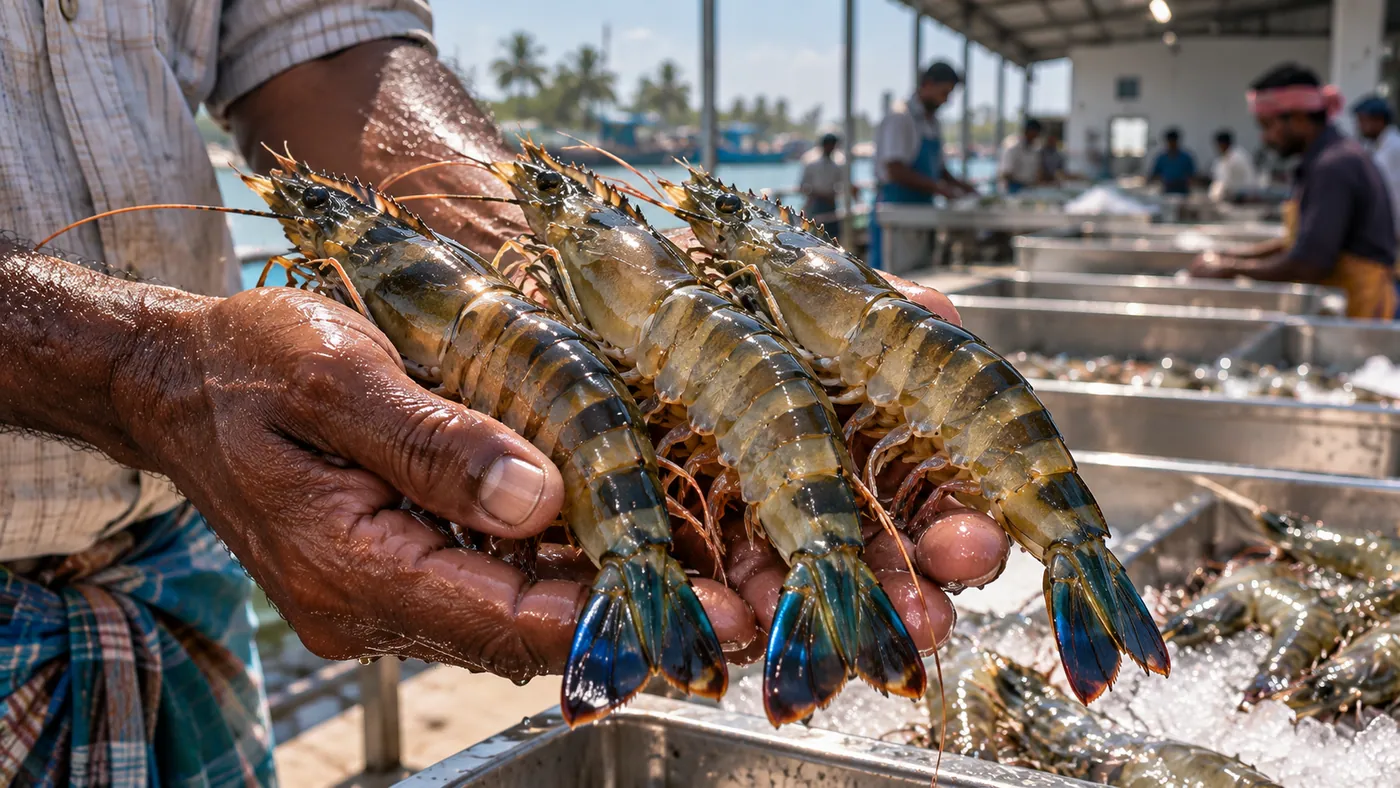
Executive Summary & Key Takeaways
- Selling direct to processing factories bypasses a predatory multi-tier middleman pyramid, immediately reclaiming between ₹25 and ₹42 per kilogram in recovered commissions, fair tare deductions, and precise count grading.
- Export processing plants operate on strict international food safety standards (HACCP, BRCGS, US FDA); their primary reason for buying from brokers is not pricing, but risk mitigation regarding antibiotic contamination (chloramphenicol, nitrofurans) and uniform consignment volume.
- A clean Pre-Harvest Certificate (PHC) issued by an Export Inspection Council (EIC) accredited laboratory is your golden ticket: plants will aggressively compete and pay top farmgate price for verified zero-residue, farm-traceable shrimp.
- Never rely on village mechanical beam scales or broker tare formulas: an uncalibrated crate weighing routine with an arbitrary 4 kg 'water/ice tare' erases 350 to 500 kg of paid biomass per 8-ton harvest, costing the farmer ₹1.2 to ₹1.8 Lakhs.
- Factory purchase orders must lock in count brackets and pricing formulas tied to transparent benchmark mandi rates with explicit deduction caps for soft-shell (<5%) and broken pieces (<2%).
- Insist on formal banking settlement instruments: direct bank wire (RTGS) or tripartite bank escrow releases triggered automatically upon factory electronic gate-in weight and QC acceptance.
Direct Factory Contracting Turnaround: Mogalthur Shrimp Cooperative Bypasses Village Brokers to Reclaim ₹41.2 Lakhs Across 140 Tons
A cluster of 12 commercial Litopenaeus vannamei farmers in Mogalthur traditionally sold their entire 140-ton seasonal crop through village sub-brokers and commission agents. Brokers extracted a visible ₹5/kg commission, but routinely imposed opaque hidden deductions: an arbitrary 5% to 8% 'ice-melt water tare' discount, downgrading 30-count harvests to 33-count 'under-weight' tiers, and delaying final payment by 45 to 90 days while charging high informal interest. Over a single season, the farming cluster leaked over ₹40 Lakhs in lost farmgate revenue. Partnering with AquaSangham's Direct Trade Desk, the cooperative established a direct procurement MoU with a leading BRCGS- and EU-certified processing exporter in Visakhapatnam. The protocol instituted pre-harvest independent count and shell-hardness sampling, certified zero-antibiotic Pre-Harvest Certificates (PHC) via EIC-accredited labs, calibrated on-site digital weighing scales with electronic data capture, and structured tripartite escrow settlement. The cooperative secured an audited net gain of ₹29.40 per kg, pocketing an extra ₹41,16,000 in direct bank transfers while completely eliminating credit default risks.
1. The Hidden Cost of Middlemen: Anatomy of the ₹30/kg Broker Tax
Across the coastal aquaculture belts of Andhra Pradesh, Tamil Nadu, Odisha, and Gujarat, a pervasive economic myth traps commercial shrimp and fish farmers: the belief that individual cultivators cannot sell directly to seafood export processing plants. For decades, local commission agents, village aggregators, and input-dealer brokers have cultivated this perception, presenting themselves as indispensable buffers between the farmer's pond bund and the sterile, corporate world of marine export processing complexes. In reality, this middleman pyramid represents one of the most extractive supply chain layers in global agriculture.
When an Indian shrimp farmer sells an 8-metric-ton crop of 30-count Litopenaeus vannamei through a local broker, the nominal commission deducted on paper appears modest—typically ₹3.00 to ₹5.00 per kilogram. However, this visible fee is merely the tip of an iceberg. The real wealth transfer occurs through an elaborate architecture of hidden deductions, manipulated count thresholds, and inflated tare weights. First is the 'Ice and Water Tare Trick': brokers mandate an arbitrary 3.5 to 5.0 kg deduction per 30 kg harvest crate to account for melting ice and surface moisture, even when shrimp have been drained on mesh inspection tables for the statutory 90 seconds. On an 8,000 kg harvest, this phantom deduction erases between 320 and 480 kg of legitimate shrimp biomass, stripping ₹1,25,000 to ₹1,90,000 in cash directly from the farmer's pocket.
Second is the 'Count-Bracket Squeeze'. When a pre-harvest cast-net sample reveals an average size of 32.5 grams (30.7 count per kg), an independent factory buyer grades the consignment in the 30-count bracket (paying, for example, ₹390/kg). A village broker, however, deliberately blends samples from pond edges to inflate the count to 33.2 pieces/kg, arbitrarily reclassifying the entire truckload into the lower 35-count bracket (paying ₹355/kg). This single subjective grading trick strips ₹35 per kilogram across 8,000 kg—costing the farmer an astonishing ₹2,80,000. When combined with delayed payment cycles (where brokers hold farm money for 30 to 60 days to finance their own high-interest informal lending operations), the total 'Middleman Broker Tax' routinely exceeds ₹28 to ₹42 per kilogram. Over an 8-ton pond cycle, bypassing the broker restores ₹2.24 to ₹3.36 Lakhs in clean net profit.
The Anatomy of Middleman Deductions on an 8-Ton Vannamei Consignment
To understand why factory-direct trading is essential for farm solvency, examine the audited economics of an 8,000 kg harvest of 30-count shrimp: Under traditional broker procurement, the nominal mandi price of ₹390/kg is eroded by ₹5/kg direct broker fee (-₹40,000), a 4.5% fictitious ice/water tare reduction (-₹1,40,400), a 2-count downgrade penalty (-₹1,60,000), and an informal finance discount (-₹35,000). The farmer takes home ₹343.20/kg, realizing ₹27,45,600.
Under direct factory procurement via transparent cold-chain contracts, the farmer sells at the verified factory gate-in rate of ₹395/kg, undergoes laser-calibrated digital crate weighing with an audited 1.2% water tare, retains legitimate 30-count grading, and incurs zero broker fees. The net realization is ₹388.50/kg, generating ₹31,08,000. Bypassing the middleman yields an immediate net cash gain of ₹3,62,400 on a single pond.
Why Processors Tolerate Brokers (And Why They Prefer Direct Farmers)
Seafood processing plants do not prefer brokers because they love paying commissions; they tolerate them because brokers historically solved two critical headaches: volume aggregation and financial risk buffer. A 50-ton-per-day processing factory cannot negotiate with 20 individual smallholders owning half-hectare ponds. Furthermore, if a pond tests positive for banned antibiotic residues, the factory can push the entire financial penalty onto the broker.
However, in 2026, the dynamics have flipped dramatically. Facing stringent US FDA Import Alerts, EU Residue Audits, and Corporate Sustainability Due Diligence Directives (CSDDD), global seafood retail buyers (such as Costco, Walmart, Sysco, and Carrefour) demand 100% digital farm-to-fork traceability. Brokers, who habitually commingle shrimp from multiple unverified farms into a single insulated truck, are a biosecurity nightmare for export processors. Processors are actively seeking organized, direct farmer partnerships that provide verified farm traceability, certified antibiotic-free status, and direct cold-chain integrity.
Never allow a broker to transport your harvest in unsealed open crates with the promise that 'the final count will be settled at the factory'. Once your shrimp leaves your pond bund, you lose 100% of your negotiating leverage. Always execute contract terms, digital weighing, and certified count sampling before the truck departs.
2. What Seafood Processing Plants Actually Want: The 5 Factory Procurement Criteria
To approach a seafood export processing plant as a credible commercial seller rather than an amateur, farmers must understand the operational constraints of modern processing facilities. Processing plants are capital-intensive, high-throughput industrial environments governed by rigorous international certifications: US FDA HACCP (Hazard Analysis Critical Control Point), BRCGS (British Retail Consortium Global Standard), IFS Food, and EU approval numbers issued by the Export Inspection Council (EIC) of India.
An export factory does not buy shrimp based on village relationships or emotional appeals. Their procurement officers operate under strict daily processing orders received from overseas buyers in Tokyo, Los Angeles, Rotterdam, and Shanghai. These contracts specify exact finished-product product forms: Head-On Shell-On (HOSO), Headless Shell-On (HLSO), Peeled Deveined Tail-On (PDTO), and Individually Quick Frozen (IQF) cooked meats. To fulfill these orders profitably, factory procurement managers evaluate incoming farm raw material against five non-negotiable industrial benchmarks.
Understanding these five criteria enables commercial farmers to tailor their harvesting strategy, pond preparation, and presentation to match factory specifications, turning their crop into premium raw material that commands top-tier factory gate-in pricing.
The 5 Non-Negotiable Factory Procurement Benchmarks
1. Guaranteed Zero Antibiotic Residues: The absolute prerequisite. Export plants face immediate license cancellation, catastrophic container rejections, and multi-crore testing penalties if a consignment tests positive for banned pharmacologically active substances (chloramphenicol, nitrofurans, fluoroquinolones, or tetracyclines). A farmer with pre-harvest certified lab clearance skips the broker queue instantly.
2. Uniform Count Distribution & Minimal Standard Deviation: Processors despise 'wide count' harvests. If an average 30-count lot contains 20% small 45-count shrimp and 15% massive 20-count shrimp, automated grading machines (grader rollers) suffer massive sorting friction, lowering factory processing line speed from 1,200 kg/hour down to 600 kg/hour and increasing manual peeling labor costs.
3. Shell Hardness & Molt Stage Management: Premium export products (especially HOSO and HLSO) require hard-shelled shrimp (inter-molt Stage C). If a farmer harvests during a lunar molt cycle (full moon or new moon) and delivers more than 5% soft-shell or paper-shell shrimp, processing yield plummets, heads detach during de-heading, and the factory imposes severe financial deductions.
4. Immediate Core Chilling (The 1:1 Slurry Protocol): Factory quality control managers immediately plunge digital needle thermometers into the core center of arriving shrimp crates. If internal muscle core temperature exceeds 4.0°C, or if melting dry block ice has left hot spots (12°C–16°C), the factory flags the lot for accelerated melanosis (black spot) risk and microbial degradation.
5. Minimum Commercial Consignment Batch Size: Modern refrigerated insulated trucks (reefers or insulated 6-wheelers) require minimum economic payloads. While a factory will rarely dispatch a refrigerated vehicle for an isolated 1,500 kg pond, clusters of farmers or progressive commercial producers offering 5,000 to 12,000 kg in a single coordinated harvest window command red-carpet treatment from factory procurement directors.
If your farm produces less than 4 tons per harvest cycle, do not attempt to approach export plants as an isolated grower. Form a 3-to-5-farmer local harvest cooperative to pool your harvest schedules. A guaranteed 15-ton weekly delivery schedule unlocks direct factory procurement managers and top-tier corporate price sheets.
3. Pre-Harvest Quality Clearance: Clearing PHC, Antibiotic Screens & Count Verification
In the direct factory sales workflow, your most powerful commercial weapon is the Pre-Harvest Certificate (PHC). Historically introduced under EIC regulations and MPEDA oversight, the PHC protocol was designed to verify that commercial aquaculture crops are completely free from banned antibiotic residues and environmental contaminants before the harvest net touches the water.
Middlemen brokers deliberately exploit farmers' fear of lab testing. Brokers convince growers that laboratory testing is a treacherous bureaucratic obstacle course where 'a corrupt lab technician can ruin your life with a fake positive result.' They offer to buy crops 'without testing'—at a punitive ₹30 to ₹50/kg discount—only to secretly take private lab samples themselves, obtain clearance, and sell the shrimp to export factories at full international prices, pocketing the massive arbitrage.
Eliminating the middleman requires mastering the independent pre-harvest testing protocol. Exactly 7 to 10 days prior to your projected harvest date, the farmer must engage an accredited third-party testing laboratory (certified by NABL and approved by EIC and MPEDA, such as EIA labs, SGS, Eurofins, or Vimta Labs) to draw official pre-harvest representative samples.
The 4-Step Pre-Harvest Sampling & Lab Clearance Protocol
Step 1: Representative Pond Sampling: Using a clean, un-medicated cast net, collect a minimum of 50 to 75 live shrimp from across all four corners and the center of the pond. Avoid collecting sluggish or moribund shrimp clinging to dykes, as they do not represent the commercial biomass.
Step 2: Triple-Rinse & Cold Chain Sealing: Rinse the live sample thoroughly in clean borewell water to remove pond bottom silt. Pack 1.0 kg of whole live shrimp into sterile Whirl-Pak bags, place inside an insulated styrofoam box with sealed gel ice packs (maintaining 0°C to 2°C), and sign the tamper-evident chain-of-custody seal alongside the certified field sampler.
Step 3: Comprehensive Antibiotic Panel: Mandate testing via High-Performance Liquid Chromatography with Tandem Mass Spectrometry (LC-MS/MS). The screen must cover the critical export panels: Chloramphenicol (CAP, limit of detection <0.1 ppb), Nitrofuran metabolites (AOZ, AMOZ, AHD, SEM, detection <0.5 ppb), Fluoroquinolones (Enrofloxacin, Ciprofloxacin), and Tetracyclines.
Step 4: Securing the Digital PHC: Official test results are typically delivered within 48 to 72 hours via digitally signed PDF certificates. A 100% clean, non-detectable screening certificate immediately elevates your harvest into the top 15% of premium market inventory, giving you the leverage to demand firm, non-negotiable cash bids from multiple competing export plants.
Field Count Verification: Eliminating the Sample Bias
Simultaneously with antibiotic testing, execute a rigorous Count-Per-Kilogram Verification Audit. Take 5 separate 2-kg cast-net samples across different pond depths at dawn (when shrimp are actively foraging). Count the exact number of individuals in each 2-kg lot and divide by 2 to determine the true mean count.
Calculate the Standard Deviation: in a high-quality, well-fed pond, 85% of individuals should fall within ±2.5 grams of the mean weight. Document this data in a structured Farmgate Pre-Harvest Quality Sheet (listing Mean Count, Percentage Hard Shell, Gut Fullness, and Cleanliness of Gills). Submitting this professional sheet alongside your PHC to factory procurement desks signals that you are an elite, data-driven producer who cannot be deceived by subjective grading games.
Never use commercial pond probiotics, feed additives, or water sanitizers within 15 days of harvest unless they carry certified 'Antibiotic-Free' guarantees from reputable manufacturers. Many cheap, unbranded import probiotics are secretly spiked with low-grade chloramphenicol or nitrofuran dust by dishonest formulators to mimic efficacy, resulting in catastrophic lab failures.
4. The Direct Factory Procurement Contract: Terms, Price Pegging & Escrow Safeguards
Once you possess a clean pre-harvest lab certificate and verified count data, you bypass local commission agents entirely and initiate direct commercial negotiations with the General Manager of Procurement at 2 to 3 licensed seafood export processing companies located within a 150-kilometer radius of your farm.
Amateur farmers make the fatal mistake of entering verbal or WhatsApp agreements regarding price. A verbal promise from a factory procurement executive that 'we will give you ₹400/kg' is legally worthless. If international container freight rates surge overnight, or if the factory receives a sudden influx of raw material, the procurement officer will unilaterally slash your payout price upon arrival at the factory gate. Professional direct trading requires a formal, written Factory Purchase Order (PO) or Direct Farmer Procurement Contract.
A bankable direct procurement agreement must explicitly define six foundational operational clauses: baseline pricing formulas, count-bracket variation tolerances, maximum permissible deduction caps, transportation logistics liability, weighing methodology, and irrevocable payment release mechanisms.
The 6 Essential Contractual Clauses for Direct Factory Sales
Clause 1: Price Pegging Mechanism: Price must be pegged either to a fixed forward contract rate (e.g., ₹395.00/kg for 30-count) or to a verifiable benchmark index (e.g., AquaSangham Daily Regional Mandi Spot Price + ₹18/kg Direct Factory Premium) determined at 18:00 hrs on the evening preceding harvest.
Clause 2: Count Variation Sliding Scale: If the actual harvest count deviates from the pre-harvest estimate, the contract must define exact, transparent step-rates (e.g., +₹7.00/kg per single-count jump for larger sizes, and -₹6.00/kg per single-count drop for smaller sizes). Reject vague clauses stating 'price subject to factory daily price list at time of arrival'.
Clause 3: Defect Deduction Caps: Establish strict, audited upper thresholds for physical defects: Soft-Shell maximum 5% (with soft-shell penalized at no more than a 25% discount, never 50%); Broken/Damaged maximum 2%; Black Spot (melanosis) maximum 1%. Any defect claims must be verified via photographic proof and physical retains stored in factory deep freeze for 48 hours.
Clause 4: Tare Weight Standards: Specify that crate tare weight will be calculated on dry, calibrated plastic crates (standard tare 2.0 to 2.2 kg) with an agreed moisture drainage allowance strictly capped at 1.5% (rejecting broker-style 5% to 8% tare deductions).
Clause 5: Logistics & Insulated Transport Responsibility: State clearly whether the sale is 'Ex-Farm Bund' (factory provides insulated refrigerated truck, slurry ice, and harvest labor) or 'Factory Gate-In' (farmer arranges transport). For beginners, Ex-Farm Bund is strongly recommended to eliminate transit mortality and weight loss risks.
Clause 6: Payment Security & Bank Escrow: Mandate payment via direct Real-Time Gross Settlement (RTGS) within 72 hours of factory gate-in, or utilize AquaSangham Direct Trade Escrow, where the processing plant deposits 100% of the projected consignment value into a regulated bank escrow account prior to the harvest truck rolling onto your farm.
Never sign a procurement contract that contains an open-ended 'Quality Deduction Discretion' clause. Every single deduction must have a mathematical ceiling and require mutual sign-off between your farm representative and the factory QC supervisor.
5. Harvest Day Logistics & Weighing Protocols: Calibrated Scales vs Broker Tricks
Harvest day is where the hard-won financial gains of a 100-day culture cycle are won or lost in four frantic hours. Under traditional middleman arrangements, harvest operations are deliberately orchestrated into chaotic, high-stress spectacles. Harvesting begins at 1:00 AM under dim halogen lights, with teams of aggressive harvesting laborers shouting, rushing crates across muddy dykes, and tossing un-drained shrimp onto slippery mechanical beam scales while the broker scribbles illegible hieroglyphics into a pocket notebook.
This manufactured chaos is designed to prevent the farmer from auditing the weighing process. In direct factory procurement, harvest operations follow a disciplined, transparent industrial standard operating procedure (SOP). Every single kilogram of biomass is tracked, drained, chilled, and weighed using certified digital instruments with electronic data logging.
The cornerstone of fair harvest logistics is the On-Farm Digital Crane Scale or Industrial Platform Scale. Prior to harvesting the first haul, the farmer and the factory procurement supervisor must jointly execute a Scale Calibration Audit using certified 20 kg cast-iron test weights. The scale's zero-point (tare) must be locked and verified in front of both parties.
The Step-by-Step Direct Harvest Weighing & Icing SOP
Step 1: Pond-Side Net Drainage: When the bag net or drag net is hauled from the water, shrimp must be transferred into perforated plastic harvest baskets and held over the pond water for exactly 60 to 90 seconds. This allows free gravitational drainage of pond water from the shrimp's carapaces and appendages before initial crate loading.
Step 2: Calibrated Tare & Weight Logging: Empty, clean harvest crates (standard 30-kg capacity) are placed on the digital scale, and their exact tare (typically 2.15 kg) is tared to zero. Shrimp are loaded to exactly 30.0 kg net weight per crate. Both the farmer's supervisor and the factory procurement representative stamp and sign a duplicate Digital Weighing Slip for every batch of 10 crates.
Step 3: Immediate 1:1 Slurry-Ice Chill-Kill: Never allow harvested shrimp to sit in dry crates waiting to be weighed. Shrimp must be immersed immediately into pre-chilled Slurry Ice (a 1:1 ratio of crushed flake ice, clean water, and 1% non-iodized salt maintained strictly at -1.0°C to 0.0°C) inside insulated 1,000-liter tubs (such as Sintex or Nilkamal insulated containers). Slurry ice drops internal core temperature from 28°C to below 3°C within 180 seconds, shutting down polyphenol oxidase enzymes, stopping melanosis, and preventing weight loss from muscle dehydration.
Step 4: Tamper-Evident Container Sealing: Once insulated tubs or truck compartments are loaded with iced shrimp, the factory representative and the farmer apply numbered, serialized plastic security pull-tight seals to every container latch. The seal numbers are recorded on the vehicle Gate Pass and Consignment Manifest. This guarantees that no driver or rogue broker can divert crates, siphon biomass, or introduce low-quality third-party shrimp during transit to the processing plant.
Assign one trusted family member or senior farm technician whose sole operational duty during harvest is to record every single scale reading on a tablet or paper tally board. Never rely on the driver's or buyer's weighing record alone.
6. Factory Receiving Dock Procedures: Sensory Grading, Soft-Shell Deductions & Yield Tests
One of the greatest fears that prevents farmers from dealing directly with factories is the 'Factory Receiving Trap'—the terror that once your shrimp truck arrives at the factory gate 100 kilometers away, the factory QC lab will reject the consignment, declare that 20% of the shrimp are soft-shelled or tainted, and hold your crop hostage. When dealing with unverified fly-by-night operators, this fear is justified. However, when working with authorized export processors under formal procurement contracts, receiving dock inspection is a highly standardized, scientific protocol that you can actively audit.
Under direct contracting, the farmer retains the absolute legal right to appoint a Farmgate Representative (either the farmer themselves, a trusted associate, or an independent AquaSangham Field Surveyor) to accompany the transport vehicle and physically observe the receiving dock inspection inside the factory intake bay.
The factory receiving procedure consists of three sequential evaluations: Consignment Security Verification, Temperature & Sensory Audit, and Mechanical Count & Defect Grading.
The 3-Phase Factory Intake Quality Audit
Phase 1: Seal Verification & Gross Vehicle Weighing: Upon arrival at the factory security gate, the transport truck drives onto an automated, certified weighbridge (calibrated under Legal Metrology standards) to log gross vehicle weight. The intake inspector inspects the serialized container seals against the Consignment Manifest; if all seals are intact, unauthorized en-route tampering is definitively ruled out.
Phase 2: Temperature & Organoleptic Audit: The truck enters the climate-controlled receiving bay (maintained at 18°C). QC technicians open the insulated containers and insert calibrated digital penetration probes into 10 randomly selected crates. Core muscle temperature must measure between 0°C and 4.0°C. Technicians evaluate organoleptic parameters: fresh marine odor (absence of sour, foul, or ammoniacal odors), translucent flesh, firm muscle resilience upon fingertip pressure, tight head-to-carapace adherence, and clean, greyish-white gills.
Phase 3: Standard 5-Kilogram Defect & Yield Test: A standardized 5.0 kg representative composite sample is drawn from across the entire consignment. Technicians wash the sample over a certified stainless-steel de-watering screen, allow it to drain for 120 seconds, and place it on a digital micro-balance to establish exact Net Drained Weight. Each individual shrimp is inspected and sorted into four stainless-steel trays: Grade A (Hard-shell export prime), Soft/Paper Shell, Broken/Crushed, and Discolored/Melanosis.
Calculating Net Payout: Each tray is weighed on a precision scale. If Soft-Shell measures 0.18 kg out of 5.0 kg (3.6%), it falls well below the 5% contractual deduction cap and incurs zero penalty. If broken pieces measure 0.05 kg (1.0%), it is within tolerance. The Grade A shrimp are counted to establish the official Certified Factory Count. Both the factory QC Manager and the Farm Representative sign the official Factory Receiving Quality Report (RQR), which instantly locks the financial settlement figure in the factory's ERP accounting software.
| Defect Category | Factory Permissible Limit | Contractual Penalty Formula | Farmer Self-Defense Strategy |
|---|---|---|---|
| Soft-Shell / Paper-Shell | Maximum 5.0% by weight | 20% to 25% price discount on soft fraction only | Halt harvest if pre-harvest checktray shows >3% molting; dose 50 kg/ha minerals |
| Broken / Crushed Shell | Maximum 2.0% by weight | Deducted at Peeling Meat (PD) price (-35%) | Never stack harvest crates more than 4-high; eliminate rough drag-net pulling |
| Black Spot (Melanosis) | Maximum 1.0% by weight | Rejected or downgraded to domestic grade | Immediate 1:1 Slurry-Ice chill-kill (-1°C); maintain continuous ice blanket in transit |
| Core Temperature Breach | Must remain < 4.0°C | Flat ₹5 to ₹10/kg ice-negligence deduction | Use 1.2 kg crushed ice per 1.0 kg shrimp in summer; verify truck insulation |
| Black / Muddy Gills | Maximum 3.0% by weight | Downgraded to Headless (HLSO) grade | Run bottom aeration and drain surface scum 24 hrs prior to harvest |
Always ensure your farm representative carries a smartphone to photograph the 5-kg QC test trays on the factory grading table alongside the official weight display. Photographic proof prevents retrospective claim adjustments by factory accounting teams.
7. Payment Settlements & Credit Traps: RTGS, Bills of Exchange & Tripartite Guarantees
In commercial seafood farming, a harvest is not completed when the shrimp are packed onto the truck; it is completed when the cash is credited to your bank account. The traditional middleman brokerage system operates on chronic credit exploitation. Brokers frequently pay 20% to 30% advance cash on harvest day, and then stretch the remaining 70% balance across 60 to 90 days. During this waiting period, farmers are forced to take high-interest private loans (often at 24% to 36% annualized interest) to pay electricity bills, feed dealers, and seed hatcheries for their next crop cycle. In the worst cases, unscrupulous brokers declare sudden 'bankruptcy' or blame foreign export cancellations, leaving farmers with uncollectible bad debts running into tens of lakhs.
Direct factory sales eliminate this chronic credit trap by integrating your farm into organized, institutional banking channels. Legitimate seafood export processors have massive working capital credit lines backed by nationalized and private commercial banks (such as State Bank of India, HDFC Bank, and Exim Bank) under RBI Export Credit schemes (Pre-Shipment and Post-Shipment Rupee Export Credit). Export factories possess abundant liquidity; they are legally and financially equipped to pay farmers promptly.
To guarantee 100% payment security when selling direct, commercial farmers utilize one of three structured institutional payment mechanisms.
The 3 Institutional Payment Frameworks for Direct Farm Sales
Framework 1: Direct Corporate RTGS (Standard 72-Hour Settlement): The most common method with established, reputable processing companies. Under the procurement PO, the factory agrees that upon signing the Receiving Quality Report (RQR) at the intake dock, the accounts department generates a commercial invoice and releases an irrevocable Real-Time Gross Settlement (RTGS) wire directly to the farmer's corporate or individual bank account within 3 business days. The farmer provides certified bank account details (cancelled cheque and PAN card) during contract signing.
Framework 2: Tripartite Bank Escrow (AquaSangham Secure Trade): For first-time transactions or large multi-pond harvests (values exceeding ₹25 Lakhs), the transaction is routed through a digital tripartite escrow account. Prior to the harvest truck departing for the farm, the processing plant deposits 100% of the estimated contract value into a scheduled commercial bank escrow account. The funds are legally locked; once the digital RQR is signed by both parties at the factory receiving dock, the escrow platform automatically disburses the exact verified net amount to the farmer's bank account within 24 hours, releasing any residual balance back to the processor.
Framework 3: Bank Letter of Credit (LC) / Usance Bills of Exchange: For corporate-scale farming estates delivering 50+ tons across an entire season, factories issue an Inland Irrevocable Letter of Credit (LC) confirmed by an A-rated commercial bank. The farmer's bank guarantees payment against presentation of standard commercial shipping documents: Consignment Manifest, Pre-Harvest Certificate (PHC), and Signed Factory Weighbridge Gate Pass.
How to Break Free from the Input-Dealer Credit Trap
The primary structural barrier that prevents small and medium farmers from selling direct to factories is the 'Input Dealer Trap'. Many farmers purchase feed, seed, and chemicals on credit from local feed dealers, who insert informal clauses mandating that the farmer must sell the eventual harvest back to the dealer or the dealer's designated broker at a discounted rate.
To break this cycle, progressive farmers utilize AquaSangham Direct Procurement Purchase Orders to secure formal institutional Working Capital crop loans from scheduled banks (such as SBI Kisan Credit Card or Agri Infrastructure Fund loans). Commercial banks readily accept an official Purchase Order from an EU-approved export processing plant as verified collateral, disbursing low-interest (7% to 9% p.a.) seasonal credit. This allows the farmer to purchase feed and inputs in upfront cash at a massive 12% to 15% cash discount, severing the middleman's shackles forever.
Never accept post-dated personal cheques from individual brokers or unverified trading firms. A cheque can bounce, leading to years of protracted Section 138 Negotiable Instruments Act litigation. Direct factory sales must always settle via electronic RTGS directly from the processor's verified corporate current account.
Summary Operational Action Checklist
Frequently Asked Questions
Q: Can an individual farmer with just 1 or 2 ponds sell directly to a seafood processing plant?
Yes, provided your harvest consignment meets the factory's minimum viable batch size (typically 3,000 to 5,000 kg) and is accompanied by a certified zero-antibiotic Pre-Harvest Certificate (PHC). If your individual pond yield is smaller (e.g., 1,500 to 2,500 kg), the proven commercial strategy is to form a local 3-to-4-farmer harvest cluster to coordinate harvest dates and share an insulated transport container, allowing the group to access direct factory contracts and top corporate price sheets.
Q: What happens if a processing plant claims my shrimp tested positive for antibiotics after they arrive at the factory?
If you followed the certified protocol and possess an official, digitally signed Pre-Harvest Certificate (PHC) issued by an EIC/NABL-accredited laboratory within 7 days of harvest, the factory cannot unilaterally reject your crop or impose arbitrary fines. Your procurement contract must stipulate that in the event of an intake screening dispute, a sealed duplicate reference sample (stored in the factory freezer with signed chain-of-custody seals) is submitted to an independent neutral referral laboratory (such as the Central Institute of Fisheries Technology - CIFT) for definitive LC-MS/MS re-testing.
Q: How do I ensure the factory does not unfairly deduct for 'ice-melt water' during intake weighing?
By executing an Ex-Farm Bund contract where net weight is officially recorded and accepted at your pond dyke using calibrated digital platform scales with a contractually agreed, standardized dry crate tare and statutory 1.5% drainage allowance. If selling on a Factory Gate-In basis, ensure your appointed farm representative is physically present in the intake bay to witness the certified weighbridge gross-tare cycle and verify that water drainage times follow standard 90-second mesh screen protocols.
Q: How can I find verified, EU/US-approved seafood processing plants looking for direct farmer suppliers?
You can consult the official directory of approved marine processing establishments published by the Export Inspection Council (EIC) and Marine Products Export Development Authority (MPEDA), which lists certified processing plants by district and export approval number. Alternatively, commercial producers utilize the AquaSangham Direct Trade Desk, which directly connects verified aquaculture clusters with audited, top-rated processing companies offering transparent price sheets and bank-escrow payment protection.
AquaSangham Market Intelligence
Seafood Processing & Export Trade Advisory
Contributing Senior Technical Writer & Aqua Consultant at AquaSangham.
Recommended Farming Guides
The 3 AM Oxygen Trap: Why Fish and Shrimp Die at Dawn (And The 4.0 ppm Rule That Saves Them)
Read Article →Water QualityWhy Sudden Monsoon Rain Wipes Out Shrimp Overnight (And The 30-Minute Emergency Lime Protocol That Saves Your Pond)
Read Article →Market AnalysisEU & US Seafood Traceability Audits: Keeping Digital Farm Logs to Secure ₹15-₹20/kg Premium from Exporters
Read Article →Get Live Farm Advice on AquaSangham Mobile App
Download India's #1 Aquaculture Super App for real-time market prices, precision tools, and community advice.
Download Free Android App