Executive Summary & Key Takeaways
- Total salinity (measured via refractometer) is merely an indicator of dissolved solids; crustacean survival, osmoregulation, and molt success are governed entirely by specific ionic concentrations of Potassium (K+), Magnesium (Mg2+), Calcium (Ca2+), and Sodium (Na+).
- In low-salinity water (<5 ppt), linear mathematical dilution of seawater fails; shrimp require higher relative concentrations of K+ (30–35 ppm per ppt salinity) and Mg2+ (90–120 ppm per ppt salinity) to drive branchial Na+/K+-ATPase active transport pumps against steep osmotic gradients.
- Potassium deficiency triggers idiopathic muscle necrosis (opaque white tail muscle), tail cramping, and fatal molt failure; correct deficits by dosing highly soluble Potassium Chloride (KCl) using the stoichiometric formula (MW factor 1.91).
- High calcium with low magnesium causes brittle shells and molt failure; maintain a strict Mg:Ca ratio of at least 3:1 using Magnesium Chloride Hexahydrate flakes (MgCl2·6H2O).
- Supplementing minerals into water must be paired with dietary feed top-dressing: coat pellets with 5–8 g/kg KCl and 5–10 g/kg Magnesium chelate bound with soya lecithin/fish oil, ramping up 48 hours prior to new and full moon molts.
- Acclimation from coastal hatchery salinity (25–30 ppt) to inland ponds (<3 ppt) must follow a rigorous 48-to-72-hour step-down schedule (max 1.0–1.5 ppt reduction per 6 hours) validated by a 2-hour freshwater stress test.
Field Case Study: 4-Hectare Inland Low-Salinity Estate Turnaround
An inland shrimp farm in Fazilka, Punjab, utilizing inland saline groundwater at 2.2 ppt salinity suffered catastrophic 40% mortality during maiden stockings, with post-larvae exhibiting cloudy white muscles, soft shells, and fatal molt failure. Water tests revealed critical ion deficits: potassium was merely 18 ppm (seawater equivalent: 25 ppm, but required: 70+ ppm for low salinity) and magnesium was 42 ppm. Under AquaSangham nutritional engineering advisory, the farm dosed technical Potassium Chloride (KCl) @ 140 kg/ha and Magnesium Chloride Flakes (MgCl2·6H2O) @ 350 kg/ha to achieve a 1:3:1 K:Mg:Ca stoichiometric ratio, fortified daily feed with chelated potassium and magnesium aspartate, and maintained alkalinity at 145 ppm using Sodium Bicarbonate. Over 102 DOC, the farm achieved 89.4% survival, harvesting 31.2 metric tons across 4 hectares of 26.5g Vannamei with an average FCR of 1.23, generating a net operating profit of ₹48.5 Lakhs.
1. The Low-Salinity Frontier: Osmoregulatory Physiology of Vannamei
Inland and low-salinity farming of the Pacific White Shrimp (Penaeus vannamei) represents one of the most explosive frontiers in modern Indian aquaculture. Over the past seven years, shrimp farming has expanded dramatically beyond traditional maritime coastal belts into inland agricultural heartlands—most prominently the semi-arid, saline groundwater tracts of southwest Punjab (Fazilka, Sri Muktsar Sahib, Mansa), Haryana (Sirsa, Hisar, Rohtak), and Rajasthan (Churu), as well as low-salinity river estuaries in Andhra Pradesh and West Bengal. In these regions, farmers utilize subterranean brackish borewell aquifers or freshwater canals with salinities ranging from a mere 0.5 to 5.0 parts per thousand (ppt), compared to typical oceanic seawater at 35 ppt.
Penaeus vannamei is an exceptionally euryhaline crustacean, biologically capable of surviving and growing in salinities ranging from 0.5 ppt up to 45 ppt. However, an insidious misconception has caused catastrophic crop failures among inland farmers: the belief that total salinity (measured as parts per thousand via a refractometer or electrical conductivity) is the sole determinant of shrimp survival.
In reality, total salinity is merely a physical metric of total dissolved solids. What dictates cellular survival, osmoregulation, and molt success is not raw salinity, but the absolute concentrations and stoichiometric ratios of specific essential ions—specifically Potassium (K+), Magnesium (Mg2+), Calcium (Ca2+), and Sodium (Na+).
In oceanic seawater, these essential ions exist in a virtually immutable thermodynamic balance. But inland groundwater aquifers and low-salinity estuarine waters are profoundly unbalanced. Inland borewells frequently contain high concentrations of calcium and sulfates, but are critically, lethally deficient in potassium and magnesium. When naive post-larvae are stocked into such waters, their cellular branchial ion pumps stall. Shrimp experience acute osmotic shock, white opaque muscle necrosis, tail cramping, soft-shell syndrome, and fatal ecdysis collapse (where shrimp become fatally trapped inside their old exoskeletons during molting). This technical master blueprint outlines the biophysical principles, stoichiometric target ratios, commercial chemical dosing calculations, and dietary supplementation protocols required to achieve 85% to 92% survival in low-salinity shrimp systems.
Crustacean Osmoregulation and the Branchial Ion Engine
The Osmotic Gradient: Penaeus vannamei maintains an internal blood (hemolymph) osmolality approximately equivalent to 26 ppt seawater (approx. 700 to 800 mOsm/kg). In a low-salinity pond (e.g., 2 to 4 ppt), the internal body fluid of the shrimp is hyper-osmotic relative to the surrounding water. Physics dictates that water constantly diffuses into the shrimp's body across permeable gill membranes, while essential salts continuously diffuse outward into the pond water.
Active Branchial Ion Transport: To prevent its cells from swelling and bursting with water, the shrimp must continuously excrete excess water through its antennal glands while actively pumping essential ions (Na+, K+, Cl-, Ca2+, Mg2+) against the steep concentration gradient from pond water back into its hemolymph.
The Cellular Engine (Na+/K+-ATPase): This vital active transport is driven by specialized enzyme complexes embedded in the basolateral membranes of gill epithelial cells—predominantly the Sodium-Potassium Adenosine Triphosphatase (Na+/K+-ATPase) pump and the apical V-type H+-ATPase.
Consequence of Ion Deficiency: The Na+/K+-ATPase pump requires precise concentrations of dissolved Potassium (K+) and Magnesium (Mg2+, which acts as the mandatory catalytic cofactor for ATP cleavage) to operate. If pond water lacks sufficient potassium or magnesium, the branchial pumps fail. Intracellular ATP is rapidly exhausted. The shrimp cannot maintain cellular turgor pressure or clear lactic acid from muscle tissues, leading directly to idiopathic muscle necrosis (cloudy, opaque white tail muscles), violent tail cramping, and mass mortality during nocturnal molting.
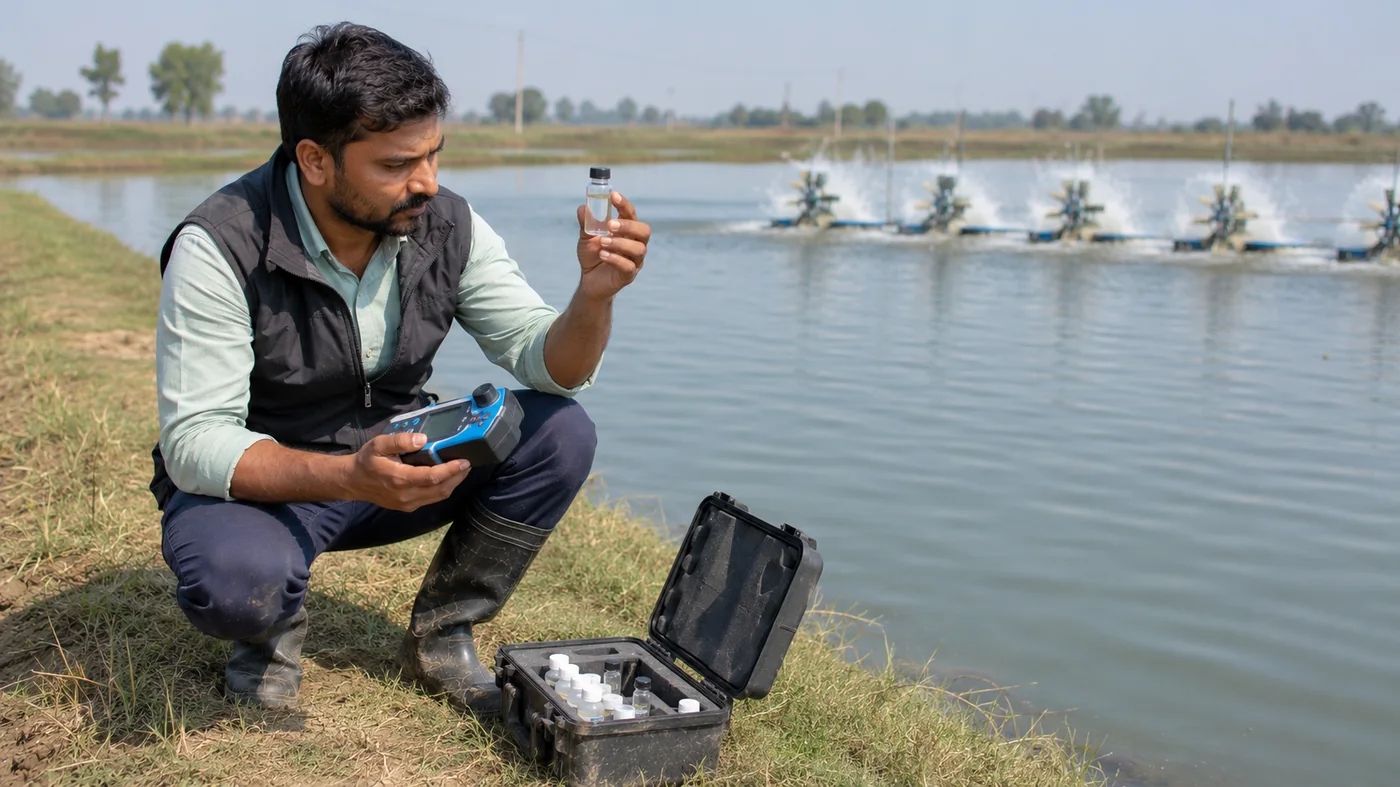
Never stock post-larvae into inland borewell ponds based solely on refractometer readings. Send a 1-liter water sample to a certified laboratory for Inductively Coupled Plasma (ICP) spectroscopy or test on-site with a photometer to measure exact parts-per-million of K+, Mg2+, and Ca2+ prior to seed ordering.
2. The Golden Ionic Ratios: Seawater Equivalents vs. Low-Salinity Multipliers
In standard seawater diluted with pure distilled water, ion concentrations diminish proportionally with salinity:
- Normal Seawater (35 ppt): Sodium (Na+) ~10,770 ppm; Magnesium (Mg2+) ~1,290 ppm; Calcium (Ca2+) ~412 ppm; Potassium (K+) ~380 ppm; Chloride (Cl-) ~19,350 ppm; Sulfate (SO42-) ~2,710 ppm.
- The Seawater Ratio Benchmark: In seawater, the Na:K ratio is approximately 28:1; the Mg:Ca ratio is approximately 3.1:1; and the Ca:K ratio is approximately 1.1:1.
- Why Linear Dilution Fails at Low Salinity: In high-salinity water (25–35 ppt), shrimp can easily extract ions because ambient concentrations are abundant. But at low salinities (0.5 to 5.0 ppt), the concentration gradient across the gill membrane is extremely steep. Under these physiologically demanding conditions, simply providing the mathematical seawater dilution equivalent is inadequate. Shrimp require higher relative concentrations of Potassium and Magnesium per unit of salinity than in natural seawater to drive active transport kinetics.
- The Low-Salinity Multiplication Rule: Potassium Target: Minimum 30 to 35 ppm of K+ for every 1.0 ppt of salinity (e.g., in a 3.0 ppt pond, maintain K+ at >90 to 105 ppm, rather than the seawater dilution of only 32 ppm). Magnesium Target: Minimum 90 to 120 ppm of Mg2+ for every 1.0 ppt of salinity (e.g., in a 3.0 ppt pond, maintain Mg2+ at >270 to 360 ppm, rather than the seawater dilution of 110 ppm). Calcium Target: Maintain Ca2+ at 30 to 45 ppm per ppt salinity. Mg:Ca Ratio: Never allow the Mg:Ca ratio to fall below 3:1. If calcium exceeds magnesium, calcification pathways are disrupted.
| Water Salinity (ppt) | Natural Seawater Dilution K+ (ppm) | Target Fortified K+ (ppm) | Natural Seawater Dilution Mg2+ (ppm) | Target Fortified Mg2+ (ppm) | Target Ca2+ (ppm) | Target Alkalinity (ppm CaCO3) | Key Commercial Mineral Dosing / Ha-m |
|---|---|---|---|---|---|---|---|
| 1.0 ppt | 11 ppm | 35 – 45 ppm | 37 ppm | 110 – 140 ppm | 40 – 50 ppm | > 100 ppm | KCl ~600 kg, MgCl2 ~1,000 kg, NaHCO3 ~250 kg |
| 2.0 ppt | 22 ppm | 65 – 80 ppm | 74 ppm | 200 – 250 ppm | 70 – 90 ppm | > 110 ppm | KCl ~1,000 kg, MgCl2 ~1,800 kg, NaHCO3 ~300 kg |
| 3.0 ppt | 33 ppm | 95 – 115 ppm | 111 ppm | 300 – 360 ppm | 100 – 120 ppm | > 120 ppm | KCl ~1,400 kg, MgCl2 ~2,500 kg, NaHCO3 ~350 kg |
| 5.0 ppt | 54 ppm | 150 – 180 ppm | 184 ppm | 480 – 550 ppm | 150 – 180 ppm | > 130 ppm | KCl ~2,000 kg, MgCl2 ~3,800 kg, NaHCO3 ~400 kg |
| 10.0 ppt | 108 ppm | 220 – 260 ppm | 368 ppm | 750 – 850 ppm | 220 – 260 ppm | > 140 ppm | KCl ~2,200 kg, MgCl2 ~4,500 kg, NaHCO3 ~400 kg |
| 35.0 ppt (Ocean) | 380 ppm | 380 ppm (Natural) | 1,290 ppm | 1,290 ppm (Natural) | 412 ppm | 120 – 150 ppm | Natural ocean equilibrium (No fortification) |
In low-salinity culture, always monitor the Na:K ratio. If the Na:K ratio exceeds 35:1 or 40:1, excessive sodium competes with potassium at branchial receptor sites, impairing muscle nerve conduction. Add Potassium Chloride to bring the ratio back down below 30:1.
3. Potassium (K+) Fortification: Preventing Muscle Cramp & Ecdysis Collapse
Potassium (K+) is the single most critical and most frequently deficient cation in inland aquaculture:
- Diagnosing Potassium Deficiency: Shrimp exhibiting potassium deficit show cloudy, milky-white discoloration in the abdominal musculature (frequently misdiagnosed as viral Infectious Myonecrosis Virus / IMNV), rigid curved tails ('cramped tail syndrome'), and high mortality during molting. When held in a hand basin, affected shrimp cannot straighten their tails.
- Chemical Sourcing: Technical-grade Muriate of Potash (Potassium Chloride, KCl; containing 50% to 52% elemental Potassium) or Potassium Sulfate (K2SO4; containing 41% to 43% elemental Potassium). KCl is vastly preferred due to its high aqueous solubility and the beneficial addition of chloride ions.
- Stoichiometric Water Fortification Formula: To calculate the required dosing of Potassium Chloride (KCl) for a pond: Required KCl (kg) = [(Target K+ ppm - Current K+ ppm) × Pond Water Volume (m³) × 1.91] / 1,000. Where 1.91 is the molecular weight conversion factor for KCl (74.55 g/mol KCl / 39.10 g/mol K = 1.906).
Example: For a 1.0-hectare pond (10,000 m³ volume at 1.0 m depth) with a current K+ of 15 ppm and a target K+ of 90 ppm: Deficit = 90 - 15 = 75 ppm. Required KCl = (75 × 10,000 × 1.91) / 1,000 = 1,432.5 kg of commercial Potassium Chloride.
Never dump dry Potassium Chloride fertilizer directly into pond water. Pre-dissolve KCl in 200L plastic drums with pond water, decant to leave any insoluble clay filler behind, and broadcast the concentrated solution across paddlewheel aerator wakes at 06:00 AM for rapid distribution.
4. Magnesium & Calcium Equilibrium: The Exoskeleton Hardening Matrix
While Calcium (Ca2+) is the structural building block of the shrimp cuticle, Magnesium (Mg2+) is the biological master regulator that controls calcium precipitation and enzymatic hardening:
- The Danger of High Calcium / Low Magnesium: Most inland borewell waters in northern India are rich in dissolved calcium (derived from subterranean limestone and gypsum deposits) but virtually devoid of magnesium. If Ca2+ exceeds Mg2+ (ratio < 1:1), calcium precipitates prematurely as insoluble calcium carbonate inside the cuticular matrix, causing brittle shells, deformed appendages, and incomplete ecdysis.
- Chemical Sourcing: 1. Magnesium Chloride Hexahydrate Flakes (MgCl2·6H2O; containing ~11.8% to 12.0% elemental Magnesium). Highly soluble, rapidly releasing free Mg2+ and Cl- ions. 2. Epsom Salt / Magnesium Sulfate Heptahydrate (MgSO4·7H2O; containing ~9.8% elemental Magnesium). Slower dissolution and increases sulfate concentration.
- Dosing Formula for Magnesium: Required MgCl2·6H2O (kg) = [(Target Mg2+ ppm - Current Mg2+ ppm) × Pond Water Volume (m³) × 8.33] / 1,000. Where 8.33 is the molecular weight conversion factor (203.3 g/mol MgCl2·6H2O / 24.31 g/mol Mg = 8.36).
If your borewell water has excessive calcium (>200 ppm) at 2 ppt salinity, do not add agricultural lime or gypsum. Instead, focus exclusively on dosing Magnesium Chloride to drive magnesium up to 600 ppm, establishing the required 3:1 Mg:Ca ratio.
5. Dual-Route Delivery: Feed Top-Dressing & Dietary Mineral Chelates
In low-salinity systems, relying exclusively on water-column chemical dosing is an expensive and incomplete strategy. Shrimp gills absorb ions continuously, but during rapid growth and ecdysis, dietary gut absorption provides a direct, highly efficient pathway to replenish cellular mineral reserves:
- Chelated Organic Minerals: Supplement commercial shrimp feeds with organic mineral chelates (amino acid chelates such as Potassium Proteinate and Magnesium Glycinate) which exhibit 3 to 4 times higher bioavailability across the crustacean hepatopancreas and gut lining compared to inorganic salts.
- Feed Top-Dressing SOP: Technical Potassium Chloride (KCl): 5.0 to 8.0 grams per kg of feed. Magnesium Chloride or Aspartate: 5.0 to 10.0 grams per kg of feed. Soya Lecithin / Fish Oil Binder: 15 to 20 mL per kg of feed to coat and waterproof the pellets, preventing rapid mineral leaching in the water column before ingestion.
- Pre-Molt Fortification: Administer mineral-fortified rations continuously, with a 50% dosage increase initiated 48 hours prior to anticipated new moon and full moon tidal molting peaks.
Always use a high-quality lipid binder (marine fish oil or soya lecithin) when top-dressing minerals. Water-soluble mineral salts like KCl leach out into pond water within 10 minutes of broadcast if unbound; lipid coating retains minerals inside the pellet until ingested by shrimp.
6. Post-Larvae Acclimation Blueprint: Step-Down Salinity SOP
Hatcheries produce post-larvae in full-strength coastal seawater (28 to 32 ppt). Transporting PL directly into a 2.0 ppt inland pond will kill 100% of the cohort from osmotic shock:
- Hatchery Acclimation: Require the seed hatchery to gradually step down salinity from 30 ppt to 12–15 ppt over a 4-day period prior to packing.
- On-Farm Step-Down Protocol: Upon arrival at the inland farm, transfer PL into biosecure indoor nursery tanks or lined hapa chambers maintained at the transport bag salinity (12–15 ppt). Gradually drip-feed pre-conditioned, mineral-fortified pond water at a strict step-down rate not exceeding 1.0 to 1.5 ppt every 6 hours. The transition from 15 ppt down to 2 ppt must span at least 48 to 72 hours.
- The 2-Hour Freshwater Stress Test: Prior to pond release, test 100 post-larvae in a bucket containing 50% pond water and 50% freshwater for 2 hours, followed by return to pond water. If survival exceeds 95%, the cohort is fully acclimated and osmoregulatorily competent for stocking.
Never accept post-larvae younger than PL12 for low-salinity stocking. Early post-larvae (PL8–PL10) possess immature branchial gill filaments and lower concentrations of Na+/K+-ATPase enzyme, making them incapable of surviving severe hyper-osmoregulation.
7. Routine Field Testing, Digital Ion Loggers & Inland Economics
Inland low-salinity aquaculture demands rigorous monitoring to sustain profitability:
- Routine Field Testing: Test potassium, magnesium, and calcium weekly. In fast-growing crops, shrimp biomass bio-accumulates ions rapidly from the water column, causing ambient concentrations to deplete over time. Dose top-up mineral rations (KCl @ 25 kg/ha, MgCl2 @ 50 kg/ha) bi-weekly to replace biological depletion.
- Alkalinity Stabilization: Maintain total alkalinity above 120 ppm as CaCO3. In low-salinity waters with soft carbonate profiles, dose Sodium Bicarbonate (NaHCO3) @ 20 to 30 kg/ha weekly to buffer water pH between 7.6 and 8.2.
- Inland Farming Economics: Despite mineral fortification costs (averaging ₹45,000 to ₹65,000 per hectare per crop), inland farmers enjoy immense financial advantages: zero land lease costs compared to coastal estates, biosecurity isolation from coastal viral epidemics, and proximity to major inland urban consumption markets (Delhi NCR, Ludhiana, Chandigarh) that pay a ₹40 to ₹60/kg premium for fresh farmgate harvest.
Log your weekly mineral test results directly in the AquaSangham app. The built-in Low Salinity Calculator automatically calculates exact commercial chemical bag requirements based on pond area, depth, and target ion ratios.
Summary Operational Action Checklist
Frequently Asked Questions
Q: Why can Penaeus vannamei die of mineral deficiency in 3 ppt water even if salinity is stable?
Salinity measures total dissolved salts, but does not indicate which specific ions are present. A pond water reading 3 ppt on a refractometer might be high in sodium and sulfates but completely devoid of Potassium (K+) and Magnesium (Mg2+). In low-salinity environments, the shrimp's internal body fluid is hyper-osmotic relative to the pond, forcing its cells to actively pump ions inward across gill membranes using the enzyme Na+/K+-ATPase. This enzyme requires specific dissolved concentrations of K+ and Mg2+ to hydrolyze ATP and function. Without these ions, the shrimp's cellular pumps fail, causing severe osmotic shock, white muscle necrosis, tail cramping, and mass mortality during molting.
Q: What are the visual clinical symptoms of Potassium (K+) deficiency in low-salinity shrimp?
Potassium deficiency manifests through distinct physical signs: 1) Idiopathic Muscle Necrosis: The abdominal tail muscles become cloudy, milky-white, and opaque, starting from the tail fan and moving forward, 2) Cramped Tail Syndrome: The tail curls rigidly beneath the body and the shrimp cannot straighten it even when placed in water, 3) Incomplete Ecdysis (Molt Death): Shrimp lack the osmotic pressure to cast off their old cuticles, becoming trapped and dying with shed exoskeletons stuck to their heads or walking legs, and 4) Soft Shells: The newly molted cuticle remains limp and rubbery, failing to harden within 12 hours.
Q: Why should farmers choose Magnesium Chloride (MgCl2) over Epsom Salt (MgSO4) in inland aquaculture?
Magnesium Chloride Hexahydrate Flakes (MgCl2·6H2O) contain approximately 11.8% to 12.0% elemental magnesium and dissolve almost instantaneously in water, rapidly delivering free bioavailable Mg2+ and Cl- ions. Epsom Salt (Magnesium Sulfate Heptahydrate, MgSO4·7H2O) contains only 9.8% magnesium and adds large quantities of sulfate ions (SO42-). Most inland borewell aquifers already contain elevated sulfate levels; adding more sulfate can lead to anaerobic hydrogen sulfide (H2S) generation in the pond bed. Furthermore, chloride ions (from MgCl2) play a crucial protective role in reducing nitrite toxicity across shrimp gills.
Q: How does dietary mineral top-dressing complement water-column mineral dosing?
While branchial gill cells absorb dissolved ions from the water column, this process consumes significant metabolic energy in low-salinity environments. Dietary supplementation provides an immediate, energy-efficient absorption pathway through the gut enterocytes and hepatopancreas. Top-dressing feeds with organic potassium and magnesium chelates bound with fish oil or lecithin ensures that minerals enter the hemolymph directly during digestion, replenishing intracellular mineral reserves rapidly—especially during critical 48-hour periods before and after ecdysis (molting).
Q: How should post-larvae be safely acclimated from coastal hatchery salinity (30 ppt) to inland pond water (2 ppt)?
Acclimation must occur in two structured phases: 1) Hatchery Phase: Request the seed supplier to gradually lower salinity from 30 ppt down to 12–15 ppt over 3 to 4 days prior to packaging, and 2) On-Farm Phase: Stock the PL upon arrival into aerated nursery tanks maintained at 12–15 ppt. Gradually drip pre-conditioned, mineral-fortified pond water into the nursery tanks at a rate that reduces salinity by no more than 1.0 to 1.5 ppt every 6 hours over a 48 to 72-hour window. Prior to pond stocking, perform a 2-hour stress test with 50% freshwater; if survival exceeds 95%, release the post-larvae.
AquaSangham Technical Advisory
Aquatic Chemistry & Low-Salinity Physiology Desk
Contributing Senior Technical Writer & Aqua Consultant at AquaSangham.
Recommended Farming Guides
Total Ammonia Nitrogen (TAN) Mass Balance Math: Sizing Biofilters in Commercial RAS
Read Article →Farming TechThe Recirculating Aquaculture System (RAS) Master Guide: Design, Hydraulics & Mass Balance
Read Article →Farming TechIndigenous Magur (Clarias batrachus) Induced Breeding & Nursery Rearing SOPs
Read Article →Get Live Farm Advice on AquaSangham Mobile App
Download India's #1 Aquaculture Super App for real-time market prices, precision tools, and community advice.
Download Free Android App