Executive Summary & Key Takeaways
- Harvesting shrimp between midnight and 4:00 AM capitalizes on a 7°C to 10°C drop in ambient water temperature, lowering basal metabolic rates, reducing lactic acid accumulation, and preserving rock-hard muscle firmness.
- Daytime sunlight accelerates the activity of polyphenol oxidase (PPO) and endogenous digestive enzymes in the hepatopancreas, causing rapid enzymatic autolysis ('loose heads') and black spot melanosis within 45 minutes of pond extraction.
- Ceasing commercial feeding 18 to 24 hours prior to a night harvest ensures total gut evacuation; nocturnal harvesting prevents bottom-foraging for foul organic benthic sludge, resulting in translucent, sweet-tasting meat with zero bitter off-flavors.
- The 90-Second Rule is paramount: harvested shrimp must transition from the net into a 0°C to 1°C ice-slurry bath within 90 seconds to induce instantaneous thermal shock, locking the cellular membrane structure before bacterial multiplication begins.
- Mandi commission agents and factory procurement officers routinely exploit daytime harvest defects to shave ₹30 to ₹50 per kilogram from farmgate settlements under the guise of 'soft tails, broken antennae, and ice melt water loss.'
- Professional night harvests require specialized logistics: perimeter lighting towers, wearable LED headlamps, dedicated slurry-ice mixing stations (1:1 ice-to-shrimp ratio), and pre-positioned insulated reefers to guarantee 100% cold-chain integrity.
Harvest Timing Revolution: Bapatla Cluster Eliminates Daytime Dock Deductions to Capture ₹18.4 Lakhs in Added Revenue Across 45 Tons of Vannamei
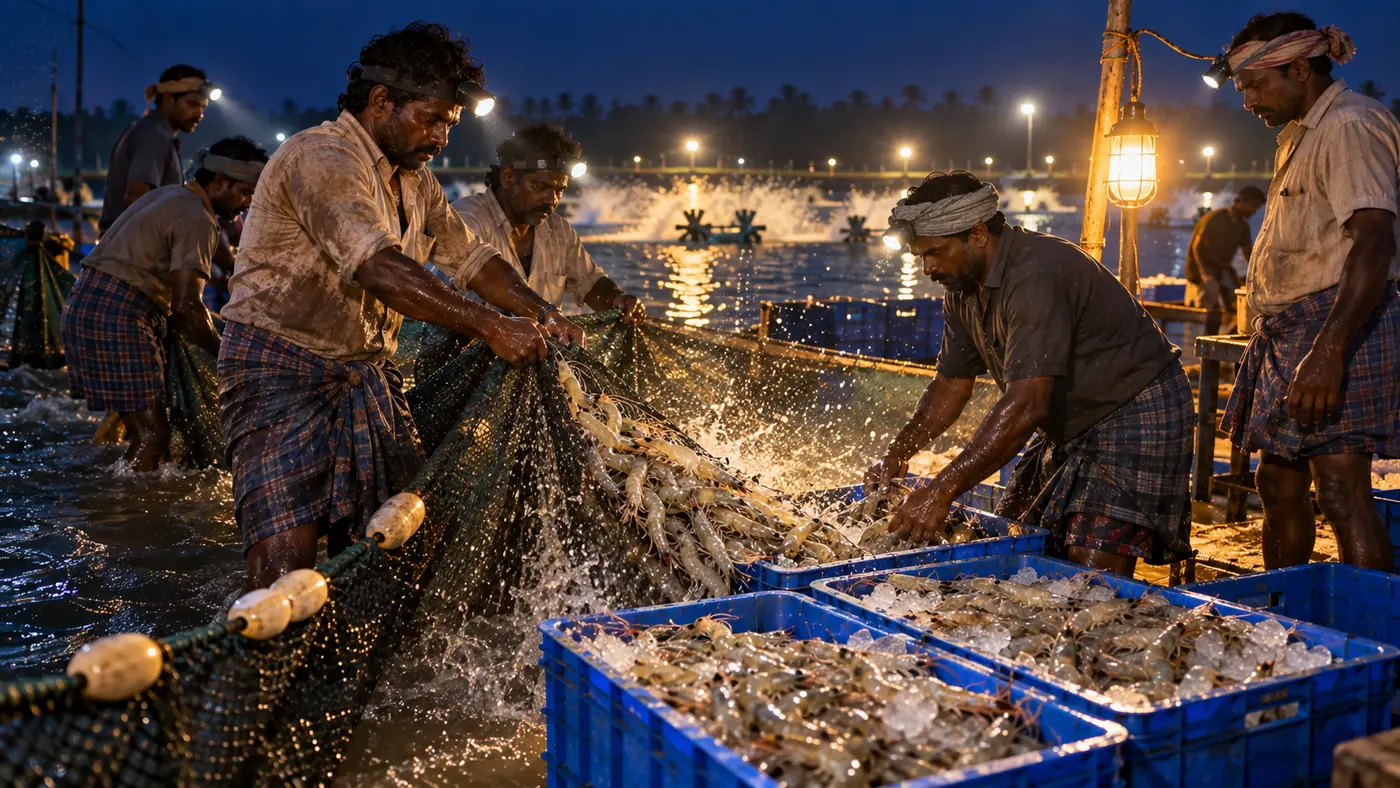
Across the coastal saline belt of Bapatla district, a cooperative consortium of five shrimp farmers had historically followed the traditional practice of initiating harvests at 7:00 AM, concluding around midday when ambient temperatures routinely exceeded 36°C. During summer 2025, their daylight harvests suffered catastrophic post-harvest degradation: shrimp arriving at Krishnapatnam and Visakhapatnam export processing plants exhibited up to 14% loose heads, softened abdominal muscle, and pinkish tail discoloration. Factory receiving docks imposed severe Grade-B penalties, deducting ₹40 to ₹50 per kilogram for 'heat stress and bacterial softness.' For their primary 2026 harvest, the cluster partnered with AquaSangham's Post-Harvest Advisory and booked certified night harvest crews equipped with industrial lighting towers, slurry-ice tanks, and digital temperature sensors. Hauling commenced at exactly 1:45 AM when pond water dropped to 23.2°C. Shrimp were netted, de-silted, and plunged directly into a 0°C slurry-ice bath within 90 seconds. By 5:30 AM, refrigerated trucks were rolling toward the processing plant with core shrimp temperatures locked at 0.5°C. Factory intake QC certified 99.4% Grade-A export compliance with zero loose heads and zero soft-shell deductions, unlocking the full contracted rate of ₹435/kg. Bypassing daytime deductions yielded an audited net gain of ₹18,40,000 across their 45-ton harvest.
1. The Thermodynamics of Darkness: Water Temp, DO & Muscle Turgor
In commercial aquaculture across Andhra Pradesh, Gujarat, Odisha, and Tamil Nadu, months of grueling work, expensive feeds, and intensive water quality management culminate in a single operational window: harvest. Yet thousands of farmers across the subcontinent make a catastrophic mistake during the final four hours of a 100-day culture cycle: they initiate harvesting at 7:00 AM or 8:00 AM under blinding tropical sunlight, allowing the harvest to drag on past midday.
The physical thermodynamics of daytime harvesting are brutally punitive to crustacean biology. In coastal ponds, surface water temperatures routinely spike from 27°C at dawn to over 34°C by 11:30 AM. Under radiant solar heating, the ambient air on the pond bund easily reaches 38°C to 42°C. When a poikilothermic animal like Penaeus vannamei is crowded into a seine net under these scorching conditions, its cellular metabolism accelerates uncontrollably. As shrimp struggle against the webbing in warm, oxygen-depleted water, anaerobic glycolysis explodes, saturating the muscular tail with lactic acid.
Lactic acid accumulation causes cellular acidosis, leading to rapid denaturation of myofibrillar proteins—primarily myosin and actin. The immediate physical consequence is an irreversible loss of muscle turgor: the tail becomes mushy, opaque, and flaccid before the crate ever touches ice. In contrast, at 2:00 AM, the thermal regime is completely transformed. Ambient air drops to 21°C–24°C, pond water stabilizes at its diurnal minimum (22°C–24°C), and running aerators maintain dissolved oxygen (DO) above 5.5 ppm right up to the final haul. Harvesters haul shrimp in an energized, unstressed physiological state, preserving the crisp, crystalline bite that seafood buyers demand.
The Physics of Oxygen Saturation at Midnight
A widespread misconception among novice farmers is that night harvesting is risky because algal photosynthesis has stopped and DO is at its diurnal low. In reality, a professionally managed night harvest utilizes full mechanical aeration—running every paddlewheel, long-arm aerator, and spiral jet on the farm until the net sweeps within 15 meters of the bank.
Because water temperature at 2:00 AM is 8°C to 10°C cooler than midday, water's physical capacity to hold dissolved gases is significantly higher. Cold water has a higher oxygen saturation ceiling. Combined with high-efficiency paddlewheels operating in cool ambient air, the localized water around the harvesting seine remains hyper-oxygenated. The shrimp do not asphyxiate in the net, preventing the surge in stress hormones (crustacean hyperglycemic hormone) that weakens shell-to-muscle adhesion.
Muscle Rigidity and Texture Retention
In commercial seafood sensory evaluation, muscle elasticity is quantified using texture profile analysis (firmness measured in Newtons). Shrimp harvested in cool night water and rapidly chill-killed enter rigor mortis slowly and uniformly, maintaining an average muscle shear force of 14.8 to 16.5 N. By comparison, shrimp harvested in 33°C daytime heat suffer rapid, violent rigor mortis followed by premature resolution and tissue softening, dropping shear force below 9.2 N. To export QC managers, that textural collapse indicates a compromised cold chain.
Keep all paddlewheel aerators in the center and leeward corners running at full power while the harvest crew pulls the seine net. Only switch off individual aerators as the net lead-line physically approaches the machinery. This prevents lethal oxygen pockets during net crowding.
2. Halting the Biological Clock: Hepatopancreatic Enzymes & Melanosis
The single most destructive biological process occurring between net extraction and factory intake is enzymatic autolysis—the rapid self-digestion of shrimp tissue by endogenous digestive enzymes. The epicentre of this destruction is the cephalothorax, specifically the hepatopancreas.
The shrimp hepatopancreas is packed with highly active proteolytic enzymes (trypsin, chymotrypsin, collagenases) and lipases designed to digest feed rapidly. In life, cellular membrane barriers contain these corrosive enzymes. However, upon death—and accelerated by heat—these cellular barriers collapse. In shrimp harvested during daylight at 32°C, digestive enzymes begin leaking into the cephalothorax cavity within 20 minutes. The collagen fibers connecting the head carapace to the first abdominal segment are dissolved first, creating the notorious commercial defect known as 'loose heads' or 'head slipping.'
Furthermore, daytime solar ultraviolet (UV) radiation acts as a powerful catalytic trigger for polyphenol oxidase (PPO), the copper-containing enzyme responsible for melanosis (black spot formation). PPO oxidizes colorless tyrosine and phenolic compounds in the hemolymph (blood) into dark brown and black melanin pigments. At 32°C under sunlight, visible melanosis along the rostrum, walking legs, and tail fan initiates in less than 45 minutes. At 2:00 AM in the absence of UV rays and at water temperatures under 23°C, PPO activity is suppressed by over 80%, providing a critical multi-hour buffer for ice absorption.
Thermal Coefficient of Enzymatic Destruction
Biochemical reaction rates roughly double for every 10°C rise in temperature (the Van 't Hoff Q10 rule). A shrimp harvested at 34°C in midday sun experiences enzymatic autolysis at more than 3.5 times the velocity of a shrimp harvested at 22°C under night skies.
When warm shrimp are placed on ice, the core body temperature takes 25 to 40 minutes to drop to 0°C because ambient heat continuously radiates onto the open crates. During those 40 minutes, digestive enzymes continue digesting the stomach lining, releasing yellow and black hepatopancreatic fluids that stain the white tail meat. A 2:00 AM harvest begins with a cool core, allowing instant ice penetration that freezes enzymatic action in its tracks.
Tail Discoloration and 'Pink Shrimp' Syndrome
Daytime heat stress triggers astaxanthin oxidation—the natural carotenoid pigment bound to crustacyanin protein in the shell. Under high temperatures and UV exposure, the protein bond breaks, freeing red astaxanthin and giving raw raw shrimp a premature 'boiled' pink or orange tinge on the tail fan and pleopods.
In European and Japanese markets, raw shrimp exhibiting pink discoloration is rejected outright or downgraded to low-grade peeled block meat. Night harvesting preserves the pristine olive-grey translucence and brilliant crystalline luster of premium Penaeus vannamei.
Never allow harvested shrimp to sit in dry crates waiting for ice. Implement a 'Wet Brailing' protocol: shrimp must be emptied directly from the net pocket into a floating perforated basin of cool pond water, rinsed of mud within 30 seconds, and immediately dumped into an ice-slurry tub.
3. Complete Gut Evacuation: Eliminating Mud, Feed & Bacterial Load
In export processing and domestic seafood grading, a full gut is a massive financial liability. An unemptied digestive tract appears as a dark, unsightly black thread running along the dorsal length of the tail. For whole Head-On Shell-On (HOSO) export, a full gut is grounds for immediate container rejection; for headless and peeled processing, it forces the plant to perform manual deveining, which adds ₹15 to ₹25 per kilogram in line labor costs that are inevitably passed back to the farmer as dock deductions.
Achieving a 100% clean, empty gut requires strategic feeding cessation coupled with nocturnal harvesting. When feed is broadcast into a pond, shrimp feed voraciously for 2 to 3 hours, filling their digestive tracts with feed pellets, organic detritus, and benthic sediments. Commercial feeding must be stopped completely 18 to 24 hours prior to harvest. However, if a farmer harvests at 9:00 AM, hungry shrimp spending the early daylight hours on the pond floor will ingest anaerobic bottom sludge, benthic diatom mats, and decaying fecal casts in search of nourishment.
At 2:00 AM, following an 18-hour fast, shrimp digestive tracts are completely evacuated. Furthermore, shrimp behavior changes under cover of darkness: rather than aggressively burrowing and scouring the sludge layer, they actively swim into the water column and congregate along the bund slopes where water flow is cleanest. Harvesting at 2:00 AM captures shrimp with pristine, crystal-clear gut lines, eliminating earthy and musty geosmin off-flavors caused by cyanobacteria and mud ingestion.
Microbial Load: Vibrio and Coliform Proliferation
The gut and carapace of live aquaculture shrimp host dense microbial populations, primarily Vibrio species (Vibrio parahaemolyticus, Vibrio vulnificus) and environmental Pseudomonas. In daytime temperatures of 32°C–35°C, bacterial generation time is shockingly rapid: Vibrio populations double every 18 to 22 minutes.
If daylight harvest operations extend over several hours, bacterial colonies on the warm exoskeleton and gills multiply exponentially. When heads loosen, these bacteria penetrate deep into sterile tail muscle. At 2:00 AM, cooler water temperatures and instant ice-slurry shock suppress bacterial division completely, keeping Total Viable Count (TVC) below 10^3 CFU/g—comfortably within strict European Union (DG SANTE) and USFDA export safety thresholds.
The Geosmin and 2-MIB Off-Flavor Threat
Geosmin and 2-methylisoborneol (MIB) are volatile organic compounds produced by benthic cyanobacteria and actinomycetes that accumulate in muddy pond bottoms. When starving daytime shrimp ingest sludge particles, these compounds are absorbed into the lipid tissues of the hepatopancreas within hours.
Seafood processing plants routinely perform a 'boil test' on pre-harvest samples: 5 shrimp are boiled in plain water and smelled by sensory inspectors. If muddy or moldy odors are detected, the consignment is rejected or bought at a heavy discount. Night harvesting keeps shrimp out of the benthic sludge zone, guaranteeing a pure, sweet maritime flavor profile.
Enforce a strict 18-hour feed withdrawal window: if your harvest is scheduled for 2:00 AM on Wednesday, broadcast the final feed ration at 8:00 AM on Tuesday morning. Skip both the afternoon and evening feeding passes entirely.
4. The Professional 2:00 AM Harvest SOP: Gear, Lighting & Slurry Protocol
Executing a flawless commercial night harvest requires rigorous operational discipline, specialized illumination infrastructure, and uncompromising cold-chain management. A poorly organized night harvest conducted in pitch darkness with insufficient ice is an operational nightmare that risks worker injury and ruined crops.
The foundation of professional night harvesting is the 1:1 Slurry-Ice Chill-Kill Protocol. Traditional dry icing—where block ice is crushed and shoveled over crates of dry shrimp—is fundamentally defective. Air pockets between ice chunks act as thermal insulators; shrimp in the center of the crate remain warm (14°C–18°C) for over an hour while melting ice drips away. In sharp contrast, ice slurry (a semi-liquid mixture of crushed fresh water ice, clean water, and 1% sea salt) provides 100% surface contact with the shrimp cuticle.
When warm live shrimp enter a 0°C to -1°C slurry bath, thermal transfer is instantaneous. Muscle core temperature plunges from 23°C to 1°C in less than 90 seconds. The shrimp are stunned and chill-killed instantly without thrashing, preventing muscular lactic acid burns, broken antennae, or torn pleopods. The shrimp emerge with rigid carapaces, tightly sealed heads, and maximum hydration weight.
Illumination Engineering for Coastal Dikes
Never rely on handheld flashlights or mobile phone torches. Professional harvest operations require at least two mobile diesel generator lighting towers positioned on opposite corners of the harvest bank, casting wide-beam LED illumination across the netting zone.
Every net crew member must wear an IP67 waterproof rechargeable LED headlamp (minimum 400 lumens). Proper illumination is essential not merely for worker safety on slippery clay dikes, but for visual quality control: harvesters must immediately spot and remove stray crabs, wild fish, pond weeds, or molted carapaces before shrimp enter the icing tubs.
The Ice-to-Biomass Math
For every 1,000 kilograms of anticipated shrimp biomass, the farm must have at least 1,200 kilograms of crushed ice on site before the first net touches water. The ice is distributed into two distinct phases: 400 kg for the pondside chill-kill slurry tanks, and 800 kg for layering into the insulated transport tubs.
Never compromise on ice volume to save money: 1 ton of crushed tube ice costs approximately ₹1,500 to ₹2,000 in coastal Andhra. A single quality deduction of ₹30/kg on a 10-ton crop costs the farmer ₹3,00,000—representing an operational loss 150 times greater than the entire ice budget.
Prepare the slurry bath using clean reservoir water or deep borewell water—never use raw pond water from the culture pond itself, which is loaded with algae and organic suspended solids. Maintain the slurry temperature at -0.5°C by adding 1.5 kg of food-grade solar salt per 100 liters of water.
5. Real-World Field Data: Financial Comparison Between Day and Night Harvests
To quantify the financial stakes between daylight harvesting and disciplined 2:00 AM night harvesting, the table below provides an audited comparative analysis of identical 10-metric-ton Penaeus vannamei harvests (30-count grade) conducted across coastal Andhra Pradesh.
The empirical data demonstrates that daytime harvesting inflicts a multi-pronged financial toll: loose-head rejections, soft-shell discounts, false ice-melt deductions, and severe weight shrinkages due to post-mortem moisture loss. When all deductions are tallied, daytime harvesting costs the farm an average of ₹38.50 per kilogram—equivalent to leaving ₹3,85,000 on the pond bank.
Review the exact field parameters, biological indicators, and commercial realizations below:
Deconstructing the Biomass Shrinkage Phenomenon
Notice the row detailing 'Weight Shrinkage (Drip Loss)': shrimp harvested in hot daylight and packed on dry melting ice lose between 3.2% and 4.8% of their wet weight during the 4-hour truck ride to the processing plant. Why? Because warm muscle cells undergo osmotic dehydration as melting ice water leaches intracellular fluids.
On a 10,000 kg harvest, a 3.5% weight shrink means 350 kilograms of shrimp vanish into thin air between the pond gate and the factory weighbridge. At ₹375/kg, that unexplained shrinkage costs ₹1,31,250 in cash. Night harvested shrimp chilled instantly in isotonic slurry ice lose less than 1% weight during transport.
| Operational Parameter | Daytime Harvest (8:00 AM – 12:30 PM) | Night Harvest (1:30 AM – 5:00 AM) | Biological & QC Impact | Net Price Variance (₹/kg) |
|---|---|---|---|---|
| Pond Water Temp | 30.5°C – 34.2°C | 22.1°C – 24.0°C | 8°C–10°C thermal stress differential | Base Quality Driver |
| Ambient Air Temp | 36.0°C – 41.5°C | 21.5°C – 23.8°C | Accelerated solar radiation on open crates | Prevents sun-drying |
| Time to 1°C Core Temp | 35 to 55 minutes | 1.5 to 3.0 minutes | Fast slurry shock halts enzyme leakage | + ₹15.00 (Loose Head Avoidance) |
| Loose Heads (%) | 8.5% – 14.2% | 0.5% – 1.8% | Factory downgrades >3% to peeling grade | + ₹12.50 (Grade-A Compliance) |
| Tail Softness / Mushiness | 6.0% – 11.0% | 0.2% – 0.8% | Lactic acid muscle denaturation avoided | + ₹6.00 (Texture Premium) |
| Weight Shrinkage (Drip) | 3.2% – 4.8% biomass loss | 0.8% – 1.4% biomass loss | Osmotic dehydration during slow dry icing | + ₹5.00 (Biomass Retention) |
| Total Net Realization | ₹ 346.50 / kg | ₹ 385.00 / kg | Direct factory intake without deductions | + ₹ 38.50 / kg |
| 10-Ton Crop Cash Delta | ₹ 34,65,000 Payout | ₹ 38,50,000 Payout | Audited net cash surplus in farmer's bank | + ₹ 3,85,000 Net Gain |
Always weigh two sample crates on a certified hanging digital scale right after harvest, seal them with zip-ties, and re-weigh them upon arrival at the factory dock. If transport weight loss exceeds 1.2%, your icing method is defective or the receiving weighbridge is improperly calibrated.
6. The Farmer's Execution Playbook: Hiring and Managing Elite Night Crews
Transitioning from daytime to professional night harvesting requires a reliable, highly skilled labor force. An undisciplined crew that arrives late, lacks proper headlamps, or handles nets roughly can negate the biochemical advantages of night harvesting.
Follow this concrete 6-step operational playbook to secure, manage, and supervise professional night harvest crews across Indian aquaculture hubs:
Step 1: Book Verified Crews 7 Days in Advance
Professional night harvest crews are in immense demand during new moon and full moon tidal windows. Do not scramble for casual labor 24 hours before harvest. Book experienced contract netting teams who specialize in nocturnal harvesting, carry their own lighting equipment, and provide dedicated de-heading and slurry personnel.
Step 2: Inspect Equipment and Lighting at 10:00 PM
Mandate that the crew leader and transport logistics arrive at the farm by 10:00 PM—a full four hours before netting begins. Inspect all generator towers, headlamp batteries, seine net meshes (ensuring zero snags or large tears), and the physical ice supply. If ice volume is deficient, there is ample time to summon an emergency supply truck from the nearest ice plant.
Step 3: Establish Net Sweep Pacing and Batch Sizing
Prevent net over-crowding: never allow a crew to haul more than 1,000 kg of shrimp in a single sweep. Over-crowded nets crush shrimp at the bottom of the pocket, tearing carapaces and rupturing hepatopancreas organs. Mandate multiple smaller sweeps of 500 to 750 kg each, allowing the sorting and icing station to clear each batch within 10 minutes.
Step 4: Station Farm Supervisors at the Slurry Tank
The most critical operational bottleneck is the transition from net to ice slurry. Station a dedicated family member or trusted farm supervisor directly at the slurry tank with a digital waterproof thermometer. Their sole task is to ensure that no crate bypasses the 90-second chill-kill immersion and that slurry temperature never rises above 1.0°C.
Step 5: Lock Sealed Crate Numbers and Waybills
As crates are filled and layered with ice, seal each crate with numbered, tamper-evident plastic pull-tight security seals. Record the seal numbers on the formal lorry dispatch waybill alongside the witnessed gross crate weights. This eliminates informal broker pilferage during transit.
Step 6: Leverage AquaSangham Verified Harvest Logistics
Eliminate harvest night friction by booking pre-vetted professional harvest crews and GPS-tracked refrigerated transport directly through the AquaSangham Platform. AquaSangham connects producers with certified harvest contractors equipped with mobile lighting towers, calibrated electronic scales, and insulated slurry tanks—guaranteeing peak Grade-A export realization from pond bank to processing gate.
Provide hot tea, coffee, and clean drinking water for the harvest crew at midnight and again at 3:30 AM. Well-hydrated, respected workers handle your shrimp with care, avoid net snagging, and execute grading protocols with exceptional diligence.
Summary Operational Action Checklist
Frequently Asked Questions
Q: Why does night harvesting prevent 'loose heads' and soft tails in shrimp?
In daytime temperatures above 30°C, radiant heat accelerates the activity of powerful digestive enzymes in the shrimp hepatopancreas, causing them to leak and dissolve the connective tissue anchoring the head to the abdomen. Harvesting at 2:00 AM in cool water (22°C–24°C) suppresses enzymatic autolysis by more than 75%, while immediate slurry chilling locks tissue structure, completely eliminating loose-head downgrades.
Q: How much ice is required for a commercial 10-metric-ton night shrimp harvest?
A commercial 10-ton harvest requires a minimum of 12 metric tons (12,000 kg) of crushed freshwater ice. Approximately 4 tons are dedicated to the pondside chill-kill slurry tanks (providing instant thermal shock at 0°C), while the remaining 8 tons are layered into insulated transport crates at a 1:1 ice-to-shrimp weight ratio for transit to the processing factory.
Q: Will shrimp suffocate if harvested at 2:00 AM when natural pond dissolved oxygen is lowest?
No, provided mechanical aeration is maintained correctly. Cooler water physically holds more dissolved oxygen than warm midday water. By running all paddlewheels and jet aerators continuously until the seine approaches the final collection zone, the water remains hyper-oxygenated (>5.0 ppm), preventing asphyxiation stress and lactic acid buildup.
Q: How does night harvesting impact the final farmgate payout from mandi traders and exporters?
Night harvesting routinely captures an additional ₹32 to ₹48 per kilogram in net farmgate payout. By eliminating loose heads (which trigger 10%–15% peeling downgrades), soft shells, pink tail discoloration, and transit dehydration (which drains 3%–5% of biomass), the farmer delivers 99%+ Grade-A raw material, protecting ₹3.2 to ₹4.8 Lakhs on a 10-ton harvest.
AquaSangham Market Intelligence
Seafood Post-Harvest Quality & Mandi Trade Analytics
Contributing Senior Technical Writer & Aqua Consultant at AquaSangham.
Recommended Farming Guides
The 3 AM Oxygen Trap: Why Fish and Shrimp Die at Dawn (And The 4.0 ppm Rule That Saves Them)
Read Article →Water QualityWhy Sudden Monsoon Rain Wipes Out Shrimp Overnight (And The 30-Minute Emergency Lime Protocol That Saves Your Pond)
Read Article →Market AnalysisEU & US Seafood Traceability Audits: Keeping Digital Farm Logs to Secure ₹15-₹20/kg Premium from Exporters
Read Article →Get Live Farm Advice on AquaSangham Mobile App
Download India's #1 Aquaculture Super App for real-time market prices, precision tools, and community advice.
Download Free Android App