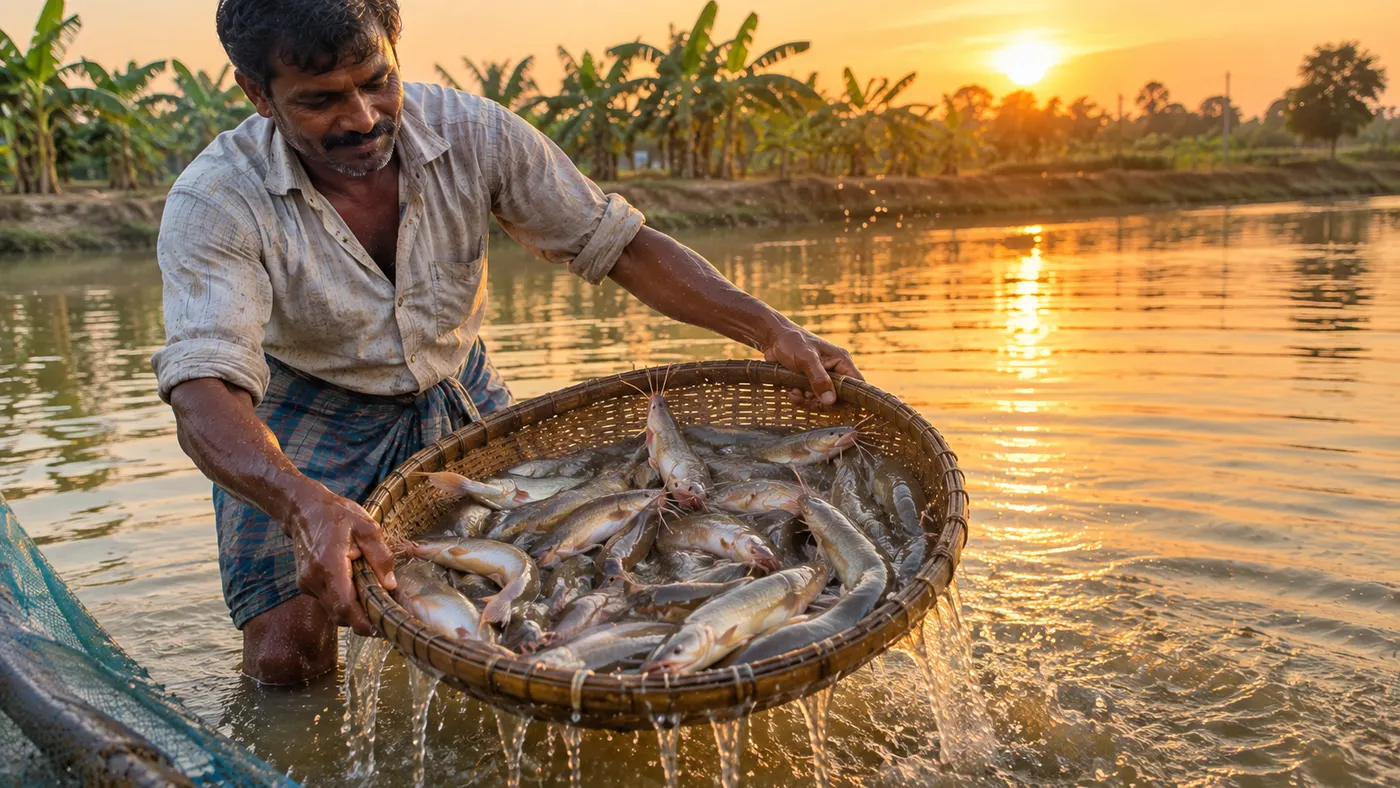
Executive Summary & Key Takeaways
- Pabda catfish (Ompok pabda and Ompok bimaculatus) is one of India's most commercially valuable freshwater table fish, selling at ₹380 to ₹500/kg in Eastern and North-Eastern mandis—nearly 3.5x the price of Indian Major Carps.
- Unlike hyper-carnivorous species (such as Murrel or Seabass requiring 45%–48% CP feed costing ₹120+/kg), Pabda thrives on economical 30%–34% CP commercial sinking or slow-floating extruded feeds costing only ₹65–₹75/kg, resulting in a lean feed cost of under ₹95 per kg of fish produced.
- The culture cycle is exceptionally rapid: stocked fingerlings (10g–15g) reach prime commercial table size (90g–130g, 8 to 11 fish per kg) in just 6 to 7 months, allowing farmers to achieve two harvest cycles per year.
- Early nursery cannibalism is the primary biological hurdle: during the first 25 days, fry exhibit aggressive sibling predation if live zooplankton (Moina micrura, Daphnia, or Tubifex worms) is lacking; intensive live-feed culturing and 4-day grading are mandatory.
- Pabda is a twilight and nocturnal feeder: administering 70% of the daily feed ration after sunset (between 07:00 PM and 08:30 PM) on submerged feeding trays dramatically increases feed intake and eliminates feed wastage.
- Pond water depth should be kept shallow to moderate (1.0 to 1.2 meters); excessive depth (>1.8m) creates cold, stagnant benthic dead zones that suppress Pabda foraging activity.
- A 1-acre intensive monoculture pond stocked at 25,000 to 30,000 fingerlings produces 2,200 to 2,800 kg of table fish in 190 to 210 days, securing an audited net operating profit of ₹6.5 to ₹9.5 Lakhs per crop.
Commercial Freshwater Case Study: Converting a Low-Yield Carp Nursery into a ₹6.85 Lakh Profit Pabda Monoculture
A progressive freshwater fish culturist in North 24 Parganas, West Bengal, previously reared Rohu and Catla fingerlings with stagnant annual earnings of ₹1.2 Lakhs per acre due to oversaturated regional seed supplies. Transitioning to commercial Pabda (Ompok pabda) monoculture, the farmer partnered with AquaSangham freshwater advisory to deploy a three-stage operational protocol: (1) Sourced 32,000 hatchery-produced Pabda fry (2.5 cm) from an ICAR-CIFA accredited private hatchery in Naihati, rearing them in four nursery hapas (6m x 3m x 1.2m) with intensive live Moina cultures cultured in outdoor bio-tanks, eliminating early cannibalism; (2) Weaned fingerlings over 12 days from minced trash fish and tubifex dough onto a 34% crude protein commercial micro-pellet (1.0mm to 1.5mm); (3) Stocked 26,800 graded 15g fingerlings into a 1.0-acre earthen pond (water depth maintained at 1.1m) equipped with two 1.0-HP spiral jet aerators. Feeding was administered strictly during twilight hours (06:00 AM and 07:30 PM) on submerged feeding trays at 3.5% body weight daily. Over 195 days, the fish attained an average harvest weight of 115 grams with an audited survival of 83.2% (2,560 kg total biomass) and an outstanding commercial FCR of 1.28. Marketed live to wholesale fish commission agents at Kolkata's Sealdah and Howrah markets at ₹465/kg, gross revenue reached ₹11.90 Lakhs against total operating expenses of ₹5.05 Lakhs (feed ₹2.42 L, seed fingerlings ₹1.28 L, electricity, labor, and lime ₹1.35 L), securing a record net profit of ₹6.85 Lakhs in under 7 months.
2. Species Taxonomy & Traits: Ompok pabda vs Ompok bimaculatus
To achieve commercial success, a fish culturist must distinguish between the two commercially farmed species of the genus *Ompok* (family Siluridae) indigenous to Indian riverine deltas and wetlands:
1. *Ompok pabda* (True Pabda): Characterized by a laterally compressed, elongated body with a prominent silvery-grey to golden-bronze dorsal coloration, dark mottled blotches along the lateral line, a small dorsal fin, and two pairs of long sensory barbels (the maxillary barbels extending past the pectoral fin base). Ompok pabda is the prized indigenous species of the Bengal delta; it possesses a slightly sweeter flesh profile, higher natural lipid content, and commands a 10% to 15% price premium in Kolkata's Howrah and Sealdah markets.
2. *Ompok bimaculatus* (Butter Catfish / Two-Spot Glass Catfish): Distinguished by a dark, distinct round black spot immediately behind the opercular gill cover and a fainter black spot at the base of the caudal peduncle. Ompok bimaculatus grows slightly faster, exhibits higher tolerance to fluctuating water temperatures, adapts more quickly to artificial pellet feeds, and achieves higher stocking survival in high-density pond culture.
Both species share the prized culinary characteristics that drive consumer demand: the flesh is glistening white, soft, delicate, and practically boneless—containing only a central vertebral spine without any fine intramuscular Y-bones. In traditional Bengali cuisine, Pabda requires minimal cooking time (typically simmered in light mustard or coriander gravy as *Pabda Macher Jhal*), making it a staple of high-end household dining and luxury festival banquets.
Physiologically, Pabda are benthic-pelagic column swimmers. While they lack the accessory suprabranchial air-breathing organs found in Clarias magur or Channa murrel, they possess well-developed vascularized gill filaments that support rapid swimming and feeding in oxygenated water. Maintaining ambient dissolved oxygen above 4.0 mg/L is essential for voracious appetite and high growth rates.
Salinity & Water Hardness Preferences
Pabda is primarily a freshwater silurid, thriving in salinities between 0 ppt and 4 ppt. While it cannot tolerate high marine salinities, it performs exceptionally well in inland freshwater borewell ponds across Andhra Pradesh, Telangana, and coastal West Bengal.
Maintain water pH between 7.4 and 8.2, total alkalinity between 110 and 150 mg/L (as CaCO3), and total hardness above 90 mg/L. Mussels or agricultural lime should be applied periodically to prevent acidic water swings.
Sensory Barbels & Twilight Orientation
Pabda possesses highly sensitive sensory barbels lined with chemoreceptor taste buds and tactile nerve endings. They rely on their barbels to locate feed particles in murky or dark water, making them uniquely adapted to feeding during twilight and night hours.
3. Nursery Cannibalism & Live Feed Mastery: The 25-Day Moina & Tubifex Sizing Strategy
While adult Pabda are docile, peaceful fish that school harmoniously in growout ponds, early-stage Pabda fry (from Day 5 to Day 25 post-hatching, 1.0 cm to 3.5 cm length) exhibit intense, aggressive sibling cannibalism. Newly hatched Pabda larvae possess wide, terminal mouths and sharp pharyngeal teeth. In their natural habitat, they are obligate zooplankton feeders. If live zooplankton densities drop below critical thresholds, fry immediately attack and swallow smaller siblings tail-first.
In unmanaged nursery ponds where farmers broadcast dry flour or commercial starter powders directly into the water, cannibalism mortality exceeds 70% within three weeks. Overcoming this bottleneck requires an intensive **25-Day Two-Tier Live-Feed Nursery Protocol** conducted inside floating fine-mesh nylon hapas (5m x 3m x 1.2m, 0.5mm to 1.0mm knotless mesh):
Phase 1: The Live Moina Bloom (Days 5 to 14): For the first ten days of exogenous feeding, Pabda fry cannot digest artificial dry crumbles. They must be fed live, swimming freshwater zooplankton—specifically the cladoceran *Moina micrura* or *Daphnia pulex*. Commercial farms establish outdoor 500-liter circular tanks fertilized with baker's yeast and fermented poultry manure to produce pure cultures of live Moina. Live Moina is filtered through a 200-micron sieve and fed to the hapas 4 times daily (07:00 AM, 12:00 PM, 05:00 PM, and 10:00 PM). The constant presence of actively swimming live prey satiates the fry, reducing sibling cannibalism by over 90%.
Phase 2: Tubifex Mud Worms & Wet Paste (Days 15 to 25): As fry reach 2.0 cm to 2.5 cm, live *Tubifex* mud worms (thoroughly purged and disinfected in 2 ppm potassium permanganate) are introduced, chopped finely and combined with 20% boiled egg yolk and 20% high-protein starter crumbles. The moist paste is placed on shallow floating plastic plates. Fry congregate in dense schools, gorging on the protein paste.
Mechanical Slot-Grading on Day 12 and Day 22: Every 10 days, technicians lift each hapa and pass the fry through a 3mm and 5mm slot-grading box. Segregating fast-growing shooters into separate hapas prevents them from preying on smaller fry. Following this live-feed and grading protocol guarantees an overall nursery survival rate exceeding **80% to 85%**.
Live Moina Mass Production Recipe
In a 1,000-liter outdoor tank, dissolve 200g baker's yeast, 500g groundnut oil cake slurry, and 100g single superphosphate. Inoculate with 50g of pure Moina seed culture.
Under bright tropical sunlight, the culture explodes into a dense, reddish-brown zooplankton swarm within 96 hours, yielding 2 to 3 kilograms of pure live feed daily for nursery hapas.
Prophylactic Bath Post-Grading
Pass graded fry through a 3-minute bath containing 3 ppt salt (NaCl) and 1 ppm acriflavine to heal minor fin abrasions and prevent Saprolegnia fungal colonization.
4. Low-Cost Growout Nutrition: Transitioning to 32% CP Pellets & Twilight Feeding Schedules
Once fingerlings reach 3.5 cm to 4.5 cm (10g to 15g weight), their digestive physiology shifts from obligate live carnivory to omnivorous benthic-pelagic scavenging. This is the exact moment when the farmer unlocks massive commercial profitability by weaning the cohort onto low-cost commercial aquafeeds.
Extruded Pellet Specifications: While high-priced marine fish feeds contain 45% to 48% crude protein (priced at ₹120+/kg), Pabda produces optimum muscle deposition on **32% to 34% Crude Protein commercial extruded pellets** with 5% to 7% crude fat, costing approximately **₹65 to ₹72 per kilogram**. The feed must be slow-sinking or extruded slow-floating (pellet size 1.2mm for early growout, increasing to 1.8mm and 2.2mm for advanced growout). Hard, fast-sinking compressed pellets should be avoided as they sink into the benthic mud where they dissolve and rot.
The Twilight Feeding Advantage: Pabda are crepuscular and nocturnal by evolutionary design. In bright midday sun, they seek refuge in deeper water or beneath shaded dike berms, exhibiting sluggish feeding behavior. Commercial farmers who broadcast feed at 12:00 PM witness low surface feeding, leading to pellet decomposition and wasted feed.
The winning operational SOP is the **Twilight & Night Feeding Regimen**: partition the daily feed ration into two distinct windows—**30% of daily feed at 06:00 AM (dawn)** and **70% of daily feed at 07:30 PM (twilight / post-sunset)**. When feed is dispensed in the evening, Pabda rise in dense, boiling schools, consuming 100% of the broadcast pellets within 15 minutes with near-zero feed waste. This nocturnal feeding discipline maintains commercial FCR strictly between **1.25 and 1.35** across the entire 7-month growout cycle.
Daily Feeding Rate Progression
Month 1 (15g to 30g fish): Feed 5.0% to 6.0% of standing biomass daily (1.2mm slow-sinking crumbles).
Months 2 to 4 (30g to 75g fish): Feed 4.0% to 4.5% of standing biomass daily (1.8mm slow-floating pellets).
Months 5 to 7 (75g to 120g fish): Feed 2.8% to 3.2% of standing biomass daily (2.2mm pellets); observe checktrays to adjust rations precisely before harvest.
Natural Pond Productivity & Plankton Supplementation
Maintain moderate green water (Secchi disc visibility 30cm to 40cm) by applying 25 kg/acre fermented cow dung slurry and 5 kg single superphosphate bi-weekly. Pabda continuously graze on natural copepods and chironomid midge larvae, reducing reliance on purchased feed.
5. Pond Engineering & Water Quality: Managing Silt, Aeration & Benthic Health
Commercial pond culture of Pabda requires specific environmental parameters that differ substantially from traditional carp ponds.
Optimal Pond Depth (The 1.1-Meter Rule): Rookie farmers often assume that deeper water is always better. In Pabda farming, excessive pond depth (>1.6 meters) is counterproductive. Deep earthen ponds develop thermal and chemical stratification: cold, stagnant, anoxic bottom layers accumulate heavy toxic metabolites, while Pabda prefer grazing in the warm, oxygenated photic zone. The optimal water depth for commercial Pabda growout is strictly **1.0 to 1.2 meters**. Shallow-to-moderate depth allows sunlight to penetrate the entire water column, maintaining healthy benthic diatom films and accelerating metabolic digestion.
Aeration Infrastructure: While Pabda do not require hyper-intensive aeration like vannamei shrimp, high-density culture (25,000 to 30,000 fish/acre) demands nocturnal dissolved oxygen stabilization. Install two 1.0-HP spiral jet or paddlewheel aerators per 1.0-acre pond. Run aerators from **11:00 PM to 05:30 AM** every night. Nighttime aeration creates a gentle circular current that aggregates organic feces into a central drainage zone while ensuring peripheral feeding zones remain saturated with dissolved oxygen (>4.5 ppm).
Benthic Silt Hygiene & Water Exchanges: Because Pabda dwell near the pond bottom during daylight hours, anoxic black mud accumulation triggers severe bacterial whiskers rot and fin erosion (caused by *Aeromonas hydrophila* and *Pseudomonas* spp.). Exchange 10% to 15% of bottom water every 15 to 20 days. Broadcast agricultural dolomite lime (CaMg(CO3)2) @ 80 kg/acre monthly, alternating with commercial soil probiotics (Bacillus subtilis @ 1 kg/acre) to digest organic muck and maintain pristine benthic soil chemistry.
Polyculture Compatibility with Carps & Scampi
Pabda performs exceptionally well in polyculture. A 1-acre pond can be stocked with 20,000 Pabda fingerlings combined with 1,000 Catla (to graze surface zooplankton) and 2,000 freshwater Scampi prawns (Macrobrachium rosenbergii) to scavenge benthic feed wastes.
Avoid stocking predatory murrel, seabass, or aggressive bottom-rooting Common Carp (Cyprinus carpio), which muddy the water column and stress the sensitive catfish.
6. Comprehensive 1-Acre Commercial P&L: Seed Costs, Feed FCR & Net Farmgate Realization
To illustrate the compelling commercial viability of Pabda aquaculture, we present the fully audited financial profit and loss (P&L) statement for a 1.0-acre intensive monoculture pond operating across a 200-day production cycle in India.
The operational model assumes stocking **28,000 weaned, certified 15g fingerlings** in a 1.0-acre earthen pond. Benefiting from structured nursery grading and twilight extruded pellet feeding, survival is benchmarked at **82%**, yielding **22,960 harvestable table fish**. Over 200 days of culture on a 32% crude protein commercial pellet diet with a biological FCR of 1.30, the fish reach an average table weight of **115 grams** (roughly 9 fish per kilogram), producing **2,640 kilograms of prime live Pabda**.
Marketed live to wholesale seafood consolidators serving Kolkata, Siliguri, and Guwahati at an average wholesale farmgate realization of **₹440 per kilogram**, gross harvest revenue reaches **₹11,61,600 (₹11.61 Lakhs)**. Total operational expenditure—including certified seed fingerlings (₹1.40 L), 32% CP commercial feed (₹2.47 L), pond lease, electricity for night aeration, labor, and harvesting logistics (₹1.25 L)—totals **₹5.12 Lakhs**, securing an audited net operating profit of **₹6.49 Lakhs per acre in under 7 months**.
The comparative matrix below benchmarks the commercial unit economics of Pabda against Indigenous Magur, Singhi, and Pangasius catfish across an identical 1-acre farm footprint.
| Commercial Benchmark | Pabda (Ompok pabda) | Indigenous Magur (C. batrachus) | Singhi (H. fossilis) | Pangasius (P. hypophthalmus) |
|---|---|---|---|---|
| Wholesale Farmgate Price | ₹ 380 – ₹ 480 / kg | ₹ 420 – ₹ 550 / kg | ₹ 380 – ₹ 460 / kg | ₹ 85 – ₹ 105 / kg |
| Target Table Size | 100 g – 130 g | 120 g – 160 g | 80 g – 120 g | 1.2 kg – 1.8 kg |
| Culture Cycle Duration | 6 – 7 Months | 8 – 10 Months | 7 – 8 Months | 6 – 7 Months |
| Feed Protein Requirement | 30% – 34% CP (Economical) | 38% – 42% CP (Moderate) | 36% – 40% CP (Moderate) | 26% – 30% CP (Low Cost) |
| Feed Cost / kg Fish Gain | ₹ 82 – ₹ 96 / kg | ₹ 115 – ₹ 135 / kg | ₹ 105 – ₹ 125 / kg | ₹ 55 – ₹ 65 / kg |
| Crops Achievable / Year | 1.8 to 2.0 Crops | 1.0 Crop | 1.2 to 1.4 Crops | 1.8 to 2.0 Crops |
| NET PROFIT PER ACRE | ₹ 6,50,000 – ₹ 9,50,000 | ₹ 5,20,000 – ₹ 7,80,000 | ₹ 4,80,000 – ₹ 6,90,000 | ₹ 1,20,000 – ₹ 1,80,000 |
Pabda prices peak dramatically during the monsoon wedding season and festive winter months (October to January). Align your stocking calendar in February or March to execute your primary harvest in September/October, capturing peak festive demand when wholesale prices surge above ₹500/kg.
7. Operational Field SOP Checklist & Frequently Asked Questions
To achieve the commercial benchmark of 82%+ survival, 1.30 FCR, and ₹7+ Lakhs net profit per acre, farm managers must execute operations with disciplined consistency. Below is the non-negotiable operational checklist for commercial Pabda farming, followed by expert solutions to critical production challenges.
The 6-Rule Field SOP Action Checklist for Pabda Culture
1. 25-Day Moina Nursery Inoculation: Feed live zooplankton (Moina/Daphnia) 4 times daily throughout the first 25 days in hapas to suppress early cannibalism.
2. 10-Day Mechanical Slot-Grading: Pass fry through mechanical slot-graders every 10 days to segregate aggressive shooters into separate cohorts.
3. 32% CP Extruded Pellet Weaning: Wean fingerlings onto 32%–34% CP slow-floating commercial extruded feeds; avoid un-extruded mash feeds.
4. 70% Night Feeding Schedule: Administer 70% of daily feed rations after sunset (07:30 PM) on submerged feeding trays to match nocturnal foraging.
5. 1.1-Meter Water Depth Control: Maintain pond depth strictly between 1.0m and 1.2m; avoid excessive water depth that creates cold, anoxic bottom layers.
6. 1:1 Live Transport in Aerated Water: Transport harvested Pabda live in water-filled plastic tubs with portable battery aerators to capture the full ₹450+/kg live market rate.
Summary Operational Action Checklist
Frequently Asked Questions
Q: Can Pabda be farmed in Biofloc tarpaulin tanks or circular HDPE tanks?
Yes, Pabda adapts well to Biofloc Technology (BFT) in circular HDPE tarpaulin tanks (50,000-liter capacity) at intensive stocking densities of 120 to 150 fingerlings per cubic meter. However, biofloc total suspended solids (TSS) must be kept strictly below 250 mg/L using settling cones; dense bacterial floc clogs Pabda's delicate gill filaments, causing respiratory distress and mortality.
Q: Where can farmers procure quality certified Pabda seed fingerlings in India?
Commercial Pabda seed (induced-bred using synthetic hormones like Ovatide) is produced in abundance across private and government hatcheries in Naihati, Barasat, and Kalyani (West Bengal), Agartala (Tripura), and CIFA centres in Odisha. Commercial nurseries now also operate in Andhra Pradesh (Bhimavaram and Vijayawada). Always procure advanced fingerlings (minimum 2.5 to 3.0 inches, 10g–15g) that are pre-weaned to artificial pellets.
Q: What are the common diseases in Pabda farming, and how are they treated?
The primary disease threats are: (1) Bacterial Gill Rot and Whiskers Erosion (Aeromonas hydrophila), caused by anoxic bottom silt—prevented by regular water exchange, 80 kg/acre dolomite lime, and soil probiotics; (2) Trichodina and Epistylis ectoparasitic ciliates on skin—treated with a 15 ppm formalin bath; and (3) White spot skin ich (Ichthyophthirius multifiliis)—controlled by raising water temperature and applying 2 ppm copper sulphate.
Q: How is Pabda transported live to distant metropolitan markets without mortality?
Pabda has a sturdy, mucous-coated skin that handles live transport exceptionally well. Fish are conditioned (starved for 24 hours) to purge gut wastes, packed into 500-liter insulated fiberglass tanks filled with chilled water (20°C to 22°C) with continuous pure oxygen bubbled through ceramic diffusers. At densities of 80 to 100 kg of fish per cubic meter of water, live Pabda achieve 98%+ survival over 12 to 16-hour highway journeys.
AquaSangham Freshwater Advisory
Indigenous Species & High-Density Catfish Division
Contributing Senior Technical Writer & Aqua Consultant at AquaSangham.
Recommended Farming Guides
The 3 AM Oxygen Trap: Why Fish and Shrimp Die at Dawn (And The 4.0 ppm Rule That Saves Them)
Read Article →Water QualityWhy Sudden Monsoon Rain Wipes Out Shrimp Overnight (And The 30-Minute Emergency Lime Protocol That Saves Your Pond)
Read Article →Market AnalysisEU & US Seafood Traceability Audits: Keeping Digital Farm Logs to Secure ₹15-₹20/kg Premium from Exporters
Read Article →Get Live Farm Advice on AquaSangham Mobile App
Download India's #1 Aquaculture Super App for real-time market prices, precision tools, and community advice.
Download Free Android App