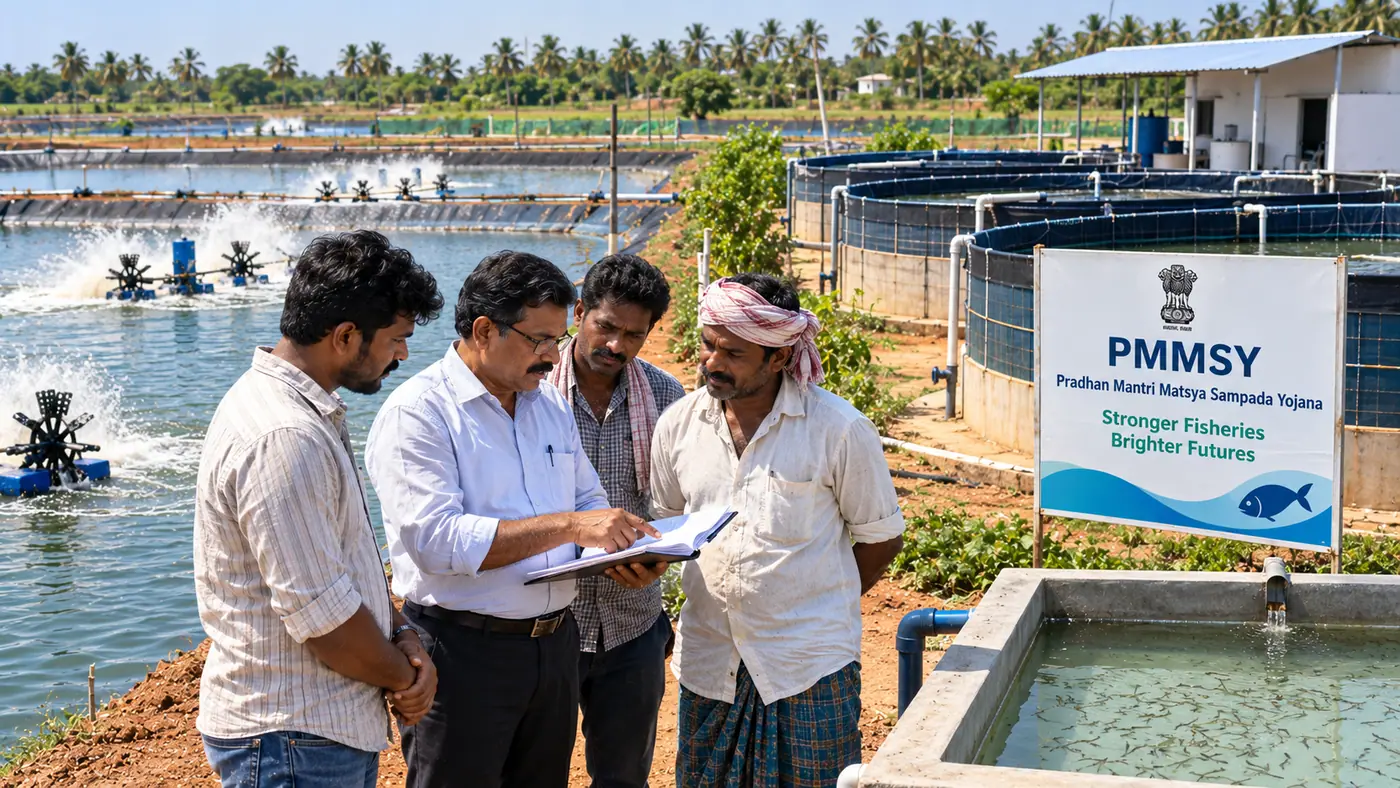
Executive Summary & Key Takeaways
- The Pradhan Mantri Matsya Sampada Yojana (PMMSY) is an unprecedented ₹20,050 Crore government initiative designed to modernize Indian fisheries, offering 40% capital grants for general category applicants and 60% for women, SC, ST, and fisheries cooperatives.
- Recognized unit costs are fixed by the National Fisheries Development Board (NFDB): new freshwater/brackishwater pond construction is capped at ₹7.00 Lakhs/Ha (plus ₹4.50 Lakhs/Ha for first-year inputs), while biofloc units range from ₹7.50 Lakhs (small) to ₹50.00 Lakhs (large).
- Over 65% of rejected PMMSY applications fail due to deficient Detailed Project Reports (DPRs)—lacking certified civil engineering estimates, geo-referenced cadastral maps, or verified DSCR (> 1.50) financial projections.
- PMMSY subsidies are disbursed exclusively as back-ended Direct Benefit Transfers (DBT) linked to institutional bank term loans; the government does not hand out cash upfront before construction begins.
- Mandatory geo-tagging via the official Department of Fisheries mobile app is enforced at three distinct milestones: baseline vacant land, 50% civil completion (plinth/bunds), and 100% operational completion with active water and aeration.
- Entrepreneurs can combine PMMSY capital subsidies with the Fisheries Kisan Credit Card (KCC) scheme, accessing collateral-free working capital up to ₹2.00 Lakhs at an effective 4% subsidized annual interest rate.
PMMSY Grant Realization Case Study: Securing ₹8.40 Lakhs Government Subsidy for a 2-Hectare Biofloc & Nursery Facility
A women-led agri-startup in coastal Thanjavur district sought to establish a commercial freshwater fish nursery and medium biofloc rearing unit across 2 hectares of ancestral land. Navigating bureaucratic bottlenecks, the promoter partnered with AquaSangham policy advisors to execute an airtight application: (1) Selected PMMSY sub-component 'Establishment of Medium Biofloc System (6 tanks) and Freshwater Rearing Ponds' with an official recognized unit cost of ₹14.00 Lakhs; (2) Prepared a comprehensive Detailed Project Report (DPR) complete with civil engineering estimates certified by a chartered engineer, geo-tagged site layout drawings, borewell water test certificates showing zero heavy metals, and a 5-year financial model demonstrating a Debt Service Coverage Ratio (DSCR) of 2.15; (3) Submitted the dossier through the Tamil Nadu State Fisheries online portal and cleared scrutiny by the District Level Committee (DLC) chaired by the District Collector; (4) Secured in-principle term loan sanction from State Bank of India (SBI) for 40% promoter equity and debt; (5) Executed civil works under two-stage geo-tagged physical inspections using the official PMMSY mobile app; and (6) Received the full 60% government subsidy of ₹8.40 Lakhs credited directly as Direct Benefit Transfer (DBT) into her bank loan escrow account, slashing net capital debt to just ₹5.60 Lakhs and achieving full operational profitability within 7 months.
1. The ₹20,050 Cr Framework: Central & State Architecture
Launched by the Government of India under the Ministry of Fisheries, Animal Husbandry and Dairying, the Pradhan Mantri Matsya Sampada Yojana (PMMSY) represents the largest single financial intervention in the history of Indian aquaculture. With a total budgetary outlay of ₹20,050 Crores spanning across all states and union territories, the scheme is engineered to bridge critical infrastructure gaps across the fish and shrimp value chain—from broodstock multiplication centers and grow-out ponds to cold chain logistics and domestic retail fish markets.
To navigate the scheme successfully, an entrepreneur must understand its dual administrative architecture: (1) Central Sector Schemes (CS), which are 100% funded by the central government and administered directly through national agencies like the National Fisheries Development Board (NFDB), Marine Products Export Development Authority (MPEDA), and ICAR research institutes; and (2) Centrally Sponsored Schemes (CSS), which represent the vast majority of farmer-facing subsidies and are co-funded by the Central Government and State Governments (typically 60:40 ratio for general states, and 90:10 for North Eastern and Himalayan states).
Because Centrally Sponsored Schemes are executed through state fisheries directorates, actual implementation timelines, annual district targets, and quota allocations are managed locally by District Fisheries Officers (DFOs) and State Level Approval Committees (SLACs). Knowing how to interface with both central guidelines and state-level administrative protocols is essential to getting your project approved and funded.
Eligible Beneficiary Categories
PMMSY offers broad eligibility across the agribusiness spectrum. Individual fishers, fish farmers, rural youth, and agricultural landowners can apply directly.
Additionally, collective entities—including Self-Help Groups (SHGs), Joint Liability Groups (JLGs), Fisheries Cooperative Societies, and registered Farmer Producer Organizations (FPOs)—receive priority quota allocations, while private limited companies, MSMEs, and agri-startups can access high-cap infrastructure components like large Recirculating Aquaculture Systems (RAS) and feed manufacturing plants.
State-Wise Allocation Quotas and Priority Districts
Funds are not distributed equally across all districts. State fisheries departments allocate annual PMMSY budgets based on District Fisheries Development Plans (DFDP), designating specific 'Aqua Clusters' and 'Aspirational Districts'.
For instance, coastal districts in Andhra Pradesh (Nellore, Krishna, Bapatla) and Tamil Nadu (Nagapattinam, Ramanathapuram) prioritize saline shrimp and mariculture infrastructure, while inland districts in Bihar, Uttar Pradesh, and West Bengal prioritize freshwater pond excavation, Pangasius culture, and biofloc units.
Before drafting your project report, visit your local District Fisheries Office (DFO) in April or May at the start of the financial year. Ask for the official 'Annual Action Plan (AAP) Component List' to verify exactly which sub-components have open budget quotas in your specific district for the current fiscal year.
3. 40% vs. 60% Rules & Tranche-Wise DBT Disbursement
A critical principle of PMMSY is that it operates strictly on a back-ended Direct Benefit Transfer (DBT) model. The government never advances upfront cash directly to an applicant's savings account to begin construction. Instead, the subsidy is tied to an institutional bank loan or an audited capital expenditure escrow account.
Under the financial rules: (1) General Category applicants (including male general and OBC applicants) are eligible for a 40% capital grant. In Centrally Sponsored Schemes, this 40% is split between the Central Government (24%) and the State Government (16%); (2) Special Category applicants—which explicitly includes all women entrepreneurs (regardless of caste or economic status), Scheduled Castes (SC), Scheduled Tribes (ST), and recognized coastal fisherfolk cooperatives—receive a 60% capital grant (36% Central + 24% State).
Subsidies are released in structured tranches corresponding to verified physical progress milestones on the ground. Attempting to claim subsidies without passing official geo-tagged verification will result in immediate suspension of funds.
The 3-Tranche Milestone Disbursement Schedule
For civil and infrastructure projects (such as new pond excavation, biofloc sheds, and RAS units), subsidies are released across three distinct milestones:
Tranche 1 (20% of subsidy): Released after baseline geo-tagging, land leveling, and completion of plinth, foundation, or initial dyke earthwork compaction.
Tranche 2 (40% of subsidy): Released upon structural completion, including installation of major machinery (paddlewheel aerators, three-phase electrical transformers, blowers, filtration systems, or tank lining).
Tranche 3 (40% of subsidy): Released following final inspection confirming active biological stocking (fingerlings or post-larvae in the water) and live operational verification.
How Bank Loan-Linked Subsidies Actually Work
When funding a project through a commercial bank loan, the bank sanctions the full project cost (e.g., ₹10.0 Lakhs) with a promoter margin of 20% (₹2.0 Lakhs) and a bank loan of 80% (₹8.0 Lakhs).
When the government releases the 40% subsidy (₹4.0 Lakhs), this money is credited directly into a specialized 'Subsidy Reserve Fund (SRF)' account maintained by the bank. The subsidy amount is held against the loan principal: the farmer pays interest only on the net outstanding balance (₹4.0 Lakhs), and upon successful completion of the lock-in period (typically 3 years), the subsidy is formally adjusted to extinguish the loan principal.
4. Drafting a Bankable Detailed Project Report (DPR): The 8 Mandatory Sections
The single most frequent reason for PMMSY application rejection—accounting for over 65% of failed files at the District Level Committee (DLC) stage—is a poorly drafted, unscientific Detailed Project Report (DPR). Many applicants submit generic one-page estimates downloaded from internet forums or handwritten contractor quotes lacking engineering and biological rigor.
A bankable DPR must satisfy two distinct scrutiny panels: (1) The District Fisheries Technical Committee, which evaluates biological viability, water parameters, and biosecurity; and (2) Commercial Bank Credit Officers, who evaluate financial ratios, Debt Service Coverage Ratios (DSCR), and repayment solvency.
Every institutional DPR prepared for PMMSY must contain eight non-negotiable sections.
The 8 Mandatory DPR Sections
1. Executive Summary & Scheme Alignment: Clearly stating the specific PMMSY sub-component, total project outlay, proposed subsidy amount, and promoter contribution.
2. Promoter Profile & Operational Experience: Professional bio, educational background, proof of aquaculture training (from ICAR-CIBA, CIFA, state ATMA, or recognized universities), and Aadhaar/PAN documentation.
3. Land & Geotechnical Site Evaluation: Registered land title records (Pattadar Passbook / Jamabandi) or a minimum 7-to-10 year registered lease deed, cadastral survey map, soil texture analysis (clay percentage), and certified water quality lab test reports (salinity, pH, heavy metals).
4. Civil Engineering Drawings & Itemized Bill of Quantities (BOQ): Architectural site plan, pond elevation cross-sections (slope 1:1.5), dyke dimensions, and itemized cost estimates certified by a licensed Chartered Civil Engineer.
5. Biological Production & Biosecurity Protocol: Target species (e.g., Litopenaeus vannamei, GIFT Tilapia, Labeo rohita), stocking density per m², Feed Conversion Ratio (FCR) targets, biosecurity fencing, and disease prevention protocols.
6. Financial Model & Cash Flow Forecast: Line-by-line 5-year operating expenditure (OPEX) ledgers, projected harvest volumes, count-wise price realizations, and projected profit and loss statements.
7. Debt Service & Financial Sensitivity Ratios: Calculation of Net Present Value (NPV), Internal Rate of Return (IRR > 25%), Break-Even Analysis, and Debt Service Coverage Ratio (DSCR > 1.75).
8. Statutory Clearances & Environmental Approvals: Proof of Coastal Aquaculture Authority (CAA) application for brackishwater, state pollution control board consent (if applicable), and local Gram Panchayat NOC.
| Financial Viability Metric | Minimum Bankable Benchmark | Optimal Project Range | High-Risk / Rejection Range |
|---|---|---|---|
| Debt Service Coverage Ratio (DSCR) | Minimum 1.50 | 1.85 – 2.40 | < 1.30 (Loan rejected for high default risk) |
| Internal Rate of Return (IRR) | Minimum 20% | 28% – 42% | < 15% (Unviable capital return) |
| Promoter Equity Contribution | Minimum 15% – 20% | 25% – 35% | < 10% (Insufficient promoter stake) |
| Operating Profit Margin (EBITDA) | Minimum 35% | 45% – 60% | < 25% (Vulnerable to feed price spikes) |
| Break-Even Production Volume | Maximum 55% of capacity | 35% – 45% of capacity | > 70% of capacity (No margin for error) |
5. Step-by-Step Roadmap: From DLC to Final Bank Sanction
Navigating the administrative pipeline of PMMSY requires meticulous documentation and disciplined follow-up across six sequential phases. Skipping a phase or beginning excavation before receiving formal administrative approval will permanently disqualify the project from receiving subsidies.
The comprehensive roadmap below outlines the exact journey from initial portal registration to the final release of subsidy funds.
Phase 1: Land Title Due Diligence & Pre-Requisites
Ensure the land parcel has clear, unencumbered ownership. If leased, the lease agreement must be registered with the Sub-Registrar for a minimum tenure of 7 to 10 years (unregistered notarized stamp paper agreements are rejected 100% of the time).
Obtain a certified laboratory water test report showing adequate groundwater or canal supply free from industrial effluents.
Phase 2: Online Registration & Application Submission
Submit your application and upload the comprehensive DPR through the designated state fisheries online portal (e.g., Fisheries department portals in AP, TN, Odisha, WB) or the National Fisheries Development Board (NFDB) PMMSY portal (pmmsy.dof.gov.in).
Select the exact sub-component and attach all supporting identity, land, engineering, and training documents. Obtain your unique Application Acknowledgment Number.
Phase 3: District Level Committee (DLC) Scrutiny
The District Fisheries Officer (DFO) and technical inspectors conduct an initial document audit. The file is then placed before the District Level Committee (DLC) chaired by the District Collector / District Magistrate.
The DLC evaluates local feasibility, confirms quota availability, and formally recommends approved files to the State Fisheries Directorate.
Phase 4: State Level Approval Committee (SLAC) Administrative Sanction
The State Level Approval Committee (SLAC), headed by the Principal Secretary or Director of Fisheries, reviews DLC recommendations and issues the formal 'Administrative Sanction Order' (ASO).
The ASO is the legal foundation of your subsidy: it officially reserves the central and state subsidy funds for your project for a specific validity window (typically 6 to 9 months).
Phase 5: Bank Loan Sanction & Work Commencement
Take your Administrative Sanction Order and bankable DPR to your commercial bank (SBI, Canara Bank, Union Bank, or regional rural bank) to execute loan documentation and receive the formal loan sanction letter.
Only after receiving the written ASO and bank sanction can you begin civil work. The DFO conducts Baseline Geo-Tagging of the vacant land parcel before earthmoving machines touch the soil.
Phase 6: Stage-Wise Geo-Tagging & DBT Release
As construction advances, the DFO or assistant fisheries inspector visits the site at specified milestones (50% civil completion and 100% operational completion with active fish/shrimp biomass).
Using the official PMMSY mobile application, the inspector captures geo-tagged, time-stamped photographs with exact GPS coordinates. Upon uploading the verification report to the portal, the state treasury and central PFMS release the subsidy via Direct Benefit Transfer (DBT) into your bank loan reserve account.
6. Fisheries KCC: Securing 4% Subsidized Working Capital Credit
While PMMSY provides substantial grants for capital assets (ponds, aerators, and sheds), it does not cover recurring operational costs beyond the first year. To support continuous working capital requirements—principally high-protein commercial feed, certified seed, and electricity—the Government of India extended the Kisan Credit Card (KCC) facility to fisheries and aquaculture farmers.
Fisheries KCC operates as a revolving cash-credit facility, enabling farmers to draw cash for operational inputs as needed throughout the 100 to 180-day crop cycle and repay upon harvest sales.
Under KCC norms: (1) Collateral-free credit is sanctioned up to ₹2.00 Lakhs for individual fish farmers; (2) Credit up to ₹3.00 Lakhs is available for farmers pledging land mortgage or hypothecation; (3) The baseline interest rate is set at 7% per annum; and (4) The central government provides a 3% Prompt Repayment Incentive (PRI), reducing the effective interest rate to an astonishingly low 4.0% per annum for farmers who settle dues within one year.
Combining PMMSY and KCC for Maximum Leverage
Smart aqua-entrepreneurs coordinate both schemes simultaneously: they utilize PMMSY's 40% to 60% capital grant to build world-class, bio-secure pond infrastructure, while activating a Fisheries KCC credit line to fund 100% of seasonal feed and seed requirements.
By funding working capital at 4% subsidized interest rather than taking 18% to 24% credit from local input dealers, the farmer preserves complete pricing independence at harvest, boosting annual net margins by an additional ₹60,000 to ₹1.2 Lakhs per hectare.
Summary Operational Action Checklist
Frequently Asked Questions
Q: Can I claim PMMSY subsidies on leased agricultural land?
Yes, PMMSY explicitly permits applications on leased land, provided: (1) The lease agreement is registered with the Sub-Registrar (notarized stamp papers are rejected); (2) The registered lease tenure is for a minimum of 7 to 10 years (depending on state norms); and (3) The lease deed contains an explicit 'No Objection' clause from the landowner permitting the lessee to construct aquaculture ponds, install electrical connections, and claim government subsidies.
Q: How long does the entire PMMSY approval and subsidy disbursement process take?
A well-documented application typically takes 3 to 4 months to receive the formal Administrative Sanction Order (ASO) following District Level Committee (DLC) and State Level Approval Committee (SLAC) meetings. Construction typically spans 2 to 4 months. Following final stage-wise geo-tagged inspection and upload to the PFMS portal, the DBT subsidy is credited into the bank loan account within 45 to 60 days. The complete cycle from application to fund credit spans approximately 7 to 10 months.
Q: Can I claim a PMMSY subsidy for an existing aquaculture pond already constructed?
No. PMMSY does not provide retrospective subsidies for past construction. A strict prerequisite for the scheme is 'Baseline Geo-Tagging': a fisheries officer must inspect and photograph the vacant land with GPS coordinates before any earthworks begin. However, owners of existing ponds can apply for separate modernization sub-components, such as installing biofloc tanks, solar-powered aeration units, effluent treatment systems, or cold-chain logistics.
Q: Can a farmer apply for PMMSY without taking a bank loan?
Yes, 'Self-Financed' applications are permitted under PMMSY guidelines in several states. In this case, the applicant must deposit their 40% to 60% promoter equity contribution into a dedicated project escrow bank account and provide bank solvency certificates. The government subsidy is released via DBT directly into this audited account following milestone geo-tagged inspections. However, bank-linked applications generally receive faster administrative clearance because banks provide third-party financial vetting.
AquaSangham Policy Desk
Government Subsidies & PMMSY Financial Advisory
Contributing Senior Technical Writer & Aqua Consultant at AquaSangham.
Recommended Farming Guides
The 3 AM Oxygen Trap: Why Fish and Shrimp Die at Dawn (And The 4.0 ppm Rule That Saves Them)
Read Article →Water QualityWhy Sudden Monsoon Rain Wipes Out Shrimp Overnight (And The 30-Minute Emergency Lime Protocol That Saves Your Pond)
Read Article →Market AnalysisEU & US Seafood Traceability Audits: Keeping Digital Farm Logs to Secure ₹15-₹20/kg Premium from Exporters
Read Article →Get Live Farm Advice on AquaSangham Mobile App
Download India's #1 Aquaculture Super App for real-time market prices, precision tools, and community advice.
Download Free Android App