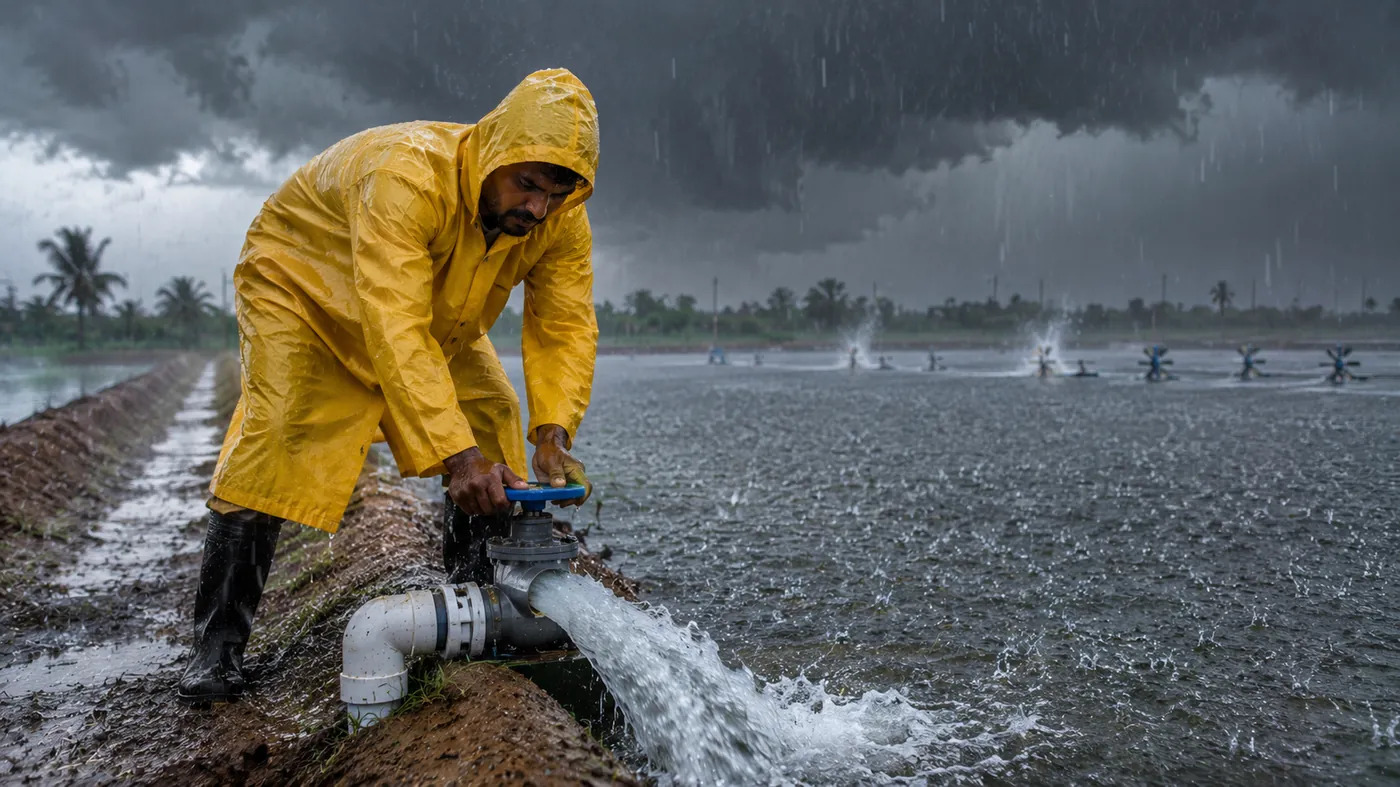
Executive Summary & Key Takeaways
- A 100 mm tropical downpour dumps 1,000,000 liters of freshwater per hectare; because cold freshwater is lighter than saltwater, it forms an unmixed buoyant surface lens that prevents vertical oxygen diffusion, suffocating benthic shrimp.
- Never turn on paddlewheel aerators immediately during heavy rain; leave aerators off for the first 60 to 90 minutes to let freshwater stratify, then skim off the top 8 to 15 cm via telescopic spillway pipes before mixing begins.
- Acidic cloudburst rainwater (pH 5.5–6.2) strips dissolved bicarbonate buffers, crashing total alkalinity by 30 to 50 ppm; immediately broadcast highly soluble Sodium Bicarbonate (NaHCO3 @ 25–40 kg/ha) to restore alkalinity >130 ppm.
- Rapid salinity drops trigger an involuntary surge of ecdysone molting hormone, forcing 40% to 70% of the pond population to molt simultaneously; without emergency mineral dosing, shrimp suffer fatal cramped-tail syndrome.
- Immediately replenish diluted cations by broadcasting Potassium Chloride (KCl @ 60–100 kg/ha) and Magnesium Chloride (MgCl2 @ 120–200 kg/ha) directly across aerator wakes to support post-molt calcification.
- Cut feeding rations by 50% for 24 hours post-downpour; voluntary feed intake drops dramatically during rainstorms and cold water shifts, and uneaten pellets will decompose into toxic ammonia and nitrite in bottom mud.
Field Case Study: 6-Hectare Cyclone Deluge Recovery
During a severe cyclonic storm in coastal Andhra Pradesh, a 6-hectare farm received 142 mm of torrential rainfall in 5 hours, causing surface salinity to plummet from 24 ppt to 11 ppt and forming an unmixed freshwater lens (pH 5.8) that trapped benthic shrimp beneath a suffocating thermocline. Operating under AquaSangham emergency monsoon protocols, the farm: 1) Immediately unbolted its surface telescopic PVC spillway pipes to skim off 12 cm of buoyant freshwater without disturbing saline bottom water, 2) Activated all paddlewheel aerators to break thermal stratification and homogenize water density, 3) Broadcast Sodium Bicarbonate @ 35 kg/ha to restore alkalinity from 85 ppm back to 135 ppm, and 4) Dosed Potassium Chloride (KCl) @ 80 kg/ha and Magnesium Chloride (MgCl2) @ 150 kg/ha to compensate for rainwater dilution and prevent molt cramping. The farm recorded zero mortality across 6 ponds, maintaining regular feeding schedules within 18 hours of storm clearance and harvesting 44.8 tons of 29g Vannamei at 105 DOC with an exceptional 1.20 FCR.
1. The Physics of a Cloudburst: Stratification, Thermocline & Osmotic Shock
Along the tropical maritime coastal belts of India—from the cyclone-prone deltas of Andhra Pradesh (Krishna, Godavari, Bapatla) and Odisha (Balasore, Bhadrak) to the monsoon-battered estuaries of West Bengal, Tamil Nadu, and Gujarat—few operational emergencies are as swift, violent, and biologically perilous as a severe tropical cloudburst. During the southwest and northeast monsoon seasons, as well as pre-monsoon cyclonic squalls, coastal aquaculture estates frequently experience intense cloudburst events delivering 100 to 150 millimeters of torrential rainfall within a compressed 3-to-5-hour window.
To the uninitiated observer, rainwater appears harmless—pure, clear freshwater falling from the sky. To an intensive shrimp farm stocked with hundreds of thousands of post-larvae or juvenile Penaeus vannamei, an unmanaged 100 mm cloudburst represents an existential chemical shock. A 100 mm rainfall event dumps exactly 1,000,000 liters (1,000 cubic meters) of freshwater across every single hectare of pond water spread. In a pond operating at a standard 1.0-meter water depth (10,000 m³ volume), this downpour instantly increases pond water volume by 10% with pure, unbuffered freshwater.
The biological consequences of this rapid dilution are catastrophic if mishandled: 1. Acute Osmotic Shock: Salinity plummets by 5 to 12 parts per thousand (ppt) within hours. This sudden osmotic drop triggers a massive, involuntary surge of the crustacean molting hormone (ecdysone), forcing 40% to 70% of the entire pond population to molt simultaneously into soft-shelled vulnerability. 2. Lethal Chemical & Thermal Stratification: Pure freshwater has a physical density of 1.000 g/cm³, whereas brackish or marine pond water (20–30 ppt) has a density of 1.015 to 1.022 g/cm³. Because freshwater is significantly lighter than saltwater, the cold rainwater does not naturally mix with the underlying pond water. Instead, it forms an unmixed, buoyant, low-salinity freshwater lens (10 to 15 cm thick) floating directly on top of the dense, warm saline water column. This density stratification forms a sharp thermocline and halocline that completely blocks oxygen diffusion to the bottom, trapping shrimp in anoxic benthic mud. 3. Rainwater Acidity & Alkalinity Collapse: Tropical cloudburst rain is naturally acidic (pH 5.4 to 6.2) due to atmospheric dissolution of carbon dioxide and sulfurous emissions. Divalent calcium and magnesium ions, along with bicarbonate buffers, are diluted instantly. Total alkalinity crashes by 30 to 50 ppm, causing water pH to destabilize and predisposing newly molted shrimp to fatal muscle cramps, soft shells, and mass cannibalism.
The Stratification Trap & Hypolimnion Collapse
1. Density Gradient: Cold freshwater (density 1.000 g/cm³) floats over warm saltwater (density 1.020 g/cm³), forming a sharp halocline that blocks vertical gas diffusion.
2. Benthic Anoxia: Wind moves only the buoyant surface lens. The isolated bottom water becomes completely anoxic within 90 minutes as benthic respiration strips oxygen.
3. Acidic Rain Infiltration: Tropical rainwater contains dissolved carbonic acid, stripping natural bicarbonate reserves and dropping water pH below 7.2.
| Water Quality Parameter | Pre-Rain Normal | Post-100mm Cloudburst (Unmanaged) | Emergency Triage Target | Clinical Threat | Remediation Action & Dosage |
|---|---|---|---|---|---|
| Surface Salinity | 25 – 28 ppt | 10 – 14 ppt (Fresh Lens) | 22 – 24 ppt | Osmotic shock & molt surge | Skim surface lens via swivel overflow pipe |
| Bottom Salinity | 25 – 28 ppt | 24 – 26 ppt (Stratified) | 22 – 24 ppt (Mixed) | Halocline blocks oxygen diffusion | Paddlewheel sequence de-stratification |
| Surface Water pH | 8.1 – 8.3 | 6.8 – 7.2 (Acid Shock) | 7.8 – 8.2 | Branchial acidosis & mucus sloughing | Sodium Bicarbonate @ 25–40 kg/ha |
| Bicarbonate Alkalinity | 135 – 150 ppm | 80 – 95 ppm (Diluted) | > 130 ppm CaCO3 | Soft shells, molt failure, mortality | Dolomite @ 100 kg/ha + NaHCO3 |
| Bottom Dissolved Oxygen | 5.5 – 6.5 ppm | < 1.8 ppm (Anoxic) | > 5.5 ppm | Mass nocturnal suffocation & black gills | Run 100% aerators continuously for 12 hrs |
| Potassium (K+) | 280 – 310 ppm | 180 – 210 ppm | > 260 ppm | Acute muscle cramp & molt death | Potassium Chloride (KCl) @ 60–100 kg/ha |
| Magnesium (Mg2+) | 950 – 1,050 ppm | 650 – 750 ppm | > 900 ppm | Inability to calcify new shell post-molt | Magnesium Chloride (MgCl2) @ 120–200 kg/ha |
Equip your farm with a dual-sensor salinity and temperature probe with a 2-meter cable. Measure water parameters simultaneously at 10 cm below the surface and 10 cm above the pond bed to instantly detect halocline and thermocline stratification during rainstorms.
2. The Surface Decanting Spillway: Skimming the Buoyant Freshwater Lens
The golden rule of post-rain management is: Never mix what you can skim.
Because the freshwater lens floats naturally on top of the saline water, farm infrastructure must be designed to discharge the buoyant freshwater before it mixes with the saline bottom water:
1. Engineering the Surface Decanting Siphon: Every culture pond dyke must feature an adjustable surface overflow drainage mechanism: Telescopic Swivel Elbow Pipes: A 6-inch or 8-inch PVC drainage pipe fitted with an external 90-degree swivel elbow outside the dyke. Raising or lowering the elbow pipe adjusts the pond overflow crest. Perforated Crest Flumes or Skimming Boards: Concrete sluice gates fitted with slotted skimming weir boards that allow only the top 5 to 10 cm of water to spill over into the drainage canal.
2. The Decanting SOP: As torrential rain commences, the pond supervisor must immediately lower the swivel pipe or remove the top skimming boards, setting the discharge lip exactly at the pre-rain high-water line. While the rain falls, leave all aerators turned OFF for the first 60 to 90 minutes. This preserves the density stratification, allowing the buoyant freshwater to form a clean lens that continuously discharges over the skimming weir into the drainage canal. Utilizing this protocol, 60% to 75% of the total rainfall volume (600 to 750 m³ of pure freshwater per hectare) is evacuated from the pond without losing a single drop of saline bottom water or valuable mineral ions.
Install a wide floating baffle boom (using sealed 4-inch PVC pipes) 1.5 meters in front of your surface skimming weir. This prevents wind waves from disturbing the surface lens, ensuring pure, unmixed rainwater discharges cleanly over the overflow lip.
3. Thermal & Chemical De-Stratification: Controlled Aerator Sequencing
Once the torrential downpour ceases and excess surface freshwater has been skimmed off, the remaining stratified layers must be rapidly and safely homogenized:
- Sequencing Aerator Activation: Do not start all aerators at once, which creates violent bottom scouring and kicks up anoxic mud. Start 50% of paddlewheel aerators (operating along the peripheral dykes) to generate a gentle circular current. After 15 minutes, activate the remaining aerators and bottom diffuser grids.
- Thermal De-Stratification: Paddlewheel rotation pulls warm, dense bottom water upward and pushes surface water downward, completely destroying the halocline and thermocline within 20 to 30 minutes. Water temperature and dissolved oxygen become uniform across the entire depth profile, preventing localized hypoxia.
- DO Floor Maintenance: Keep 100% of aeration equipment running continuously for at least 12 hours post-rain. Cloud cover blocks sunlight, preventing microalgal photosynthesis; mechanical aeration must provide 100% of biological oxygen demand.
Angle outer paddlewheel aerators slightly toward the center (10 to 15 degrees inward). This maintains surface water rotation without scouring the dyke toe, pulling sinking cold rainwater into the circular flow where it mixes smoothly with bottom water.
4. Neutralizing Rainwater Acidity & Alkalinity Re-Buffering Chemistry
Tropical rainwater lacks dissolved mineral buffers and carries an acidic pH. Furthermore, rainwater washes acidic topsoil from unlined earthen dykes into the pond:
- The Alkalinity Crash: Rainwater dilution strips dissolved bicarbonate (HCO3-) ions. Total alkalinity frequently drops from an optimal 140 ppm down to 85–95 ppm, and water pH falls below 7.3.
- The Liming Selection Rule: Never Use Quicklime (Calcium Oxide, CaO): Quicklime releases intense exothermic heat upon hydration and causes violent, lethal pH spikes (>9.2) that burn shrimp gills. Avoid Agricultural Limestone (CaCO3) Alone: Limestone dissolves far too slowly (taking 48 to 72 hours) to counteract acute post-rain acid shock. Deploy Sodium Bicarbonate (NaHCO3) + Dolomite: Broadcast food/technical-grade Sodium Bicarbonate (NaHCO3) @ 25 to 40 kg per hectare directly across aerator wakes. Sodium Bicarbonate dissolves instantaneously, rapidly releasing bicarbonate ions to restore total alkalinity to >130 ppm and stabilizing pH between 7.8 and 8.1. Simultaneously, broadcast Agriculture-Grade Dolomite [CaMg(CO3)2] @ 100 to 150 kg/ha to provide secondary long-term mineral buffering.
Keep at least 10 bags of Sodium Bicarbonate (25 kg each) per hectare pre-positioned in your farm warehouse before the onset of monsoon season. Supply chain delays during storm events can prevent emergency procurement when every hour counts.
5. Emergency Ionic Replenishment: Countering Sudden K+ and Mg2+ Dilution
The most acute biological danger following a rainstorm is the Osmotic Molt Spike. The sudden drop in salinity, coupled with the sharp 3°C–5°C drop in water temperature, triggers an involuntary mass molt across the pond:
- The Molt-Cramp Catastrophe: When shrimp molt in water where Potassium (K+) and Magnesium (Mg2+) have been diluted, their cellular branchial pumps cannot maintain muscle turgor. The animals suffer from severe muscle cramping (rigid curled tails) and incomplete ecdysis. Soft-shelled shrimp sink to the bottom where they are cannibalized by inter-molt companions or attacked by opportunistic Vibrio bacteria.
- Emergency Chemical Reconstitution SOP: Within 2 hours of rainfall cessation, test pond water for salinity, K+, and Mg2+. Immediately apply the emergency mineral restoration dose: 1. Technical Potassium Chloride (KCl, 50% K): Broadcast @ 60 to 100 kg per hectare. This rapidly restores extracellular potassium, allowing newly molted shrimp to pump ions across fresh cuticles and preventing cramped tail syndrome. 2. Magnesium Chloride Hexahydrate Flakes (MgCl2·6H2O, 12% Mg): Broadcast @ 120 to 200 kg per hectare. This restores the mandatory 3:1 Mg:Ca ratio, enabling shrimp to enzymaticly harden their new cuticles within 4 to 6 hours of molting.
Pre-dissolve Potassium Chloride and Magnesium Chloride in 200L plastic drums with water before broadcasting. Broadcasting pre-dissolved mineral brines ensures instantaneous aqueous assimilation, reaching molting shrimp within minutes.
6. Post-Storm Feeding Adjustments: Preventing Gut Enteritis & Fouling
One of the most widespread and costly mistakes made by farm workers is broadcasting normal feed rations immediately following a heavy downpour:
- Why Shrimp Stop Eating: Cloudbursts disturb benthic sediments, drop water temperatures by 3°C to 5°C, and force shrimp into a soft-shelled post-molt state. During this period, shrimp voluntary feed consumption drops by 60% to 80%. Dumping full feed rations results in mounds of unconsumed pellets decaying in the bottom mud, fueling explosive spikes of toxic un-ionized ammonia (NH3) and nitrite (NO2-).
- The 24-Hour Feeding SOP: Immediately cut scheduled feed rations by 50% for the first 24 hours post-rain. Inspect submerged checktrays 60 minutes after broadcasting. If feed remains on trays, skip the subsequent feed ration entirely. Top-Dress Surviving Feed: Coat remaining feed rations with Vitamin C (coated ascorbic acid @ 5 g/kg feed) to boost immune defense against osmotic shock, Betaine Anhydrous (@ 6 g/kg) for cellular rehydration, and a multi-strain Bacillus probiotic to stabilize gut enterocytes.
Never increase feed rations back to 100% until 48 hours post-storm, and only after verifying that checktrays are clean and water temperature has returned to normal baseline (>28°C).
7. Post-Monsoon Pathogen Bloom Suppression: Algal Crashes & Vibrio
Heavy rains wash massive quantities of terrestrial mud, organic detritus, and wild bacteria into culture ponds, followed by sudden, intense sunshine that causes delicate microalgal diatom blooms to crash:
- The Die-Off Warning Signs: Within 24 to 48 hours post-storm, dying phytoplankton turns the pond water from a rich golden-brown to a murky olive-black, accompanied by thick, foul-smelling brown foam accumulating along the downwind dyke corners.
- Biological Remediation: Apply concentrated enzymatic water probiotics containing Bacillus subtilis and Bacillus licheniformis @ 1.5 to 2.0 kg/ha combined with 15 kg of fermented molasses. The beneficial heterotrophs rapidly digest the dead algal biomass, preventing ammonia surges and outcompeting virulent green-colony Vibrio parahaemolyticus before bacterial enteritis can develop.
Skim off thick surface foam using a fine-mesh hand scoop net along the downwind corners of the pond. That foam contains dead organic matter, lipid films, and high concentrations of pathogenic bacteria.
Summary Operational Action Checklist
Frequently Asked Questions
Q: Why is turning on all paddlewheel aerators immediately during heavy rain a dangerous mistake?
Cold rainwater is less dense than saline pond water (1.000 g/cm³ vs 1.020 g/cm³) and naturally forms an unmixed freshwater lens (10 to 15 cm deep) floating on top of the pond. If aerators are started immediately while overflow drains are closed, the rotating blades violently mix this freshwater into the saline water column, permanently diluting the entire pond by 6 to 10 ppt and crashing overall alkalinity. By leaving aerators off for the first 60 to 90 minutes and opening surface overflow spillways, farmers can skim off 60% to 75% of the total rainfall volume before aerating, preserving valuable saline water and minerals.
Q: How does a cloudburst trigger an involuntary mass molting event in shrimp ponds?
Crustacean molting is regulated by the steroid hormone ecdysone. When pond water salinity suddenly drops by 5 ppt or more and water temperature drops by 3°C to 5°C during a tropical storm, the sudden environmental hypoosmotic and thermal shock triggers an involuntary surge of ecdysone release. This causes 40% to 70% of the shrimp population to molt simultaneously within 12 to 24 hours. Because the water's dissolved calcium, magnesium, and potassium have been diluted by rain, newly molted shrimp suffer from soft shells, severe muscle cramping, and mass cannibalism unless emergency minerals are dosed immediately.
Q: Why is Sodium Bicarbonate vastly superior to Agricultural Lime or Quicklime after a rainstorm?
Tropical rainwater is acidic (pH 5.5 to 6.2) and rapidly consumes bicarbonate alkalinity. Agricultural Limestone (CaCO3) dissolves extremely slowly in seawater (taking 48 to 72 hours) and cannot stop an acute post-rain acid crash. Quicklime (CaO) dissolves quickly but causes violent, caustic pH spikes (>9.2) that chemically burn shrimp gills. Technical-grade Sodium Bicarbonate (NaHCO3) dissolves instantaneously in cold water, releasing bicarbonate ions (HCO3-) that immediately restore total alkalinity above 130 ppm while self-buffering water pH safely between 7.8 and 8.1.
Q: What causes 'Cramped Tail Syndrome' after a sudden salinity drop, and how is it prevented?
'Cramped Tail Syndrome' occurs when shrimp undergo osmotic shock or molt in water deficient in dissolved Potassium (K+) and Magnesium (Mg2+). The branchial Na+/K+-ATPase pump fails, preventing the animal from regulating intracellular electrolytes or clearing lactic acid from tail muscles. The abdominal muscles contract violently and rigidly into an arched curve, leaving the shrimp unable to swim or escape predators. It is prevented by immediately broadcasting Potassium Chloride (KCl @ 60–100 kg/ha) and Magnesium Chloride (MgCl2 @ 120–200 kg/ha) within 2 hours of a heavy downpour.
Q: How soon should normal feeding resume after a major monsoon downpour?
Normal feeding should never resume immediately. Heavy downpours drop water temperatures, stir up benthic silt, and cause mass molting, reducing shrimp appetite by 60% to 80%. Immediately cut the scheduled feed ration by 50% for the first 24 hours. Check feeding trays after 60 minutes; if feed remains unconsumed, cancel the next ration. Gradually ramp feeding back to 100% only over a 48-hour period, and only after verifying that checktrays are clean, dissolved oxygen is >5.5 ppm, and water temperature has stabilized above 28°C.
AquaSangham Technical Advisory
Monsoon Crisis Management & Water Chemistry Desk
Contributing Senior Technical Writer & Aqua Consultant at AquaSangham.
Recommended Farming Guides
Total Ammonia Nitrogen (TAN) Mass Balance Math: Sizing Biofilters in Commercial RAS
Read Article →Farming TechThe Recirculating Aquaculture System (RAS) Master Guide: Design, Hydraulics & Mass Balance
Read Article →Farming TechIndigenous Magur (Clarias batrachus) Induced Breeding & Nursery Rearing SOPs
Read Article →Get Live Farm Advice on AquaSangham Mobile App
Download India's #1 Aquaculture Super App for real-time market prices, precision tools, and community advice.
Download Free Android App