Executive Summary & Key Takeaways
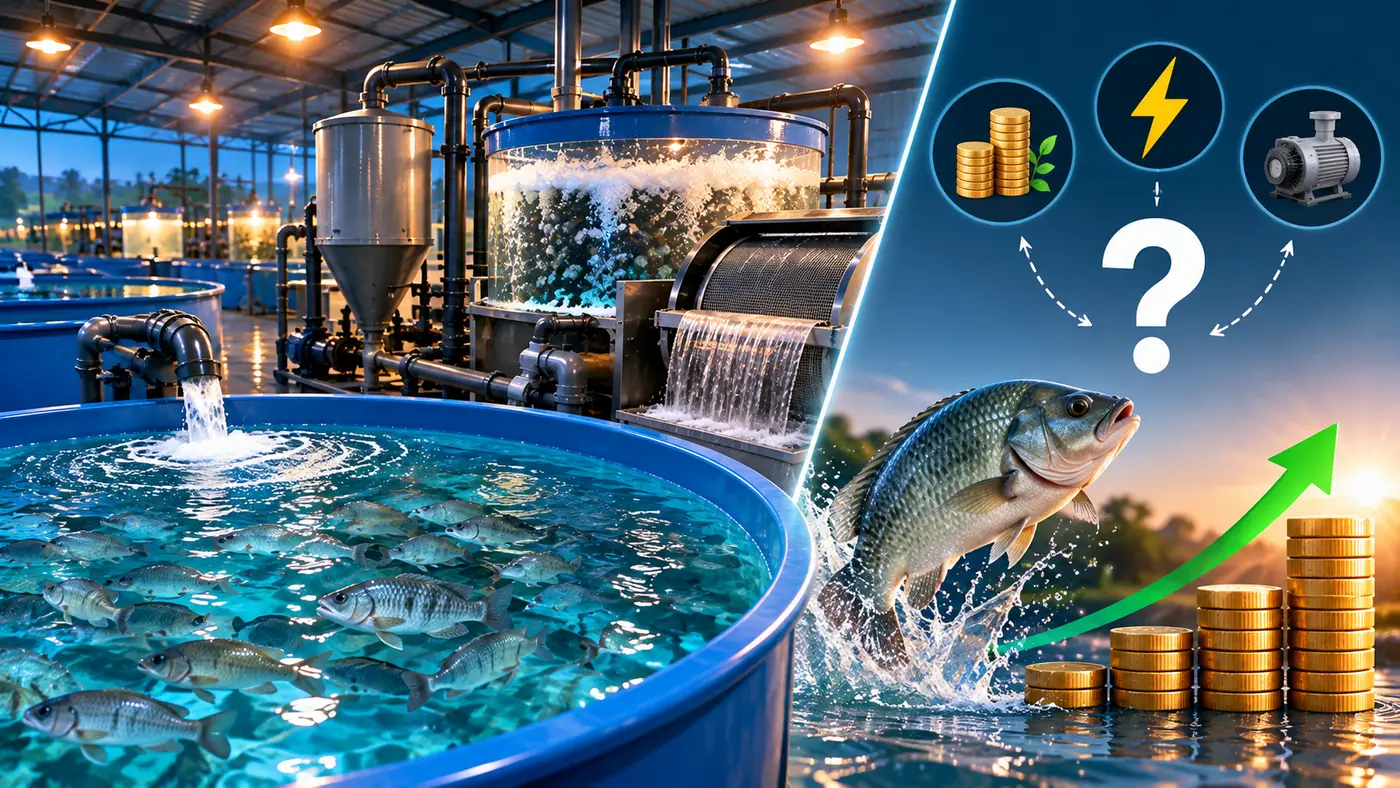
- Recirculating Aquaculture Systems (RAS) promise 95% to 99% water recycling, climate independence, and hyper-dense production (50 to 90 kg/m³), but over 75% of commercial RAS ventures in India shut down within 18 months due to unhedged operational expenditure and flawed species selection.
- The primary operational cost driver in RAS is non-stop 24/7 electrical energy: powering continuous mechanical water pumps, rotary drum filter backwashes, high-volume air blowers, and oxygen generators costs between ₹1.20 and ₹1.85 Lakhs per month on a 100-ton module.
- A catastrophic economic error made by novice investors is growing low-value commodity fish (GIFT Tilapia or Pangasius selling at ₹100–₹130/kg) in a high-CAPEX system where production cost averages ₹135 to ₹160/kg, guaranteeing structural losses on every kilogram harvested.
- To achieve commercial solvency, an Indian RAS facility must culture high-value species commanding farm-gate prices above ₹450 to ₹600/kg—specifically Asian Seabass (Bhetki), Murrel (Channa striata), or indigenous freshwater pearl spot—sold live or chilled directly into premium metropolitan retail channels.
- The biological heart of an RAS facility is the Moving Bed Biofilm Reactor (MBBR): sizing must provide at least 800 to 1,000 m² of protected specific surface area per kilogram of daily feed nitrogen to prevent lethal total ammonia nitrogen (TAN) and nitrite (NO2) spikes.
- AquaSangham's RAS Bio-Engineering Calculator enables investors to model hydraulic head loss, drum filter screen microns, MBBR bio-media cubic meters, and multi-year cash flow break-even curves before committing capital to construction.
Commercial RAS Turnaround Case Study: Pivoting from Low-Margin Tilapia to Premium Asian Seabass to Achieve 28% Net ROI
An urban agri-tech startup invested ₹58 Lakhs in a 50-ton indoor Recirculating Aquaculture System (RAS) consisting of eight 50m³ circular fiberglass tanks, a 40-micron rotary drum screen, an MBBR nitrification chamber, and an industrial oxygen cone. During Year 1, following generic consultant advice, the promoter stocked GIFT Tilapia targeting 40 tons of production. The results were financially catastrophic: (1) Total production cost reached ₹148/kg (dominated by commercial 32% extruded feed and ₹1.45 Lakhs monthly electricity bills); (2) Local wholesale mandi brokers offered only ₹115 to ₹125/kg for dead iced Tilapia, generating an immediate operational loss of ₹9,40,000; (3) Facing impending insolvency, the promoter engaged AquaSangham's High-Tech Engineering Advisory. The restructuring involved: (A) Converting the salinity to 8 ppt brackishwater using sea-salt remineralization; (B) Upgrading the MBBR bio-media surface area with K3 biomedia to handle higher protein waste; (C) Stocking pre-graded Asian Seabass (Bhetki) fingerlings fed on high-performance 45% marine micro-pellets; (D) Establishing direct live-fish supply logistics to five-star hotels and premium seafood retailers in Mumbai and Pune at ₹620/kg; and (E) Installing a 25 kW rooftop solar PV system that slashed daytime power bills by 42%. In Year 2, harvesting 28 metric tons of premium live Seabass generated ₹1,73,60,000 in gross revenue against total operating expenses of ₹1,52,00,000, yielding ₹21,60,000 in clean net cash profit and validating the commercial turnaround.
1. The RAS Fantasy vs. Indian Ground Reality: Why 75% of Projects Collapse
In the glittering landscape of agricultural technology investment, Recirculating Aquaculture Systems (RAS) are marketed as the ultimate futuristic panacea. Turnkey equipment vendors and glossy consulting brochures present an irresistible vision: 'Produce 100 tons of fresh fish on less than half an acre of land! Use 99% less water than earthen ponds! Zero chemical runoff, complete climate independence, and harvest fresh fish 365 days a year inside a clean, modern factory!'
Lured by this high-tech narrative, hundreds of corporate executives, returning NRIs, and venture-backed agri-entrepreneurs across Delhi-NCR, Bengaluru, Hyderabad, Pune, and Ahmedabad have poured crores of rupees into indoor RAS facilities. Yet, visit these industrial sheds 18 to 24 months after commissioning, and you will find an alarming reality: over 75% of commercial RAS projects in India are either completely shuttered, standing with empty, bone-dry fiberglass tanks, or operating at a fraction of their capacity while bleeding cash every single month.
The reason for this systemic industry failure is not biological mystery; it is mathematical denial. Commercial RAS is not merely farming; it is heavy industrial chemical and mechanical engineering applied to a living aquatic ecosystem. While turnkey vendors provide optimistic 2-page balance sheets showing 60% gross margins, they routinely hide the brutal reality of Indian operational conditions: non-industrial rural electrical power volatility, massive diesel generator fuel burn, bio-filter maturation crashes, high feed conversion ratios, and the fatal trap of growing low-value commodity fish in an ultra-high-capital machine.
Never purchase a 'turnkey packaged RAS' from equipment importers without having an independent bio-systems engineer audit the hydraulic pump head calculations and biofilter specific surface area. Over 60% of imported turnkey packages are grossly undersized for tropical ambient water temperatures and high feeding loads.
2. Core Engineering Anatomy: Tanks, Drum Filters, MBBR, UV & Oxygen Cones
To evaluate the true cost and operational complexity of an RAS facility, one must dissect its mechanical and biological organs. An RAS is a continuous closed-loop life-support system where water constantly circulates from the culture tanks through a multi-stage water treatment train and returns purified to the fish. The system consists of five non-negotiable engineering subsystems:
1. Circular Culture Tanks with Dual-Drain Hydrodynamics: Modern RAS utilizes circular or octagonal fiberglass-reinforced plastic (FRP) or heavy polyethylene tanks with conical bottoms. Inflow water is introduced tangentially to create a rotational vortex (the 'tea cup effect') that sweeps heavy settleable solids (feces and uneaten pellets) to a central bottom drain within 3 to 5 minutes, while clean water overflows through an upper peripheral side-box. 2. Rotary Micro-Screen Drum Filter (Primary Mechanical Separation): The central bottom drain effluent flows by gravity into an automated rotary drum filter fitted with a 40 to 60-micron stainless steel woven mesh. As solids accumulate on the screen, a differential pressure sensor triggers a high-pressure backwash pump that blasts the trapped solids into a sludge trough, removing up to 80% of suspended solids before they can dissolve and degrade water quality.
3. Moving Bed Biofilm Reactor (MBBR - Biological Nitrification): The heart of the system. Dissolved toxic total ammonia nitrogen (TAN) excreted across the fish gills cannot be filtered mechanically. The water enters an aerated biological chamber filled with thousands of specialized plastic biomedia rings (Kaldnes K1/K3 or Hel-X media, providing 800 to 1,200 m²/m³ of protected surface area). Nitrosomonas bacteria oxidize toxic ammonia (NH3) to nitrite (NO2-), and Nitrobacter bacteria oxidize nitrite to relatively harmless nitrate (NO3-). Continuous aggressive aeration via regenerative blowers keeps the biomedia in continuous fluid suspension while stripping toxic dissolved carbon dioxide (CO2). 4. Low-Head Oxygenation Cones (LHO) & Pure Oxygen Injection: Because fish biomass in RAS exceeds 50 to 90 kg/m³, atmospheric air aeration is biologically incapable of maintaining required dissolved oxygen. Pure oxygen generated by Pressure Swing Adsorption (PSA) oxygen generators is injected into pressurized downflow oxygen cones at 1.5 to 2.0 bar, supersaturating the return water to 15 to 25 ppm DO. 5. Ultraviolet (UV) & Ozone Disinfection: Return water passes through high-output germicidal UV sterilizers (minimum 30 mJ/cm² dose) to destroy circulating bacterial and fungal spores before entering the tanks.
Technical Engineering Specifications: 100-Ton Annual Commercial RAS Module
The table below details the engineering specifications, hydraulic flow rates, and power consumption of a standard commercial 100-ton annual production capacity RAS module:
| Subsystem / Engineering Component | Technical Sizing & Specifications | Continuous Power Draw (kW) | Operational Criticality / Failure Mode |
|---|---|---|---|
| Culture Tanks (8 Units) | Circular FRP, 6.0m diameter x 1.8m depth (50m³ each = 400m³ total volume) | 0.0 kW (Passive gravity flow) | Vortex velocity must maintain 15-25 cm/s to self-clean floor |
| Rotary Micro-Screen Drum Filter | 40-micron screen, 180 m³/hr hydraulic throughput capacity | 1.5 kW (Drive motor + backwash pump) | Screen clogging causes tank overflow and biofilter fouling |
| Moving Bed Biofilm Reactor (MBBR) | 60m³ chamber filled with 35m³ K3 biomedia (800 m²/m³ surface area) | 5.5 kW (Roots air blower continuous) | Aeration failure causes biofilter suffocation and TAN spike in 40 mins |
| Main Water Recirculation Pumps | Dual high-efficiency centrifugal pumps (1 working, 1 auto-standby), 180 m³/hr @ 8m head | 7.5 kW continuous | Pump stoppage halts water exchange; fish suffocate within 15 minutes |
| PSA Oxygen Generator & Cone | 15 Nm³/hr industrial PSA generator with downflow oxygenation contact cone | 5.5 kW (Compressor + PSA unit) | Loss of pure oxygen drops tank DO from 12 ppm to 1.5 ppm in 20 minutes |
| UV Disinfection & Degassing Trickling Tower | Medium-pressure inline UV reactor (400W) + forced-draft counter-current CO2 stripping tower | 1.8 kW (Fan blower + UV lamps) | CO2 accumulation above 20 ppm causes fish respiratory acidosis |
Always design your system with an 'Auto-Failover Sump Bypass'. If the drum filter jams or power blinks, water must gravity-divert directly to the biofilter sump rather than backing up and overflowing the culture tanks onto the warehouse floor.
3. Real-World 100-Ton System CAPEX: Itemized Equipment & Civil Costs
The initial capital expenditure required to commission an industrial-grade commercial RAS facility is substantial. Turnkey vendors frequently quote an artificially low 'equipment package' price of ₹25 to ₹30 Lakhs, deliberately omitting the massive civil engineering, electrical substation, and climate-control costs that represent nearly half of the total project budget.
A true commercial 100-ton annual capacity facility (designed to sustain 35 to 40 metric tons of standing biomass at 70 kg/m³ with three staggered stocking batches) requires an enclosed industrial shed of at least 8,000 to 10,000 square feet. Civil foundation work is demanding: 400 tons of water supported on concrete slabs requires heavy reinforced cement concrete (RCC) plinths with epoxy-coated drainage trenches.
In total, establishing an institutional-grade 100-ton facility costs between ₹48,00,000 and ₹65,00,000 (excluding land cost). Attempting to cut corners by fabricating homemade drum filters from plastic mesh or building uninsulated polyhouse sheds results in premature equipment failure, catastrophic temperature fluctuations, and structural leaks that force expensive shutdowns.
Comprehensive Itemized CAPEX Schedule: 100-Ton Commercial RAS Facility
The table below provides a verified, market-tested line-item capital expenditure budget for constructing a 100-ton indoor RAS facility in India:
| Capital Expenditure Item | Technical Description / Scope | Budget Allocation (INR) | % of Total CAPEX |
|---|---|---|---|
| Industrial Steel Shed & Civil Foundation | 8,000 sq ft insulated PEB shed, reinforced concrete floor, epoxy floor trenches | ₹16,50,000 | 28.5% |
| Culture Tanks & Primary Plumbing | 8 circular FRP tanks (50m³ each), bottom drains, PVC Sch-40 piping & valves | ₹11,20,000 | 19.3% |
| Rotary Micro-Screen Drum Filter | Automated 40-micron 316L stainless steel drum filter with control panel | ₹6,80,000 | 11.7% |
| MBBR Chamber & Biomedia | 60m³ RCC bio-chamber, 35m³ virgin K3 biomedia, coarse bubble aeration grid | ₹5,40,000 | 9.3% |
| Pumps & Blowers with Redundancy | 2 main recirculation pumps (15 HP total), 2 regenerative Roots blowers (10 HP total) | ₹4,80,000 | 8.3% |
| PSA Oxygen Generator & Oxygen Cone | 15 Nm³/hr industrial PSA unit, air compressor, storage tank & 2.0 bar FRP oxygen cone | ₹5,90,000 | 10.2% |
| Electrical Substation & Automatic DG Set | 63 kVA dedicated transformer line, LT panel, capacitor bank, 50 kVA AMF silent DG set | ₹5,20,000 | 9.0% |
| UV Sterilization & Monitoring Sensors | Dual UV chambers, digital multi-parameter optical DO/pH/TAN telemetry sensors | ₹2,15,000 | 3.7% |
| Total Capital Expenditure (Turnkey) | Complete 100-Ton Annual Indoor Commercial Facility | ₹57,95,000 | 100.0% |
Apply for the central government capital subsidy under the PMMSY 'Establishment of Large Recirculating Aquaculture Systems (RAS)' scheme. The National Fisheries Development Board (NFDB) recognizes an official unit cost of ₹50.00 Lakhs, providing a 40% capital grant (₹20 Lakhs) for general category and 60% (₹30 Lakhs) for women/SC/ST promoters, dramatically lowering capital risk.
4. The 24/7 Power Bill Nightmare: Pumping Head, Kilowatt-Hours & DG Sets
In pond aquaculture, nature provides significant free ecosystem services: the sun powers phytoplankton photosynthesis, wind drives surface gas exchange, and soil bacteria naturally cycle nitrogen. In an indoor RAS, nature is completely replaced by electric motors. Every drop of water must be pumped, filtered, aerated, oxygenated, and disinfected by electricity—24 hours a day, 365 days a year.
Consider the relentless electrical arithmetic of a 100-ton commercial module: The main circulation pumps draw 7.5 kW continuously. The aeration blowers draw 5.5 kW. The oxygen compressor and PSA system draw 5.5 kW. Drum filter backwashes, UV lamps, degassing fans, and facility lighting add another 3.5 kW. The total continuous running load is 22.0 Kilowatts.
Running a continuous 22 kW load translates to 528 kilowatt-hours (kWh or units) of electricity consumed every single day—over 15,840 units per month! In industrial or semi-commercial tariff brackets in states like Maharashtra, Haryana, or Karnataka (averaging ₹8.50 to ₹10.50 per unit), the monthly electricity bill lands between ₹1,35,000 and ₹1,66,000. Add routine diesel generator runs during rural power blackouts (burning ₹25,000 to ₹40,000 of fuel monthly), and the annual energy expenditure surpasses ₹18,00,000 to ₹22,00,000! If your facility produces 80 tons of fish, energy alone costs ₹22 to ₹27 for every single kilogram of fish produced.
If a catastrophic power failure occurs and the backup diesel generator fails to start within 15 to 20 minutes, standing biomass in hyper-dense tanks (70 kg/m³) will consume all remaining dissolved oxygen, resulting in 100% stock mortality. An RAS facility cannot survive without dual-redundant automatic mains failure (AMF) generator backup.
Install a rooftop solar photovoltaic (PV) array on the roof of your industrial shed. A 25 kWp solar array generates approximately 100 to 120 units daily, offsetting daytime pumping loads and saving between ₹30,000 and ₹42,000 every month in electrical utility bills.
5. The Deadly Species Trap: Why Growing Cheap Fish Guarantees Bankruptcy
The single greatest cause of commercial RAS business failures in India is not pump failure, biofilter toxicity, or electrical blackouts. It is a fatal marketing blunder: 'The Low-Value Species Trap.'
Over 80% of novice RAS operators choose to culture Genetically Improved Farmed Tilapia (GIFT Tilapia) or Pangasius catfish. Their reasoning seems logical on paper: 'Tilapia is extraordinarily hardy, tolerates poor water quality, survives high ammonia, and grows rapidly.' All of this is biologically true. However, commercially, it is an economic death sentence.
The financial reality of growing Tilapia in RAS in India: Total production cost (high-protein extruded feed + electricity + fingerlings + labor + capex depreciation) averages ₹135 to ₹155 per kilogram. Meanwhile, in wholesale fish mandis across India, fresh iced Tilapia and Pangasius are supplied in massive multi-ton volumes by open earthen pond and cage farmers in Andhra Pradesh and Chhattisgarh at wholesale prices of ₹95 to ₹115 per kilogram. Selling a fish that costs you ₹145 to produce for ₹110 in the wholesale market means losing ₹35 on every single kilogram harvested! Producing 50 tons guarantees a net loss of ₹17,50,000.
An industrial RAS is an ultra-high-capital production machine; it can only achieve commercial break-even if the harvested product commands a premium farm-gate price exceeding ₹450 to ₹650 per kilogram. To succeed, the operator must culture high-value mariculture or predatory freshwater species: Asian Seabass / Bhetki (Lates calcarifer), Murrel / Snakehead (Channa striata), or indigenous freshwater pearl spot (Karimeen)—and market them live directly into metropolitan restaurants, premium retail seafood counters, and direct-to-consumer online channels.
Never plan your business model around selling dead iced fish into traditional wholesale mandis. An RAS operator's decisive competitive advantage is the ability to deliver live, swimming, pristine fish directly to high-end urban culinary markets at a 40% to 60% price premium over dead fish.
6. The Ultimate Break-Even Model: Tilapia vs. Pangasius vs. Murrel vs. Seabass
To establish absolute financial clarity for prospective investors, let us examine an audited, real-world economic simulation across four different species cultured in an identical 100-ton commercial RAS facility in India.
The simulation models a standardized 100-ton capacity system (8 x 50m³ tanks, 22 kW continuous power draw, ₹58 Lakhs initial CAPEX amortized over 7 years at ₹8.28 Lakhs/year):
Species A (GIFT Tilapia): Harvests 85 metric tons. Production cost: ₹142/kg (dominated by ₹1.45L monthly electricity and ₹95/kg feed). Mandi wholesale price: ₹115/kg. Gross Revenue: ₹97,75,000. Operating Expenditure: ₹1,20,70,000. Net Annual Deficit: - ₹22,95,000 (Complete financial insolvency).
Species B (Pangasius Catfish): Harvests 95 metric tons. Production cost: ₹131/kg. Wholesale price: ₹105/kg. Gross Revenue: ₹99,75,000. Operating Expenditure: ₹1,24,45,000. Net Annual Deficit: - ₹24,70,000 (Fatal loss).
Species C (Murrel / Channa striata): Harvests 65 metric tons (slow cannibalistic growth). Production cost: ₹245/kg (requires 45% CP marine feed @ ₹140/kg). Mandi live market price: ₹480/kg. Gross Revenue: ₹3,12,00,000. Operating Expenditure: ₹1,59,25,000. Amortized Capex: ₹8,28,000. Net Annual Profit: + ₹1,44,47,000.
Species D (Asian Seabass / Bhetki): Harvests 75 metric tons in 8 ppt brackishwater. Production cost: ₹285/kg (high-protein feed + nursery grading labor). Premium live metro market price: ₹580/kg. Gross Revenue: ₹4,35,00,000. Operating Expenditure: ₹2,13,75,000. Amortized Capex: ₹8,28,000. Net Annual Profit: + ₹2,12,97,000.
Comprehensive 100-Ton Facility Commercial Species Financial Performance Ledger
The table below details the cost components, market realizations, and net profitability across all four species in a commercial 100-ton RAS facility:
| Financial & Operational Parameter | GIFT Tilapia (Commodity) | Pangasius (Volume) | Murrel / Snakehead | Asian Seabass / Bhetki |
|---|---|---|---|---|
| Annual Production Yield (Tons) | 85.0 Metric Tons | 95.0 Metric Tons | 65.0 Metric Tons | 75.0 Metric Tons |
| Average Harvest Body Weight | 550 grams | 1,100 grams | 750 grams | 1,200 grams |
| Feed Cost per kg Harvested | ₹84.00 (FCR 1.40 @ ₹60/kg) | ₹72.00 (FCR 1.45 @ ₹50/kg) | ₹154.00 (FCR 1.40 @ ₹110/kg) | ₹168.00 (FCR 1.40 @ ₹120/kg) |
| Electricity & DG Power per kg | ₹22.50 / kg | ₹19.80 / kg | ₹29.40 / kg | ₹25.50 / kg |
| Fingerlings, Labor & Chemistry | ₹21.00 / kg | ₹24.00 / kg | ₹44.00 / kg (Grading heavy) | ₹68.00 / kg (Vaccinated fry) |
| Total Operating Cost per kg | ₹127.50 / kg (excl capex) | ₹115.80 / kg (excl capex) | ₹227.40 / kg (excl capex) | ₹261.50 / kg (excl capex) |
| Average Market Sale Price | ₹115.00 / kg | ₹105.00 / kg | ₹480.00 / kg (Live) | ₹580.00 / kg (Live/Chilled) |
| Gross Annual Sales Revenue | ₹97,75,000 | ₹99,75,000 | ₹3,12,00,000 | ₹4,35,00,000 |
| Net Operating Cash Flow | - ₹10,62,500 (Deficit) | - ₹10,26,000 (Deficit) | + ₹1,64,19,000 (Surplus) | + ₹2,38,87,500 (Surplus) |
| Net Annual Profit (Post-Amortization) | - ₹18,90,500 (Bankruptcy) | - ₹18,54,000 (Bankruptcy) | + ₹1,55,91,000 (Highly Profitable) | + ₹2,30,59,500 (Elite Commercial ROI) |
Notice the stark divergence: Culture Tilapia or Pangasius in RAS, and you lose nearly ₹20 Lakhs per year. Culture Asian Seabass or Murrel, and that exact same facility generates over ₹1.5 Crores in annual net profit. Success in RAS is 20% engineering and 80% species selection.
7. Engineering Success: How AquaSangham Sizes Filtration, Power & Capital
Building a commercial RAS facility without precise thermodynamic, biological, and hydraulic modeling is a recipe for capital destruction. Every cubic meter of biofilter media, every micron of drum mesh, and every kilowatt of pump head must be matched to your peak feeding load.
AquaSangham permanently eliminates high-tech guesswork through our proprietary RAS Bio-Engineering & Commercial Feasibility Sizer, accessible via our web platform and mobile advisory suite. By inputting your target species, annual tonnage, and local water parameters, our engineering engine calculates: (1) Exact daily metabolic waste loads (Total Ammonia Nitrogen, biochemical oxygen demand, and suspended solids); (2) Required hydraulic recirculation turnover rate (mandating 45-minute to 60-minute full tank volume exchange); (3) Volume of K3 biomedia and cubic meters of MBBR aeration required; (4) PSA oxygen generator output in Nm³/hr; and (5) A certified, bankable Detailed Project Report (DPR) formatted to secure 40% to 60% PMMSY capital grants from the National Fisheries Development Board.
Furthermore, our platform integrates live urban market price intelligence across Mumbai, Bengaluru, Hyderabad, and Delhi—connecting certified high-tech producers directly with premium culinary buyers and institutional hotel chains to guarantee high-margin live farm-gate sales.
Use the AquaSangham RAS Sizer to simulate your break-even biomass threshold before signing civil construction contracts. Knowing your exact break-even tonnage protects your investment from under-scaled failure.
Summary Operational Action Checklist
Frequently Asked Questions
Q: Why do so many commercial RAS fish farming projects fail in India?
The primary cause of commercial RAS failure in India is the 'Low-Value Species Trap'. Most operators stock GIFT Tilapia or Pangasius, which cost ₹135 to ₹155/kg to produce in an indoor RAS due to high 24/7 power bills. However, wholesale mandi prices for these fish are only ₹100 to ₹120/kg due to competition from open earthen ponds, guaranteeing bankruptcy. Additional failure causes include undersized biofilters and diesel fuel costs during electrical blackouts.
Q: What is the total capital cost (CAPEX) to build a commercial 100-ton RAS facility in India?
A complete, commercial-grade 100-ton annual capacity indoor RAS facility costs between ₹48.0 and ₹65.0 Lakhs (excluding land purchase). This includes an 8,000 sq ft insulated industrial shed, reinforced concrete foundations, 8 circular FRP tanks (400m³ total volume), an automated 40-micron rotary drum filter, an MBBR bio-chamber with K3 media, a 15 Nm³/hr PSA oxygen generator, UV sterilizers, and an automated 50 kVA diesel generator set.
Q: How much electricity does a 100-ton commercial RAS facility consume per month?
A 100-ton RAS module requires a continuous running electrical load of approximately 20 to 24 Kilowatts (pumps, blowers, oxygen compressors, UV lights). This translates to approximately 14,500 to 17,200 units (kWh) of electricity per month, generating a monthly power bill of ₹1.20 to ₹1.85 Lakhs depending on state commercial/agricultural tariffs.
Q: Which fish species are the most profitable to grow in an RAS in India?
The most commercially viable species for RAS in India are high-value carnivorous and predatory species that command premium farm-gate prices (₹450 to ₹650/kg) in live metropolitan markets. These include Asian Seabass (Lates calcarifer / Bhetki), Murrel / Snakehead (Channa striata), and indigenous freshwater Pearl Spot (Karimeen). Their high market value easily absorbs the electrical and capital costs of the system.
AquaSangham Engineering Advisory
Recirculating Aquaculture Systems & Bio-Engineering Division
Contributing Senior Technical Writer & Aqua Consultant at AquaSangham.
Recommended Farming Guides
The 3 AM Oxygen Trap: Why Fish and Shrimp Die at Dawn (And The 4.0 ppm Rule That Saves Them)
Read Article →Water QualityWhy Sudden Monsoon Rain Wipes Out Shrimp Overnight (And The 30-Minute Emergency Lime Protocol That Saves Your Pond)
Read Article →Market AnalysisEU & US Seafood Traceability Audits: Keeping Digital Farm Logs to Secure ₹15-₹20/kg Premium from Exporters
Read Article →Get Live Farm Advice on AquaSangham Mobile App
Download India's #1 Aquaculture Super App for real-time market prices, precision tools, and community advice.
Download Free Android App