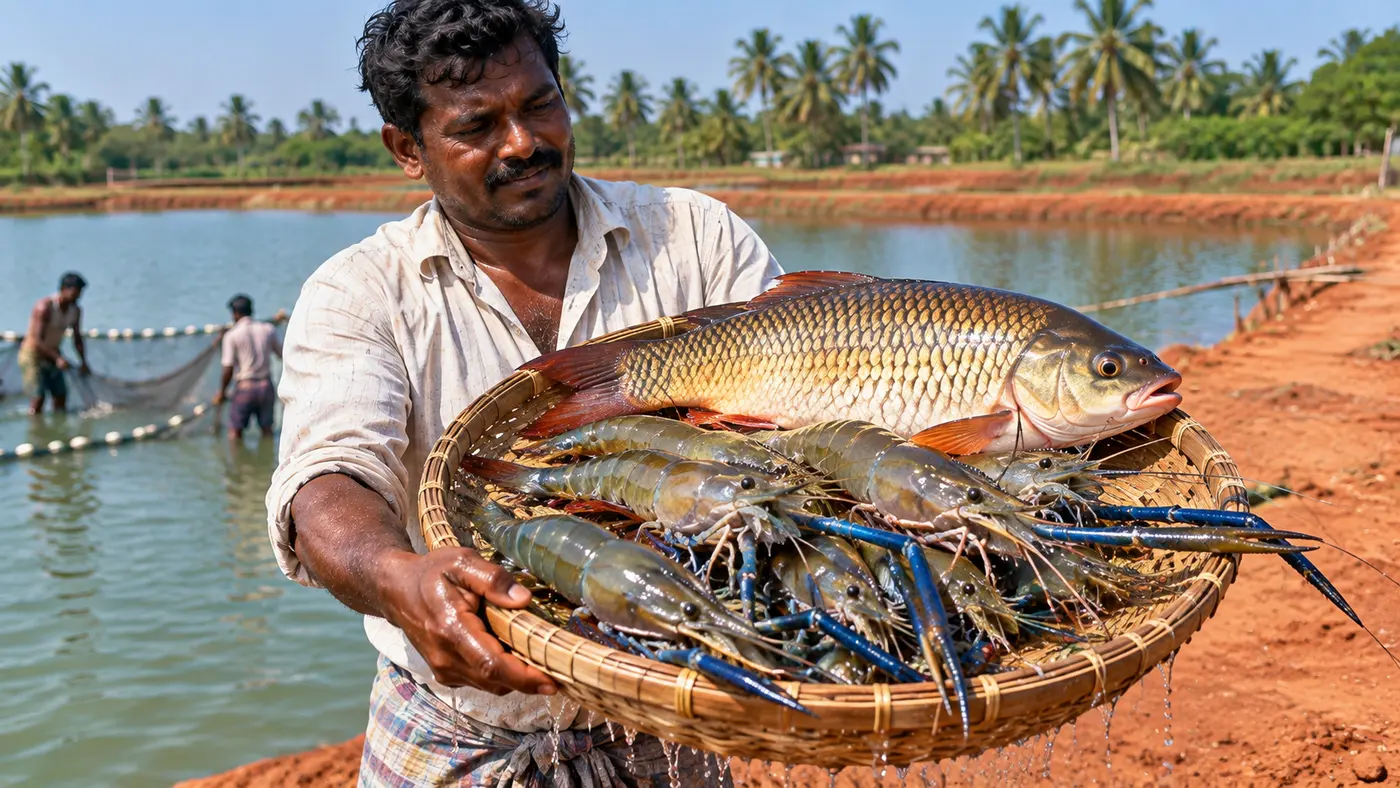
Executive Summary & Key Takeaways
- Scampi + Rohu polyculture is the single most effective margin-enhancer in Indian freshwater aquaculture, generating an extra ₹1.8 to ₹2.6 Lakhs net profit per acre without spending a single rupee on extra feed.
- The ecological synergy is flawless: Rohu feeds in the mid-water column, Catla grazes surface plankton, and benthic Scampi scavenges unconsumed sinking pellets, feces, and benthic worms from the pond bed.
- In conventional monoculture carp ponds, 15% to 22% of feed sinks uneaten, rotting into toxic black sludge that generates lethal hydrogen sulfide (H2S); Scampi transforms this organic waste into high-value export prawns.
- Stocking nursery-reared Scampi juveniles (3g to 5g size) is mandatory; never stock delicate post-larvae (PL-15) directly into carp ponds, as fish will accidentally ingest them.
- Benthic shelters prevent cannibalism: Scampi molt frequently and become defenseless soft-shelled prey; installing 200 to 300 benthic hideouts (PVC pipes, bamboo clusters, coconut fronds) raises prawn survival from 45% to over 78%.
- Overcoming Heterogeneous Individual Growth (HIG): Dominant Blue Claw (BC) males emit pheromones that dwarf smaller Orange Claw (OC) males; selective cull-harvesting BC males every 30 days unlocks rapid compensatory growth in remaining prawns.
- While Rohu sells at ₹130–₹160/kg, Scampi commands ₹480 to ₹650/kg from seafood exporters and metro markets, providing an instant 40% to 55% net profit expansion on existing carp pond acreage.
Commercial Polyculture Case Study: Capturing ₹3.92 Lakhs Net Profit by Integrating Scampi into a 1.2-Acre Andhra Carp Pond
A commercial freshwater fish producer in West Godavari district, Andhra Pradesh, culturing Rohu (Labeo rohita) and Catla (Gibelion catla) in a 1.2-acre earthen pond, faced stagnant operating margins due to escalating feed ingredient costs. Seeking to monetize the 18% unconsumed sinking feed that routinely accumulated as benthic sludge, the farmer partnered with AquaSangham freshwater advisory to deploy a Scampi + Carp polyculture blueprint: (1) Maintained the carp stocking density at 3,500 Rohu and 500 Catla fingerlings; (2) Added 5,500 nursery-reared Giant Freshwater Prawn (Macrobrachium rosenbergii) juveniles (averaging 4.5 grams) directly into the pond; (3) Installed 250 benthic hideouts (halved bamboo culms and bundled coconut fronds) across the pond bed to shield molting prawns from conspecific cannibalism; (4) Retained the existing commercial carp feed ration (32% CP sinking mash and pellets) with zero additional feed allocated for the prawns; and (5) Executed monthly selective cull-harvests of large Blue Claw (BC) males starting from Month 5 using large-mesh cast nets. At the 270-day final drainage harvest, the pond yielded 4,850 kg of table carps (worth ₹6.79 Lakhs) and 490 kg of export-grade Scampi prawns (averaging 75g to 110g, sold at ₹560/kg, generating ₹2.74 Lakhs). Total gross revenue reached ₹9.53 Lakhs against total pond expenses of ₹5.61 Lakhs (seed prawns cost only ₹16,500), securing a net profit of ₹3.92 Lakhs—a dramatic ₹1.22 Lakhs surplus over adjacent monoculture carp ponds on the exact same feed budget.
1. The Zero-Feed Profit Expansion: Why Scampi + Rohu Outearns Monoculture Carps by 40%
In the commercial freshwater fish belts of India—from the extensive Kolleru lake basin in Andhra Pradesh to the deltaic districts of West Bengal and Odisha—thousands of fish farmers are caught in a structural financial squeeze. The farmgate price of Indian Major Carps (specifically Rohu, *Labeo rohita*, and Catla, *Gibelion catla*) has remained stubbornly anchored between ₹130 and ₹160 per kilogram for years. Meanwhile, the prices of de-oiled rice bran (DORB), groundnut oil cake, commercial floating pellets, electricity, and diesel have surged by over 45%.
In an average 1-acre carp monoculture pond, a farmer feeds between 5.5 and 7.0 tons of feed over a 10-month production cycle, incurring an operational feed bill of ₹3.5 to ₹4.2 Lakhs. However, thermodynamic and biological field studies reveal a startling inefficiency: even under careful feeding management, **15% to 22% of all broadcast carp feed goes completely unconsumed by the fish**.
Pellets and mash crumble, dissolve, and sink to the bottom of the pond. There, this nutrient-dense organic matter rots in the anoxic sediment. It breeds heterotrophic bacteria, depletes precious nocturnal dissolved oxygen, generates lethal hydrogen sulfide (H2S) gas, and creates a thick layer of toxic black sludge that eventually forces the farmer to spend thousands of rupees on chemical bioremediation and post-harvest pond digging.
Now, consider the transformative economic alternative: **Scampi + Rohu Polyculture**. By stocking 4,000 to 5,000 nursery-reared juveniles of the Giant Freshwater Prawn (*Macrobrachium rosenbergii* / Scampi) into that exact same 1-acre carp pond, you introduce an obligate benthic scavenger that occupies the bottom water column. Scampi actively forages across the mud floor, devouring the sinking carp feed particles, unconsumed mash, fecal casts, and benthic insect larvae.
The farmer allocates **zero separate feed and zero additional feed expenditure** to the prawns. The Scampi grows entirely on the biological waste of the carps. At harvest, while the pond yields its standard 4,000 kg of Rohu and Catla, it yields a bonus harvest of **380 to 480 kilograms of export-grade live Scampi**. In Indian wholesale seafood markets and export packing houses, large Scampi prawns sell for **₹480 to ₹650 per kilogram**—over 3.5 times the price of Rohu! This produces an immediate, clean cash windfall of ₹2.0 to ₹2.8 Lakhs, elevating net farm profit from ₹1.4 Lakhs to **over ₹3.5 to ₹4.0 Lakhs per acre—a direct 40% to 55% net profit expansion on the exact same feed bill**.
Never stock post-larvae (PL-15) directly from hatcheries into a carp pond. Tiny 12mm prawn post-larvae will be grazed on by omnivorous carps. Nurse post-larvae in a small hapa or nursery pond for 30 to 45 days until they reach 3 to 5 grams (advanced juvenile size) before releasing them into the main pond.
2. Benthic Synergy & Pond Ecology: How Freshwater Prawns Clean Floors and Aerate Sludge
The reason Scampi (*Macrobrachium rosenbergii*) and Rohu (*Labeo rohita*) thrive so spectacularly together lies in their complementary ecological niches, perfected over millions of years of evolutionary divergence in tropical riverine ecosystems.
In ecological terminology, this is known as **Trophic Niche Partitioning**. A well-balanced polyculture pond utilizes all three vertical layers of the aquatic environment:
1. Surface Layer (Planktonic Zone): Catla (*Gibelion catla*), stocked at low densities (300 to 500 fish/acre), utilizes its upturned mouth and fine gill rakers to strain surface phytoplankton and zooplankton blooms, keeping the water clear and preventing sudden algal die-offs.
2. Mid-Water Column (Herbivorous / Detrital Zone): Rohu (*Labeo rohita*), stocked as the primary fish crop (3,000 to 3,500 fish/acre), possesses a sub-terminal mouth fringed with soft lips, browsing column plankton, submerged plant matter, and feeding actively on broadcast floating or slow-sinking pellets.
3. Benthic Floor (Demersal Scavenging Zone): Giant Freshwater Prawns (*Macrobrachium rosenbergii*), stocked at 4,000 to 5,000 juveniles/acre, live exclusively on the pond bottom. Equipped with sensitive chemosensory antennules and dexterous second chelipeds (claws), Scampi continuously patrols the benthic mud, scavenging organic detritus, uneaten fish feed fragments, broken bivalve shells, and aquatic oligochaete worms.
The Mechanical Aeration Bonus: Beyond nutrient recycling, Scampi performs an invaluable physical service known as **Bioturbation**. As hundreds of prawns walk across the pond bed using their walking pereiopods and fanning their pleopods (swimmerets), they continuously stir and aerate the top 2 centimeters of benthic sediment. This constant mechanical agitation prevents the formation of anaerobic crusts, allows dissolved oxygen to penetrate the soil-water interface, oxidizes lethal hydrogen sulfide (H2S) into harmless sulfate (SO4^2-), and stimulates autotrophic nitrifying bacteria that convert toxic ammonia into nitrate.
Water Quality Synergy: Dissolved Oxygen & Alkalinity
Both Rohu and Scampi require clean, well-oxygenated freshwater. Maintain dissolved oxygen above 4.0 mg/L at all times. During nocturnal hours, install a 2.0-HP paddlewheel aerator to prevent bottom stratification.
Water Alkalinity & Hardness: Giant freshwater prawns require dissolved minerals for cuticle hardening following each molt. Maintain total water alkalinity between 120 and 160 mg/L (as CaCO3) and total hardness above 100 mg/L. Broadcast agricultural limestone (CaCO3) @ 100 kg/acre every 45 days to supply essential calcium.
Salinity Limits for Scampi
While Scampi breeds in brackishwater hatcheries (12 ppt), growout is conducted in pure freshwater (0 to 2 ppt) or very low-salinity brackishwater (up to 5 ppt). Do not attempt Scampi culture in high-salinity shrimp ponds exceeding 8 ppt.
3. Stocking Density Ratios & Nursery Sizing Math: Rohu, Catla & Scampi Balancing
In polyculture, the delicate mathematical balance of stocking densities determines whether your pond functions as a thriving cooperative ecosystem or descends into competition and stunted growth.
If you overstock carps, fish crowding stresses the prawns and monopolizes oxygen. If you overstock Scampi beyond benthic carrying capacity, prawns fight over bottom territory, resulting in limb loss and suppressed growth. The scientifically validated stocking ratio for a 1.0-acre commercial earthen pond is:
1. Rohu (*Labeo rohita*): **3,000 to 3,500 fingerlings/acre** (stocking size: 50g to 80g fingerlings).
2. Catla (*Gibelion catla*): **300 to 500 fingerlings/acre** (stocking size: 75g to 100g fingerlings). Catla must never exceed 15% of the total fish stocking; overstocked Catla compete directly with Scampi for sinking organic matter.
3. Giant Freshwater Prawn (*Macrobrachium rosenbergii*): **4,000 to 5,000 advanced juveniles/acre** (stocking size: 3g to 5g, length 5cm to 7cm).
The Golden Staging Rule: Fish and prawns should not be introduced on the exact same day. Prepare the pond, fertilize organically to generate rich zooplankton blooms, and **stock the Scampi juveniles first**. Allow the prawns to establish their benthic territories and colonize benthic shelters for 7 to 10 days before releasing the carp fingerlings into the water column.
The 45-Day Nursery Staging SOP for Scampi
Hatcheries supply Scampi as fragile post-larvae (PL-15 to PL-20, weighing barely 0.02g). Rearing PL directly in open carp ponds results in 70%+ mortality.
Establish a 0.1-acre nursery pond or floating nylon hapas (1mm mesh). Stock PL at 200/m²; feed 40% CP micro-starter crumbles and boiled egg yolk for 45 days until juveniles attain 3g to 5g with an audited survival rate of 80% to 85%.
Disinfection Dip Before Pond Release
Dip advanced Scampi juveniles in a 10 ppm formalin or 2 ppm potassium permanganate bath for 5 minutes prior to pond stocking to eliminate external protozoan ectoparasites (Zoothamnium and Epistylis) picked up during nursery rearing.
4. Benthic Shelter Engineering: PVC Pipes, Bamboo Fronds & Molting Protection
The single greatest cause of mortality in freshwater prawn farming is conspecific cannibalism during the molting cycle. As an arthropod, a Scampi prawn must shed its rigid exoskeleton every 15 to 20 days to grow. The moment a prawn emerges from its old shell during ecdysis, its body is soft, velvety, and completely defenseless for 4 to 6 hours.
If a hard-shelled prawn encounters a newly molted, soft-shelled neighbor on an open, barren pond floor, it will ruthlessly attack and consume it. In unmanaged ponds with bare mud bottoms, cannibalism destroys 45% to 55% of the prawn population by Month 6.
To eliminate cannibalism and achieve **78% to 84% prawn survival**, the farmer must engineer an extensive network of **Benthic Artificial Shelters** across the pond floor before stocking. Benthic shelters expand the effective surface area of the pond bottom by over 200%, providing private, secure cavities where soft-shelled prawns can hide until their carapaces harden.
Optimal Low-Cost Benthic Shelters (Provide 200 to 300 shelter units per acre):
1. Split-Bamboo Culm Clusters: Take 1.5-meter lengths of thick bamboo, split them lengthwise, and tie 5 to 6 half-culms together in loose pyramidal clusters weighted with a brick. Distribute 50 clusters across the pond floor.
2. Perforated PVC Pipe Sections: 30cm to 40cm lengths of 50mm to 75mm scrap PVC drainage pipes tied in bundles of three. These provide smooth, durable, rot-proof artificial burrows.
3. Bundled Coconut Palm Fronds: Traditional dried coconut palm leaves tied in weighted bunches and anchored 15cm off the bottom with bamboo stakes. The dense, overlapping leaflets create natural underwater 'forests' where juvenile prawns browse micro-crustaceans in complete safety from both carps and larger prawns.
Substrate Distribution Pattern
Never dump all shelters in one central pile. Distribute shelters evenly along the deeper peripheral trench of the pond, approximately 3 to 4 meters away from the dike berms where prawns naturally congregate during daylight hours.
5. The Blue-Claw Cull-Harvesting Master Strategy: Overcoming Growth Suppression
In Scampi biology, males exhibit a bizarre, highly pronounced behavioral phenomenon known as **Heterogeneous Individual Growth (HIG)**. A single cohort of male prawns naturally differentiates into three distinct morphological and social morphotypes:
1. Blue Claw (BC) Males: The dominant alpha males, characterized by enormous, elongated, bright electric-blue claws (chelipeds) that can be twice the length of their body. BC males are territorial, aggressive, and attain massive weights of 90g to 140g.
2. Orange Claw (OC) Males: Subordinate fast-growing males with shorter, golden-orange claws, weighing 40g to 70g.
3. Small Males (SM): Dwarf, non-territorial males with clear, translucent claws, weighing barely 15g to 30g.
The Social Suppression Trap: Blue Claw males emit chemical pheromones and physically intimidate Orange Claw and Small males, suppressing their molting frequency and growth. As long as a dominant BC male patrols a territory, the surrounding OC and SM males cannot molt or grow larger. If a farmer waits until Month 9 to drain the pond in a single harvest, they will find only a few massive BC males and hundreds of stunted, unmarketable small prawns.
The Master Solution: **Monthly Selective Cull-Harvesting**. Starting from **Month 5**, the farmer begins partial harvesting every 25 to 30 days using a large-mesh cast net (mesh size 40mm to 50mm) or selective drag seine. The large mesh catches only the massive 80g+ Blue Claw males and berried (egg-bearing) females, while allowing smaller OC and SM males and juvenile carps to escape unharmed.
The moment the dominant Blue Claw males are removed and sold at peak market rates, the social suppression is broken. Within 10 to 14 days, the largest Orange Claw males undergo a metamorphic molt, developing blue claws and doubling their body weight. By repeating this selective cull-harvest 4 to 5 times between Month 5 and Month 9, the farmer effectively 'harvests the cream' multiple times, multiplying total prawn yield by **60% to 80%** compared to a single final harvest.
Handling Berried (Egg-Carrying) Females
Mature female Scampi carry an external sponge-like mass of bright orange eggs beneath their abdominal pleopods. In wholesale markets, berried females command full price. However, progressive farmers can sell live berried females to local prawn hatcheries at a 25% premium (₹700 to ₹800/kg) as certified wild broodstock.
6. Comprehensive 1-Acre Commercial P&L: Monoculture Carp vs Polyculture Comparison
To demonstrate the definitive financial advantage of polyculture, we present an audited comparative profit and loss (P&L) statement benchmarking a standard **1.0-Acre Carp Monoculture Pond** against an identical **1.0-Acre Scampi + Rohu Polyculture Pond** operating across a 270-day production cycle in coastal Andhra Pradesh.
In the monoculture pond, 4,000 Rohu and Catla fingerlings consume 6,000 kg of commercial feed (FCR 1.50), yielding 4,000 kg of fish sold at ₹140/kg for gross sales of ₹5,60,000. Total operational expenses equal ₹4,15,000, leaving a net profit of **₹1,45,000**.
In the polyculture pond, the exact same 4,000 carps are stocked and fed the exact same 6,000 kg of feed. In addition, 4,500 Scampi juveniles (costing ₹15,750) are stocked into the benthic layer. The Scampi consumes the unconsumed sinking feed waste, yielding 430 kg of prime prawns (averaging 80g) sold at ₹540/kg (generating ₹2,32,200 in bonus revenue).
Total gross revenue surges to **₹7,92,200**, while total operating costs increase by only ₹33,750 (seed prawns and harvesting labor), delivering a spectacular net profit of **₹3,43,450 per acre**—an extraordinary **₹1,98,450 (+136%) net cash surplus** achieved on the exact same feed budget!
The detailed commercial balance sheet below illustrates the precise line-item economic breakdown.
| Operational & Financial Parameter | 1-Acre Carp Monoculture (Rohu + Catla) | 1-Acre Scampi + Rohu Polyculture | Polyculture Economic Bonus |
|---|---|---|---|
| Carp Seed Stocking (Fingerlings) | 3,500 Rohu + 500 Catla (₹ 18,000) | 3,500 Rohu + 500 Catla (₹ 18,000) | Identical carp stocking density |
| Scampi Seed Stocking (Juveniles) | 0 (Zero Prawns) | 4,500 juveniles @ ₹3.50 (₹ 15,750) | Minor seed investment for huge upside |
| Total Feed Consumed (Pond) | 6,000 kg (Mash & Pellets) | 6,000 kg (Identical carp ration) | Zero extra feed allocated to Scampi |
| Total Feed Expenditure | ₹ 3,42,000 (@ ₹57/kg avg) | ₹ 3,42,000 (@ ₹57/kg avg) | ₹ 0 / Nil additional feed cost |
| Pond Maintenance, Power & Labor | ₹ 55,000 (Lease, power, labor) | ₹ 73,000 (Includes prawn cull-harvest) | + ₹18,000 labor for selective harvests |
| TOTAL OPERATING EXPENDITURE | ₹ 4,15,000 | ₹ 4,48,750 | + ₹33,750 total additional cost |
| Carp Harvest Realization | 4,000 kg @ ₹140/kg = ₹ 5,60,000 | 4,000 kg @ ₹140/kg = ₹ 5,60,000 | Carp yield completely unaffected |
| Scampi Harvest Realization | ₹ 0 / Nil | 430 kg @ ₹540/kg = ₹ 2,32,200 | + ₹2,32,200 high-value export revenue |
| TOTAL GROSS REVENUE | ₹ 5,60,000 | ₹ 7,92,200 | + ₹2,32,200 gross cash expansion |
| NET OPERATING PROFIT / ACRE | ₹ 1,45,000 | ₹ 3,43,450 | + ₹1,98,450 (+136.8% NET PROFIT) |
In corporate contract farming or leased land, adopting Scampi polyculture is the single fastest way to pay off high annual land lease rentals (which often run ₹40,000 to ₹60,000/acre). The bonus Scampi crop alone covers 100% of your annual land lease and electricity bills, leaving all carp revenues as pure profit.
7. Operational Field SOP Checklist & Frequently Asked Questions
To capture the audited benchmark of 78%+ prawn survival and an extra ₹1.8+ Lakhs net profit per acre, farm managers must execute operations with disciplined precision. Below is the non-negotiable operational checklist for Scampi + Rohu polyculture, followed by expert solutions to critical field questions.
The 6-Rule Field SOP Action Checklist for Scampi + Rohu Polyculture
1. 45-Day Juvenile Pre-Rearing: Never stock hatchery post-larvae directly into carp ponds; nurse PL to 3g–5g advanced juveniles before stocking.
2. Scampi-First Stocking Priority: Release Scampi juveniles 7 to 10 days before introducing carp fingerlings to allow prawns to establish benthic territories.
3. 250+ Benthic Shelter Units: Install a minimum of 250 PVC pipe bundles, bamboo clusters, or coconut fronds per acre to suppress molting cannibalism.
4. Month-5 Blue-Claw Cull Harvest: Begin monthly selective cast-net harvesting of large 80g+ Blue Claw males on Day 150 to break social growth suppression.
5. 120+ ppm Water Alkalinity: Apply agricultural limestone @ 100 kg/acre every 45 days to maintain dissolved calcium for rapid shell calcification.
6. Live Ice Slurry Packing: Chill harvested Scampi immediately in a 1:1 freshwater-slurry ice bath (0°C) to prevent black spot melanosis and head softening.
Summary Operational Action Checklist
Frequently Asked Questions
Q: Do Rohu or Catla fish eat the Scampi prawns in a polyculture pond?
No, adult Rohu and Catla are non-predatory herbivores and planktivores with toothless jaws and soft gill rakers; they physically cannot bite or chew juvenile prawns. The only time carps might consume prawns is if microscopic 12mm post-larvae (PL) are stocked directly, which carps may accidentally swallow while grazing. Stocking advanced 3g to 5g juveniles completely eliminates this risk.
Q: Can I add Scampi to Pangasius catfish ponds?
Polyculture of Scampi with Pangasius is NOT recommended. Pangasius (*Pangasianodon hypophthalmus*) is an aggressive, heavy-feeding benthic feeder that vigorously disturbs the pond bottom, competes directly for bottom detritus, and can harass molting prawns. Scampi thrives best alongside Indian Major Carps (Rohu, Catla, Mrigal) and Silver Carp.
Q: Why do some farmers report low Scampi survival (<40%) in polyculture?
Low survival is caused by two avoidable mistakes: (1) Stocking hatchery PL-15 directly into the pond where they starve or get sucked into mud; and (2) Zero benthic shelters. Because Scampi molt every 2 to 3 weeks, soft-shelled prawns on a bare pond bottom are cannibalized by hard-shelled prawns. Providing 250 benthic hideouts per acre raises survival from 40% to over 78%.
Q: Where can farmers sell harvested Scampi in India?
Scampi has exceptional commercial liquidity across two channels: (1) Export Seafood Processing Plants in Visakhapatnam, Kakinada, Kochi, and Kolkata, which purchase whole Head-On (HOSO) and Headless (HL) prawns for air-freight to the USA, Europe, and Japan; and (2) Domestic Metro Mandis (Hyderabad, Bengaluru, Chennai, Mumbai) where live, large Blue Claw prawns command ₹550 to ₹650/kg in luxury seafood retail.
AquaSangham Freshwater Advisory
Polyculture & Benthic Crustacean Management Division
Contributing Senior Technical Writer & Aqua Consultant at AquaSangham.
Recommended Farming Guides
The 3 AM Oxygen Trap: Why Fish and Shrimp Die at Dawn (And The 4.0 ppm Rule That Saves Them)
Read Article →Water QualityWhy Sudden Monsoon Rain Wipes Out Shrimp Overnight (And The 30-Minute Emergency Lime Protocol That Saves Your Pond)
Read Article →Market AnalysisEU & US Seafood Traceability Audits: Keeping Digital Farm Logs to Secure ₹15-₹20/kg Premium from Exporters
Read Article →Get Live Farm Advice on AquaSangham Mobile App
Download India's #1 Aquaculture Super App for real-time market prices, precision tools, and community advice.
Download Free Android App