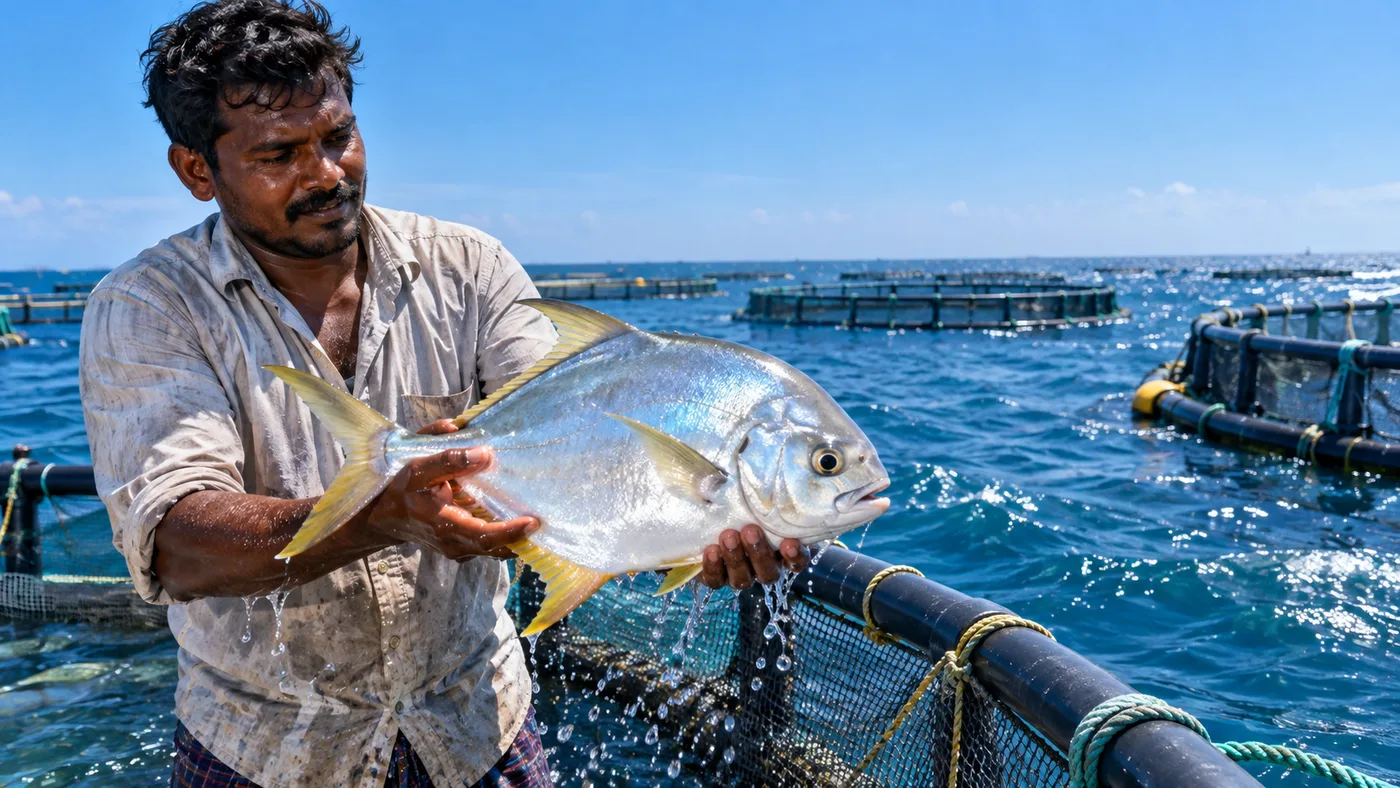
Executive Summary & Key Takeaways
- Silver Pompano (Trachinotus blochii) is rapidly emerging as India's most profitable marine finfish, outearning Asian Seabass in operational efficiency due to its peaceful schooling nature and complete absence of juvenile cannibalism.
- While Seabass requires 10 to 12 months to attain a 1.2 kg market size, Pompano reaches the prime restaurant 'single-portion table size' (450g to 600g) in just 6 to 7 months, allowing farmers to complete two crops per year.
- Nursery survival in Pompano routinely exceeds 92% to 96% with minimal size-grading labor, compared to Seabass where cannibalism often destroys 40% to 60% of un-graded fingerlings.
- Pompano possesses wide euryhaline adaptability: thriving across salinities from 10 ppt to 35 ppt, making it ideal for coastal earthen ponds, lined shrimp ponds, estuarine creeks, and open-sea floating HDPE cages.
- Feeding is simple and cost-effective: Pompano voraciously consumes 40%–42% crude protein commercial floating extruded pellets, achieving an efficient biological FCR of 1.45 to 1.65 with zero dependence on fresh trash fish.
- High dissolved oxygen is non-negotiable: Pompano are pelagic, high-metabolism swimmers requiring continuous dissolved oxygen above 5.0 ppm; provide 4.0 to 6.0 HP of paddlewheel aeration per acre in pond culture.
- A 1-acre coastal pond stocked at 8,000 to 10,000 fingerlings produces 3.8 to 4.5 metric tons of table fish in 200 days, generating ₹7.2 to ₹9.5 Lakhs net profit per crop (over ₹15 Lakhs annualized across two cycles).
Commercial Mariculture Case Study: Transforming a Coastal Shrimp Pond into a ₹8.42 Lakh Profit Silver Pompano Monoculture
A commercial mariculture operator in Ramanathapuram, Tamil Nadu, seeking to de-risk his coastal farm after recurring viral white-spot outbreaks in tiger shrimp, transitioned a 1.0-acre coastal pond (salinity 26 ppt) to Silver Pompano (Trachinotus blochii) monoculture. Partnering with AquaSangham mariculture advisory, the farm executed three core protocols: (1) Procured 8,500 certified disease-free Pompano fingerlings (3.0 cm) from the ICAR-CMFRI Mandapam Regional Centre, rearing them in four floating nursery hapas (6m x 3m x 1.5m) for 30 days until reaching 35g advanced fingerlings with a stellar 95.8% nursery survival; (2) Stocked 8,140 graded fingerlings into the growout pond equipped with four 2.0-HP long-arm paddlewheel aerators operating during nocturnal hours to keep dissolved oxygen above 5.2 ppm; (3) Weaned fish entirely onto 40% crude protein commercial marine floating extruded pellets (2.0mm transitioning to 4.0mm) fed twice daily in anchored feeding rings at 3.5% body weight daily. Over 195 days, the fish grew rapidly, exhibiting schooling harmony with zero cannibalism. The harvest yielded 4,180 kg of gleaming, diamond-shaped Pompano averaging 520 grams with 94.1% overall survival and a commercial FCR of 1.52. Marketed iced in slurry to premium seafood buyers and hotel consolidators in Madurai and Chennai at ₹415/kg, gross revenue reached ₹17.34 Lakhs against total operational expenditures of ₹8.92 Lakhs (feed ₹5.25 L, seed fingerlings ₹1.70 L, electricity, labor, and lease ₹1.97 L), securing a net profit of ₹8.42 Lakhs in under 7 months.
1. The Tropical Salmon Revolution: Why Silver Pompano Outearns Seabass and Carps
In the competitive world of commercial mariculture, the ideal aquaculture fish has long been defined by five holy-grail criteria: (1) High consumer market value; (2) Rapid growth rate to single-portion table size; (3) Complete acceptance of dry commercial extruded pellets; (4) High survival with minimal cannibalism; and (5) Resistance to common coastal water diseases.
While Asian Seabass (Bhetki) has captured immense farmer interest due to its ₹600/kg price tag, it falls short on two critical operational metrics: its aggressive juvenile cannibalism demands round-the-clock grading every 4 days, and its long 10-to-12-month culture cycle ties up expensive working capital. Conversely, shrimp farming offers rapid 90-day cycles but exposes coastal farmers to devastating viral wipeouts (WSSV, EHP, and IMNV).
Enter **Silver Pompano** (*Trachinotus blochii*)—celebrated across international seafood markets as the **Tropical Salmon** or **White King**. Silver Pompano is a pelagic carangid fish with a deep, laterally compressed diamond-shaped body, brilliant mirror-like silver scales, and vibrant golden-yellow fins. In culinary circles, Pompano is prized for its firm, snow-white meat, rich healthy marine fat profile (high in heart-healthy EPA and DHA omega-3s), and completely boneless fillets containing only a central spine.
In Indian wholesale seafood auctions, high-end retail supermarkets, and five-star hotel chains, fresh Silver Pompano commands farmgate prices between **₹360 and ₹450 per kilogram**. It serves as the supreme domestic substitute for wild Silver Pomfret (*Pampus argenteus*), which has become increasingly scarce and expensive due to marine overfishing.
What truly elevates Silver Pompano above Asian Seabass is its phenomenal biological velocity: while Seabass requires a full year to attain a 1.2 kg harvest weight, Pompano reaches the prime restaurant single-portion table size (**450 grams to 600 grams**)—the exact size preferred by chefs for whole-grilled or pan-roasted seafood presentations—in just **180 to 210 days (6 to 7 months)**. Furthermore, Pompano fingerlings exhibit zero cannibalism, allowing nursery survival to consistently exceed 94% to 96% with a fraction of the labor required for Seabass.
Target the 450g to 550g harvest bracket. In the Indian restaurant and hotel trade, single-portion whole fish commanding ₹200 to ₹250 per piece on menus are the highest-velocity sellers. Growing Pompano past 700g slows your growth curve and increases feed FCR without providing an equivalent price premium per kilogram.
2. Species Biology & Physiological Advantages: The Zero-Cannibalism Superpower
Silver Pompano (*Trachinotus blochii*), belonging to the family Carangidae, inhabits tropical coral reefs, coastal rocky shoals, and shallow estuarine mouths across the Indo-Pacific. Understanding its evolutionary biology reveals why it is uniquely suited to intensive commercial farming:
1. Complete Absence of Sibling Cannibalism: Unlike Asian Seabass or Murrel, which possess cavernous predatory maws and swallow siblings whole, Silver Pompano possesses a small, sub-terminal mouth with fine villiform teeth designed for browsing benthic molluscs, crustaceans, and pelagic zooplankton. Even when fingerlings exhibit a 20% to 30% size disparity in nursery hapas, Pompano never attack or cannibalize their smaller siblings. This single physiological trait eliminates the grueling 4-day grading labor required in Seabass nurseries and secures baseline nursery survival exceeding 92% to 96%.
2. Euryhaline Osmoregulation: While Pompano spawns in marine waters (32 to 35 ppt), juveniles and adults are remarkably euryhaline. They thrive in salinities between **10 ppt and 35 ppt**, and can be acclimated to brackishwater ponds with salinities as low as **5 to 8 ppt**. This allows shrimp farmers in Andhra Pradesh, Tamil Nadu, and Gujarat to stock Pompano in coastal shrimp ponds and inland estuarine creeks without investing in expensive marine water intake infrastructure.
3. Schooling & Docile Temperament: Pompano are obligate schooling fish. When stocked at high densities in ponds (8,000 to 10,000 fish/acre) or floating sea cages (30 to 40 fish/m³), schooling behavior reduces territorial stress and stimulates competitive feeding frenzy. The entire population rushes to the water surface the moment floating pellets are broadcast, consuming 100% of the feed within 10 to 12 minutes.
Dissolved Oxygen & Hydrodynamic Demands
Pompano are continuous, fast-swimming pelagic fish with high metabolic oxygen consumption rates. In coastal earthen ponds, ambient dissolved oxygen must remain strictly above 5.0 mg/L. Unlike bottom-dwelling catfish, Pompano cannot tolerate hypoxic conditions (DO < 3.0 ppm).
Pond aeration must be sized aggressively: install 4.0 to 6.0 HP of paddlewheel aerators per acre, operating continuously during nocturnal hours (10:00 PM to 06:00 AM) and on overcast afternoons.
Thermal Tolerance Thresholds
Optimal growth occurs between 27°C and 32°C. Below 22°C (during North Indian winter months), feed consumption drops by 50%. Coastal southern and western India (Tamil Nadu, Kerala, Andhra Pradesh, Maharashtra, and Gujarat) provide year-round 26°C+ thermal profiles ideal for continuous dual-crop production.
3. Hatchery Seed Sourcing & Nursery Rearing: 30-Day Protocol to 35g Fingerlings
In commercial mariculture, seed quality dictates the entire crop trajectory. In India, commercial seed production of Silver Pompano was successfully standardized by the Central Marine Fisheries Research Institute (ICAR-CMFRI). Today, certified disease-free, induced-bred Pompano seed is produced at ICAR-CMFRI marine hatcheries in Mandapam (Tamil Nadu), Visakhapatnam (Andhra Pradesh), and Karwar (Karnataka), as well as private commercial marine hatcheries in Tamil Nadu and Gujarat.
Farmers purchase Pompano fry at the **1.0 to 1.5-inch stage (2.5 cm to 3.0 cm length, weighing 1.5g to 2.5g)**. Sourcing costs typically range from **₹15 to ₹20 per fry** delivered at farm gate.
The 30-Day Nursery Rearing SOP: Fry must never be stocked directly into open earthen ponds. They must be reared in floating nursery hapas (6m x 3m x 1.5m, 2mm knotless nylon mesh) suspended in a clean, predator-free brackishwater pond or concrete nursery tanks at a stocking density of 250 to 300 fry per square meter.
Feeding Protocol: Pompano fry are aggressive, surface-oriented feeders with rapid metabolisms. Feed commercial micro-extruded high-protein floating pellets (45% crude protein, 10% crude fat, pellet size 0.8mm to 1.2mm). Feed 4 times daily (07:00 AM, 11:00 AM, 03:00 PM, and 06:30 PM) at 8% to 10% of body weight daily. The feed must contain high marine fishmeal and lecithin to support rapid skeletal ossification.
By Day 30, the fry attain **advanced fingerling size (8 cm to 10 cm length, weighing 30g to 35g)** with a survival rate of **94% to 96%**. These robust, active fingerlings are now fully armed against aquatic predators and ready for growout stocking.
Acclimation & Salinity Matching Protocol
Hatchery fry are delivered in 28 to 32 ppt seawater. When transferring to lower-salinity farm ponds (e.g. 15 ppt), float shipping oxygen bags in the nursery pond for 30 minutes for temperature equalization.
Gradually exchange bag water with pond water over 45 minutes, ensuring salinity differential does not exceed 3 ppt per hour before releasing the fry.
4. Coastal Earthen Ponds vs Open-Sea Floating Cages: Siting & Water Flow
Commercial production of Silver Pompano in India is successfully executed across two distinct culture environments: Coastal Earthen/Lined Ponds and Open-Sea / Estuarine Floating HDPE Cages.
System 1: Coastal Earthen & Lined Ponds (The Shrimp Farmer's Salvation). Earthen ponds measuring 0.5 to 1.5 acres with water depths of 1.2 to 1.5 meters are the primary production vehicle in Andhra Pradesh, Tamil Nadu, and Gujarat. Ponds should feature central drainage sumps and clay-loam or HDPE-lined bottoms. Stocking density is **8,000 to 10,000 advanced fingerlings (35g size) per acre**.
The immense advantage of pond culture is biosecurity, ease of daily management, and complete protection from open-sea storms and monsoon swells. Furthermore, converting abandoned shrimp ponds requires minimal capex—existing sluice gates, dikes, and electrical connections can be utilized immediately.
System 2: Open-Sea & Estuarine Floating HDPE Cages. Floating circular HDPE cages (standard 6.0-meter diameter x 4.0-meter net depth, holding roughly 110 m³ of water volume) are installed in protected bays, coastal coves, and deep estuarine channels (such as the Gulf of Mannar, Karwar bay, and Veraval coast). Cages are stocked at **30 to 40 fingerlings per m³ (3,500 to 4,500 fish per cage)**.
The advantage of cage culture is zero pumping or electrical aeration costs: natural tidal currents provide continuous, pristine oxygenated seawater exchange, resulting in faster growth rates and pristine flesh quality. However, cage farming requires motorized boats, scuba divers for net maintenance, and secure mooring grids capable of withstanding monsoon storm swells.
Floating Feed Ring Installation in Ponds
Pompano consume floating pellets aggressively. In windy coastal ponds, surface wind drift pushes pellets onto grassy dikes before fish can finish them.
Anchor three 4m x 4m floating feeding squares (constructed of 50mm PVC pipe) in the pond corners. Broadcast feed exclusively inside these rings; fish swarm beneath the frames, consuming 100% of feed with zero wastage.
5. Growout Nutrition & Feeding SOP: 40% CP Extruded Pellets & FCR Optimization
In commercial mariculture, feed represents 60% to 65% of total operating expenditure. Achieving high profitability depends entirely on selecting the correct feed formulation and maintaining tight biological FCR.
Commercial Pelleted Diet Specifications: Unlike slow-digesting herbivorous fish, pelagic Pompano possess high metabolic rates and require nutrient-dense diets. The commercial feed must be **100% slow-floating extruded aquafeed** meeting strict nutritional benchmarks: (1) **Crude Protein: 40% to 42%** derived from high-grade steam-dried marine fishmeal and krill meal; (2) **Crude Lipid: 8% to 10%** marine fish oil rich in EPA and DHA; (3) **Crude Fiber: < 4.0%**; and (4) **Digestible Energy: > 16.0 MJ/kg**.
Pellet Size Progression: As fish grow, pellet size must be upgraded promptly to prevent energy loss during feeding: (1) Fingerlings (35g to 100g): 2.0mm pellets; (2) Juveniles (100g to 250g): 3.0mm pellets; (3) Finishing Table Fish (250g to 550g): 4.0mm to 5.0mm pellets.
Feeding Regimen & Satiety Management: Feed twice daily: **40% of the daily ration at 07:30 AM** and **60% at 05:30 PM**. Feed at **4.0% to 4.5% of standing biomass daily** during early growout (up to 150g), tapering to **2.8% to 3.2%** during mid-growout, and **2.0% to 2.2%** during the final 45 days before harvest. Following this disciplined feeding schedule maintains commercial FCR strictly between **1.45 and 1.65**, keeping feed cost per kilogram of fish produced under **₹125 to ₹140**.
Avoiding Compressed Sinking Pellets
Never feed cheap, compressed sinking pellets or agricultural mash. Sinking pellets plunge directly into the pond mud where pelagic Pompano refuse to feed, causing immediate benthic soil fouling and wasted feed capital.
6. Parasite Biosecurity & Health: Managing Benedenia Flukes with Freshwater Dips
Silver Pompano is remarkably rugged against bacterial and viral epizootics. They are 100% immune to White Spot Syndrome Virus (WSSV) and Enterocytozoon hepatopenaei (EHP) that plague shrimp farms, and exhibit high natural resistance to vibriosis in well-aerated water.
The primary health challenge in marine and high-salinity cage/pond culture is the marine ectoparasitic skin fluke **Benedenia seriolae** and **Neobenedenia melleni** (monogenean trematodes). These transparent, disc-shaped flukes attach to the fish's cornea, head, and flank scales using sharp chitinous hooks (haptors), feeding on epidermal epithelial cells and mucus.
Symptoms of Fluke Infestation: Heavily infested Pompano exhibit 'flashing' (rubbing their sides against cage nets or aeration pipes), clouded eyes (cataracts), frayed fins, and loss of appetite. If left untreated, secondary bacterial ulcerations occur, leading to mortality.
The 5-Minute Chilled Freshwater Dip Protocol: Fortunately, marine monogenean flukes have a fatal biological weakness: they possess zero osmotic tolerance to freshwater. When an infested marine fish is placed in pure freshwater (0 ppt), the sudden osmotic pressure change causes the flukes to absorb water rapidly, burst, and detach within 3 to 5 minutes, turning opaque white and dropping to the tub floor.
In cage culture or pond handling, submerge fish in a 500-liter tub of clean, aerated freshwater for **strictly 4 to 5 minutes**. Pompano (being euryhaline) easily tolerate this short freshwater bath without stress, while 100% of attached flukes are destroyed. Performing a prophylactic freshwater dip every 60 days guarantees completely clean, pristine fish.
Marine White Spot (Cryptocaryon irritans) Prevention
In high-salinity summer ponds, the ciliate protozoan Cryptocaryon can cause tiny white nodules on skin and gills. Maintaining strong water circulation and broadcasting copper sulphate (CuSO4) @ 0.5 ppm or reducing pond salinity by 5 ppt through freshwater addition halts the parasite life cycle immediately.
7. Comprehensive 1-Acre Commercial P&L: Capex, Dual-Crop Budgets & Net Realization
To provide a realistic investment roadmap for commercial mariculture entrepreneurs and coastal landowners, we analyze the fully audited commercial P&L for a 1.0-acre intensive Silver Pompano crop operating over a 200-day production cycle in India.
The model is based on stocking **8,500 certified, nursery-reared 35g fingerlings** in a 1.0-acre earthen or lined coastal pond (22 ppt salinity). Benefiting from zero cannibalism and 40% CP floating extruded pellet feeding, overall survival is benchmarked at a conservative **92%**, yielding **7,820 harvestable table fish**. Over 200 days of culture with a commercial FCR of 1.55, the fish reach an average table weight of **520 grams**, generating **4,066 kilograms of prime Silver Pompano**.
Sold at a realistic wholesale farmgate realization of **₹410 per kilogram** to live seafood buyers and cold-chain distributors serving Chennai, Bengaluru, and Mumbai hotel chains, gross revenue reaches **₹16,67,060 (₹16.67 Lakhs)**. Total operating costs—including fingerling procurement (₹1.70 L), 40% CP commercial extruded feed (₹5.25 L), electricity for paddlewheel aeration (₹1.40 L), pond lease, labor, and harvesting logistics (₹1.45 L)—totals **₹9.80 Lakhs**, delivering an audited net operating profit of **₹6.87 Lakhs per single crop**.
Because the crop completes in just 6.5 months, coastal farmers in southern and western India operate **Two Crops Per Calendar Year**, doubling their annual net operating profit to **₹13.70 Lakhs to ₹16.50 Lakhs per acre**—generating more net income with far lower biological risk than intensive shrimp monoculture.
The comparative matrix below benchmarks the commercial performance of Silver Pompano against Asian Seabass, Cobia, and Grey Mullet across an identical 1-acre farm footprint.
| Commercial Benchmark | Silver Pompano (T. blochii) | Asian Seabass (L. calcarifer) | Cobia (R. canadum) | Grey Mullet (M. cephalus) |
|---|---|---|---|---|
| Nursery Cannibalism Risk | 0% (Zero Cannibalism) | Extremely High (50–80%) | Moderate (15–25%) | 0% (Herbivorous/Detritivore) |
| Culture Cycle Duration | 6 – 7 Months (to 520g) | 10 – 12 Months (to 1.2kg) | 12 – 14 Months (to 3.5kg) | 8 – 10 Months (to 600g) |
| Wholesale Farmgate Price | ₹ 360 – ₹ 450 / kg | ₹ 520 – ₹ 680 / kg | ₹ 380 – ₹ 460 / kg | ₹ 280 – ₹ 360 / kg |
| Target Harvest Size | 450 g – 600 g (Single Plate) | 1.0 kg – 1.3 kg (Large) | 3.0 kg – 4.5 kg (Jumbo) | 500 g – 750 g |
| Commercial FCR (Pellets) | 1.45 – 1.65 | 1.35 – 1.50 | 1.60 – 1.85 | 1.30 – 1.50 |
| Crops Achievable / Year | 1.8 to 2.0 Crops / Year | 1.0 Crop / Year | 0.8 Crop / Year | 1.0 Crop / Year |
| ANNUAL NET PROFIT / ACRE | ₹ 13,70,000 – ₹ 16,50,000 | ₹ 10,50,000 – ₹ 14,20,000 | ₹ 8,50,000 – ₹ 11,20,000 | ₹ 3,50,000 – ₹ 5,20,000 |
To maximize export-grade freshness, harvest Pompano at night or early dawn. Pack fish immediately in a 1:1 freshwater-slurry ice bath (0°C). Chilling within 5 minutes of harvest preserves the dazzling mirror-silver luster of the scales, completely prevents black spot melanosis, and commands a ₹25/kg premium from metro seafood consolidators.
8. Operational Field SOP Checklist & Frequently Asked Questions
To achieve the commercial benchmark of 92%+ survival, 1.55 FCR, and ₹7+ Lakhs net profit per crop, farm managers must execute daily operations with disciplined technical rigor. Below is the non-negotiable operational checklist for commercial Silver Pompano culture, followed by expert solutions to critical production challenges.
The 6-Rule Field SOP Action Checklist for Silver Pompano
1. 30-Day Floating Hapa Nursery: Rear fry in fine-mesh hapas for 30 days until reaching 35g advanced fingerlings before releasing into open ponds.
2. 5.0+ ppm Continuous DO: Maintain nighttime paddlewheel aeration (minimum 4 to 6 HP/acre) to satisfy pelagic metabolic oxygen demands.
3. 40%+ CP Floating Extruded Feed: Feed strictly high-protein marine floating pellets; avoid compressed sinking feeds or agricultural mashes.
4. Confined PVC Ring Feeding: Broadcast pellets strictly inside anchored floating PVC feeding rings to prevent wind drift onto grassy dikes.
5. 5-Minute Freshwater Fluke Bath: Execute prophylactic 5-minute freshwater dips if fish exhibit flashing or gill flukes (*Benedenia*).
6. Immediate 1:1 Slurry Ice Pack: Harvest fish directly into 1:1 freshwater-slurry ice to lock in glistening silver scales and pristine flesh quality.
Summary Operational Action Checklist
Frequently Asked Questions
Q: Can Silver Pompano be cultured in freshwater ponds with zero salinity?
While Silver Pompano is euryhaline and can survive temporary drops to 2–3 ppt, it is fundamentally a marine carangid fish. Optimal growth and immune resilience require a minimum salinity of 8 to 10 ppt, with 15 to 28 ppt representing the physiological sweet spot. In pure freshwater (0 ppt), Pompano experience chronic osmoregulatory stress, slow growth, and heightened vulnerability to bacterial infections.
Q: Why does Silver Pompano grow faster than Asian Seabass?
Pompano reaches market table size (450g–600g) in 6 to 7 months because it has a continuous, rapid schooling feed response and reaches its commercial harvest endpoint at a smaller body size. Seabass requires 10 to 12 months because the market demands a 1.0 kg to 1.5 kg fish for thick fillets. Furthermore, Pompano wastes zero metabolic energy on territorial fighting or cannibalism, converting feed directly into somatic muscle growth.
Q: Can Pompano be cultured in HDPE-lined shrimp ponds without modifying the dikes?
Yes! Silver Pompano is the single best finfish crop for converting HDPE-lined shrimp ponds. The smooth plastic liner prevents burrowing parasites, allows high-speed circular water currents from paddlewheel aerators, and central drain sumps allow easy daily sludge flushing. Stocking density in lined ponds with 6 HP aeration can be increased to 12,000 fingerlings per acre.
Q: Where can farmers sell harvested Silver Pompano in India?
Silver Pompano has strong demand across three primary commercial channels: (1) Wholesale coastal fish mandis (Chennai, Visakhapatnam, Kochi, Mumbai, and Mangalore) where it auctions as an alternative to wild Pomfret; (2) Premium retail seafood supermarket chains and e-commerce platforms (FreshToHome, Licious) selling whole cleaned fish; and (3) Star hotels and coastal tourist resorts that feature whole-grilled Pompano on high-end seafood menus.
AquaSangham Commercial Mariculture Desk
Marine Finfish & Open-Water Mariculture Division
Contributing Senior Technical Writer & Aqua Consultant at AquaSangham.
Recommended Farming Guides
The 3 AM Oxygen Trap: Why Fish and Shrimp Die at Dawn (And The 4.0 ppm Rule That Saves Them)
Read Article →Water QualityWhy Sudden Monsoon Rain Wipes Out Shrimp Overnight (And The 30-Minute Emergency Lime Protocol That Saves Your Pond)
Read Article →Market AnalysisEU & US Seafood Traceability Audits: Keeping Digital Farm Logs to Secure ₹15-₹20/kg Premium from Exporters
Read Article →Get Live Farm Advice on AquaSangham Mobile App
Download India's #1 Aquaculture Super App for real-time market prices, precision tools, and community advice.
Download Free Android App