Executive Summary & Key Takeaways
- Electrical power and diesel generator backup represent the second largest operating expenditure in intensive Indian aquaculture (10% to 15% of total production cost), second only to commercial feed.
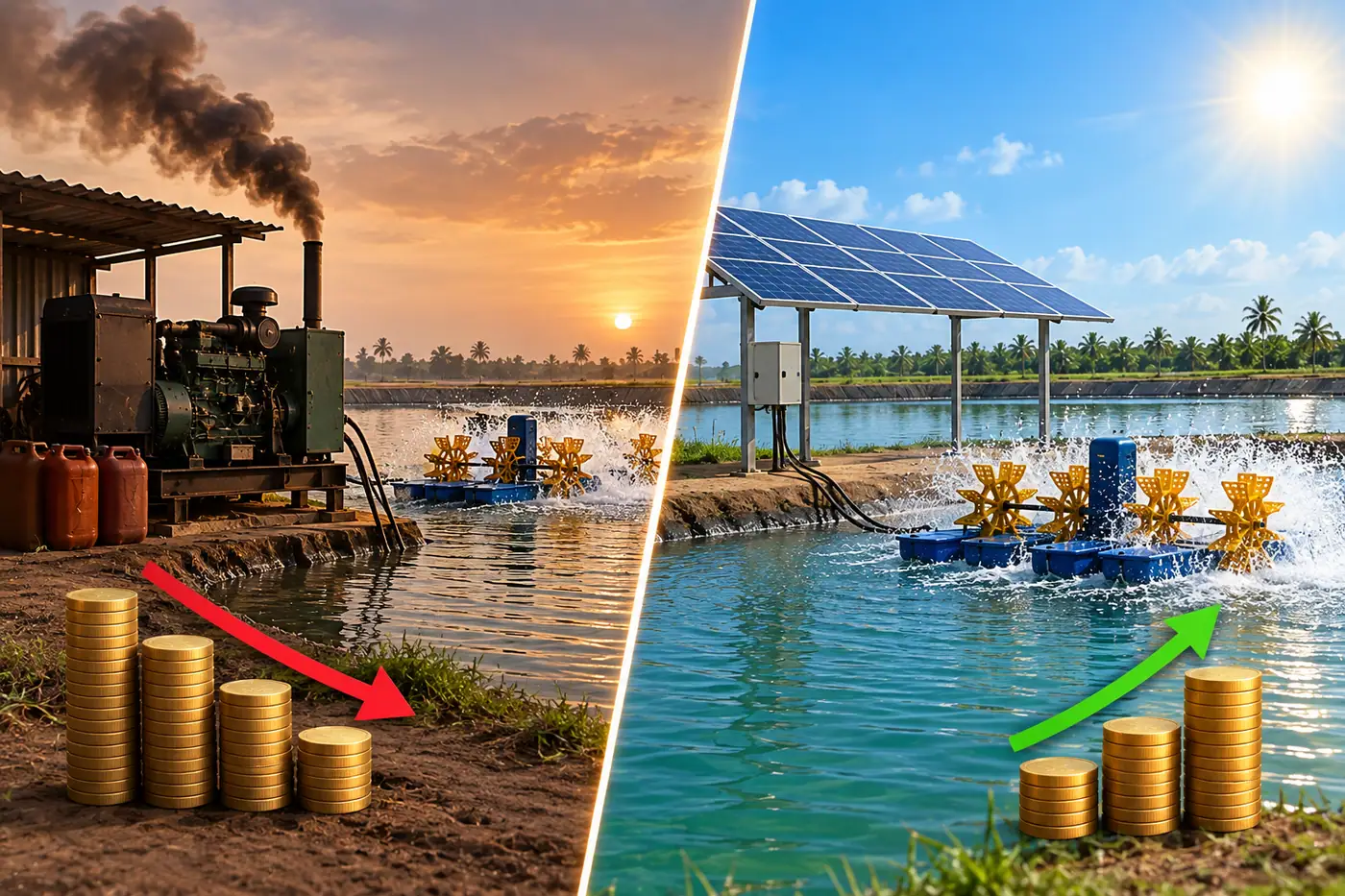
- Running diesel generators as primary or emergency daytime aeration burns an unsustainable 3.2 to 4.5 liters of diesel per hour on a 50 kVA set, translating to an astronomical energy cost of ₹26 to ₹32 per kilowatt-hour (kWh)—nearly five times higher than grid electricity.
- Modern solar aeration utilizes Brushless DC (BLDC) permanent-magnet motors that achieve 88% to 92% electrical-to-mechanical efficiency, compared to obsolete three-phase AC induction motors which operate at a dismal 68% to 74% efficiency in saline, outdoor pond environments.
- A hybrid solar-grid configuration eliminates expensive battery storage banks by routing direct DC solar power through Variable Frequency Drives (VFDs) during daylight hours (8:00 AM to 5:00 PM), automatically switching to subsidized agricultural grid power at night.
- Under Component-B and Component-C of the PM-KUSUM scheme and state renewable energy policies, aquaculture operators can access 40% to 60% capital subsidies for stand-alone and grid-connected solar agricultural pumping and aeration systems.
- AquaSangham provides an integrated Solar Aeration Feasibility Calculator, enabling farmers to size PV wattage, model local coastal solar irradiance, and calculate exact Capex payback timelines based on district electricity tariffs.
Solar Aeration Retrofit Case Study: Cutting Annual Energy Expenses from ₹11.20 L to ₹5.40 L in a 4-Hectare Farm
A commercial Vannamei producer running four 1.0-hectare ponds in the Machilipatnam coastal belt struggled with exorbitant operational power expenses. Operating in a remote tail-end coastal feeder, the farm suffered 6 to 9 hours of daily voltage drops and load-shedding during peak summer culture months, forcing the operator to run a 65 kVA diesel generator at a crippling fuel cost of ₹94/liter (consuming over 28 liters daily and generating ₹7,80,000 in diesel bills annually on top of ₹3,40,000 in DISCOM power bills). Partnering with AquaSangham Energy Advisory, the farmer executed an engineering retrofit: (1) Installed a 20 kWp ground-mounted monocrystalline PERC solar array along elevated pond dykes; (2) Replaced ten conventional inefficient 2HP AC induction paddlewheels with ultra-efficient 2HP Brushless DC (BLDC) permanent-magnet solar paddlewheels equipped with intelligent Variable Frequency Drive (VFD) solar pump inverters; (3) Programmed the solar controllers to maximize aerator speed (110 RPM) during peak sunlight hours (9:00 AM to 4:00 PM), stripping daytime dissolved oxygen deficit and super-saturating water to 8.5 ppm; (4) Utilized grid power exclusively during night hours with zero diesel consumption during daylight hours; and (5) Leveraged a 40% state renewable energy grant under the PM-KUSUM agriculture solarization initiative. The results transformed farm finances: annual power and diesel capex plummeted from ₹11,20,000 down to ₹5,40,000 (a net 51.8% cash savings of ₹5,80,000 per year), achieving 100% capex payback in 19 months while eliminating over 26 metric tons of carbon emissions.
1. The Rural Energy Crisis: Why Power & Diesel Threaten Shrimp Farm Solvency
In intensive shrimp and finfish aquaculture, dissolved oxygen is the non-negotiable breath of life. A standing biomass of 6 to 8 metric tons of Litopenaeus vannamei per hectare requires continuous mechanical aeration to survive. If paddlewheels halt for as little as 45 to 60 minutes during nocturnal peak biomass (DOC 70 to 100), bottom dissolved oxygen drops below the lethal threshold of 1.5 ppm, triggering total crop hypoxia and wiping out crores of rupees in minutes.
To safeguard against this catastrophe, commercial farms across coastal Andhra Pradesh, Gujarat, Odisha, and Tamil Nadu maintain an extensive electrical infrastructure. However, coastal aquaculture operates at the vulnerable tail-ends of rural distribution grids. Rural feeders are notorious for erratic power supply: 4 to 8 hours of unscheduled daily load-shedding, phase drops, severe voltage fluctuations (dropping from 415V down to 320V, which burns out induction motor copper windings), and transformer blowouts during monsoon storms.
To keep aerators spinning, every commercial farmer is compelled to install heavy diesel generator (DG) sets (35 kVA to 125 kVA). But diesel is an economic hemorrhage: with commercial fuel prices exceeding ₹90 to ₹96 per liter in coastal states, running a generator during routine daytime blackouts burns through lakhs of rupees each month. For a mid-scale 4-to-6-hectare farm, energy costs routinely consume 10% to 15% of total crop expenditure—ranking second only to commercial feed. In an era of compressed market prices, continuing to burn diesel for daytime pond aeration is a direct path to financial ruin.
Audit your power bills for low power factor penalties. Operating dozens of uncorrected AC induction motors on a single transformer can drop your power factor below 0.85, triggering an automatic 10% to 15% surcharge penalty from your state electricity distribution company (DISCOM).
3. Solar Aeration Technology: Why Brushless DC (BLDC) Crushes AC Motors
The historic barrier to solar aeration in aquaculture was electrical mismatch. Traditional paddlewheel aerators are driven by standard 3-phase AC induction motors (2HP, 415V). To run an AC motor on solar power, a system required huge solar arrays, large battery banks to absorb inrush starting currents (which can be 5 to 6 times running current), and heavy DC-to-AC power inverters—resulting in energy conversion losses exceeding 30% to 35% and making early systems financially unviable.
The technological revolution that has unlocked modern solar aeration is the integration of Brushless DC (BLDC) Permanent-Magnet Motors and intelligent Variable Frequency Drives (VFDs). A BLDC motor replaces traditional copper rotor windings and mechanical brushes with powerful neodymium permanent magnets. This engineering shift delivers four game-changing advantages for commercial shrimp ponds: (1) Superior Electrical Efficiency: Traditional 2HP AC induction motors operate at only 68% to 74% electrical-to-mechanical efficiency, dissipating one-third of power as waste heat. BLDC motors operate at an extraordinary 88% to 92% efficiency across all speed ranges; (2) Soft-Start Electronics: BLDC controllers incorporate advanced soft-start algorithms that ramp up impeller rotation smoothly over 15 seconds, eliminating destructive starting inrush currents and allowing direct-drive connection to solar panels without giant inverters; (3) Direct Solar MPPT Coupling: BLDC drivers feature built-in Maximum Power Point Tracking (MPPT) logic that continuously adjusts aerator paddlewheel speed (from 60 RPM to 120 RPM) to track available solar sunlight from dawn to dusk; and (4) Extreme Corrosion Resistance: BLDC motors are hermetically sealed (IP68 rated) with no brushes to spark or corrode in salty coastal mist.
Technical Specification Matrix: 2HP Traditional AC Induction vs. 2HP Solar BLDC Paddlewheel
The table below contrasts the engineering and electrical performance of traditional AC paddlewheels against modern solar-optimized BLDC units:
| Technical Specification | Standard 2HP AC Induction Paddlewheel | Advanced 2HP Solar BLDC Paddlewheel | Operational Impact on Farm |
|---|---|---|---|
| Motor Type & Technology | Squirrel-cage 3-phase AC induction motor | Permanent magnet Brushless DC (BLDC) | BLDC eliminates rotor copper losses |
| Motor Energy Efficiency | 70% – 74% efficiency | 89% – 93% efficiency | Requires 25% fewer solar panels to run |
| Starting Current Surge | 500% – 650% of rated current (Inrush) | 100% – 110% (Soft-start controlled) | Prevents inverter trips and generator surges |
| Motor Enclosure & Protection | Cast iron / aluminum (IP55 rated) | Hermetic 316 Stainless / Resin (IP68 rated) | Impervious to saltwater corrosion and flooding |
| Variable Speed Capability | Fixed speed (Typically 105 RPM) | Variable 40 – 125 RPM (MPPT tracked) | Maintains aeration even under cloudy skies |
| Standard Oxygen Transfer Rate (SOTR) | 1.8 – 2.1 kg O2 / kWh | 2.6 – 3.1 kg O2 / kWh | + 45% Greater oxygen transfer efficiency |
Ensure your solar aerator uses nylon-reinforced helical bevel gearboxes rather than cheap worm gears. Worm gears suffer high mechanical friction losses (up to 20%), whereas helical gearboxes achieve 96% mechanical transmission efficiency, squeezing maximum water splash from every solar watt.
4. The Hybrid Solar-Grid Architecture: Managing 24-Hour Continuous Oxygen
A common objection raised by skeptical farmers is: 'Solar only works during the day, but shrimp need the most oxygen at 3:00 AM! How can solar solve my night-time aeration crisis?' The answer lies in modern Hybrid Solar-Grid Architecture—specifically engineered to avoid expensive chemical battery storage while optimizing 24-hour pond dissolved oxygen dynamics.
Chemical battery storage (lithium-ion or lead-acid) is commercially impractical for large-scale aquaculture: powering 50 HP of aeration through the night would require a battery bank costing over ₹40,00,000, with battery life degrading rapidly in coastal heat and humidity. Instead, the smart hybrid architecture functions as a seamless, dual-source energy manager: (1) Daytime Solar Super-Saturation (8:00 AM to 5:00 PM): During daylight hours, dedicated ground-mounted solar arrays generate 100% of the power required by the pond's BLDC aerators. The aerators spin at maximum speed (115–120 RPM), churning atmospheric oxygen into the water and driving daytime DO levels to super-saturation (8.0 to 10.0 ppm). This massive oxygen reservoir oxidizes benthic organic sludge, strips toxic hydrogen sulfide, and delays nocturnal oxygen depletion; (2) Automatic Evening Grid Hand-Off: At dusk (around 5:30 PM), as solar irradiance drops, the intelligent hybrid solar inverter automatically transitions power draw to the rural three-phase grid without a microsecond of motor interruption. The aerators continue running all night on subsidized agricultural grid tariffs; (3) Standby Generator Backup: The diesel generator remains strictly on standby. It only fires up if an electrical grid blackout occurs during night hours—cutting generator run hours by over 75% to 85%.
Position your ground-mounted solar panels along the widest southern pond dykes at a 15-degree tilt angle facing true south. Wash the panel surfaces with fresh water once weekly to remove coastal salt spray crusts, which can reduce solar generation by up to 12% if neglected.
5. Government Subsidies & Financing: Tapping PM-KUSUM 60% Capital Grants
The economics of transitioning to solar aeration are supercharged by unprecedented government subsidies. Under the Pradhan Mantri Kisan Urja Suraksha evam Utthaan Mahabhiyan (PM-KUSUM) and coastal State Renewable Energy Development Agencies (such as NREDCAP in Andhra Pradesh, GEDA in Gujarat, and OREDA in Odisha), aquaculture is formally classified as an eligible agricultural activity for solar power subsidies.
Farmers can leverage two primary subsidy pathways: (1) PM-KUSUM Component-B (Stand-Alone Solar Agriculture Systems): Provides capital subsidies for off-grid solar pumping and aeration systems. The central government provides a 30% capital grant, the state government provides an additional 30% grant, and the farmer contributes only 40% through bank loans or equity. This slashes the effective capital cost of a 10 kW solar aeration unit from ₹7,00,000 down to just ₹2,80,000; (2) PM-KUSUM Component-C (Solarization of Grid-Connected Agricultural Pumps & Feeders): Enables farmers with existing three-phase connections to solarize their operational feeders. Ponds utilize solar electricity during the day, draw grid power at night, and can even sell surplus daytime power back to the DISCOM under net-metering regulations at ₹2.50 to ₹3.00 per unit.
In addition to government grants, scheduled commercial banks (SBI, Bank of Baroda, Canara Bank) provide priority-sector agricultural term loans for solar aquaculture installations, offering 7-year tenures at competitive interest rates of 7.5% to 8.5% per annum. With annual electricity and diesel savings far exceeding annual loan installments, a solarized farm operates cash-flow positive from Day 1.
When applying for PM-KUSUM solar subsidies, ensure your electricity connection is officially registered under the agricultural aquaculture category rather than commercial industry. Agricultural connections qualify for the highest state subsidy brackets.
6. 5-Hectare Farm Financial Model: Traditional Grid/DG vs. Hybrid Solar
To evaluate whether the capital expenditure of solar aeration is justified, let us examine an audited 5-year financial simulation across a 5-hectare commercial Vannamei shrimp farm (operating 10 ponds, requiring 40 HP of installed aeration) in coastal Andhra Pradesh.
Baseline System (Traditional 3-Phase Grid + 65 kVA Diesel Generator): The farm incurs an average monthly DISCOM electricity bill of ₹65,000 during culture months. Due to 6 hours of average daily rural load-shedding during peak summer, the generator runs 600 hours per year, consuming 9,000 liters of diesel (₹8,46,000 in fuel) plus ₹90,000 in generator maintenance and oil. Total annual energy expenditure: ₹14,56,000.
Solarized System (25 kWp Solar PV Array + 12 BLDC Paddlewheels + Hybrid Inverters): The farm installs a 25 kWp ground-mounted solar system. Gross capital expenditure is ₹14,50,000. Applying a 40% PM-KUSUM subsidy reduces the farmer's net capital investment to ₹8,70,000. The solar array powers daytime aeration 100% of the time, completely eliminating daytime diesel generator use and shaving 45% off the DISCOM daytime grid bill. Annual DISCOM grid bill drops to ₹38,000/month, and annual generator fuel drops to just 1,200 liters (emergency night blackouts only = ₹1,12,800). Total annual energy expenditure drops to ₹4,92,800—a direct annual net cash savings of ₹9,63,200! The entire net capital investment of ₹8,70,000 is fully paid back in just 10.8 months of operational culture.
5-Year Cumulative Financial Ledger: Traditional Energy vs. Hybrid Solar Aeration
The table below contrasts the capital expenditure, operational cash flow, and 5-year cumulative energy costs of traditional power versus hybrid solar aeration on a 5-hectare commercial farm:
| Financial & Operational Metric (5-Ha Farm) | Traditional Grid + Diesel Generator | Hybrid Solar PV + BLDC System | Net Variance / Farmer Advantage |
|---|---|---|---|
| Initial Capital Investment (Aeration/Energy) | ₹6,50,000 (DG set & AC aerators) | ₹8,70,000 (Net after 40% subsidy) | + ₹2,20,000 initial capex delta |
| Annual DISCOM Grid Electricity Bill | ₹5,20,000 / year | ₹3,04,000 / year | ₹2,16,000 annual grid savings |
| Annual Diesel Fuel Consumption (Liters) | 9,000 Liters / year (@ ₹94/L) | 1,200 Liters / year (@ ₹94/L) | 7,800 Liters saved per year |
| Annual Diesel Fuel Expenditure | ₹8,46,000 / year | ₹1,12,800 / year | ₹7,33,200 direct fuel savings |
| Annual Maintenance & Generator Overhaul | ₹90,000 / year | ₹16,000 / year (Solar cleaning) | ₹74,000 maintenance savings |
| Total Annual Energy Expenditure | ₹14,56,000 / year | ₹4,32,800 / year | + ₹10,23,200 Net Cash Savings / Year |
| Net Capex Payback Timeline | N/A (Sunk operating cost) | 10.2 Months of culture | 100% Capital recovered in Year 1 |
| 5-Year Cumulative Net Cash Savings | Baseline Energy Cost (₹72.80 L) | ₹21.64 L total 5-year cost | + ₹51,16,000 Retained Farm Wealth |
A 5-year cumulative savings of over ₹51 Lakhs is the difference between a farm that struggles with working capital debt and one that can self-fund pond expansions, nursery systems, and automated feed distribution lines without bank borrowing.
7. Designing Your Solar Farm: How AquaSangham Calculates Sizing & Payback
Sizing a solar aeration system is not a one-size-fits-all exercise. Under-sizing your solar array means your BLDC aerators will fail to reach full RPM during morning and late afternoon hours. Over-sizing your array wastes capital on surplus daytime electricity that your ponds cannot absorb.
AquaSangham permanently streamlines solar planning through our integrated Solar Aeration Engineering & ROI Calculator. Accessible directly via the mobile app, the engine uses satellite solar irradiation datasets from the National Renewable Energy Laboratory (NREL) calibrated specifically for Indian coastal coordinates (from Bhavnagar to Tuticorin and Balasore).
By inputting your pond dimensions, average water depth, current electricity tariff, and generator fuel logs, the AquaSangham engine automatically generates: (1) Exact Photovoltaic (PV) kilowatt sizing tailored to your pond footprint; (2) Optimal tilt angle and dyke spacing to eliminate shading from coconut trees and adjacent bunds; (3) Sizing for BLDC motors, helical gearboxes, and MPPT inverters; and (4) An audit-ready Bankable Project DPR (Detailed Project Report) formatted to clear state renewable energy subsidy approvals under PM-KUSUM with zero bureaucratic friction.
Use the AquaSangham app to monitor daily solar generation versus grid consumption. The app alerts you to abnormal voltage spikes or panel soiling, ensuring your renewable energy setup operates at peak efficiency every hour of the culture cycle.
Summary Operational Action Checklist
Frequently Asked Questions
Q: Can solar aerators really keep running during cloudy or monsoon days?
Yes. Modern solar aeration systems utilize intelligent Variable Frequency Drives (VFDs) with Maximum Power Point Tracking (MPPT). Even during overcast or cloudy weather with diffuse sunlight, the solar panels continue generating 25% to 40% of their rated power. The BLDC motor automatically adjusts speed—running at 50 to 70 RPM instead of stopping—maintaining surface water circulation and oxygenation.
Q: Why don't commercial solar shrimp farms use battery banks for night-time aeration?
Chemical battery storage (lithium-ion or lead-acid) is commercially unviable for large-scale aquaculture. Powering 20 to 40 HP of aeration for 10 hours overnight would require a battery bank costing over ₹25,00,000 to ₹40,00,000, with battery cells degrading rapidly in hot, humid, corrosive coastal air. Instead, smart hybrid systems use solar power exclusively during the day and switch to cheap agricultural grid electricity at night.
Q: How long does it take for a solar aeration setup to pay for itself in Indian shrimp farming?
Under standard coastal commercial conditions with a 40% to 60% PM-KUSUM government subsidy, the capital investment pays for itself in just 10 to 18 months of operational culture. The massive savings generated by eliminating daytime diesel generator use and cutting daytime grid power bills directly offsets the net capital expenditure.
Q: Will coastal salt spray corrode the solar panels and motors?
Not if high-grade marine-spec equipment is specified. Modern aquaculture solar arrays utilize anodized aluminum frames, hot-dip galvanized mounting structures (minimum 80-micron zinc coating), and IP68-sealed 316 stainless steel BLDC motors designed specifically to withstand saline marine atmospheres for 20+ years.
AquaSangham Engineering Advisory
Aquaculture Renewable Energy & Electrical Systems Division
Contributing Senior Technical Writer & Aqua Consultant at AquaSangham.
Recommended Farming Guides
The 3 AM Oxygen Trap: Why Fish and Shrimp Die at Dawn (And The 4.0 ppm Rule That Saves Them)
Read Article →Water QualityWhy Sudden Monsoon Rain Wipes Out Shrimp Overnight (And The 30-Minute Emergency Lime Protocol That Saves Your Pond)
Read Article →Market AnalysisEU & US Seafood Traceability Audits: Keeping Digital Farm Logs to Secure ₹15-₹20/kg Premium from Exporters
Read Article →Get Live Farm Advice on AquaSangham Mobile App
Download India's #1 Aquaculture Super App for real-time market prices, precision tools, and community advice.
Download Free Android App