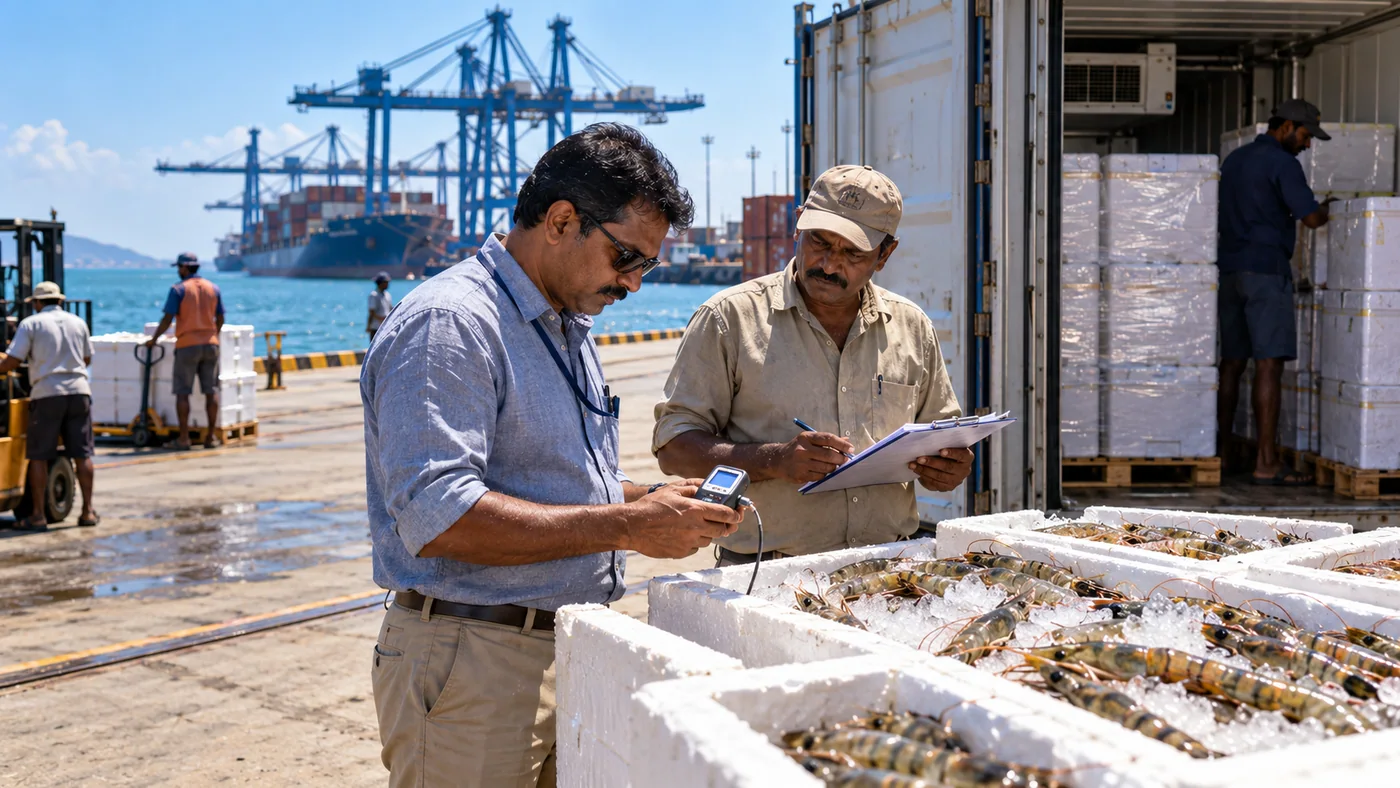
Executive Summary & Key Takeaways
- The United States remains India's largest single seafood export destination, absorbing over 290,000 metric tons ($2.1+ Billion USD) of Indian warmwater shrimp annually, representing approximately 38% of total export volume.
- The combined imposition of Anti-Dumping (AD) duties and new Countervailing Duties (CVD) ranging between 7.8% and 12.5% creates an immediate $0.60 to $1.10 per kilogram cost barrier at US ports of entry.
- US seafood importers and retail chains (Walmart, Kroger, Sysco) operate on razor-thin 3% to 5% gross margins; they will not absorb tariff surcharges, ruthlessly pushing 80% to 100% of the duty burden back onto Indian exporters and pond farmgate prices.
- India's primary global competitor, Ecuador, benefits from geographically shorter transit times (10 days vs 35 days) and massive economies of scale from automated, large-scale earthen ponds, intensifying competitive pressure in the US market.
- Value-added products (cooked, blanched, breaded, and ready-to-heat preparations) enjoy significant regulatory exemptions from raw shrimp anti-dumping duty scopes, offering forward-thinking processors a high-margin survival corridor.
- To survive the 2026 trade compression, Indian cultivators must structurally lower their pond Cost of Production (COP) below ₹220/kg through FCR optimization (targeting <1.25), functional feed regimes, solar micro-aeration, and stocking density rationalization (25–35 PL/m²).
Export Realignment Case Study: Bhimavaram Processing Consortium Pivots 4,200 Tons to China & Europe to Shield Farmgate Payouts
When the US Department of Commerce (DOC) issued preliminary countervailing duty (CVD) determinations on Indian warmwater shrimp, an export consortium representing 18 processing units in Bhimavaram faced sudden buyer renegotiations from major US seafood distributors demanding a 10% price concession ($0.75/kg). Passing this concession downstream would have forced farmgate spot prices down from ₹380/kg to ₹320/kg, threatening widespread crop abandonments. Partnering with AquaSangham's Global Trade Desk, the consortium executed a 90-day structural pivot: diverting 2,500 MT of large-count shrimp (20-count and 30-count) to high-paying direct supermarket buyers in Qingdao and Shanghai, retooling two IQF lines for cooked peeled tail-on (PDTO) products that carry lower tariff burdens, and securing forward currency hedges against USD/INR swings. The strategic pivot protected their farmer network's farmgate price at ₹372/kg, containing the tariff impact to less than ₹8/kg and preserving ₹19.4 Crores in annualized exporter-farmer realization.
1. The 2026 US Tariff Shock: Deconstructing the Combined AD and CVD Determinations
In the interconnected world of international seafood commerce, a single regulatory pronouncement issued in a boardroom in Washington, D.C. can instantaneously alter the financial destiny of a shrimp cultivator standing on a muddy pond bund in Bhimavaram or Nellore. In 2026, the Indian aquaculture sector faces its most severe geopolitical and commercial stress test in over two decades: the simultaneous escalation of Anti-Dumping (AD) administrative review margins and the newly determined Countervailing Duty (CVD) tariffs imposed by the United States Department of Commerce (USDOC) and the United States International Trade Commission (USITC).
For nearly twenty years, Indian warmwater shrimp (primarily Litopenaeus vannamei and Penaeus monodon) has been subjected to US Anti-Dumping orders dating back to 2005. Historically, Indian exporters navigated these orders with manageable annual review margins hovering between 3.0% and 5.5%, allowing Indian frozen shrimp to capture dominant market share in American supermarket freezers and foodservice distributors. However, the current trade petition filed by domestic US shrimping lobbies has fundamentally escalated the battlefield by pairing Anti-Dumping investigations with aggressive Countervailing Duty petitions targeting alleged government subsidies.
Under the USDOC's preliminary determinations, Indian exporters face combined preliminary duty cash deposit requirements ranging from 7.8% to as high as 12.5% ad valorem. For an industry that generates over $2.1 Billion USD in foreign exchange and ships more than 290,000 metric tons of shrimp to North America annually—representing nearly 38% of India's total marine export volume—this tariff barrier represents a multi-hundred-million-dollar shockwave. Understanding how these duties function, how they are calculated, and how they filter down to pond farmgate spot rates is essential for every stakeholder seeking to survive the 2026 trade compression.
Anti-Dumping (AD) vs Countervailing Duty (CVD): The Two Fronts of the Tariff War
To formulate an effective defense, exporters and farmers must understand the distinct legal architecture of AD and CVD duties: Anti-Dumping Duty (AD) is governed by the Tariff Act of 1930 and targets alleged 'unfair commercial pricing'. It penalizes foreign companies for selling merchandise in the United States at prices lower than their 'Normal Value' (the price charged in their home market or cost of production plus reasonable profit).
Countervailing Duty (CVD), by contrast, targets foreign government subsidies. Petitioners allege that the Government of India, MPEDA, and state fisheries departments provide unfair, actionable subsidies to shrimp cultivators and processors through programs such as the Pradhan Mantri Matsya Sampada Yojana (PMMSY), Duty Drawback Schemes, the Remission of Duties and Taxes on Exported Products (RoDTEP), subsidized agricultural electricity, and concessional export credit lines. If USDOC determines that these schemes confer a specific financial benefit, a corresponding percentage tariff is levied to neutralize the alleged subsidy advantage.
The Cash Deposit Requirement: The Immediate Importer Cash Squeeze
A critical legal misunderstanding among farmers is the assumption that tariffs are only paid at year-end after legal appeals. In US customs law, as soon as the USDOC publishes its Preliminary Determination in the Federal Register, the US Customs and Border Protection (CBP) mandates that US importers of record must post immediate, non-refundable cash deposits on every single container clearing US ports.
For a standard 40-foot refrigerated container carrying 40,000 pounds (18,144 kg) of frozen headless shrimp valued at $160,000 USD, a combined 10% tariff requires the American importer to deposit $16,000 USD in upfront cash with US Customs on day of arrival. Because US seafood importers operate on slim 3% to 5% net margins, this cash deposit locks up immense working capital lines, forcing importers to immediately deduct the equivalent value from their purchase bids to Indian processing factories.
Track the USDOC Federal Register notices and MPEDA legal advisory circulars weekly. The gap between preliminary tariff announcements and final administrative reviews is when global buyers panic; locking in forward fixed-price contracts during calm market windows insulates your farm from abrupt price dips.
2. The Legal Mechanics: How US Shrimp Processors (ASPA) Weaponize Trade Petitions
The ongoing tariff crisis is not an organic market phenomenon; it is a meticulously coordinated legal campaign engineered by the American Shrimp Processors Association (ASPA) and the Southern Shrimp Alliance (SSA). These domestic US trade associations represent wild-harvest trawler fleets and coastal canneries in the Gulf of Mexico (Louisiana, Texas, Mississippi, Alabama, and Florida).
Domestic US wild-caught brown and white shrimp account for less than 8% to 10% of total American consumer demand. The US commercial fleet suffers from high operating expenses: surging marine diesel costs, aging vessel infrastructure, severe labor shortages, and seasonal catch quotas. Unable to compete on price, quality consistency, or year-round availability against modern farmed shrimp from India and Ecuador, the domestic industry relies on aggressive trade litigation as a commercial survival strategy.
Under US trade law, domestic petitioners need only establish two legal benchmarks before the USITC: that foreign merchandise is being sold at less than fair value or subsidized, and that the domestic industry is suffering 'Material Injury' (or threat of material injury), such as declining operating margins, capacity underutilization, or lost sales. By filing broad petitions targeting multiple exporting nations simultaneously (India, Ecuador, Indonesia, and Vietnam), ASPA attempts to force a nationwide artificial price floor across the entire US seafood supply chain.
Mandatory Respondents and the All-Others Tariff Trap
In every administrative review, the USDOC does not investigate hundreds of individual Indian exporters. Instead, they select two or three 'Mandatory Respondents'—typically the largest volume exporters (such as Devi Sea Foods, Sandhya Aqua, or Falcon Marine)—to undergo forensic accounting audits. These selected companies must disclose thousands of pages of proprietary cost data, pond feeding receipts, diesel expenditures, labor wages, and shipping manifests.
The individual margins calculated for these mandatory respondents are then averaged to establish the 'All-Others Rate'. Every other licensed Indian exporter that did not undergo direct audit is automatically assigned this All-Others tariff rate. If a single mandatory respondent fails to submit documentation in the exact format required by USDOC, the Department applies 'Adverse Facts Available' (AFA), slapping punitive tariffs exceeding 25% across the board. This creates immense collective vulnerability for the entire Indian industry.
The Scope of the Order: Which Products Are Caught?
The legal scope of the warmwater shrimp AD/CVD order covers virtually all raw, frozen, and peeled shrimp species in all forms: Head-On Shell-On (HOSO), Headless Shell-On (HLSO), Easy-Peel, Peeled Undeveined (PUD), and Peeled Deveined Tail-On (PDTO), whether individually quick frozen (IQF) or block frozen.
However, the legal definition contains highly specific, strategic exclusions. Recognizing these exemptions is the foundation of the exporter's value-added survival strategy: products that have undergone distinct culinary processing—specifically battered, breaded, or fully cooked and seasoned ready-to-eat meals—fall outside the raw warmwater shrimp tariff scope.
Support organized legal defense initiatives funded through MPEDA and SEAI (Seafood Exporters Association of India). The forensic legal teams hired in Washington, D.C. to challenge USDOC subsidy benchmarks are the only legal mechanism capable of knocking preliminary 10% tariffs down to de minimis (<2%) levels upon final review.
3. The Downstream Ripple Effect: How Tariffs Directly Depress Indian Pond Farmgate Prices
A dangerous misconception among aquaculture farmers is that 'tariffs are an exporter's problem, not a farmer's problem.' In reality, international commodity supply chains operate like a hydraulic pressure system: when external pressure is applied at the destination retail port, that financial force travels backwards through the supply chain with zero attenuation, discharging its full destructive energy onto the least mobile, most capital-constrained participant—the primary producer at the pond bund.
The economic mechanism of this transmission is direct and mathematical. US seafood buyers, including massive supermarket chains (Costco, Walmart, Albertsons) and broadline foodservice distributors (Sysco, US Foods, Performance Food Group), purchase shrimp on strict cost-plus models. When confronted with an 8% to 10% US customs cash deposit requirement, an American importer will not accept lower profit margins. Instead, they immediately issue a revised Purchase Order (PO) to their Indian processing plant partners, reducing their bid price by $0.30 to $0.50 per pound ($0.66 to $1.10 per kilogram).
An Indian export processor operating on a net profit margin of 4% to 6% cannot absorb a $0.80/kg price reduction without plunging into immediate operational bankruptcy. Consequently, within 24 to 48 hours of an international tariff announcement, procurement managers in Visakhapatnam, Kakinada, and Kochi adjust their daily farmgate spot price sheets downward. A 10% US tariff translates into an immediate, unavoidable drop of ₹35 to ₹55 per kilogram on raw Indian pond biomass.
Count-Wise Price Vulnerability Analysis Across Andhra & Tamil Nadu
The impact of US tariffs is not distributed evenly across all size classes; it concentrates aggressively on specific count brackets that dominate US import volume. Historically, the United States is overwhelmingly a market for medium-to-large peeled and headless shrimp: 26/30, 31/40, and 41/50 counts.
Prior to the 2026 tariff escalation, 30-count Vannamei commanded a healthy farmgate rate of ₹390 to ₹410 per kg, providing a farmer with a ₹120 to ₹140/kg margin over typical production costs (₹270/kg). Under a 10% tariff contraction, 30-count farmgate bids plummet to ₹345–₹355/kg. For 40-count shrimp, price plunges from ₹330/kg down to ₹285/kg. For farmers operating with high feed conversion ratios (>1.6) or high land lease rates, a drop of ₹45/kg entirely erases net operating margins, pushing the farm into negative cash flow.
The Threat of Procurement Holds and Factory Intake Freezes
Even more devastating than price discounts are factory intake freezes. During periods of regulatory uncertainty—such as the 60-day window following preliminary tariff announcements—US buyers frequently pause new contract signings while assessing legal risk. Unable to commit finished goods, Indian processing plants slash their daily harvest intake quotas by 30% to 50%.
This triggers a catastrophic supply bottleneck at the pond level: thousands of hectares of mature shrimp reach Day 100 with nowhere to go. Farmers are forced to continue feeding large crops (burning ₹15,000 to ₹25,000 per hectare daily in commercial feed), watching FCR deteriorate, water quality degrade, and disease risks (WSSV, EHP) multiply while waiting for processing slots.
Never hold mature shrimp in your pond hoping that international spot prices will rebound next week. An extra 10 days of feeding a 30-count crop will burn ₹18 to ₹25/kg in feed and electricity, which almost never offsets speculative market gains. Harvest promptly when your target count is achieved.
4. The Global Cost War: India vs Ecuador vs Vietnam in the Post-Tariff Landscape
The impact of US tariffs cannot be analyzed in isolation; it must be viewed within the fierce, cutthroat arena of global aquaculture competition. For the past five years, the global shrimp market has been redefined by the explosive rise of Ecuador as an aquaculture superpower. Any trade distortion that handicaps Indian exports to North America directly accelerates Ecuador's competitive dominance.
Ecuador produces over 1.3 million metric tons of Litopenaeus vannamei annually. The Ecuadorian production model is fundamentally different from India's: while Indian farming is dominated by intensive, smallholder earthen and lined ponds (typically 0.5 to 2.0 hectares per pond stocking 35 to 60 PL/m² with intensive mechanical aeration and commercial pelleted feeding), Ecuador operates massive, semi-intensive estuarine estates (ponds averaging 10 to 50 hectares stocking only 12 to 20 PL/m² with automated acoustic feeders and zero water exchange).
Because Ecuadorian farms rely heavily on natural estuarine productivity and automated feeding, their Cost of Production (COP) for medium counts is remarkably low—frequently hovering between $2.80 and $3.20 USD per kg (₹235 to ₹265/kg). Furthermore, Ecuador enjoys a massive geographic logistics advantage: a container ship from Guayaquil reaches the Port of Miami in 8 to 10 days, compared to 30 to 38 days from Visakhapatnam through the Suez or Cape routes. When US tariffs penalize Indian imports, US buyers naturally substitute Indian raw headless product with Ecuadorian supplies.
Comparative Production and Tariff Matrix: India, Ecuador, and Vietnam
The following comparative matrix details the core cost structures, average farmgate costs of production, preliminary tariff liabilities, and logistics lead times among the world's three leading shrimp exporting nations in the 2026 trade environment.
| Operational / Trade Metric | India (Intensive Smallholder) | Ecuador (Semi-Intensive Mega-Estates) | Vietnam (Multi-Tier & High-Tech) |
|---|---|---|---|
| Average Pond Size & Density | 0.5 – 1.5 Ha (35–60 PL/m²) | 10.0 – 40.0 Ha (12–22 PL/m²) | 0.2 – 0.8 Ha (80–150 PL/m² CP Model) |
| Average Farmgate COP (30-Count) | ₹260 – ₹285 / kg ($3.10–$3.40/kg) | ₹235 – ₹260 / kg ($2.80–$3.10/kg) | ₹310 – ₹345 / kg ($3.70–$4.15/kg) |
| Preliminary US Tariff Burden | 7.8% – 12.5% (AD + CVD Combined) | 1.5% – 3.8% (CVD Focus / Lower AD) | 2.8% – 4.5% (Established Exclusions) |
| US Shipping Transit Window | 30 to 38 Days (East Coast) | 8 to 12 Days (Direct Gulf / East) | 25 to 32 Days (Pacific Routes) |
| Value-Added Processing Share | 12% – 16% (Predominantly Raw) | 6% – 8% (Predominantly Raw HOSO) | 42% – 48% (Dominates Cooked/Breaded) |
| Primary Global Competitive Edge | Reliable year-round peeling labor & volume | Ultra-low energy & feed capex per hectare | Sophisticated value-added factory lines |
Do not attempt to compete against Ecuador on raw, commodity Head-On Shell-On (HOSO) volume in the US market. India's competitive moat lies in skilled manual processing: high-yield Peeled Deveined (PD), Easy-Peel, and butterfly tail-on cuts where Ecuadorian automated plants cannot match Indian artisan peeling recovery.
5. The Value-Addition Escape Hatch: Cooked, Breaded, and Ready-to-Eat Exemptions
In every regulatory crisis lies structural commercial opportunity. While the escalating US tariff determinations inflict severe damage on raw commodity frozen shrimp (HLSO and block-frozen PUD), they contain a critical legal and regulatory escape hatch: Value-Added Seafood Products.
Under US Customs classification standards and the historical scope rulings of the USDOC, products that undergo substantial culinary transformation—specifically thermal cooking, blanching, seasoning, tempura battering, breading, or marination in ready-to-eat meal kits—fall outside the raw warmwater shrimp anti-dumping tariff classification (Harmonized Tariff Schedule heading HTSUS 0306.17 vs HTSUS 1605.21/1605.29).
While raw shrimp imports are penalized with 8% to 12% cash deposit duties, fully cooked peeled tail-on shrimp (such as IQF Cooked Cocktail Shrimp rings) and breaded butterfly shrimp enter the United States under standard general tariff schedules, carrying zero punitive anti-dumping penalties. Forward-thinking Indian seafood processors are rapidly converting raw processing capacity into high-tech, steam-cooking and value-addition infrastructure.
The Economics of Value-Addition: Shielding Farmgate Realization
Value-added processing is not merely a tariff shield; it represents a fundamentally superior economic margin engine. A kilogram of raw 30-count shrimp sold as commodity block headless commands an export FOB price of approximately $6.80 USD/kg. That same raw material, when blanched, peeled, deveined, glazed with 8% protective moisture, and packed in consumer-ready 500-gram zipper pouches with dipping sauce, sells in US and European retail channels for $9.50 to $11.20 USD/kg.
This substantial margin buffer absorbs international shipping fluctuations and enables the processing plant to pay contracted farmers a premium of ₹25 to ₹40 per kilogram above prevailing mandi spot rates. Farmers who align their crop cycles with value-added export processors enjoy guaranteed off-take contracts and complete immunity from spot mandi crashes.
What Factories Require for Value-Added Export Lines
Converting raw shrimp into export-grade cooked and breaded products requires exceptionally stringent microbiological and biochemical standards at the farm level. Cooked shrimp lines cannot tolerate high bacterial loads, Vibrio contamination, or chemical taints, because thermal processing sets off-flavors permanently into the meat.
Farmers aiming for value-added supply contracts must guarantee three farmgate parameters: zero chemical residues (100% PHC lab clearance), minimal physical cuticle damage (broken appendages tear during automated steam cooking belts), and uniform harvest counts (uneven shrimp cook unevenly, resulting in rubbery, over-cooked small shrimp and under-cooked large shrimp). Producers who consistently achieve these standards become preferred corporate suppliers.
Inquire whether your local export processing plants operate certified BRCGS/HACCP cooking and IQF nitrogen freezing lines. Partnering with processors that sell finished consumer retail packs rather than raw commodity blocks protects your farm from raw tariff volatility.
6. Market Diversification Playbook: Expanding into China, Europe, Russia, and the Domestic Market
The fundamental strategic flaw of the Indian shrimp sector over the past decade has been excessive geographic concentration: placing nearly 40% of national export volume into a single regulatory jurisdiction (the United States). When the US market catches a cold—whether through anti-dumping tariffs, countervailing duties, or consumer demand slowdowns—the entire Indian coastal economy enters an economic depression.
The permanent antidote to US tariff vulnerability is aggressive, strategic Market Diversification. While the US Department of Commerce has been tightening tariff screws, massive alternative consumption markets across China, the European Union, the United Kingdom, Russia, the Middle East, and India's own domestic metropolitan centers are expanding rapidly.
In 2026, China has solidified its position as the world's largest gross consumer of warmwater shrimp. Chinese consumers possess an immense cultural appetite for whole, head-on shrimp (HOSO). Unlike American consumers who demand sterile, headless, shell-less meats, Chinese seafood banquet culture, hot-pot dining, and Lunar New Year gifting celebrate large, vibrant, whole shrimp with pristine orange-red hepatopancreas heads intact.
The Chinese Market Opportunity: High-Margin Head-On (HOSO) Trade
Chinese seafood buyers in major trading hubs (Zhanjiang, Guangzhou, Qingdao, and Dalian) pay exceptional prices for fresh-frozen, Grade-A Head-On shrimp, particularly large sizes: 20-count, 25-count, and 30-count. Because HOSO products require zero manual peeling labor, processing factory overhead is minimal, allowing exporters to return a higher percentage of the FOB price directly to the farmer.
Furthermore, trade with China carries zero Anti-Dumping duties. Consignments shipped from Visakhapatnam or Chennai reach southern Chinese ports in just 14 to 18 days, dramatically reducing container lease expenses and ocean freight working capital requirements. Farmers who manage water quality to produce pristine, hard-shelled shrimp with clean gills find a virtually bottomless, lucrative market in China.
The Untapped Indian Domestic Market: The 1.4-Billion Consumer Frontier
Perhaps the greatest irony of Indian aquaculture is that while Indian farmers struggle to ship shrimp 12,000 kilometers across the Pacific to appease foreign regulators, India's own urban domestic market—encompassing 1.4 billion people and a rapidly expanding middle class of 300+ million consumers—remains almost entirely starved of premium seafood.
In metropolitan centers like Bengaluru, Hyderabad, Mumbai, Delhi-NCR, and Pune, tech-enabled D2C fresh-meat platforms (such as Licious, FreshToHome, Zepto, and Blinkit) and modern supermarket chains are experiencing explosive 35% year-on-year growth in fresh, antibiotic-free shrimp sales. Urban consumers routinely pay ₹450 to ₹650 per kilogram for cleaned, fresh Vannamei shrimp. By creating direct farm-to-city cold-chain links, progressive aquaculture cooperatives are capturing premium domestic retail realizations completely insulated from global geopolitical crosswinds.
If your pond water allows you to cultivate large-size shrimp (20-count or larger), target export processors with active Chinese GACC (General Administration of Customs of China) approval numbers. Chinese buyers pay immediate premiums for whole large shrimp, bypassing US headless price depressions.
7. The Farmer's Survival SOP: Cutting Cost of Production (COP) Below ₹220/kg
Macroeconomic analysis, international legal trade defense, and market diversification strategies are vital corporate initiatives. However, for the individual commercial farmer managing 2 to 5 hectares of coastal ponds, survival in a tariff-compressed market ultimately comes down to a single brutal, non-negotiable metric: Cost of Production (COP) per Kilogram.
When global farmgate prices drop from ₹390/kg to ₹330/kg due to US import tariffs, a farmer whose COP is ₹310/kg faces immediate financial ruin, losing ₹20 on every kilogram produced (a loss of ₹1,60,000 on an 8-ton pond). Conversely, a disciplined, scientific producer whose COP is tightly engineered down to ₹220/kg continues to generate an outstanding net profit of ₹110 per kilogram—clearing ₹8,80,000 in clean cash profit on that identical 8-ton harvest.
Lowering COP is not accomplished by cutting corners on essential inputs—such as buying cheap, diseased wild seed or purchasing expired, uncertified chemicals—which inevitably triggers catastrophic 80% crop mortalities. Lowering COP requires an aggressive, data-driven operational overhaul focused on the three largest expenditure buckets in aquaculture: Feed Efficiency (FCR), Electrical Energy Consumption, and Stocking Density Rationalization.
The 3 Pillars of Sub-₹220/kg Farm Cost Engineering
Pillar 1: Compressing Feed Conversion Ratio (FCR) from 1.65 to 1.20: Feed represents 60% to 65% of total pond operating costs. Producing 1 kg of shrimp at an FCR of 1.65 consumes ₹148 in commercial feed (at ₹90/kg feed cost). Lowering FCR to 1.22 consumes only ₹109 in feed—an immediate, permanent cost reduction of ₹39 per kilogram. Achieve this by transitioning from blind hand broadcasting to automated acoustic or timer checktray-regulated auto-feeders, preventing feed leaching and soil fouling.
Pillar 2: Slashing Energy Bills via Solar-Grid Hybrid Aeration: Electrical power and diesel generator backup account for 18% to 22% of total operational expenditure (averaging ₹35 to ₹50 per kg of shrimp). By installing grid-tied solar microgrids with variable frequency drive (VFD) paddlewheel aerators, farmers eliminate 45% to 60% of daytime grid electricity tariffs, slicing ₹18 to ₹24/kg off their production costs.
Pillar 3: Stocking Density Rationalization (The 30 PL/m² Sweet Spot): The greatest myth in intensive shrimp farming is that 'higher stocking density equals higher profit'. Stocking at hyper-intensive rates (70 to 90 PL/m²) forces exponential increases in aeration requirements, probiotic dosages, water exchange stress, and disease vulnerability, while slowing individual growth rates. Downsizing stocking density to 28 to 35 PL/m² slashes seed costs by 50%, doubles natural carrying capacity grazing, accelerates growth to 30-count in just 85 days, and dramatically reduces total crop mortality.
Run a weekly Cost of Production (COP) ledger on your smartphone or farm log. Track your exact feed spend, electrical meter units, labor wages, and mineral dosing per kilogram of estimated standing biomass. Knowing your break-even number allows you to lock in forward sales contracts with complete financial confidence.
Summary Operational Action Checklist
Frequently Asked Questions
Q: What is the difference between Anti-Dumping Duty (AD) and Countervailing Duty (CVD) in shrimp aquaculture?
Anti-Dumping (AD) duty is levied when a foreign exporter is judged to be selling seafood in the United States at prices below their domestic production cost or home market value ('dumping'). Countervailing Duty (CVD), by contrast, is imposed to offset alleged government subsidies (such as government grants, subsidized power tariffs, or tax exemptions) that supposedly give foreign producers an unfair cost advantage over domestic US shrimpers. When both are applied simultaneously, the duties are stacked together, creating a substantial cumulative cash deposit barrier at US customs.
Q: Will the US Anti-Dumping tariffs shut down Indian shrimp exports completely?
No. The United States simply does not possess the domestic wild-catch or farmed aquaculture capacity to meet its massive annual consumer seafood demand (over 800,000 metric tons). While tariffs compress profit margins and alter market market share between competing countries (like India, Ecuador, and Indonesia), the US market cannot survive without imported shrimp. Exporters who pivot to value-added cooked products, optimize logistics, and diversify into China and Europe will continue to thrive.
Q: Why does Ecuador pay lower tariffs to the United States compared to India?
In recent trade litigation, the specific government programs and financial documentation audited by the US Department of Commerce resulted in lower preliminary subsidy calculation margins for major Ecuadorian producers compared to Indian respondents. Additionally, Ecuador's geographical proximity allows lower freight and container costs, while India's trade defense continues to challenge USDOC's subsidy calculation methodology during ongoing legal appeals.
Q: Can an individual Indian shrimp farmer appeal against US Department of Commerce tariff rulings?
Individual farmers do not have direct standing to petition the USDOC or USITC. The legal defense is coordinated collectively through national trade organizations, specifically the Marine Products Export Development Authority (MPEDA) and the Seafood Exporters Association of India (SEAI), who retain specialized international trade attorneys in Washington, D.C. Farmers support this defense by maintaining transparent farm accounts, registering with the Coastal Aquaculture Authority (CAA), and participating in official industry surveys.
AquaSangham Market Intelligence
Global Trade, Policy & Exporter Analytics Desk
Contributing Senior Technical Writer & Aqua Consultant at AquaSangham.
Recommended Farming Guides
The 3 AM Oxygen Trap: Why Fish and Shrimp Die at Dawn (And The 4.0 ppm Rule That Saves Them)
Read Article →Water QualityWhy Sudden Monsoon Rain Wipes Out Shrimp Overnight (And The 30-Minute Emergency Lime Protocol That Saves Your Pond)
Read Article →Market AnalysisEU & US Seafood Traceability Audits: Keeping Digital Farm Logs to Secure ₹15-₹20/kg Premium from Exporters
Read Article →Get Live Farm Advice on AquaSangham Mobile App
Download India's #1 Aquaculture Super App for real-time market prices, precision tools, and community advice.
Download Free Android App