Executive Summary & Key Takeaways
- Viral social media claims of making ₹3 Lakhs per month from a 500 sq ft room represent theoretical gross capacity under zero-mortality conditions and completely ignore capital depreciation, feed waste, and 24/7 electrical bills.
- Real-world turnkey setup cost (Capex) for a 1,000-box commercial indoor crab condo with industrial-grade RAS, protein skimmer, UV sterilization, and backup power ranges from ₹8.5 to ₹11.8 Lakhs.
- The growout model (rearing 5g crablets to 500g adults over 120–150 days in boxes) is economically unfeasible due to high cumulative power consumption and slow crustacean growth in confined spaces.
- The only commercially proven profitable business model in crab condos is 21-Day Crab Fattening: sourcing lean 'water crabs' (400g–600g) at ₹350–₹500/kg and feeding high-protein marine diet to harden shell meat for ₹1,300–₹1,800/kg live export.
- Biofilter ammonia collapse is the primary cause of sudden facility mortality; each kilogram of fresh crab feed introduces 30–36g of Total Ammonia Nitrogen (TAN), requiring minimum 12–15 m² of active aerobic biofilm surface area.
- Individual box hygiene is labor-intensive: unconsumed trash fish or bivalve meat must be manually extracted from all 1,000 boxes within 90 minutes of feeding to prevent lethal hydrogen sulfide and bacterial spikes.
- When executed with strict water temperature control (25°C–28°C), continuous dissolved oxygen (>5.5 ppm), and disciplined seed sourcing, an indoor 1,000-box setup reliably produces ₹1.2 to ₹1.8 Lakhs in monthly net profit.
Commercial Indoor RAS Case Study: Auditing a 1,200-Box Urban Crab Condo Facility Over Six 21-Day Fattening Batches
An agritech graduate in Tiruvallur district set up a 1,200-box vertical crab condo unit across an 800 sq ft covered shed, initially targeting ₹3 Lakhs monthly earnings based on viral internet tutorials. During Batches 1 and 2, the unit suffered a crushing 38% mortality rate due to undersized moving bed biofilters (MBBR), severe ammonia toxicity (TAN peaking at 2.8 ppm after feeding uncleaned trash fish), and continuous water overheating (32.4°C during midday heatwaves). After partnering with AquaSangham engineering advisory, the operator executed four critical system retrofits: (1) Doubled K1 bio-carrier volume from 250L to 550L with active 80 W regenerative blowers; (2) Installed a 2.0-ton titanium plate water chiller maintaining closed-loop salinity water at 26.5°C; (3) Shifted feed protocol strictly to boiled marine ribbonfish and freshly blanched estuarine clam meat fed at 5% body weight with mandatory 90-minute waste tray extraction; and (4) Abandoned crablet growout entirely to specialize in 21-day fattening of wild-caught 450g–600g 'water crabs' (thinly muscled post-molt crabs) purchased from Pulicat Lake crabbers at ₹450/kg. Across Batches 3 through 8, the facility stabilized at 84.6% survival, processing 1,015 finished Grade-XL hard meat crabs per 21-day cycle. Crabs were sold at ₹1,550/kg to Chennai air-cargo exporters, generating ₹7.86 Lakhs gross revenue against ₹6.44 Lakhs operating costs (including seed crab procurement, power bills, oxygen, and labor), yielding a consistent, audited net profit of ₹1.42 Lakhs per month.
2. Engineering Architecture of a Functional Crab Condo: Boxes, Plumbing & Hydraulics
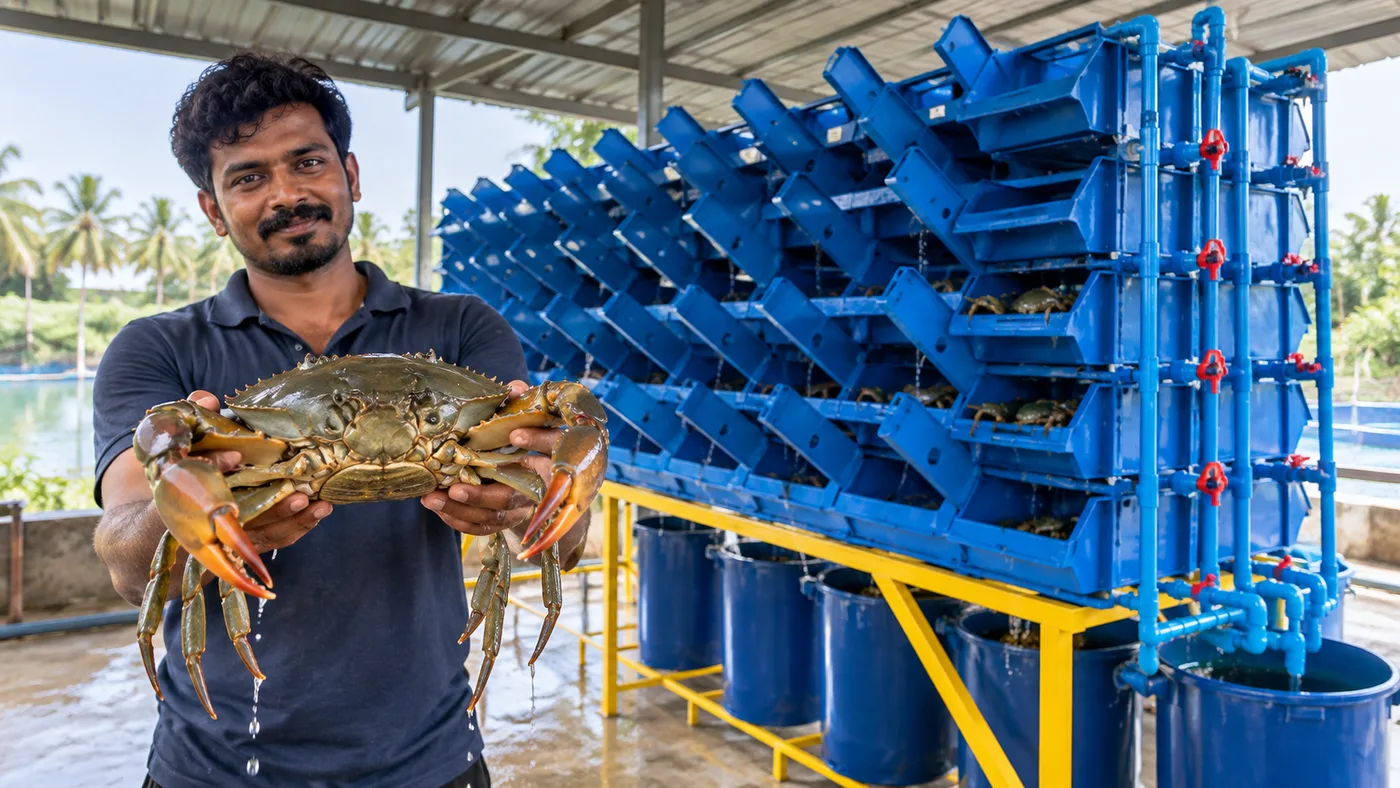
A commercial vertical crab condo facility relies on high-density modular stacking to maximize vertical space while isolating each individual animal. Mud crabs (Scylla serrata and Scylla tranquebarica) are aggressive, territorial predators with powerful chelipeds (claws) capable of exerting crushing pressures exceeding 40 kg/cm². In open ponds or pens, crabs inevitably cannibalize newly molted, soft-bodied conspecifics. Individual isolation boxes completely eliminate cannibalism—provided the structural engineering of each cell meets biological specifications.
Standard commercial crab boxes are molded from high-impact, food-grade virgin polypropylene (PP) with ultraviolet stabilizers. Recycled brittle plastics must be strictly avoided, as large 800g+ male crabs will crack weak lids and escape into the facility floor. A standard single-crab apartment box measures 32 cm in width, 42 cm in depth, and 24 cm in height. Each box features a perforated, self-draining sloped floor (with a 3° to 5° fall toward the rear drain) to ensure that heavy benthic fecal matter and unconsumed feed particles naturally migrate toward the discharge port rather than rotting beneath the crab's carapace.
The hydraulic circulation loop is the circulatory system of the facility. A standard 1,000-box installation is arranged in 10 double-sided racks, with each rack holding 100 boxes stacked 5 to 7 tiers high. Water is pumped from the clean sump through a 63mm UPVC main header, reducing to 25mm sub-manifolds running horizontally across each tier. Above each individual box, an adjustable needle-valve drip emitter delivers conditioned water at a continuous flow rate of 1.5 to 2.2 liters per minute. This flow ensures complete water exchange inside each box every 6 to 8 minutes without creating high-velocity shear currents that induce chronic swimming stress in benthic crabs.
Discharge hydraulics require meticulous slope sizing to prevent bacterial biofilm clogging. Each box drains into an open horizontal PVC gutter through an anti-escape mesh grid (aperture 8mm to 10mm). Water cascading down these open gutters discharges into a central 110mm gravity return flume pitched at a minimum 1.5% gradient. The gravity flume directs raw wastewater into the primary mechanical solids filtration chamber before any water can enter the biological treatment loops.
Box Drainage & Solids Clearance Mechanics
In poorly designed crab boxes, the drainage hole is placed flat on the bottom with a simple plug. Feces and shed cuticle fragments settle into dead zones, triggering severe anaerobic pockets where toxic hydrogen sulfide (H2S) accumulates. At concentrations as low as 0.02 ppm, H2S paralyses the crab's branchial scaphognathite (gill bailer), leading to silent suffocation within 12 hours.
Industrial-grade crab condo drawers utilize a self-flushing siphon standpipe or rear overflow weir with a bottom-scavenging siphon shield. When water trickles into the front of the box, it forces bottom water up and over the discharge weir, actively purging heavy particulate sludge every minute of the day.
Anti-Escape Locking Lids & Drawer Slide Integrity
Mud crabs are escape artists of legendary capability. They push upward against container ceilings using their powerful second and third walking legs while wedging their carapace corners into crevices. Every box drawer must feature a positive mechanical dual-cam latch or sliding track lock that cannot be dislodged from the inside.
Inspect drawer tracks weekly for salt encrustation and warping. A warped drawer that leaves a 15mm gap is sufficient for a 500g crab to squeeze its flattened cephalothorax through, dropping multiple tiers onto the concrete floor and sustaining fatal carapace fractures.
3. Recirculating Life-Support & Biofiltration: TAN Mass Balance & Water Chemistry
The most catastrophic mistake rookie crab condo operators commit is treating water management like home aquarium filtration. In an intensive 1,000-box indoor setup with an average standing biomass of 500 kg to 600 kg of mud crabs, the daily biochemical oxygen demand (BOD) and total ammonia nitrogen (TAN) production are immense. Feeding 25 kg to 30 kg of high-protein marine feed daily releases approximately 0.9 kg to 1.1 kg of raw Total Ammonia Nitrogen into the closed water loop every 24 hours.
Total Ammonia Nitrogen exists in two forms: non-toxic ionized ammonium (NH4+) and lethal un-ionized toxic ammonia (NH3). The equilibrium between these two forms is dictated entirely by water pH, temperature, and salinity. In brackishwater systems operating at pH 8.0 to 8.2 and water temperature of 27°C, approximately 5% to 8% of TAN is in the lethal un-ionized NH3 form. Mud crabs show severe respiratory distress and branchial tissue necrosis when ambient un-ionized ammonia exceeds 0.10 ppm. Therefore, the recirculating biofilter must possess immense autotrophic nitrifying capacity.
To achieve stable nitrification, commercial facilities utilize Moving Bed Biofilm Reactors (MBBR) filled with virgin high-density polyethylene bio-carriers (such as K1 or K3 media) featuring a protected specific surface area of 800 to 1,200 m²/m³. For a 1,000-box unit, the biofilter chamber must contain a minimum of 600 liters of active K1 media suspended in a 1,500-liter baffled reactor tank, vigorously aerated with 0.05 m³/min of compressed oil-free air per cubic meter of media. The aerobic nitrifying bacteria (Nitrosomonas and Nitrobacter) convert toxic TAN into nitrite (NO2-), and subsequently into relatively benign nitrate (NO3-), consuming 7.14 grams of water alkalinity (as CaCO3) for every gram of ammonia oxidized.
In addition to biofiltration, fine colloidal solids and dissolved proteins must be stripped continuously using a commercial counter-current foam fractionator (protein skimmer). Crabs produce heavy mucous secretions, particularly during feeding and shell hardening. Protein skimmers remove these amphiphilic organic molecules before they decompose into dissolved organic carbon (DOC), maintaining crystal-clear water with Secchi disc visibility exceeding the bottom of the sump.
Critical Water Quality Operational Parameters for Scylla serrata
Salinity: Maintain strictly between 18 ppt and 26 ppt. While Scylla serrata is euryhaline and can survive in 5 ppt to 35 ppt, rapid osmotic shifts force the crab to expend up to 25% of its metabolic energy on branchial Na+/K+-ATPase osmoregulation rather than muscle accretion and shell hardening.
Dissolved Oxygen (DO): Keep baseline DO above 5.5 mg/L at all times. Install micro-porous diffusers or oxygen cones in the distribution manifold. Never let DO drop below 4.0 mg/L, as hypoxia drastically elevates crab blood lactate levels and triggers feed refusal.
Water Temperature: Optimum metabolic range is 26.0°C to 28.5°C. In North and Central India during summer, ambient shed temperatures exceed 42°C, heating recirculating water past 32°C. Above 31°C, crab mortality spikes exponentially due to bacterial proliferation (Vibrio vulnificus and Vibrio parahaemolyticus). A 2.0-ton titanium heat-pump chiller is mandatory for commercial stability.
Alkalinity & pH: Maintain alkalinity at 130 to 160 ppm (as CaCO3) and pH at 7.8 to 8.3. Dose pure sodium bicarbonate (NaHCO3) @ 80g to 120g daily per 1,000 liters of water volume to buffer the acid produced by continuous biofilter nitrification.
UV Disinfection & Pathogen Exclusion Sizing
Indoor vertical systems recirculate 90% to 95% of their daily water volume. Without terminal sterilization, opportunistic pathogenic bacteria and fungal zoospores (such as Lagenidium and Fusarium) amplify rapidly. Water exiting the biofilter must pass through a closed-chamber stainless steel or PVC UV sterilizer delivering a minimum germicidal dosage of 35,000 to 45,000 μW·sec/cm².
Clean the quartz sleeves of the UV sterilizer with dilute muriatic acid every 14 days. Calcium carbonate scale and organic films reduce UV-C transmission by up to 60% within two weeks of continuous operation.
4. The Profitable Business Model: 21-Day Fattening vs The Growout Trap
In aquaculture business planning, operational velocity is king. The single largest financial trap that ruins vertical crab farm startups is attempting full-cycle 'Growout Culture' inside boxes. In a growout model, the farmer purchases 5g to 10g crablets from coastal hatcheries or wild seed collectors and attempts to rear them to a marketable 500g table size inside individual plastic boxes. This process takes 120 to 160 days.
During this 5-month growout period, each box occupies valuable racking space, consumes 24/7 electrical pumping power, and requires daily manual feeding and siphon cleaning. Over 150 days, the cumulative electricity, labor, and feed costs per crab exceed ₹480, while the crab undergoes 8 to 10 vulnerable molting cycles. In confined boxes without natural substrate minerals, juvenile crabs suffer from molt-death syndrome (MDS) and carapace deformities, dropping final survival to under 45%. The resulting unit economics produce a heavy financial loss.
In stark contrast, the commercially validated model that actually generates reliable cash flow is **21-Day Crab Fattening** (converting empty 'water crabs' into premium 'meat crabs'). When wild mud crabs molt in natural estuaries and coastal creeks, their newly expanded exoskeleton is soft and their internal body cavity is filled with watery hemolymph fluid rather than firm muscle tissue. These post-molt crabs are known in the Indian seafood trade as 'Water Crabs' or 'Hollow Crabs'. Local commission agents and fishermen sell them at steep discounts—often ₹350 to ₹500/kg—because seafood restaurants and processing plants reject them due to low meat yield.
When these healthy 400g to 700g water crabs are stocked into individual condo boxes and provided high-protein, energy-dense marine diets (fresh trash fish, squids, and bivalves), their hepatopancreas recovers rapidly, and muscle protein fills the inner claw and thoracic shell chambers within 18 to 24 days. The shell darkens, hardens into Grade-A rock-solid carapace, and the crab transforms into a prime 'Hard Meat Crab' commanding ₹1,300 to ₹1,800/kg from live seafood exporters flying shipments daily to Singapore, Malaysia, and East Asia. This gives you 12 to 14 rapid turnaround cycles per year with minimal molting mortality.
The Soft-Shell Crab Export Alternative
A second high-margin business model compatible with vertical condos is **Soft-Shell Crab Production**. Instead of fattening, the facility stocks late-stage 'peeler crabs'—crabs exhibiting pre-molt signs such as a distinct dark suture line along the paddle fin (dactylus) and abdominal margin.
Once stocked, operators inspect the boxes every 3 to 4 hours day and night. When a crab sheds its hard shell, it must be removed from the box within 60 to 90 minutes before sea salts in the water initiate carapace sclerotization (hardening). The soft crab is rinsed in chilled freshwater, vacuum-packed, and flash-frozen at -20°C. Frozen soft-shell crabs sell to five-star hotel distributors and premium export markets at ₹1,800 to ₹2,400/kg, offering massive margins for facilities with disciplined round-the-clock labor.
Seed Sourcing & Grade Selection Criteria
Never purchase mixed wild crabs from middlemen without rigorous physical grading. Only buy active crabs with both intact claws (chelipeds) and all walking legs present. Missing limbs force the crab to redirect its metabolic nutrients toward limb regeneration rather than thoracic muscle synthesis, delaying shell hardening by 10 to 15 days.
Inspect the ventral abdominal flap for parasitic barnacles (Sacculina spp.) and black shell necrotic spots. Crabs infected with Sacculina are castrated parasites that will never fatten and must be rejected at the intake gate.
5. Daily Feeding Logistics, Sludge Hygiene & Labor: The 4-Hour Individual Box Protocol
Operating an indoor vertical crab farm is intensely physical, disciplined work. While the water recirculation and aeration systems run automatically, feed delivery and fecal sludge hygiene are 100% manual. For a 1,000-box facility, feeding and cleaning cannot be treated as casual side chores—they require a structured 4-hour daily operational protocol split between morning and evening shifts.
Mud crabs are nocturnal bottom scavengers with acute chemosensory receptors on their antennules and dactyls. Feeding them dry floating or sinking shrimp pellets in vertical boxes is almost universally unsuccessful; commercial extruded pellets dissolve within 45 minutes in moving water, coating the box floor in an organic paste that fouls the biofilter while the crab ignores it. The only feed that drives rapid hepatopancreas lipid deposition and muscle hardening is fresh, raw marine and estuarine biomass.
The optimal daily feed formulation comprises 60% marine trash fish (chopped sardinella, anchovies, or ribbonfish offcuts) and 40% freshly crushed estuarine bivalves (clams or mussels like Meretrix casta or Perna viridis). Clam shells provide essential bio-available calcium, magnesium, and phosphorus necessary for rapid cuticle hardening. Feed is administered at 5% to 7% of crab body weight daily, partitioned into 30% in the morning (08:00 AM) and 70% in the evening (06:00 PM) to match their natural nocturnal peak feeding rhythm.
The non-negotiable golden rule of crab condo management is the **90-Minute Clean-Out Rule**. Exactly 90 minutes after feed administration, the technician must walk every aisle with a rolling inspection cart, slide open each drawer, and use long plastic forceps to remove any unconsumed fish flesh. If uneaten flesh remains in a 24-liter water box for more than two hours at 27°C, heterotrophic bacteria bloom exponentially. The water turns cloudy, dissolved oxygen crashes to zero, and the crab dies of bacterial branchial suffocation within hours.
The 4-Hour Daily Operational Schedule for 1,000 Boxes
07:30 AM – 08:30 AM (Morning Audit & Light Feeding): Walk all 10 racks; inspect individual water drip nozzles for blockages; record temperature, pH, and DO on the master board; distribute 15g morning feed ration per crab.
09:30 AM – 10:30 AM (Checktray Siphon & Extraction): Slide open all drawers; extract unconsumed morning feed; siphon heavy fecal casts from box corners into drainage gutters; identify and isolate any molted crabs.
05:30 PM – 06:30 PM (Evening Heavy Feeding): Distribute 35g evening feed ration (crushed fresh clams and trash fish); check biofilter aeration blowers and verify protein skimmer foam consistency.
08:00 PM – 09:00 PM (Night Hygiene Clean-Down & Security Check): Second pass waste extraction; flush main return gutters with fresh brackish water; verify generator automated transfer switch (ATS) and battery inverter levels.
Biosecurity & Footbath Protocols
Commercial indoor crab RAS units operate at immense biological densities. Slipper dips and hand sanitization stations containing 100 ppm Potassium Permanganate (KMnO4) or 50 ppm active Iodine must be maintained at every entrance door.
Quarantine all incoming wild crabs in a dedicated 200-liter acclimation tank with 15 ppm formalin dip for 15 minutes before introducing them into the main recirculating condo racks. This destroys external protozoan ectoparasites (such as Zoothamnium) before they colonize the closed system.
6. Real Turnkey Capex, Monthly Opex & Full P&L: The Commercial Unit Economics
To evaluate whether an indoor vertical crab farm makes commercial sense for your agribusiness portfolio, we must discard promotional social media presentations and examine the fully loaded capital expenditure (Capex), monthly operating overhead (Opex), and net profit and loss (P&L) of a standard commercial 1,000-box facility operating in coastal India.
The complete turnkey setup cost for a 1,000-box industrial-grade facility totals approximately ₹9.15 Lakhs. This includes 1,000 food-grade polypropylene boxes with multi-tier galvanized iron (GI) or stainless-steel racking frames (₹3.40 L), complete UPVC plumbing manifolds, drip emitters and return gutters (₹1.15 L), a 2,500-liter multi-chamber fiberglass RAS sump with 600L K1 media (₹1.35 L), an industrial 1.5 kW Venturi protein skimmer (₹0.85 L), dual 55W inline germicidal UV sterilizers (₹0.45 L), a 2.0-ton titanium plate water chiller (₹1.20 L), and an essential 5 kVA diesel generator with automatic transfer switch (₹0.75 L).
Operating costs for a 21-day fattening cycle processing 1,000 crabs (averaging 500g stocked weight) total ₹1.48 Lakhs per cycle. The primary cost component is the purchase of 500 kg of wild-caught 'water crabs' @ ₹450/kg (₹2.25 L). Monthly electrical power consumption (submersible circulation pumps, aeration blowers, UV sterilizers, and intermittent chilling) averages 2,100 kWh @ ₹8.50/unit (₹17,850). Fresh marine trash fish and clam feed (30 kg/day @ ₹45/kg for 21 days) costs ₹28,350. Two trained labor technicians cost ₹28,000 per month. Water replenishment, synthetic sea salts, and sodium bicarbonate buffer add ₹6,500 per month.
With an audited survival rate of 85%, 850 prime hard-shell crabs are harvested per cycle, weighing an average of 540g (reflecting an 8% weight gain from muscle and hepatopancreas density), yielding 459 kg of finished live export product. Sold at an average farmgate realization of ₹1,550/kg for Grade-XL live crabs to Chennai or Mumbai air-cargo consolidators, gross revenue per 21-day batch reaches ₹7.11 Lakhs against total batch operational expenditure of ₹5.68 Lakhs (including seed crab procurement). This yields a net operating profit of ₹1.43 Lakhs per 21-day cycle, or an annualized net profit of ₹1.55 Lakhs to ₹1.75 Lakhs per calendar month.
| Operational Parameter | Social Media Hype / Video Claims | Commercial Field Reality (AquaSangham Audit) | Impact on Net Bottom-Line Profit |
|---|---|---|---|
| Turnkey Capex (1,000 Boxes) | ₹2.5 to ₹3.5 Lakhs (trays only) | ₹8.5 to ₹11.8 Lakhs (Full RAS, UV, Chiller, Power) | Under-capitalized setups experience 40%+ mortality |
| Stocking & Culture Model | Growout (5g seed to 500g in 120 days) | 21-Day Fattening (450g water crab to hard crab) | Growout loses money; fattening yields 12+ cycles/yr |
| Batch Cycle Mortality | 0% to 2% ('Crabs can't fight') | 12% to 18% (Molting failure, ammonia, handling) | Reduces harvest volume from 1,000 to ~850 crabs |
| Primary Feed Type | Leftover kitchen waste / pellets | Fresh marine trash fish & live crushed bivalves | Pellets dissolve and crash RAS biofilter within 48 hrs |
| Daily Labor Requirement | 30 minutes automated maintenance | 4 to 5 hours daily manual feeding & siphon cleanup | Requires 2 dedicated technicians for 1,000 boxes |
| Monthly Power Bill | ₹2,000 to ₹3,000 / month | ₹16,000 to ₹22,000 / month (24/7 pumps & chilling) | Significant monthly operational cash-flow line item |
| Net Monthly Profit | ₹3.0 to ₹3.5 Lakhs / month | ₹1.2 to ₹1.8 Lakhs / month (audited commercial) | Highly profitable, but realistic commercial enterprise |
Factor in capital depreciation and working capital cash flow. Never launch an indoor crab RAS without having at least ₹3 Lakhs in liquid working capital reserved for seed crab purchasing and power bills during Batches 1 and 2.
7. Operational Field SOP Checklist & Frequently Asked Questions
To achieve the audited benchmark of 82% to 88% survival and consistent ₹1.4+ Lakhs monthly net profit, adherence to a standardized operating procedure is mandatory. Below is the non-negotiable operational checklist for daily crab condo management, followed by technical solutions to the four most pressing operational challenges faced by indoor crab producers.
The 6-Rule Field SOP Action Checklist for Vertical Crab Condos
1. Flow Rate Calibration: Verify that every individual box receives between 1.5 and 2.2 L/min of water flow; clean obstructed drip emitters daily during the morning pass.
2. TAN & Nitrite Safety Ceilings: Test TAN and NO2- every morning using calibrated photometers; initiate emergency 25% water dump if TAN exceeds 0.8 ppm or NO2- exceeds 0.2 ppm.
3. Rigid 90-Minute Cleanout: Remove all unconsumed trash fish and clam meat exactly 90 minutes after feeding; never leave raw feed in drawers overnight.
4. Shell Rigidity Grading: Press thumb firmly against the inner side of the crab's second walking leg base; if the carapace flexes or feels soft, keep in fattening for another 5 days.
5. Dissolved Oxygen Redundancy: Maintain pure oxygen cylinders piped into the main header on a solenoid valve that automatically triggers if blower pressure drops.
6. Live Export Tying Protocol: Tie both chelipeds securely across the ventral thoracic plastron using moist straw or plastic raffia ribbon immediately upon harvest to prevent limb autotomy.
Summary Operational Action Checklist
Frequently Asked Questions
Q: Can I run an indoor crab box farm in North India far away from the ocean?
Yes, vertical crab condos can operate inland using synthetic sea salt blends (reconstituting borewell water to 20–22 ppt salinity) fortified with commercial magnesium chloride (MgCl2) and potassium chloride (KCl). However, indoor climate control is paramount: during North Indian winters when water temperatures drop below 18°C, titanium immersion heaters are required to maintain feeding metabolism; during summer (42°C+ ambient), heavy evaporative cooling or industrial chillers are mandatory to prevent water temperatures from exceeding 30°C.
Q: What happens if there is an unexpected power outage at 2:00 AM?
In a closed-loop recirculating system holding 500 kg of crabs, water flow stops immediately upon power failure. Within 45 to 60 minutes, dissolved oxygen inside the individual 24-liter boxes drops below 1.5 ppm, triggering mass asphyxiation and irreversible brain damage. An automated transfer switch (ATS) coupled to an inverter battery bank (for immediate 30-minute blower backup) and a 5 kVA diesel generator is a non-negotiable biosecurity requirement for any commercial installation.
Q: Where do commercial crab condo operators source 1,000 'water crabs' every 21 days?
Commercial operators establish direct supply relationships with estuarine crab pickers, artisanal gillnet fishermen, and coastal mandi commission agents in major crab hubs such as Pulicat Lake (Tamil Nadu), Repalle and Machilipatnam (Andhra Pradesh), Vypeen (Kerala), Chilika Lake (Odisha), and the Sundarbans (West Bengal). These fishermen routinely catch lean, post-molt water crabs that local markets reject, allowing operators to procure them at bulk wholesale discounts.
Q: Why can't I feed dry commercial shrimp pellets to cut feed labor costs?
Mud crabs are sensory scavengers designed to crush bivalve shells and tear fibrous marine muscle tissue. Standard commercial dry aquaculture pellets dissolve into fine organic silt within 30 to 45 minutes in a continuous-flow box. Crabs fail to ingest dissolved particles, and the decaying powder passes directly through the rear screen into the recirculating biofilter, triggering catastrophic ammonia spikes and bacterial fouling within 48 hours.
AquaSangham Commercial Mariculture Desk
Intensive RAS & High-Density Crustacean Division
Contributing Senior Technical Writer & Aqua Consultant at AquaSangham.
Recommended Farming Guides
The 3 AM Oxygen Trap: Why Fish and Shrimp Die at Dawn (And The 4.0 ppm Rule That Saves Them)
Read Article →Water QualityWhy Sudden Monsoon Rain Wipes Out Shrimp Overnight (And The 30-Minute Emergency Lime Protocol That Saves Your Pond)
Read Article →Market AnalysisEU & US Seafood Traceability Audits: Keeping Digital Farm Logs to Secure ₹15-₹20/kg Premium from Exporters
Read Article →Get Live Farm Advice on AquaSangham Mobile App
Download India's #1 Aquaculture Super App for real-time market prices, precision tools, and community advice.
Download Free Android App