Executive Summary & Key Takeaways
- EHP (Enterocytozoon hepatopenaei) microsporidia spores possess thick chitinous walls resistant to antibiotics; absolute prevention through pond disinfection and SPF seed is mandatory.
- Maintain total green colony Vibrio (pathogenic Vibrio parahaemolyticus and V. harveyi) below 100 CFU/mL on TCBS agar plates throughout the culture cycle.
- Chlorinate all incoming reservoir water with 25 to 30 ppm active chlorine (bleaching powder) and allow 72 hours of dechlorination before stocking.
- Physical biosecurity barriers (crab fencing, bird netting, vehicle wheel dips, and footwear disinfection stations) block external viral vectors.
- High-dose competitive probiotic inoculation (Bacillus, Nitrosomonas, and Nitrobacter) outcompetes pathogenic bacteria for nutrients and attachment sites.
Field Case Study: 3-Cycle EHP Exclusion Protocol
A commercial site implementing strict reservoir bleaching (30 ppm), Crab fencing (0.5m HDPE sheet), and 100% SPF PCR-tested PL12 seed maintained a consistent daily growth rate of 0.32g/day without any size variation, white gut, or microsporidia spore detection across 105 DOC.
1. The Primary Pathogen Threats in Contemporary Indian Aquaculture
Commercial shrimp farming in India faces three primary pathogen threats: White Spot Syndrome Virus (WSSV), Acute Hepatopancreatic Necrosis Disease (AHPND/EMS, caused by toxin-bearing Vibrio parahaemolyticus), and the microsporidian parasite Enterocytozoon hepatopenaei (EHP).
While WSSV causes acute mortality within 72 hours of clinical signs, EHP causes insidious, non-lethal growth retardation. EHP microsporidia infect the tubule epithelial cells of the hepatopancreas, destroying the shrimp's ability to absorb lipids and nutrients. Infected ponds display severe size variation (coefficient of variation > 35%) and stunted growth (< 0.15g/day), leading to severe financial collapse.
Because microsporidian spores cannot be eliminated with therapeutic chemicals or antibiotics once established inside living shrimp tissues, biosecurity and environmental pathogen exclusion remain the only proven defenses.
2. Physical Biosecurity: Crab Fencing, Bird Netting & Vector Control
Pathogens do not spontaneously generate in aquaculture ponds; they are transported by biological vectors such as wild crabs, aquatic insects, stray birds, and contaminated farm equipment.
Install 0.5-meter smooth HDPE crab fencing buried 10 cm into the soil around the entire farm perimeter to prevent mud crabs (Scylla serrata) and shore crabs from migrating between infected tidal creeks and culture ponds.
Overhead bird scaring lines spaced 3 meters apart deter piscivorous birds (kingfishers, egrets, cormorants) from dropping moribund diseased shrimp into healthy ponds. Install potassium permanganate (KMnO4) footwear disinfection trays at every pond entry gate.
3. Chemical Water Disinfection & Reservoir Management Protocols
Never pump raw creek or estuary water directly into grow-out ponds. Raw water must pass through a multi-stage reservoir system equipped with 60-mesh and 100-mesh nylon filter bags to exclude wild shrimp larvae, copepods, and fish fry.
Treat reservoir water with Calcium Hypochlorite (65% active chlorine) @ 25 to 30 ppm (35 to 40 kg per 1,000 m³). Aerate vigorously for 72 to 96 hours to allow complete dissipation of residual toxic chlorine gas before releasing water into culture ponds.
4. TCBS Agar Monitoring & Bacterial Thresholds
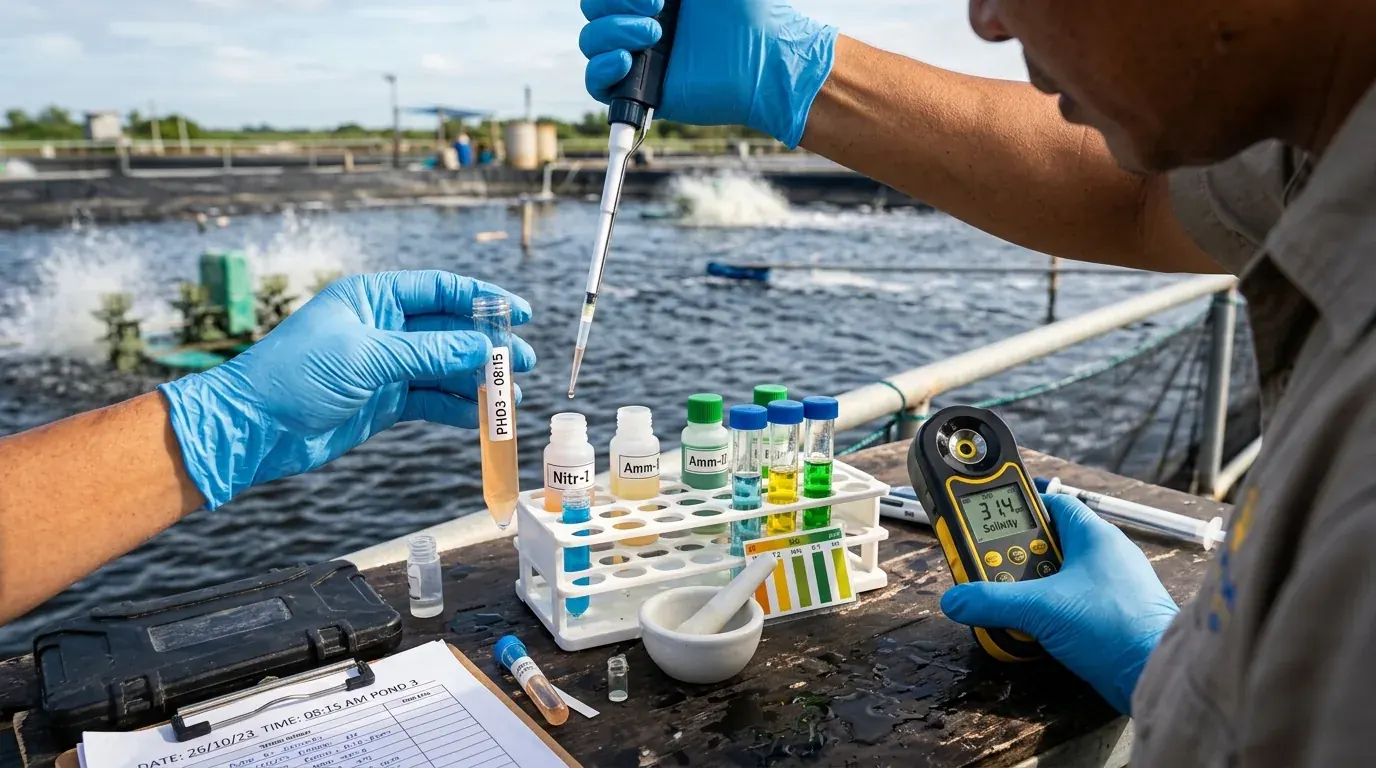
Thiosulfate-Citrate-Bile Salts-Sucrose (TCBS) agar is the gold standard diagnostic tool for enumerating Vibrio bacteria in pond water and shrimp hepatopancreas tissue.
Yellow colonies (sucrose-fermenting species like Vibrio alginolyticus) are generally benign or beneficial in moderate numbers (< 10³ CFU/mL). However, Green colonies (sucrose non-fermenting species including pathogenic Vibrio parahaemolyticus and V. vulnificus) must remain strictly below 10² CFU/mL (100 colonies per milliliter).
If green Vibrio counts exceed 250 CFU/mL: Immediately apply approved water sanitizers (such as stabilized BKC 80% or Polyvinylpyrrolidone Iodine 20%) followed 24 hours later by high-density Bacillus probiotic inoculation.
5. Competitive Exclusion via High-Potency Probiotics
Pathogenic bacteria require physical attachment sites and soluble organic nutrients to colonize the pond environment. Inoculating ponds with competitive beneficial bacteria (Bacillus subtilis, Bacillus megaterium, and photosynthetic Rhodobacter) establishes a dominant biofilm that outcompetes pathogenic Vibrio species.
Ferment soil probiotics with jaggery (molasses) and sterile aeration for 18 hours prior to pond application to maximize vegetative bacterial counts and speed colonization.
6. Soil Drying, Quicklime (CaO) Burning & Sludge Removal Between Crops
EHP spores survive for months in damp pond bottom sludge. Between culture cycles, scrape and physically remove black anaerobic sludge from the pond center.
Plough the bottom soil and apply unslaked Quicklime (Calcium Oxide, CaO) @ 1,000 to 1,500 kg per hectare. Quicklime reacts exothermically with soil moisture, generating temperatures exceeding 60°C and raising soil pH above 11.5, which ruptures and destroys resilient EHP spore walls.
Summary Operational Action Checklist
Frequently Asked Questions
Q: Can antibiotics cure EHP microsporidia in shrimp?
No. EHP is a microsporidian parasite, not a bacterium. Antibiotics are completely ineffective against EHP and are strictly banned in commercial aquaculture due to international export residue regulations.
Q: What are the early physical symptoms of Vibrio infection in shrimp?
Early symptoms include reddish discoloration of the tail fan and pleopods, empty midgut, cloudy hepatopancreas, lethargy near pond dykes, and nocturnal luminescence (glowing shrimp) caused by Vibrio harveyi.
Q: How long should reservoir water be rested after chlorination?
Chlorinated reservoir water should be aerated and rested for at least 72 to 96 hours. Always test water with an ortho-tolidine chlorine test kit to confirm 0.0 ppm residual free chlorine before transferring to culture ponds.
Team AquaSangham
Aquaculture Research & Technical Desk
Contributing Senior Technical Writer & Aqua Consultant at AquaSangham.
Recommended Farming Guides
Western Blue Shrimp (Penaeus stylirostris) Intensive Culture: Lessons from New Caledonia
Read Article →Farming TechGreen Tiger Prawn (Penaeus semisulcatus) Culture Protocols for Gulf of Mannar Coastal Ponds
Read Article →Farming TechKuruma Prawn (Penaeus japonicus) Culture in Sandy Substrates: High-Value Export SOP
Read Article →Get Live Farm Advice on AquaSangham Mobile App
Download India's #1 Aquaculture Super App for real-time market prices, precision tools, and community advice.
Download Free Android App