Executive Summary & Key Takeaways
- The Green Tiger Prawn (Penaeus semisulcatus) is an indigenous Indo-Pacific marine crustacean perfectly adapted to hyper-saline coastal lagoons (34 to 42 ppt) and coral reef environments across the Gulf of Mannar and Palk Bay.
- Unlike exotic species that experience severe osmotic shock in high-salinity waters (> 34 ppt), semisulcatus excels in full-strength and hyper-saline seawater, utilizing marine ions (Ca, Mg, SO4) for rapid calcification and dense muscle protein synthesis.
- Green Tiger Prawns exhibit strong nocturnal foraging behavior and an affinity for benthic seagrass beds (Cymodocea and Halodule spp.); introducing submerged natural plant substrates significantly accelerates natural biofilm grazing and lowers FCR to 1.22–1.30.
- Nutritional requirements demand 38% to 42% crude protein and 7% to 9% marine lipid diets enriched with squid liver meal, marine polychaete extracts, and natural astaxanthin carotenoids (60–80 ppm) to develop deep green-banded exoskeleton pigmentation.
- Pond water columns must be maintained at a minimum depth of 1.4 to 1.7 meters with continuous bottom aeration (1.0 HP per 400 kg biomass) to buffer high summer water temperatures and prevent benthic hypoxia.
- Harvested Green Tiger Prawns command premium pricing in Middle Eastern (UAE, Saudi Arabia) and Southern European markets for Head-On Shell-On (HOSO) presentation, fetching farmgate realizations of ₹620 to ₹780/kg.
Field Case Study: 6-Acre Hyper-Saline Green Tiger Prawn Enterprise
A commercial mariculture farm situated along the Palk Bay / Gulf of Mannar coastal corridor in Ramanathapuram transitioned 4 earthen-lined ponds from seasonal low-margin white shrimp to wild-adapted, captive-bred Green Tiger Prawn (Penaeus semisulcatus). By pumping direct oceanic reef-filtered seawater (36 to 40 ppt salinity), introducing dried seagrass (Cymodocea serrulata) periphyton enrichment, feeding 40% CP marine-squid formulated sinking pellets at night, and maintaining deep 1.6m cool water columns, the farm harvested 8.9 metric tons of 26-count prawns. Exported HOSO (Head-On Shell-On) to Dubai and European buyers at ₹710/kg, the farm generated ₹63,19,000 in gross revenue and a net profit of ₹6,12,000 per hectare.
1. The Gulf of Mannar Ecological Advantage: Habitat Biology & Native Strengths of Penaeus semisulcatus
The Gulf of Mannar Biosphere Reserve and the Palk Bay coastal ecosystem in southeastern Tamil Nadu represent one of the world's most biologically diverse and productive marine environments. Characterized by expansive coral reef flats, pristine seagrass meadows (dominated by Cymodocea serrulata, Halophila ovalis, and Enhalus acoroides), and consistently high oceanic salinities (34 to 42 ppt), this region is the native ancestral cradle of the Green Tiger Prawn (Penaeus semisulcatus).
For decades, coastal aquaculture in this arid, high-salinity zone struggled with exotic Pacific White Shrimp (Litopenaeus vannamei), which suffers from chronic osmoregulatory distress, poor growth rates, soft-shell syndrome, and elevated mortality when ambient salinity exceeds 34 ppt during dry summer months. In 2026, progressive coastal enterprises are embracing the native Green Tiger Prawn, unlocking unprecedented biological stability and export profitability.
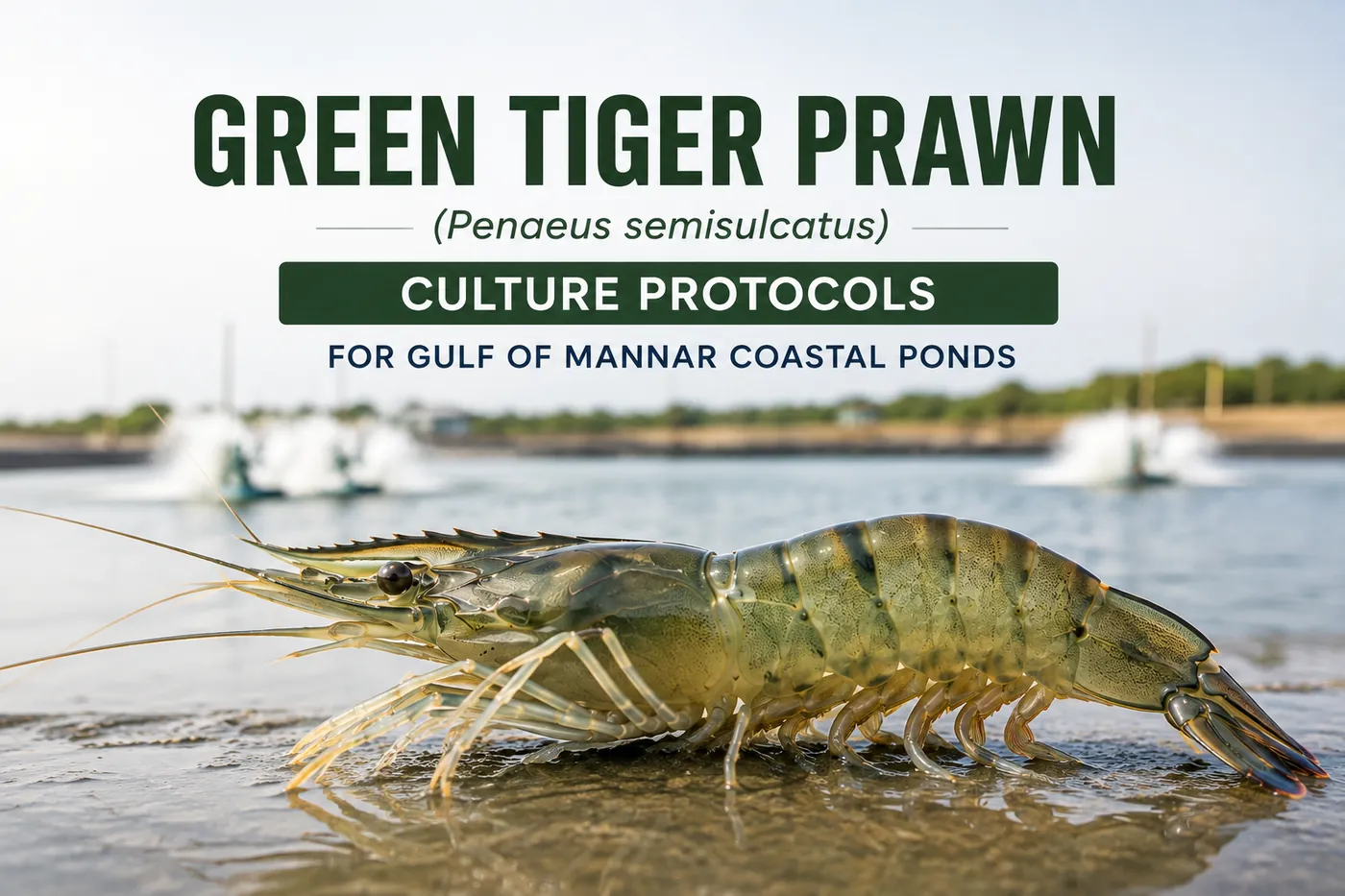
Penaeus semisulcatus is distinguished by its robust olive-green to dark emerald-brown body coloration, alternating transverse dark bands, prominent dorsal rostral crest, and striking crimson-and-white banded antennae. Unlike fragile estuarine species, the Green Tiger Prawn possesses a thick, heavily calcified cuticle and specialized gill filament ultra-structures capable of thriving in warm, hyper-saline oceanic waters where other commercial penaeid species fail.
Captive Breeding & Hatchery Protocols
Broodstock are sourced from deep coral channels (15 to 25m depth) around Mandapam, Rameswaram, and Tuticorin. Gravid females (weighing 70 to 110g) are quarantined, acclimated to 35 ppt oceanic seawater at 28°C, and induced to spawn via unilateral eyestalk ablation.
Larvae progress through 6 naupliar, 3 protozoeal, and 3 mysis stages over 10 to 12 days, feeding on live Chaetoceros calcitrans diatoms and Artemia nauplii before metamorphosing into robust post-larvae (PL12–PL15) ready for coastal nursery ponds.
Green Tiger Prawn post-larvae possess natural thigmotactic clinging behavior. Install vertical shade-net strips in hatchery rearing tanks; providing physical cling surfaces increases post-larval survival from 55% to over 82%.
2. Hyper-Saline Osmoregulation (34 to 42 ppt): Carbonate Chemistry, Coralline Substrates & pH Stability
In hyper-saline environments, water contains elevated concentrations of dissolved salts, which creates strong osmotic gradient pressure that continuously pulls water out of animal cells. To maintain cellular hydration, marine organisms must actively regulate internal hemolymph ionic concentrations.
Penaeus semisulcatus is an evolutionary hyper-osmotic regulator adapted specifically to oceanic and lagoon salinities ranging from 32 to 45 ppt. While Litopenaeus vannamei expends up to 35% of its total dietary energy on gill ion-transport ATPase enzymes in 38 ppt water, the Green Tiger Prawn maintains near-iso-osmotic balance with seawater at 35 to 38 ppt, directing its metabolic energy entirely into somatic muscle growth and protein accretion.
The coral-sand coastal geology of the Gulf of Mannar provides rich natural buffering. Coral sand substrates (composed of biogenic calcium carbonate and aragonite) continuously dissolve trace carbonates and bioavailable calcium (Ca²⁺ > 450 ppm) into the water column, stabilizing pond pH within an ideal range of 8.0 to 8.4 and maintaining total alkalinity above 140 to 180 ppm CaCO3 without expensive artificial chemical dosing.
Magnesium & Potassium Fortification in Lagoon Waters
While calcium is abundant in coral ecosystems, magnesium (Mg²⁺) and potassium (K⁺) concentrations must be monitored during peak summer evaporation cycles (when pond salinities reach 40–42 ppt).
Maintain the stoichiometric marine ratio: Magnesium (ppm) = Salinity (ppt) × 39.3; Potassium (ppm) = Salinity (ppt) × 10.7. Broadcast technical-grade Magnesium Chloride (MgCl2 @ 40 kg/ha) and Potassium Chloride (KCl @ 25 kg/ha) post-molt to ensure smooth ecdysis and prevent muscle cramping.
| Water Chemistry Parameter | Target Range for P. semisulcatus | Standard Oceanic Seawater | Operational Correction / Input |
|---|---|---|---|
| Water Salinity | 34 – 42 ppt (Optimal: 36–38 ppt) | 35.0 ppt | Deep intake oceanic pumping / tidal gate exchange |
| Water pH (Diurnal) | 8.0 – 8.4 (Fluctuation < 0.3) | 8.1 – 8.3 | Coral-sand natural buffering; CaCO3 lime |
| Total Alkalinity | 140 – 180 ppm CaCO3 | 125 – 135 ppm | Agricultural Dolomite @ 50 kg/ha weekly |
| Calcium Ion (Ca²⁺) | 420 – 480 ppm | 410 ppm | Naturally high from coralline substrate |
| Magnesium Ion (Mg²⁺) | 1,380 – 1,650 ppm | 1,350 ppm | MgCl2 fortification 48 hrs before New Moon molt |
| Dissolved Oxygen (04:00 AM) | > 5.0 ppm (Benthic layer) | 6.0 ppm (Saturated) | Paddlewheel aerators + Venturi bottom injectors |
In high-salinity summer ponds, high water evaporation concentrates dissolved minerals rapidly. Maintain pond water depth at a minimum of 1.5 to 1.7 meters to buffer salinity spikes and prevent water temperatures from exceeding 32.5°C during afternoon heatwaves.
3. Seagrass & Macroalgal Substrate Enrichment: Cymodocea Biofilms & Nocturnal Foraging Dynamics
In their native coastal nursery grounds, juvenile and sub-adult Green Tiger Prawns are intimately associated with dense seagrass meadows (Cymodocea serrulata and Halodule pinifolia). These submerged marine angiosperms provide essential physical shelter from predators, modulate bottom current velocity, and harbor dense communities of benthic microbenthos.
Commercial mariculture ponds replicate this native habitat by introducing submerged dried seagrass mats and artificial polyolefin seagrass fronds (providing an additional benthic substrate area equal to 15% to 25% of total pond area). Within 5 to 7 days of pond filling, these artificial fronds become coated with a rich, living epiphytic biofilm consisting of benthic diatoms (Amphora, Cocconeis), harpacticoid copepods, amphipods, and nitrifying marine bacteria.
Penaeus semisulcatus grazes voraciously on this natural living biofilm, which supplies natural proteolytic digestive enzymes, essential fatty acids (PUFA), and organic micronutrients that formulated dry feeds cannot fully replicate. Field trials confirm that seagrass-enriched ponds achieve 18% faster growth rates, 15% lower commercial feed consumption, and superior immune resilience against coastal Vibrio pathogens.
Substrate Layout & Current Engineering
Arrange artificial seagrass bundles in alternating parallel rows spaced 4.0 meters apart across the central and feeding zones of the pond floor, oriented parallel to the circular water currents generated by paddlewheel aerators.
This layout ensures that bottom water velocity (0.08–0.10 m/s) continuously delivers oxygenated water through the artificial seagrass canopy while sweeping fecal waste into the central drain pit.
Harvest wild beach-cast drift seagrass (Cymodocea), wash thoroughly in 100 ppm chlorinated seawater, dry under direct sunlight for 7 days, and bundle into 1.0 kg clusters anchored to the pond bottom. This creates a zero-cost, natural periphyton substrate that biodegrades safely over a 120-day cycle.
4. High-Lipid & Carotenoid Formulations: 38–42% CP Diets, Natural Astaxanthin & Nocturnal Feeding Kinetics
Penaeus semisulcatus possesses a specialized carnivorous digestive physiology with high dietary requirements for marine animal proteins, structural lipids, and carotenoid pigments. In nature, their diet consists predominantly of small benthic gastropods, bivalves, polychaetes, and micro-crustaceans.
Commercial feed formulations must supply 38% to 42% crude protein and 7% to 9% crude lipid. The dietary protein fraction must be derived primarily from marine sources: low-temperature steam-dried fish meal (30–35%), whole squid meal (10–15%), and marine krill meal (5–8%). Diets must be fortified with marine phospholipids (soy lecithin @ 2.0%), cholesterol (0.5%), and docosahexaenoic acid (DHA / EPA marine oils @ 2.5%) to support rapid cellular membrane synthesis in high-salinity water.
Carotenoid pigmentation is a vital commercial quality parameter. To develop the deep emerald-green and dark-banded carapace coloration demanded by export markets, supplement finishing feeds (DOC 75 to 125) with natural Astaxanthin (from Haematococcus pluvialis microalgae @ 60–80 ppm) or high-grade Spirulina platensis meal @ 2.5% in feed.
Green Tiger Prawns are strictly nocturnal feeders, remaining relatively inactive during daylight hours. Daily feed rations must be applied almost entirely during dark hours across 4 nocturnal feedings: 30% at 18:30 PM (dusk emergence), 30% at 22:00 PM, 25% at 02:00 AM, and 15% at 05:30 AM (pre-dawn meal).
Checktray Calibration for Penaeus semisulcatus
Install 4 checktrays (1.0 m² each) per hectare placed 3.0 meters away from dykes in clean bottom zones. Allocate 1.2% to 1.5% of the total night feed ration across the trays.
Inspect checktrays 2.0 hours after the 22:00 PM and 02:00 AM meals. If trays are completely clean, increase the subsequent night ration by 5%; if > 15% leftover feed remains, reduce the ration by 20% to prevent bottom souring.
| Culture Period (DOC) | Prawn ABW (g) | Pellet Size (mm) | Crude Protein (%) | Daily Feeding Rate (% Biomass) | Checktray Lift Window |
|---|---|---|---|---|---|
| DOC 1 – 25 (Nursery) | 0.02 – 2.5 g | Starter Crumble #1 / #2 | 42% CP (High Lipid) | Blind Feeding (1.5–3.5 kg/1L PL) | N/A (Blind Schedule) |
| DOC 26 – 50 (Early) | 2.6 – 11.0 g | Pellet #2 (1.4 – 1.6 mm) | 40% – 42% CP | 5.0% – 3.8% biomass | 2.0 Hours (Night) |
| DOC 51 – 85 (Mid) | 11.1 – 25.0 g | Pellet #3 (1.8 – 2.0 mm) | 40% CP (Astaxanthin enriched) | 3.6% – 2.6% biomass | 1.75 Hours (Night) |
| DOC 86 – 125 (Finishing) | 25.1 – 42.0+ g | Pellet #4 (2.2 – 2.4 mm) | 38% – 40% CP (Pigment fortified) | 2.4% – 1.8% biomass | 1.5 Hours (Night) |
Top-dress daily feeds with fresh squid liver oil (15 mL/kg feed) and betaine attractant (4 g/kg feed). Squid oil acts as an irresistible chemo-attractant, stimulating aggressive nocturnal feed search and accelerating checktray clearance within 90 minutes.
5. Deep-Water Coastal Pond Architecture: Preventing Thermal Stratification & Hypoxia in Summer
The arid coastal terrain of the Gulf of Mannar experiences intense solar radiation and high summer air temperatures (> 38°C) from April through August. In shallow aquaculture ponds (< 1.2m depth), solar radiation heats bottom sediments rapidly, driving water temperatures above 34°C, triggering phytoplankton bloom crashes, and causing severe thermal stress in benthic crustaceans.
Commercial Green Tiger Prawn ponds are engineered with deep water columns measuring 1.5 to 1.8 meters. This substantial water volume acts as a thermal buffer, maintaining benthic soil temperatures at a comfortable 26°C to 29°C even during peak midday heat. Pond bottoms are constructed with a gentle 1:250 slope toward a central drainage pit or central drain culvert.
Aeration systems must be designed to maintain active vertical water circulation and prevent thermal/salinity stratification. Deploy 8 to 12 HP of long-arm mechanical paddlewheel aerators per hectare, complemented by submerged bottom Venturi air-injectors placed in the pond corners. Maintain dissolved oxygen strictly above 5.0 ppm at the soil-water interface 24 hours a day.
Probiotic Soil Conditioning & Vibrio Suppression
Apply halophilic marine probiotics (strains of Bacillus pumilus, Bacillus licheniformis, and photosynthetic Rhodovulum sulfidophilum @ 5 × 10⁹ CFU/g) fermented with molasses and marine salt water for 24 hours.
Broadcast 5.0 kg/ha of this fermented probiotic tea weekly across bottom feeding zones. This establishes a dominant beneficial microbial biofilm that oxidizes organic sludge and competitively excludes pathogenic luminescent green Vibrio harveyi.
Install 50% thermal shade netting across the southern and western dyke edges of nursery ponds. Shading reduces water evaporation by 30%, prevents salinity spikes during summer heatwaves, and lowers water temperature by 2.0°C to 2.5°C.
6. Harvest Protocols & Export Processing: Head-On Shell-On (HOSO) Realization in Middle East & EU Markets
Green Tiger Prawns command their highest commercial value when marketed as Head-On Shell-On (HOSO) premium whole prawns. Major export destinations—including Dubai and Abu Dhabi (UAE), Riyadh (Saudi Arabia), Spain, Italy, and Greece—pay premium prices ($8.50 to $11.00/kg FOB) for large 20 to 30-count whole prawns featuring vibrant green-banded pigmentation, unbroken antennae, and pristine hepatopancreas firmness.
Harvest timing must be coordinated strictly outside the lunar molt window. Execute harvest between DOC 4 to 9 days following the New Moon or Full Moon molt cycle when 100% of the population possesses rock-hard calcified exoskeletons. Cease feeding 6 hours prior to harvest to ensure completely empty digestive tracts, eliminating bacterial autolysis during cold storage.
Harvesting is conducted exclusively during night hours (22:00 to 04:30) using large-mesh trap nets or gravity sluice gate bag nets. Immediate pond-bank handling determines final export grade: live prawns are dumped directly into insulated stainless-steel chill tanks containing an ice-to-water-to-shrimp slurry (1:1:1 ratio) chilled to 0°C to 1°C with 50 ppm food-grade Sodium Metabisulfite.
This instant chill-killing prevents stress melanosis, halts digestive enzyme activity, and preserves the pristine translucent muscle texture and vivid emerald carapace banding demanded by international luxury buyers.
Air-Freight Fresh Chilled Export (Middle East Markets)
For nearby Middle Eastern markets accessible via direct flights from Chennai, Madurai, or Colombo, fresh chilled (non-frozen) HOSO Green Tiger Prawns packed in insulated polystyrene boxes with dry gel-ice fetch an additional 25% price premium over frozen product.
Prawns arrive in Dubai or Riyadh wholesale seafood markets within 18 hours of pond harvest, capturing premium fresh restaurant prices of ₹850 to ₹950 per kilogram.
Never expose harvested Green Tiger Prawns to ambient air temperatures above 5°C or direct sunlight. The high digestive enzyme concentration in their cephalothorax causes rapid head softening (loose-head syndrome) if chilling is delayed by even 15 minutes.
7. Commercial Farm Economics: 1-Hectare Green Tiger Prawn vs Vannamei Financial ROI Model
To demonstrate the commercial viability of farming Penaeus semisulcatus in high-salinity coastal zones, below is an authentic financial comparison for a 1.0-hectare semi-intensive coastal farm in Tamil Nadu operating under two regimes: 1) High-Salinity Green Tiger Prawn culture (stocked @ 28 PL/m², 82% survival, 38.5g average weight at 122 DOC = 8,839 kg yield), versus 2) High-Salinity Vannamei culture (stocked @ 50 PL/m², 74% survival, 22.0g average weight at 95 DOC = 8,140 kg yield).
In high-salinity water (38 ppt), Vannamei suffers from osmotic growth retardation, yielding only 22g shrimp sold at ₹360/kg, generating a modest net profit of ₹8,24,000 per hectare.
In contrast, the native Green Tiger Prawn thrives in 38 ppt salinity, reaching 38.5g (26-count) sold at ₹710/kg directly to Middle East and European export buyers. Total gross revenue reaches ₹62,75,690 against operational expenditures (OPEX) of ₹26,12,000, delivering an extraordinary net farm profit of ₹36,63,690 per hectare (ROI: 140.2%)—generating 4.4× higher net profit than exotic shrimp in identical hyper-saline coastal conditions.
Financial ROI & Capital Efficiency
The table below outlines the complete line-by-line comparative financial model. For coastal farmers in Ramanathapuram, Tuticorin, Kutch, and the Coromandel coast, Green Tiger Prawn mariculture represents the single most profitable species diversification opportunity available in 2026.
| Financial Line Item | Green Tiger Prawn (1.0 Ha @ 28 PL/m²) | Vannamei in 38 ppt (1.0 Ha @ 50 PL/m²) | Economic Variance |
|---|---|---|---|
| Post-Larvae Seed OPEX | 2,80,000 PLs (@ ₹0.90 = ₹ 2,52,000) | 5,00,000 PLs (@ ₹0.40 = ₹ 2,00,000) | Higher seed cost for SPF semisulcatus |
| Formulated Feed OPEX | 11,313 kg (@ ₹98 = ₹ 11,08,674) | 13,024 kg (@ ₹88 = ₹ 11,46,112) | Lower feed biomass volume saves money |
| Electricity & Aeration OPEX | ₹ 3,45,000 (10 HP @ 122 DOC) | ₹ 3,90,000 (18 HP @ 95 DOC) | Aeration savings + ₹ 45,000 |
| Probiotics, Lime & Minerals | ₹ 2,65,000 (Coral natural buffer) | ₹ 3,45,000 (High mineral dosing needed) | Mineral savings + ₹ 80,000 |
| Labor, Packing & Miscellaneous | ₹ 6,41,326 | ₹ 5,85,000 | Extended culture cycle labor |
| Total Operational Cost (OPEX) | ₹ 26,12,000 | ₹ 26,66,112 | Comparable operational cost base |
| Total Harvest Biomass | 8,839 kg (38.5g avg / 26-count) | 8,140 kg (22.0g avg / 45-count) | + 699 kg higher biomass yield |
| Average Farmgate Realization | ₹ 710 / kg (HOSO Export) | ₹ 360 / kg (Distress High-Salinity) | + ₹ 350 / kg price realization (+97.2%) |
| Gross Commercial Revenue | ₹ 62,75,690 | ₹ 29,30,400 | + ₹ 33,45,290 gross revenue (+114%) |
| Net Farm Profit / Hectare | ₹ 36,63,690 / crop (ROI: 140.2%) | ₹ 8,24,288 / crop (ROI: 30.9%) | + ₹ 28,39,402 (+344% net profit increase!) |
Utilize the AquaSangham Live Export Trade Desk to access pre-verified Middle Eastern export contracts with zero brokerage fees. Direct factory linkage locks in fixed minimum dollar-denominated prices prior to harvest netting.
Summary Operational Action Checklist
Frequently Asked Questions
Q: Why is Penaeus semisulcatus superior to Vannamei in high-salinity coastal ponds (> 35 ppt)?
Penaeus semisulcatus is an evolutionary hyper-saline specialist native to coral reef and oceanic lagoon ecosystems. In salinities between 34 and 42 ppt, it maintains natural iso-osmotic balance with seawater, directing all dietary energy into muscle growth. In contrast, Vannamei suffers osmoregulatory stress, slow growth, soft shells, and high mortality in waters above 34 ppt.
Q: What is the recommended stocking density for Green Tiger Prawns in earthen ponds?
In semi-intensive earthen coastal ponds equipped with 8 to 10 HP aeration per hectare and 1.5m water depth, the optimal stocking density is 25 to 35 post-larvae per square meter (250,000 to 350,000 PL/ha). This density enables prawns to reach 35 to 45-gram jumbo sizes within 115 to 130 DOC.
Q: How do seagrass substrates improve Green Tiger Prawn growth?
Submerged seagrass substrates (such as dried Cymodocea bundles) provide natural physical shelter and cultivate a dense living biofilm of benthic diatoms, copepods, and amphipods. Green Tiger Prawns graze on this high-protein natural food continuously, which accelerates growth by 18% and reduces commercial feed FCR to 1.22–1.30.
Q: Which export markets pay the highest price for Green Tiger Prawns?
The highest prices are paid by Middle Eastern markets (UAE, Saudi Arabia, Qatar) and Southern European countries (Spain, Italy, Greece) for Head-On Shell-On (HOSO) presentation. Large 20 to 30-count whole Green Tiger Prawns fetch export realizations of ₹620 to ₹780 per kg FOB.
AquaSangham Technical Advisory
Coral Reef Mariculture & High-Salinity Crustacean Desk
Contributing Senior Technical Writer & Aqua Consultant at AquaSangham.
Recommended Farming Guides
Western Blue Shrimp (Penaeus stylirostris) Intensive Culture: Lessons from New Caledonia
Read Article →Farming TechKuruma Prawn (Penaeus japonicus) Culture in Sandy Substrates: High-Value Export SOP
Read Article →Farming TechGiant Freshwater Prawn (Macrobrachium rosenbergii / Scampi) Hatchery to Harvest SOP
Read Article →Get Live Farm Advice on AquaSangham Mobile App
Download India's #1 Aquaculture Super App for real-time market prices, precision tools, and community advice.
Download Free Android App