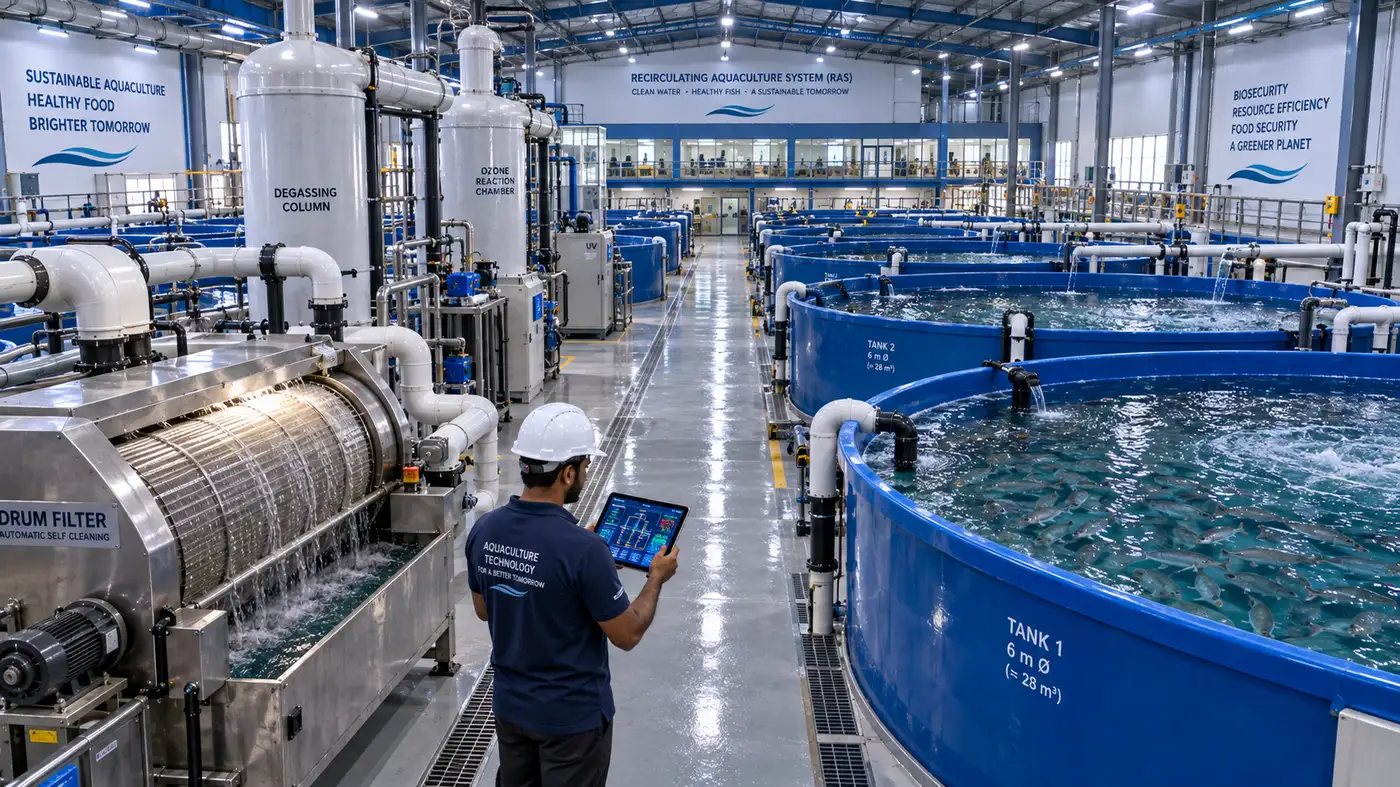
Executive Summary & Key Takeaways
- Recirculating Aquaculture Systems (RAS) recycle 95% to 99% of culture water through continuous mechanical, biological, and chemical treatment loops, completely eliminating geographic and environmental constraints.
- The Cornell Dual-Drain system is the cornerstone of RAS tank hydraulics: split flow into a 10%–15% bottom center drain (carrying 85%+ of settleable solids) and an 85%–90% sidewall drain (carrying clarified water directly to biofilters).
- Mechanical solids removal must occur within 15 to 30 minutes of excretion; sizing rotary drum filters with 40 to 60-micron screen mesh prevents physical breakdown of feces into non-filterable dissolved organics.
- Every kilogram of standard 40% CP feed metabolized by fish produces approximately 30 to 35 grams of Total Ammonia Nitrogen (TAN), requiring 0.85 to 1.1 m³ of fluidized MBBR bio-media operating at stable pH 7.2–7.8.
- Accumulated dissolved Carbon Dioxide (CO2) is a silent growth inhibitor; maintain CO2 strictly below 15 mg/L (ideally <10 mg/L) using counter-current packed degassing towers with an air-to-water volumetric ratio of 6:1 to 10:1.
- Pure industrial oxygenation via Low-Head Oxygenators (LHO) or pressurized oxygen cones delivers >150% dissolved oxygen saturation, sustaining hyper-densities exceeding 80–100 kg/m³ with exceptional feed conversion.
- Ozone injection controlled at an Oxidation-Reduction Potential (ORP) of 280 to 320 mV micro-flocculates fine colloidal particles, strips refractory yellow humic color, and inactivates viral pathogens without generating toxic oxidant residuals.
- A complete electrical blackout will cause total mortality within 20 to 30 minutes at 80 kg/m³; fail-safe engineering demands parallel backup pumps, automatic transfer switches (ATS), redundant diesel gensets, and high-pressure oxygen injection buffers.
Industrial Engineering Case Study: 150-Ton/Year Commercial Asian Seabass RAS Facility
A commercial aquaculture consortium designed a state-of-the-art super-intensive indoor RAS facility engineered to produce 150 metric tons annually of high-value Asian Seabass (Lates calcarifer). Featuring eight circular fiberglass-reinforced polymer (FRP) tanks (8-meter diameter, 2.4-meter depth, 120 m³ each), the facility integrated Cornell dual-drain hydraulics splitting flow into 12% bottom sludge discharge and 88% upper-wall return. Bottom solids passed through two 40-micron rotary stainless-steel drum filters, removing 89% of total suspended solids within 25 minutes of excretion. The bio-filtration loop utilized a 140 m³ fluidized Moving Bed Biofilm Reactor (MBBR) packed with 85 m³ of high-surface-area virgin HDPE K3 media (SSA 800 m²/m³), operating at a Volumetric Nitrification Rate (VNR) of 0.45 g TAN/m²/day. Dissolved carbon dioxide was stripped from 24 mg/L down to 6.5 mg/L using two counter-current packed degassing towers (air-to-water ratio 8:1), while Low-Head Oxygenators (LHO) boosted dissolved oxygen to 165% saturation (12.5 mg/L). Ozone injection (ORP controlled at 300 mV) coupled to medium-pressure UV reactors (120 mJ/cm²) achieved total microbiological sterility. Over a 12-month commercial cycle, the facility maintained TAN < 0.4 mg/L, NO2- < 0.2 mg/L, and harvested 152 metric tons of premium 1.0kg fish with 94.8% survival, generating ₹11.4 Crores in revenue with an operating margin of 41.5%.
1. The Closed-Loop Imperative: Why Industrial RAS Dominates Aquaculture
Global commercial aquaculture is undergoing an epochal structural transition. Traditional open-water production systems—spanning earthen coastal ponds, estuarine enclosures, and open-reservoir net cages—are increasingly constrained by catastrophic biosecurity threats (viral epidemics, bacterial septicemias), escalating climate volatility (extreme summer heatwaves, unseasonal cyclonic deluges), tightening environmental effluent restrictions, and severe water scarcity.
In response, Recirculating Aquaculture Systems (RAS) have emerged as the pinnacle of controlled-environment industrial food engineering. In a commercial RAS, culture water is continuously clarified, biologically purified, degassed, hyper-oxygenated, and recirculated back to the culture vessels in a continuous closed hydraulic loop—typically recycling 95% to 99% of the total system volume every single day. Daily makeup water requirements are reduced to merely 1% to 5% of total system volume, required solely to replace losses from solids purge discharge and evaporative cooling.
This extraordinary water conservation unlocks total geographic liberation. Commercial RAS installations can be sited anywhere: in close proximity to major metropolitan consumption centers (eliminating cross-country cold-chain logistics), on non-arable desert land, or within industrial parks. Enclosed within biosecure, climate-controlled industrial buildings, RAS protects standing fish crops completely from external wild vectors, bird droppings, surface runoff pollutants, and parasitic invasions.
Furthermore, RAS enables hyper-intensive production densities ranging from 60 to 120 kilograms of live finfish per cubic meter of water (kg/m³). In species such as Asian Seabass (Lates calcarifer), Rainbow Trout (Oncorhynchus mykiss), Atlantic Salmon, GIFT Tilapia, and Yellowtail Kingfish, modern RAS facilities maintain optimal physiological parameters 24 hours a day, 365 days a year, achieving exceptional somatic growth rates and Feed Conversion Ratios (FCR 1.05 to 1.15) unattainable in outdoor earthen systems.
However, operating at hyper-densities approaching 100 kg/m³ leaves zero margin for engineering error. At these extreme bioloads, the life-support system must process tens of kilograms of metabolic feed waste every hour. A failure in solids separation blinds the biofilter; an undersized biofilter triggers lethal ammonia toxicity within hours; and an oxygen failure causes total asphyxiation mortality in under 20 minutes. Mastering commercial RAS requires total comprehension of hydraulic mass balance, stoichiometry, and fail-safe physical engineering.
Core Engineering Advantages of Industrial RAS
1. 99% Water Conservation: Consumes less than 100 to 200 liters of fresh makeup water per kilogram of fish produced, compared to 15,000–30,000 L/kg in conventional pond systems.
2. Absolute Biosecurity: Multi-barrier intake filtration, UV-C irradiation, and ozonation create an impenetrable pathogen defense, eliminating the need for therapeutic antibiotics.
3. Year-Round Predictable Harvesting: Continuous computerized climate control stabilizes water temperatures within ±0.5°C of species-specific metabolic optima, locking in precise weekly harvest quotas.
Never size an RAS life-support system based on standing fish biomass. Always size all mechanical, biological, and oxygenation components based on the Maximum Daily Feed Loading Rate (kg feed/day) at peak production. Feed input is the true source of all metabolic waste products in the loop.
2. Tank Hydrodynamics: Circular Geometry & The Cornell Dual-Drain System
The mechanical efficiency of a recirculating aquaculture system begins in the culture vessel itself. In commercial RAS, the fish tank must not function merely as a holding container; it must operate as a highly efficient hydraulic primary clarifier.
Circular Tank Hydrodynamics: Rectangular raceways suffer from low water velocities, turbulent dead spots, and uneven dissolved oxygen distribution. In contrast, circular or octagonal tanks with rounded corners establish uniform rotational vortex hydrodynamics. Water injected tangentially along the outer tank wall generates an outer circular current that drives rotational momentum throughout the entire water column.
The Self-Cleaning 'Tea-Cup' Effect: As water rotates within a circular tank, boundary layer friction along the bottom floor decreases centrifugal force relative to the main water body. This fluid-mechanical phenomenon generates a secondary radial inward flow along the floor—the classic 'tea-cup effect'—that continuously sweeps dense, settleable fecal pellets and uneaten feed particles directly toward the center of the tank.
The Cornell Dual-Drain System: The single greatest breakthrough in RAS tank hydraulics is the Cornell Dual-Drain design, engineered by Cornell University and the Freshwater Institute. In conventional center-drain tanks, 100% of the tank discharge—carrying both heavy settleable solids and clean water—exits through a single bottom pipe, requiring the entire flow volume to be pumped through large, expensive mechanical filters.
The Cornell Dual-Drain splits the effluent into two separate hydraulic streams:
1. Bottom Center Drain (Underflow): Positioned at the apex of a slight concave bottom slope (1:15 to 1:20 slope). A central bottom extraction sump captures settleable fecal solids, pulling only 10% to 15% of the total tank water flow. Because the tea-cup vortex concentrates solids at the center, this minor 10–15% underflow stream carries over 85% to 90% of all settleable solids out of the tank within 5 to 10 minutes of excretion.
2. Sidewall Surface Drain (Overflow): Positioned on the upper sidewall or as an elevated overflow collector. This drain captures the remaining 85% to 90% of the clean, clarified water volume, bypassing the heavy mechanical solids separator and flowing directly to the biological filter or degassing unit.
By splitting the flow, the required size and capital cost of the primary mechanical drum filter is slashed by up to 50%, while solids are removed rapidly before fish swimming action breaks fragile fecal pellets into microscopic, non-settling colloidal fragments.
Rotational Velocity Criteria: The tangential inlet nozzles must be calibrated to maintain an in-tank water velocity of 0.5 to 1.5 fish body lengths per second (typically 15 to 30 cm/sec). This velocity provides sufficient exercise to stimulate fish muscle growth, prevents sedimentation on the floor, and ensures rapid solids evacuation without forcing fish to exhaust energy swimming against excessive currents.
Install directional inlet nozzles fitted with 45-degree PVC elbows and throttle valves along the tank perimeter. By adjusting the angle of water injection, operators can fine-tune rotational velocity independently of total system flow rate, maintaining perfect self-cleaning velocities across different fish growth stages.
3. Mechanical Solids Capture: Rotary Drum Filters (40–60µ) & Backwash Sizing
In intensive recirculating aquaculture, the golden rule of water quality management is: 'Remove solid wastes mechanically before they break down biologically.' Fish feces and uneaten feed pellets consist of complex organic carbon and organic nitrogen. If permitted to remain in the water column, mechanical agitation from pumps and fish swimming will shear large fecal pellets into fine colloidal particles (<30 microns).
Once sheared, these microscopic particles cannot be filtered mechanically. Heterotrophic bacteria rapidly colonize and decompose this suspended organic matter, consuming massive quantities of dissolved oxygen, producing toxic unionized ammonia, and smothering the autotrophic nitrifying biofilter with heterotrophic bio-slime.
Micro-Screen Rotary Drum Filters (RDF): The undisputed industry gold standard for primary solids separation in commercial RAS is the automated rotary drum filter. An RDF consists of a rotating stainless-steel or HDPE cylinder clothed with precision-woven stainless-steel (AISI 316L) or polyester micro-screen mesh.
Operating Mechanics & Backwash Cycles:
- Gravity Inflow: The solids-laden underflow from the tank central drains enters the interior of the drum by gravity. As water passes outward through the submerged screen panels, suspended particles are trapped on the inside surface of the mesh, while clarified water exits into the biofilter sump.
- Differential Head Level Trigger: As trapped solids accumulate, the micro-screen pores gradually blind, restricting water flow and causing the water level inside the drum to rise relative to the outside channel. When this level differential reaches 20 to 50 mm, an electronic level sensor triggers the backwash cycle.
- High-Pressure Spray Cleansing: A gear motor rotates the drum slowly (3 to 6 RPM) while an integrated high-pressure multistage booster pump (operating at 6 to 8 bar pressure) blasts a flat-fan spray of filtered water through nozzles mounted above the drum. The spray dislodges the cake of trapped solids from the exterior inward, washing the concentrated sludge into an internal collection trough that discharges directly into an external dewatering bag or sludge basin.
Selecting the Optimal Micron Rating:
- 60-Micron Mesh: The standard commercial balance for grow-out systems (Tilapia, Pangasius, Seabass). Provides high hydraulic flow-through capacity with low backwash frequency, capturing 80% to 85% of total suspended solids.
- 40-Micron Mesh: Required for sensitive species (Salmonids, Seabass fingerlings) and high-density systems. Captures fine fecal fragments, but requires 30% larger drum screen surface area to handle the same hydraulic flow and increases backwash water consumption.
- Below 30-Micron: Strongly discouraged for primary drum filtration. Fine meshes blind almost instantaneously in high-biomass systems, leading to continuous backwash cycling, premature mesh fatigue, and excessive wastewater generation.
| Screen Mesh Rating | Hydraulic Flow Capacity (m³/h / m² mesh) | Particle Capture Efficiency | Typical Backwash Frequency | Recommended Application in RAS |
|---|---|---|---|---|
| 90 Micron | 85 – 110 m³/h per m² | 65% – 70% TSS capture | Low (Every 15–20 mins) | Warm-water extensive / Pre-filtration only |
| 60 Micron | 55 – 75 m³/h per m² | 80% – 85% TSS capture | Moderate (Every 8–12 mins) | Standard commercial finfish grow-out (Gold Standard) |
| 40 Micron | 35 – 50 m³/h per m² | 88% – 93% TSS capture | High (Every 4–6 mins) | Salmonid hatcheries, juvenile nurseries & Marine RAS |
| 20 Micron | 15 – 25 m³/h per m² | 95%+ TSS capture | Continuous cycling | Not recommended for primary RDF; causes pump burn-out |
Always supply the drum filter backwash manifold with treated, bio-filtered water drawn downstream of the drum filter, never with raw solids-laden pond water. Raw water clogs fine backwash spray nozzles, creating dead spray zones that permanently foul screen panels.
4. Nitrogen Mass Balance: TAN Stoichiometry & Sizing Fluidized MBBRs
Following mechanical solids removal, the clarified water column remains saturated with toxic dissolved metabolic by-products—principally Total Ammonia Nitrogen (TAN, comprising unionized NH3 and ionized NH4+). Because ammonia is dissolved at the molecular level, no physical filter can remove it; it must be converted biochemically into non-toxic nitrate (NO3-) via biological nitrification.
Stoichiometric Mass Balance Calculations: To size a commercial biofilter, engineers must calculate the exact Total Ammonia Nitrogen generation rate based on daily feed input:
Step 1: Determine Daily Nitrogen Input ($N_{feed}$). Feed crude protein (CP) averages 16% elemental nitrogen by weight. For a facility feeding 100 kg of 40% CP feed daily:
$$N_{feed} = 100, ext{kg feed} imes 0.40, ext{CP} imes 0.16 = 6.40, ext{kg Nitrogen}$$
Step 2: Calculate Excreted Total Ammonia Nitrogen ($TAN_{prod}$). Fish assimilate approximately 35% of ingested nitrogen into somatic tissue and excrete 15% as solid fecal nitrogen (captured by the drum filter). The remaining 50% is excreted directly as dissolved TAN across the gills:
$$TAN_{prod} = 6.40, ext{kg N} imes 0.50 = 3.20, ext{kg TAN/day}quad (3,200, ext{grams TAN/day})$$
As a universal rule of thumb: 1.0 kg of 40% CP feed produces approximately 30 to 35 grams of TAN.
The Moving Bed Biofilm Reactor (MBBR): The premier commercial biofilter technology for industrial RAS is the fluidized Moving Bed Biofilm Reactor. An MBBR consists of an open tank filled with thousands of specialized, high-density polyethylene (HDPE) plastic bio-carriers (such as Kaldnes K1, K3, or Mutag BioChip) suspended and continuously fluidized by coarse-bubble aeration.
Biological Nitrification Pathways:
- Stage 1 (Ammonia Oxidation): Ammonia-Oxidizing Bacteria (AOB, primarily Nitrosomonas) oxidize toxic ammonia to nitrite ($NO_2^-$):
$$NH_4^+ + 1.5,O_2 longrightarrow NO_2^- + H_2O + 2,H^+ + 240, ext{kJ}$$
- Stage 2 (Nitrite Oxidation): Nitrite-Oxidizing Bacteria (NOB, primarily Nitrobacter and Nitrospira) oxidize nitrite to relatively non-toxic nitrate ($NO_3^-$):
$$NO_2^- + 0.5,O_2 longrightarrow NO_3^- + 75, ext{kJ}$$
Sizing the Fluidized Media Volume ($V_{media}$):
Biofilter capacity is governed by the Specific Surface Area (SSA, in m²/m³) of the carrier media and the Volumetric Nitrification Rate (VNR, in grams TAN oxidized per m² of media surface per day).
- For commercial Kaldnes K3 media: Total surface area = $800, ext{m}^2/ ext{m}^3$; Protected internal surface area = $584, ext{m}^2/ ext{m}^3$.
- Operating VNR under commercial warm-water conditions (26°C–28°C, pH 7.5, DO > 5 ppm) = $0.45, ext{g TAN}/ ext{m}^2/ ext{day}$.
- Required Media Surface Area: $3,200, ext{g TAN/day} div 0.45, ext{g/m}^2/ ext{day} = 7,111, ext{m}^2$ of active biofilm surface.
- Required Volume of K3 Media: $7,111, ext{m}^2 div 584, ext{m}^2/ ext{m}^3 = 12.18, ext{m}^3$ of media.
- Sizing the MBBR Tank: Because bio-carriers must circulate freely without clumping, media filling fraction ($FF$) is maintained strictly between 50% and 60% of total tank volume. Therefore: MBBR Tank Volume = $12.18, ext{m}^3 div 0.55 = 22.15, ext{m}^3$.
Alkalinity Consumption & Chemical Buffering: As demonstrated in the stoichiometry, nitrification releases hydrogen ions ($H^+$) and devours dissolved inorganic carbon. For every 1.0 gram of TAN oxidized to nitrate, exactly 7.14 grams of alkalinity (as CaCO3) are consumed, and 4.57 grams of dissolved oxygen are exhausted. To prevent fatal pH crashes, automated dosing pumps must continuously inject Sodium Bicarbonate (NaHCO3) or Sodium Hydroxide (NaOH) to anchor total alkalinity strictly between 120 and 160 mg/L and pH between 7.2 and 7.8.
New virgin plastic bio-media is hydrophobic and will float buoyantly at the water surface for the first 10 to 14 days, resisting fluidization. Accelerate media conditioning by soaking new carriers in a 20 ppm potassium permanganate bath for 2 hours, or dosing 5 ppm skim milk powder into the MBBR tank to create an organic conditioning film that allows nitrifiers to colonize rapidly.
5. Carbon Dioxide Stripping: Counter-Current Degassers & Air-to-Water Ratios
In intensive recirculating aquaculture, dissolved Carbon Dioxide (CO2) is the invisible, insidious limiting factor. While dissolved oxygen can be artificially supersaturated using pure oxygen injection, carbon dioxide continuously accumulates in the water column as a direct metabolic respiratory waste product of fish and nitrifying bacteria.
For every 1.0 kg of commercial feed consumed, fish consume approximately 400 to 500 grams of dissolved oxygen and respire approximately 1.35 to 1.40 grams of carbon dioxide per gram of oxygen consumed. In a closed-loop system stocking 80 kg/m³, dissolved CO2 levels will surge above 35 to 50 mg/L within hours if not aggressively stripped.
Pathophysiological Consequences of Hypercapnia (Elevated CO2):
- Blood Acidosis & Bohr Effect: When ambient CO2 exceeds 15 to 20 mg/L, carbon dioxide diffuses back across the gills into the fish bloodstream, driving blood pH down (respiratory acidosis). Under the physiological Bohr/Root effect, low blood pH drastically reduces the oxygen-binding affinity and carrying capacity of hemoglobin. Fish exhibit acute asphyxiation symptoms (lethargy, surface gasping, anorexia) even when dissolved oxygen in the tank is supersaturated at 150%+.
- Nephrocalcinosis: Chronic exposure to CO2 > 15 mg/L induces severe calcification of the renal tubules (kidney stones), causing irreversible kidney failure, stunted somatic growth, and deteriorated feed conversion.
Counter-Current Packed Degassing Towers: The universal engineering solution for stripping dissolved CO2 is the counter-current packed aeration column (trickling degassing tower). Water exiting the biofilter is pumped to the top of a vertical cylindrical or rectangular tower (height 1.8 to 2.4 meters) packed with high-void-fraction structured media (such as plastic cross-fluted packing or high-surface-area rings, void ratio >95%).
Hydraulic & Airflow Engineering Standards:
- As water cascades downward across the media packing, it is broken into thin, turbulent liquid films, maximizing the water-air interfacial contact area.
- A heavy-duty, low-pressure centrifugal blower forces large volumes of clean, outdoor fresh air upward through the bottom of the tower counter-current to the falling water.
- Because the partial pressure of CO2 in fresh atmospheric air is extremely low (~0.04% or 400 ppm), a steep concentration gradient is established, causing dissolved CO2 gas to desorb rapidly from the liquid phase into the air stream, which exhausts out of the building roof.
- Sizing the Air-to-Water Volumetric Ratio ($Q_{air} : Q_{water}$): For commercial finfish RAS, the volumetric air-to-water ratio must be sized strictly between 6:1 and 10:1. For example, a water flow rate of 100 m³/hour requires an air blower delivering 600 to 1,000 m³/hour of clean air at 1.5 to 2.5 kPa backpressure to strip dissolved CO2 from 25 mg/L down to < 8.0 mg/L in a single pass.
Never vent the exhaust air from a CO2 degassing tower into the indoor RAS building. Recirculating CO2-laden air back into the room saturates the building atmosphere, lowering the stripping efficiency of the towers to zero. Always vent degassing exhaust ducting directly through the facility roof to the outside environment.
6. Hyper-Oxygenation: Low-Head Oxygenators (LHO) vs High-Pressure Cones
In conventional aquaculture, mechanical surface aerators and air blowers dissolve oxygen by transferring atmospheric air (which contains only 20.95% oxygen) into the water. However, atmospheric aeration can only achieve 100% air saturation—equivalent to approximately 8.0 mg/L at 26°C freshwater. In an intensive RAS carrying 80 to 100 kg/m³ of standing biomass, fish respiration consumes oxygen faster than atmospheric aeration can dissolve it, and high water velocities create severe gas supersaturation nitrogen-embolism hazards.
Commercial industrial RAS requires pure, concentrated oxygen gas (93% to 99% O2 purity) generated on-site via Pressure Swing Adsorption (PSA) oxygen generators or delivered via cryogenic liquid oxygen (LOX) bulk storage tanks. Dissolving pure oxygen enables operators to achieve supersaturated dissolved oxygen levels of 150% to 250% (12 to 18 mg/L DO) in the incoming supply line, providing a massive biological safety cushion.
The Two Dominant Industrial Dissolution Technologies:
1. Low-Head Oxygenators (LHO): The premier, energy-efficient standard for high-flow, low-pressure RAS loops. An LHO consists of a horizontal distribution box divided into multiple vertical chambers positioned above a collection sump. Degassed water enters the top perforated plate and cascades down through the chambers with an hydraulic head drop of merely 0.6 to 1.0 meter. Pure oxygen gas is piped into the chambers, flowing counter-current or co-current with the falling water droplets. LHOs achieve 70% to 85% oxygen transfer efficiency with virtually zero added pumping head loss, operating by gravity before water returns to the fish tanks.
2. Pressurized Oxygen Cones (Speece Cones): High-pressure conical dissolution vessels constructed from heavy fiberglass or stainless steel. Water and pure oxygen are injected simultaneously at the apex of the cone. As the cross-sectional area of the cone widens downward, downward water velocity gradually decreases. At the specific diameter where downward water velocity equals the upward buoyant rise velocity of the oxygen bubbles, the bubbles remain stationary in the water stream, trapped in a continuous shearing vortex until 95% to 98% of the gas dissolves under 1.0 to 1.5 bar operating pressure. Cones achieve extreme saturation (over 25 to 35 mg/L DO) and are ideal for side-stream oxygen injection.
| Oxygenation Technology | Operating Hydraulic Head | Oxygen Absorption Efficiency | Power Consumption (kWh / kg O2) | Optimal System Application |
|---|---|---|---|---|
| Low-Head Oxygenator (LHO) | 0.6 – 1.0 meter (Low head) | 70% – 85% efficiency | 0.15 – 0.25 kWh / kg O2 | Full-flow gravity return loops; high-volume systems |
| Pressurized Oxygen Cone | 10 – 15 meters (1.0–1.5 bar) | 95% – 98% efficiency | 0.60 – 0.90 kWh / kg O2 | Side-stream (15–25% flow); deep-tank injection |
| U-Tube Aerator | 15 – 30 meters vertical well | 80% – 90% efficiency | 0.40 – 0.60 kWh / kg O2 | Large-scale installations with deep borewell access |
| Micro-Porous Ceramic Diffusers | 1.5 – 2.0m tank depth | 35% – 50% efficiency | High (Continuous gas loss) | Emergency fail-safe in-tank backup only |
Install an optical dissolved oxygen (DO) sensor in the effluent sump of every individual culture tank, linked directly to an automated proportional oxygen control valve. When fish feed and metabolic oxygen demand spikes, the valve modulates pure oxygen injection automatically, keeping tank DO pinned at 6.8 to 7.5 ppm while preventing expensive pure oxygen wastage.
7. Water Polishing: Ozone ORP (280–320 mV), Micro-Flocculation & UV Dosing
In a closed recirculating loop operating under 98% water reuse, microscopic organic compounds inevitably accumulate. Dissolved organic humic acids, fine refractory colloids (<10 microns), and bacterial endotoxins accumulate, turning the culture water an unappealing yellow-tea color, scattering light, and elevating organic biological oxygen demand.
Ozone (O3) Micro-Flocculation & Water Decoloration: Ozone is an exceptionally powerful, non-residual oxidizing agent generated on-site by passing dry oxygen gas through a high-voltage corona discharge tube. In commercial RAS, ozone is injected into a dedicated side-stream contact chamber or protein skimmer at a controlled dosing rate of 12 to 24 grams of O3 per kilogram of daily feed.
- Fine Colloid Micro-Flocculation: Ozone oxidizes the negative electrostatic surface charges of fine colloidal particles, causing them to coagulate and flocculate into larger aggregates that are easily captured by drum filters or foam fractionators.
- Water Polishing & Humic Stripping: Ozone cleaves the conjugated double bonds of yellow humic acids and polyphenols, transforming murky, yellow-tinted water into crystal-clear, ocean-blue water.
- Oxidation-Reduction Potential (ORP) Control: Ozone must be tightly controlled using inline ORP probes. In commercial culture, maintain system ORP strictly between 280 and 320 millivolts (mV). If ORP exceeds 350 mV, residual ozone and toxic ozone-produced oxidants (OPOs, such as bromate and hypobromous acid in marine systems) will enter the fish tanks, causing severe chemical burn to gill filaments and mass mortality.
Ultraviolet (UV-C) Disinfection Kinetics: Following ozone treatment and degassing, water passes through closed-chamber UV-C reactors equipped with low-pressure high-output (LPHO) or medium-pressure mercury amalgam lamps emitting germicidal radiation at 254 nanometers. UV-C penetrates bacterial and viral cell walls, inducing thymine dimerization in DNA/RNA and destroying replication capability.
- Sizing UV Dosing: For routine bacterial suppression (Aeromonas, Vibrio), design reactors to deliver a minimum germicidal dose of 30 to 40 mJ/cm² ($300 ext{–}400,mu ext{W}cdot ext{s/cm}^2$) at the end of lamp life (EOLL) assuming 90% water UV transmittance (UVT). For viral inactivation (such as IPNV, TiLV, or Betanodavirus), size reactors to deliver 100 to 120 mJ/cm².
Always route ozonated water through an active carbon contact chamber or an intense UV-C destruct reactor before returning it to the fish tanks. High-dose UV-C (254 nm) instantly breaks down residual dissolved ozone into harmless diatomic oxygen (O2), completely eliminating the hazard of accidental ozone toxicity.
8. Infrastructure Redundancy, CAPEX/OPEX Modeling & AquaSangham Suite
The ultimate vulnerability of any hyper-intensive RAS facility is power reliability. At an operating biomass density of 80 to 100 kg/m³, the fish population is maintained entirely by continuous artificial life support. If electrical power fails and all mechanical aeration and water circulation ceases, dissolved oxygen levels drop from 7.0 ppm to lethal asphyxiation thresholds (<2.0 ppm) in less than 20 to 25 minutes. A single unmitigated power outage will wipe out 100% of the farm's standing capital.
The Multi-Tier Electrical & Mechanical Redundancy Hierarchy:
1. Automatic Transfer Switch (ATS) & Dual Diesel Gensets: The facility must be backed by a primary diesel generator sized to carry 100% of facility peak electrical load, configured with an automated transfer switch (ATS) that senses grid brownouts and restores full power in less than 10 seconds. In addition, an identical secondary standby generator must be piped in parallel to ensure protection during generator maintenance.
2. High-Pressure Emergency Oxygen Injection Buffer: A battery of high-pressure pure oxygen gas cylinders hardwired directly to normally-closed solenoid valves in every individual fish tank. The solenoid valves are held closed by live electrical current. If complete power failure occurs and generators fail to fire, the solenoids lose power, instantly opening automatically and flooding each tank with pure oxygen micro-bubbles via floor diffusers, sustaining fish for up to 8 hours without electricity.
3. N+1 Pump Redundancy: All main circulating pump sumps must operate on an 'N+1' redundancy model: if 3 variable-frequency drive (VFD) centrifugal pumps are required to maintain system flow, a 4th identical pump must be plumbed in parallel, configured to auto-start if an active pump fails.
Comprehensive Financial Economics (100-Ton/Year Commercial High-Value RAS Facility):
CAPEX Breakdown: Insulated pre-engineered industrial shed (1,200 m²), eight 100 m³ circular tanks, drum filters, MBBR biofilters with virgin K3 media, degassing towers, LHOs, PSA oxygen generators, ozone reactors, UV units, SCADA telemetry, dual 125 kVA diesel generators, and plumbing total approximately ₹2.8 to ₹3.4 Crores.
OPEX per Kg of Fish Produced (Asian Seabass): Commercial high-protein extruded feed (1.15 FCR) = ₹115/kg; Electricity (approx. 4.5 to 5.5 kWh per kg produced @ ₹8/kWh) = ₹40/kg; Liquid oxygen / PSA power = ₹8/kg; Fingerlings and health diagnostics = ₹25/kg; Labor, management, and testing = ₹22/kg. Total Cost of Production = ₹210 to ₹225 per kilogram.
Revenue & Net Margins: Farmgate realization for premium, live or chilled-on-ice sashimi-grade Asian Seabass or Rainbow Trout ranges from ₹420 to ₹520 per kg. Producing 100,000 kg generates ₹4.5 Crores in gross revenue against ₹2.2 Crores in operating costs, yielding an exceptional annual net profit of ₹2.3 Crores and amortizing initial CAPEX within 18 to 24 months of full production capacity.
Designing Precision Commercial RAS on AquaSangham:
Designing an industrial RAS without rigorous mass-balance modeling is a recipe for catastrophic financial failure. Progressive engineers, venture funds, and commercial operators rely on the AquaSangham RAS Engineering & Mass Balance Suite—the industry-standard digital modeling engine that automates TAN stoichiometry, drum filter hydraulic sizing, MBBR carrier volumes, counter-current degassing airflow calculations, and real-time SCADA telemetry integrations.
Install dual-probe optical DO and temperature sensors in every tank, transmitting data via Modbus/LoRaWAN to the AquaSangham cloud platform. Automated push-notification emergency alarms route to farm managers' smartphones the second any tank parameter deviates by more than 10% from setpoints.
Summary Operational Action Checklist
Frequently Asked Questions
Q: How does the Cornell Dual-Drain system reduce capital expenditure in commercial RAS?
In a conventional single-drain tank, 100% of the circulating water must be pumped through the primary mechanical drum filter. The Cornell Dual-Drain splits the discharge into an underflow (10–15% of flow carrying 85%+ of settleable solids) and an overflow (85–90% of flow containing virtually no settleable solids). Because only 10–15% of the flow requires heavy solids filtration, the physical size and cost of the rotary drum filter can be reduced by up to 50%, dramatically lowering facility CAPEX.
Q: How much bio-media is required in an MBBR for every 100 kg of commercial fish feed?
Every 100 kg of standard 40% crude protein feed generates approximately 3.2 kg (3,200 grams) of Total Ammonia Nitrogen (TAN). At a standard commercial warm-water Volumetric Nitrification Rate of 0.45 g TAN/m²/day, the system requires 7,111 m² of active protected biofilm surface. Utilizing Kaldnes K3 media (protected surface area 584 m²/m³), this requires 12.2 m³ of media. At a 55% tank filling fraction, the MBBR vessel volume must be approximately 22 m³.
Q: Why is carbon dioxide (CO2) degassing critical even when dissolved oxygen is high?
Dissolved oxygen and carbon dioxide operate under independent gas solubility laws. Even if water is supersaturated with oxygen (e.g. 150% DO), accumulated dissolved CO2 (>15–20 mg/L) diffuses into the fish bloodstream, driving blood pH down (respiratory acidosis). Under the physiological Bohr/Root effect, acidic blood cannot bind oxygen, causing fish to suffocate despite high water DO. Counter-current degassing towers strip CO2 below 10 mg/L to prevent acidosis and nephrocalcinosis.
Q: What is the role of ozone in commercial RAS and how is it safely controlled?
Ozone (O3) micro-flocculates fine colloidal particles (<10 microns) so they can be filtered, oxidizes yellow humic color compounds to create crystal-clear water, and inactivates free-living bacteria and viruses. It is safely controlled by monitoring Oxidation-Reduction Potential (ORP), maintaining levels strictly between 280 and 320 mV. Over-ozonation (>350 mV) is prevented using automatic redox controllers and downstream UV destruct reactors.
Q: What happens during a power failure in a high-density commercial RAS?
At an operating biomass density of 80 to 100 kg/m³, dissolved oxygen is depleted to lethal thresholds (<2.0 ppm) in less than 20 to 25 minutes if water circulation ceases. Facilities prevent catastrophe through three fail-safe layers: (1) Automatic Transfer Switch (ATS) starting a primary diesel generator in <10 seconds, (2) Standby backup secondary generator, and (3) Normally-open emergency solenoid valves connected to high-pressure pure oxygen cylinders that automatically flood each tank with oxygen micro-bubbles if power drops.
AquaSangham Technical Advisory
Industrial Aquaculture Engineering & RAS Systems Desk
Contributing Senior Technical Writer & Aqua Consultant at AquaSangham.
Recommended Farming Guides
Total Ammonia Nitrogen (TAN) Mass Balance Math: Sizing Biofilters in Commercial RAS
Read Article →Farming TechIndigenous Magur (Clarias batrachus) Induced Breeding & Nursery Rearing SOPs
Read Article →Farming TechPangasius Meat Whitening Techniques: Feed Formulation to Prevent Yellow Fillets
Read Article →Get Live Farm Advice on AquaSangham Mobile App
Download India's #1 Aquaculture Super App for real-time market prices, precision tools, and community advice.
Download Free Android App