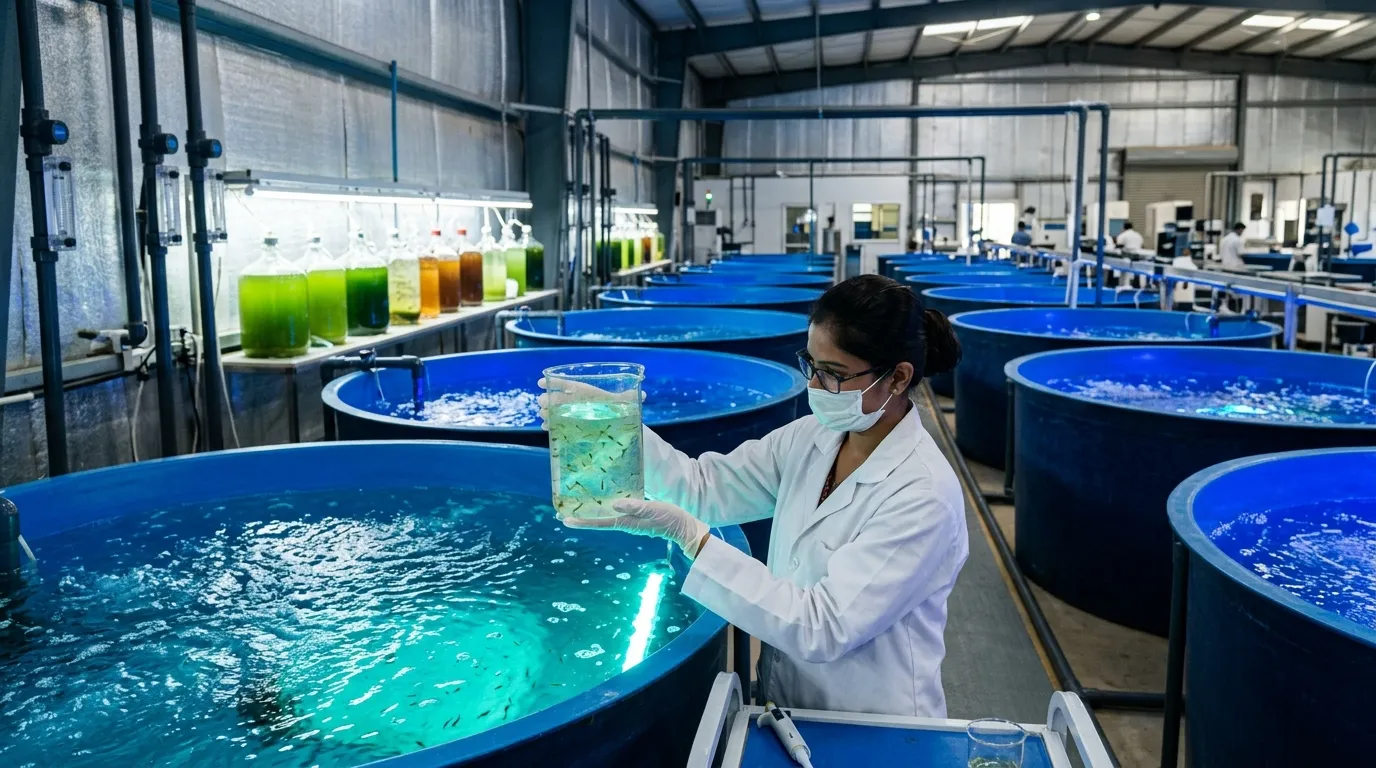
Key Operating Takeaways
- Maintain sterile bio-secure seawater (ozonated and UV-sterilized) across all larval rearing tanks.
- Feed live diatoms (Chaetoceros calcitrans @ 100,000 cells/mL) during Zoea 1 to Zoea 3 stages.
- Transition to enriched Artemia nauplii from Mysis 2 to PL 5 stages.
- Perform nested PCR testing on PL10 batches for WSSV, EHP, AHPND, and IHHNV before farm dispatch.
1. SPF Broodstock Conditioning & Spawning
Procure certified SPF (Specific Pathogen Free) broodstock from authorized quarantine centers. Maintain maturation tanks at 28°C–29°C with 30–32 ppt salinity and feed enriched squid, polychaetes, and spirulina.
2. Live Microalgae (Chaetoceros / Skeletonema) Culture
Cultivate pure monocultures of brown diatoms (Chaetoceros calcitrans and Skeletonema costatum) in sterilized seawater using Guillard's F/2 nutrient media to feed Zoea larvae.
3. Zoea, Mysis & Early Post-Larvae Feeding SOP
Zoea stages feed strictly on live diatoms. From Mysis 1 onwards, introduce newly hatched Artemia salina nauplii enriched with HUFA (Highly Unsaturated Fatty Acids) and microencapsulated larval feeds.
4. Stress Testing, PCR Certification & Farm Packing
Subject PL10–PL12 batches to a 30-minute freshwater (0 ppt) stress test (>95% recovery required). Submit 150 PLs for nested PCR screening before oxygen packing in double polyethylene transport bags.