Key News Bulletins & Findings
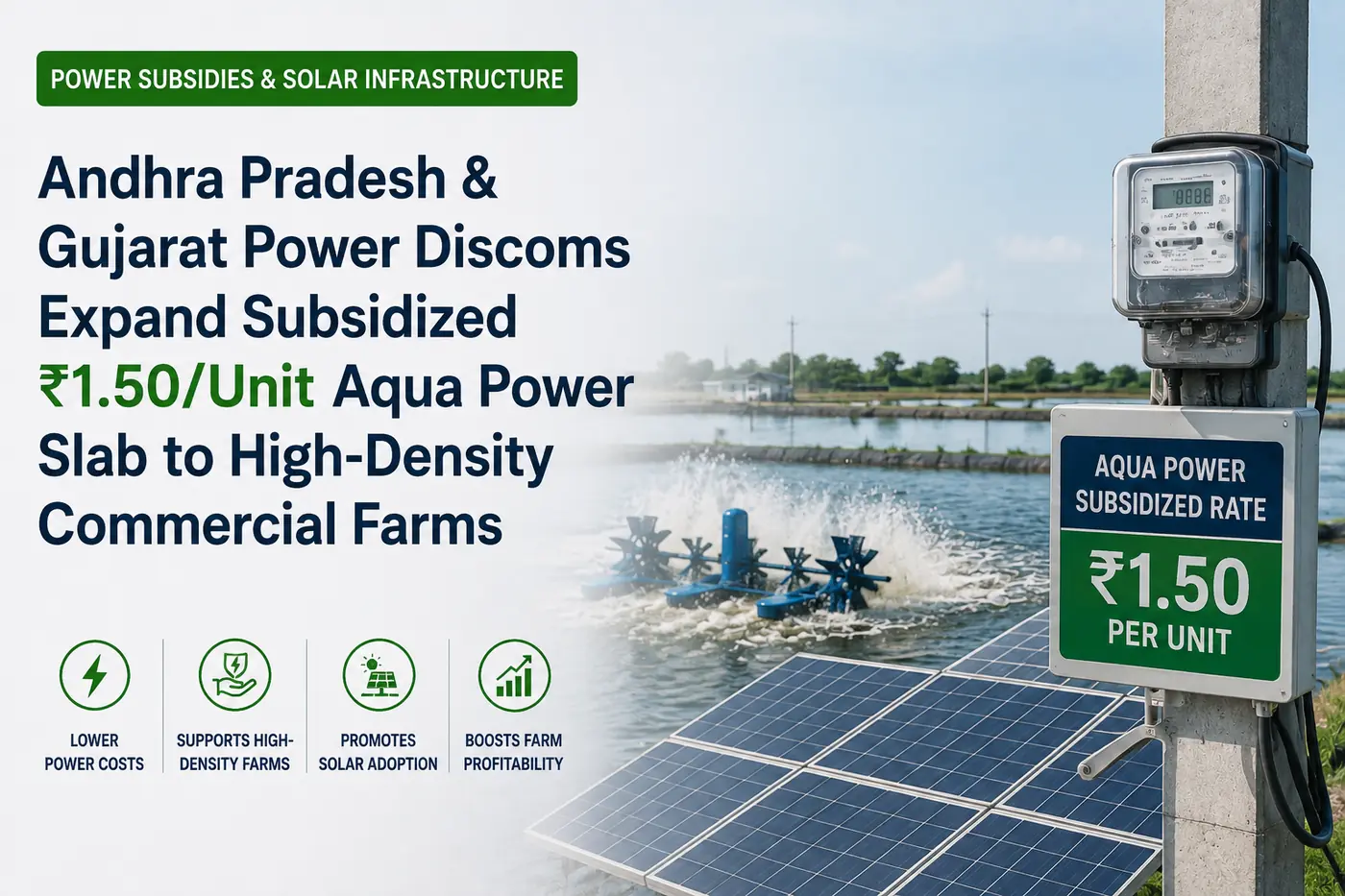
- APERC & GERC eliminate the restrictive 5-acre / 10 HP eligibility cap, extending the ₹1.50/unit subsidized agro-aquaculture electricity tariff to intensive commercial farms.
- State DISCOMs mandate 20 to 22 hours of continuous three-phase power on dedicated aquaculture feeder corridors in Nellore, Bapatla, Surat, and Navsari.
- 40% capital subsidy unlocked for grid-tied solar photovoltaic (PV) aerator systems under the PM-KUSUM scheme, reducing farm electricity bills by an additional 60%.
- Farmers save up to ₹45,000 to ₹72,000 per month on a 10-acre intensive shrimp operation, lowering per-kg production costs by ₹14 to ₹18.
1. Policy Breakthrough: APERC & GERC Tariff Amendments
In a landmark regulatory reform for the Indian aquaculture sector, the Andhra Pradesh Electricity Regulatory Commission (APERC) and the Gujarat Electricity Regulatory Commission (GERC) have officially gazetted comprehensive amendments to their respective retail supply tariff orders. The revised regulations dismantle long-standing acreage and connected load caps that previously excluded medium and large-scale commercial aquaculture farmers from subsidized agricultural power slabs.
Under the previous tariff regime, the highly subsidized ₹1.50 per kilowatt-hour (kWh) agricultural aquaculture rate was strictly capped at smallholder farms operating under 5 acres with a maximum connected motor load of 10 Horsepower (HP). Any commercial farm exceeding these thresholds was automatically classified under expensive commercial and industrial (LT-III / HT-II) tariffs, paying between ₹6.50 and ₹7.80 per unit.
Recognizing that intensive modern shrimp culture (stocking 50 to 80 PL/m²) requires 30 to 45 HP of continuous paddlewheel aeration per hectare to sustain dissolved oxygen levels above 4.5 mg/L, the power commissions have harmonized power classifications. All Coastal Aquaculture Authority (CAA)-registered brackishwater and freshwater aquaculture holdings are now legally recognized under the subsidized agro-power category across Andhra Pradesh and coastal Gujarat.
2. Eligibility Criteria, Connected Load Limits & CAA Verification
The expanded tariff framework establishes clear, objective compliance rules to ensure subsidized power directly benefits bona fide commercial farmers while preventing unauthorized power diversion.
To qualify for the ₹1.50/kWh tariff slab, the aquaculture farm must hold an active, valid registration certificate issued by the Coastal Aquaculture Authority (CAA) under the Coastal Aquaculture Authority Act. For inland freshwater fish and scampi farms, a registration certificate issued by the State Department of Fisheries serves as valid authorization.
Under the amended orders, the connected load ceiling has been expanded up to 100 HP per service connection under the Low Tension (LT) Category V(B) tariff schedule. Farms requiring over 100 HP can now access dedicated High Tension (HT 11kV) agro-aquaculture connections at a subsidized base rate of ₹2.10/unit, saving hundreds of thousands of rupees annually on transformer transmission tariffs.
3. Dedicated Feeder Reliability: 22-Hour Power & Diesel Generator Phasing
Tariff affordability is only half the battle; power continuity is a life-or-death operational necessity in intensive aquaculture. A 45-minute power outage during early morning hours in an intensive shrimp pond can trigger complete dissolved oxygen depletion, wiping out millions of rupees in standing crop biomass.
As part of the infrastructure upgrade, state distribution companies—APSPDCL (Southern AP), APEPDCL (Eastern AP), and DGVCL (South Gujarat)—have completed the segregation of dedicated 11kV aquaculture feeder corridors across the coastal belts of SPSR Nellore, Bapatla, Kakinada, Surat, and Navsari.
DISCOM operational guidelines now mandate a minimum of 20 to 22 hours of uninterrupted, balanced three-phase power supply on dedicated aqua-feeders. By eliminating frequent voltage fluctuations and daily brownouts, commercial farms can phase out their reliance on expensive diesel generators (which operate at ₹32 to ₹38 per kWh based on diesel @ ₹95/liter), delivering immediate operational cost savings of ₹1,20,000+ per month on a 10-acre farm.
4. PM-KUSUM 40% Capital Subsidy for Solar Aeration Integration
In alignment with India's national renewable energy targets, the Ministry of New and Renewable Energy (MNRE) in partnership with state fisheries departments has unlocked Component C of the Pradhan Mantri Kisan Urja Suraksha evam Utthaan Mahabhiyan (PM-KUSUM) scheme for commercial aquaculture.
Under PM-KUSUM Component C (Feeder-Level & Individual Farm Solarization), aquaculture farmers can install grid-tied solar photovoltaic (PV) microgrid arrays to power their paddlewheel aerators, blowers, and water pumps. The central and state governments provide a combined 40% direct capital subsidy on total project CAPEX, with the remaining 60% financed through low-interest (7% with 3% subvention) Kisan Credit Card (KCC) loans from commercial banks.
Under net-metering regulations, solar electricity generated during sunny daytime hours directly powers farm aeration. Any surplus power generated between 11:00 AM and 3:00 PM is automatically exported back to the state power grid, earning power credits that offset nighttime grid consumption and reducing monthly electricity expenditures by an additional 55% to 70%.
5. Step-by-Step SOP for Farmers to Apply for Subsidized Aqua Connections
Commercial aquaculture operators can migrate existing commercial power connections or apply for new subsidized connections through a simplified digital process:
1. Document Preparation: Collate digital copies of your valid CAA Farm Registration Certificate, Land Title Deed / Registered Lease Agreement (minimum 3-year term), electricity service connection number (USC No.), and Aadhaar card.
2. Online Portal Submission: Log into the state DISCOM digital portal (e.g., APSPDCL Spandana / APEPDCL Consumer Portal / DGVCL Solar Gateway) and navigate to 'Category Conversion to LT-V(B) Aquaculture' or 'New Agro-Aqua Service Connection'.
3. Field Verification: The local Assistant Divisional Engineer (ADE) and Village Fisheries Assistant (VFA) will conduct a joint physical inspection within 7 working days to verify connected motor horsepower, aeration grid layout, and meter calibration.
4. Tariff Activation: Upon ADE digital approval, the subsidized ₹1.50/unit billing rate is activated from the subsequent billing cycle.
Market Data & Rates Breakdown
| Farm Scale & Aeration Load | Commercial Tariff (₹6.80/kWh) | Subsidized Aqua Tariff (₹1.50/kWh) | Solar-Hybrid Microgrid Cost | Net Monthly Farmer Savings |
|---|---|---|---|---|
| Small Farm (2 Acres / 8 HP Aeration) | ₹ 18,500 / month | ₹ 4,080 / month | ₹ 1,650 / month | ₹ 14,420 – ₹ 16,850 / month |
| Medium Farm (5 Acres / 20 HP Aeration) | ₹ 46,250 / month | ₹ 10,200 / month | ₹ 4,120 / month | ₹ 36,050 – ₹ 42,130 / month |
| Commercial Intensive (10 Acres / 40 HP) | ₹ 92,500 / month | ₹ 20,400 / month | ₹ 8,240 / month | ₹ 72,100 – ₹ 84,260 / month |
| Corporate Farm (25 Acres / 100 HP) | ₹ 2,31,250 / month | ₹ 51,000 / month | ₹ 20,600 / month | ₹ 1,80,250 – ₹ 2,10,650 / month |
| Diesel Generator Baseline (Comparison) | ₹ 1,42,000 / month (Diesel @ ₹95/L) | N/A (Grid Subsidized) | N/A (Solar/Grid Primary) | ₹ 1,21,600 / month vs Diesel |
The expansion of the ₹1.50/unit subsidized electricity tariff directly cuts farmgate production costs by ₹14 to ₹18 per kilogram of harvested shrimp. For commercial farms running 16 to 24 hours of continuous aeration, this tariff reform eliminates the financial burden of expensive diesel generators, dramatically enhancing Indian shrimp cost-competitiveness against Ecuadorian and Southeast Asian producers.
Immediate Farmer Action Plan
Frequently Asked Questions
Q: Who is eligible for the ₹1.50 per unit subsidized aquaculture power tariff?
All brackishwater shrimp, crab, and freshwater fish farmers operating within notified aquaculture zones who possess a valid Coastal Aquaculture Authority (CAA) registration certificate or State Fisheries Department license are eligible, regardless of farm acreage.
Q: Is there a cap on the maximum horsepower (HP) or acreage allowed under the new scheme?
Under the amended 2026 APERC and GERC regulations, the restrictive 5-acre and 10 HP caps have been removed. Subsidized Low Tension (LT-V) connections are supported up to 100 HP. Holdings exceeding 100 HP can access dedicated 11kV High Tension (HT) agro-aquaculture connections at a subsidized base rate of ₹2.10/unit.
Q: Can leased aquaculture land receive the subsidized electricity connection?
Yes. Farmers operating on leased pond lands can apply provided they submit a notarized Registered Lease Agreement with a remaining validity of at least 3 years, along with a No Objection Certificate (NOC) from the landowner and a valid CAA farm certificate in the tenant's name.
Q: How does the 40% PM-KUSUM solar subsidy work for aquaculture ponds?
Under PM-KUSUM Component C, the central government provides 20% and the state government provides 20% capital subsidy (total 40%) toward the turnkey installation of grid-tied solar photovoltaic systems. The farmer pays the remaining 60%, which can be funded via low-interest agricultural loans with a typical capital payback period of 3.2 years.
More Market News & Advisories
Coastal Aquaculture Authority (CAA) Mandates Geo-Tagging & Digital QR Licenses for All Brackishwater Ponds by Dec 2026
Read Bulletin →Feed & InputsGlobal Fishmeal & Soybean Meal Price Spikes: Commercial Feed Mills Announce ₹3.50/kg Surcharge Across Coastal Belts
Read Bulletin →Export MarketUS Department of Commerce Finalizes 2026 Countervailing Duty (CVD) Rates on Indian Shrimp: Major Exporters Secure Sub-3% Relief
Read Bulletin →Get Live Farmgate Price Push Notifications
Download India's #1 Aquaculture Super App for real-time market prices, news, and tools.
Download Free Android App