Key News Bulletins & Findings
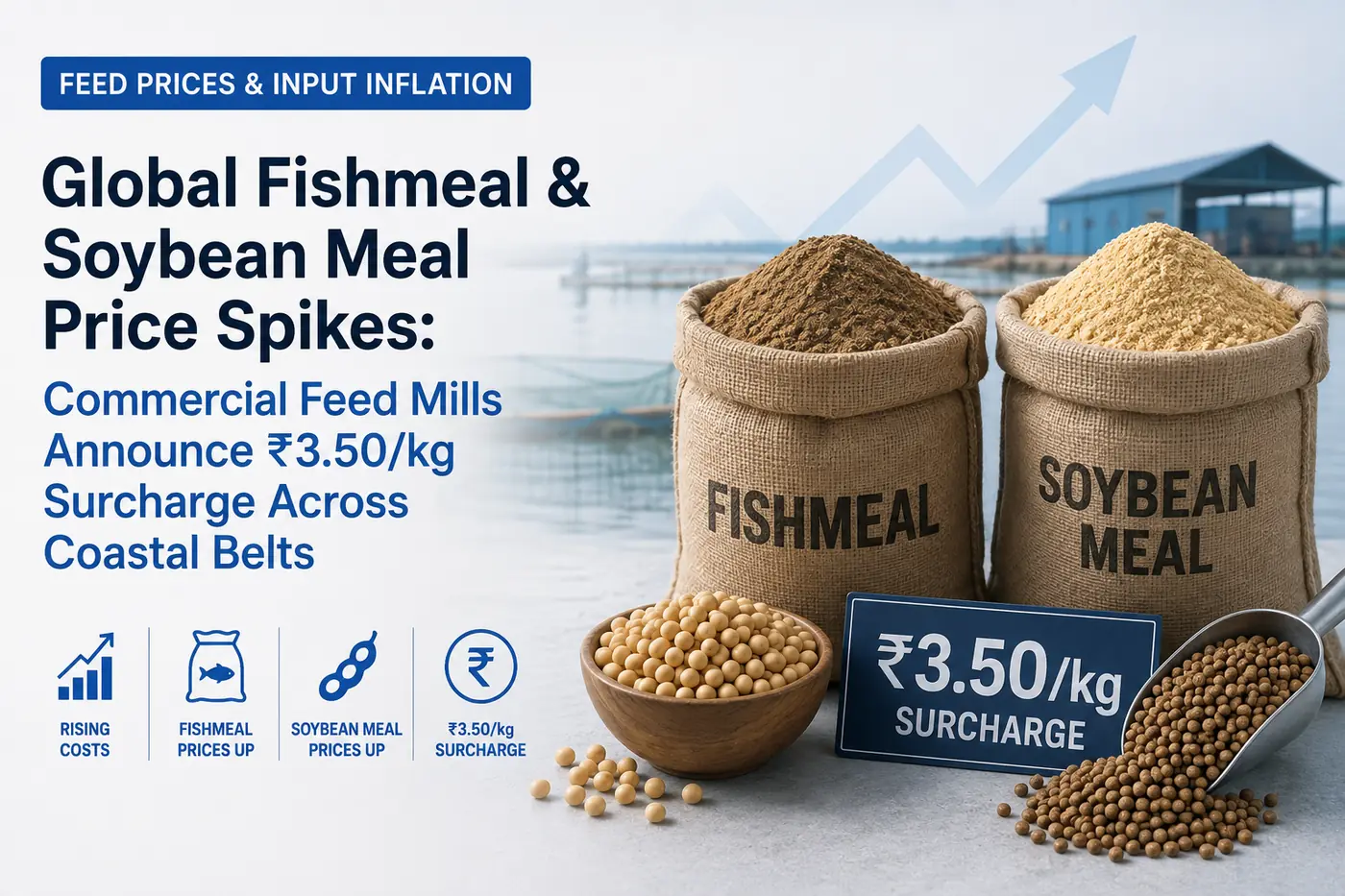
- Leading Indian aquafeed millers announce an immediate ₹3.50 per kilogram price revision across starter, grower, and finisher pellet lines.
- Peru's Ministry of Production (PRODUCE) lowers second-season anchovy fishing quotas by 18%, driving global fishmeal spot rates to $1,980 per metric ton.
- Domestic de-oiled soybean cake (DOC) prices in Indore and Nagpur rally to ₹48,500/MT amid surging protein export demand.
- Farmers implementing precision checktray feeding schedules and on-farm probiotic fermentation can lower FCR from 1.55 to 1.25, completely neutralizing feed cost inflation.
1. Global Raw Material Cost Drivers: Anchovy Quotas & SBM Spikes
Commercial aquaculture feed represents the single largest operational cost in shrimp farming, accounting for 52% to 62% of total crop expenditure. Over the past six weeks, a convergence of international commodity shocks and domestic supply constraints has triggered sharp price spikes across the two core dietary protein pillars of aquafeed: marine fishmeal and de-oiled soybean meal (SBM).
In South America, Peru's Ministry of Production (PRODUCE) announced an 18% reduction in total allowable catch (TAC) for the second-season northern-central anchovy (Engraulis ringens) fishery, citing oceanographic anomalies associated with coastal warming. As the world's primary source of high-grade 68% crude protein fishmeal, the Peruvian quota cut sent global spot benchmarks surging to $1,980 per metric ton CIF East Coast India ports—a 14.5% quarter-on-quarter increase.
Simultaneously, domestic Indian soybean meal (DOC) benchmarks in key crushing hubs across Madhya Pradesh (Indore) and Maharashtra (Nagpur) rallied from ₹42,000 to ₹48,500 per metric ton. Strong poultry industry consumption combined with international export demand for non-GMO Indian soybean meal has tightened domestic availability, forcing commercial feed millers to adjust procurement cost models.
2. Commercial Feed Manufacturer Price Revisions & Margin Pressures
In joint circulars issued across the major aquaculture hubs of Andhra Pradesh (Bhimavaram, Nellore), Gujarat (Surat), and Tamil Nadu (Chennai), leading commercial aquafeed manufacturers—including Avanti Feeds, CP Aquaculture India, Growel Feeds, and Godrej Agrovet—announced a uniform surcharge of ₹3.50 per kilogram across all commercial extruded pellet lines.
Feed mill executives noted that raw material input costs had increased by ₹5.20 to ₹6.10 per kilogram over the preceding 90 days. While feed manufacturers absorbed a portion of the commodity surge by drawing down strategic raw material buffer inventories, escalating ocean container freight and energy costs made a retail pass-through unavoidable.
The revised pricing schedule takes effect immediately for all dealer dispatches. Starter crumble lines (Crude Protein 38%) have adjusted to ₹115.50–₹119.50/kg, standard grower pellets (CP 36%) to ₹101.50–₹105.50/kg, and finisher pellets (CP 34%) to ₹94.50–₹98.50/kg.
3. On-Farm Financial Impact: Calculating Crop Expenditure at Varying FCRs
To understand the true commercial impact of a ₹3.50/kg price hike, farm operators must analyze total feed expenditure through the mathematical lens of the Feed Conversion Ratio (FCR). In a standard 10-metric-ton harvest of 30-count Vannamei shrimp:
At an inefficient FCR of 1.65, total feed consumed equals 16,500 kilograms. The ₹3.50/kg increase adds an extra ₹57,750 in direct cash outflow. However, at an optimized FCR of 1.25, total feed consumed drops to 12,500 kilograms, reducing the price hike's impact to ₹43,750 while cutting total baseline feed spend by ₹3,86,250 compared to the inefficient farm.
This mathematical reality proves that Feed Conversion Ratio efficiency exerts an exponentially greater influence on pond bottom-line profitability than minor fluctuations in per-kilogram feed cost. Improving FCR by just 0.10 saves ₹1,00,000 per 10-ton crop at current feed prices.
4. Practical On-Farm Strategies to Lower FCR from 1.55 to 1.25
Aquaculture producers cannot control international commodity markets, but they maintain complete control over daily feed dispensation, checktray reading, and biological assimilation on the pond embankment:
1. Precision Checktray Protocol: Never feed based on theoretical generic biomass charts. Install 4 checktrays per hectare and adjust daily feed rations strictly based on 2.0-hour checktray consumption. If 5% to 10% of feed remains in checktrays, immediately cut the subsequent feeding by 25%.
2. Benthic DO & Thermal Synchronization: Shrimp digest feed efficiently only when dissolved oxygen is above 4.5 mg/L and water temperature exceeds 26°C. Eliminate early morning feedings (before 8:30 AM) when water temperatures and DO levels are at their diurnal low.
3. Biofloc & Probiotic Top-Dressing: Stimulate heterotrophic in-situ biofloc by maintaining a 15:1 Carbon-to-Nitrogen (C:N) ratio using sugarcane molasses. Shrimp graze continuously on microbial flocs containing 30% crude protein, reducing commercial feed requirements by up to 18%.
5. The Shift Toward Insect Meal, Single-Cell Proteins & Yeast Hydrolysates
The current commodity squeeze is accelerating commercial R&D into next-generation alternative protein sources to reduce long-term dependency on wild-caught marine fishmeal and land-intensive soybean crops.
Leading aqua-nutrition laboratories in India and Southeast Asia are actively piloting commercial diets incorporating Black Soldier Fly (Hermetia illucens) insect larvae meal, microbial single-cell proteins (SCP) derived from gas fermentation, and enzymatic yeast hydrolysates.
Trial data published by ICAR-CIBA indicates that functional diets replacing 30% of dietary fishmeal with fermented insect protein achieve equal or superior Specific Growth Rates (SGR) while enhancing disease resistance against Vibrio parahaemolyticus through natural antimicrobial peptides (AMPs) and chitin fractions.
Market Data & Rates Breakdown
| Feed Pellet Grade & Protein % | Pre-Revision Price (₹/kg) | Revised Price (₹/kg) | Cost Impact Per 10-Ton Crop (FCR 1.35) | Key Ingredients Driving Cost |
|---|---|---|---|---|
| Starter Crumble #0 / #1 (38% Protein) | ₹ 112 – ₹ 116 / kg | ₹ 115.50 – ₹ 119.50 / kg | + ₹ 4,725 (Nursery Phase) | Super-Prime Fishmeal, Squid Meal & Cholesterol |
| Grower Pellet #2 (36% Protein) | ₹ 98 – ₹ 102 / kg | ₹ 101.50 – ₹ 105.50 / kg | + ₹ 18,900 (DOC 25–60) | Imported Fishmeal & De-Oiled Soybean Meal |
| Finisher Pellet #3 / #4 (34% Protein) | ₹ 91 – ₹ 95 / kg | ₹ 94.50 – ₹ 98.50 / kg | + ₹ 23,625 (DOC 61–Harvest) | Soybean Meal, Wheat Gluten & Fish Oil |
| Functional Gut / Health Feed (36% Protein) | ₹ 124 – ₹ 130 / kg | ₹ 127.50 – ₹ 133.50 / kg | + ₹ 5,250 (Strategic Dosing) | Nucleotides, Beta-Glucan & Encapsulated Organics |
| Overall 10-Ton Crop Average | ₹ 96.50 / kg (Weighted) | ₹ 100.00 / kg (Weighted) | + ₹ 47,250 Total Gross Expense | Blended Raw Material Ingestion Basket |
While the ₹3.50/kg feed price revision adds approximately ₹47,000 to ₹65,000 in gross production costs per 10 metric tons of harvested biomass, its financial impact is entirely manageable through operational discipline. A modest 0.15 reduction in Feed Conversion Ratio (FCR)—from 1.45 to 1.30—saves 1,500 kg of feed per 10-ton crop (worth ₹1,50,000), delivering a net profit improvement that far outweighs the headline price increase.
Immediate Farmer Action Plan
Frequently Asked Questions
Q: Why are feed millers raising prices when shrimp farmgate prices are only just recovering?
Aquafeed manufacturing is heavily exposed to global commodity markets. Super-prime fishmeal (imported from Peru) and domestic soybean meal constitute over 65% of raw feed ingredient costs. Recent fishing quota reductions in Peru and surging soybean export demand forced feed mills to adjust prices to prevent severe operational margin losses.
Q: How much does a 0.1 reduction in FCR save in total farm production costs?
On a standard 10-metric-ton shrimp harvest, reducing FCR by 0.10 (for example, from 1.45 to 1.35) eliminates 1,000 kilograms of feed consumption. At an average feed price of ₹100/kg, this delivers an immediate net cash savings of ₹1,00,000 per 10 tons of harvested biomass.
Q: Can farmers blend cheaper low-protein fish feed into shrimp rations to cut costs?
No. Feeding low-protein (24%–28%) fish feeds to penaeid shrimp results in poor growth, soft-shell syndrome, elevated FCR (> 1.8), and severe water quality deterioration due to high carbohydrate leaching. Penaeid shrimp require at least 34% to 38% highly digestible marine protein and essential lipids for proper exoskeleton formation and growth.
Q: What are the best natural binders and additives to prevent feed nutrient leaching in pond water?
Top-dressing feed with pharmaceutical-grade Soy Lecithin (10 mL/kg) or squid oil creates a hydrophobic lipid coating that prevents water-soluble vitamins, minerals, and amino acids from leaching out before shrimp consume the pellet. Adding microbial phytase and liquid digestive enzymes also accelerates gastric breakdown and nutrient absorption.
More Market News & Advisories
Coastal Aquaculture Authority (CAA) Mandates Geo-Tagging & Digital QR Licenses for All Brackishwater Ponds by Dec 2026
Read Bulletin →Government PolicyAndhra Pradesh & Gujarat Power Discoms Expand Subsidized ₹1.50/Unit Aqua Power Slab to High-Density Commercial Farms
Read Bulletin →Export MarketUS Department of Commerce Finalizes 2026 Countervailing Duty (CVD) Rates on Indian Shrimp: Major Exporters Secure Sub-3% Relief
Read Bulletin →Get Live Farmgate Price Push Notifications
Download India's #1 Aquaculture Super App for real-time market prices, news, and tools.
Download Free Android App