Executive Summary & Key Takeaways
- Phenotypic sex reversal using 17α-Methyltestosterone (17α-MT) overrides genetic XX/XY determination, converting genetically female (XX) larvae into fully functional, fast-growing phenotypic males.
- The 11mm rule is absolute: swim-up fry must be harvested between Day 8 and Day 10 post-fertilization (under 11 mm total length). Administering hormone to fry >12 mm fails because ovaries have already irreversibly differentiated.
- 17α-MT is water-insoluble; dissolve exactly 60 mg of analytical-grade hormone in 250 mL of 95% pure ethanol per kg of high-protein (45% CP) micro-feed, atomizing evenly and drying in a dark room under 30°C.
- Feed the hormone diet 8 times daily every 90 minutes from 07:00 to 17:30 hrs for 21 to 28 consecutive days, maintaining water temperature strictly between 28.5°C and 29.5°C to optimize metabolic uptake.
- Validate every commercial batch before dispatch by sacrificing 100 random 25mm fingerlings and conducting 0.5% aceto-carmine gonad squash microscopy; demand a certified >98.5% male benchmark.
- Never discharge treatment wastewater into natural canals; pass effluent through Granular Activated Carbon (GAC) columns and high-dose UV oxidation reactors to eliminate environmental endocrine disruption.
Commercial Hatchery Case Study: 4.5 Million Monosex Fingerling Scaled Production
An intensive commercial finfish hatchery faced inconsistent sex-reversal rates (82% to 88% males) and erratic fry survival during summer breeding cycles, resulting in customer complaints of wild spawning in grow-out ponds. The hatchery overhauled its protocols under AquaSangham clinical supervision: 1) Standardized broodstock collection to exactly 10-day intervals, rejecting any fry exceeding 11mm total length to ensure all treated fry were in the labile bipotential gonad window, 2) Upgraded hormone feed preparation by dissolving 60 mg/kg 17α-Methyltestosterone in 95% analytical-grade ethanol and spraying onto 45% CP micro-crumble using ultrasonic atomization, and 3) Routed hormone treatment wastewater through a 3-stage activated carbon and ultraviolet oxidation scrubbing loop. Quality control testing via microscopic aceto-carmine gonad squash confirmed 99.2% male conversion across 5 consecutive cohorts. The hatchery eliminated grow-out stunt complaints, achieved an 86.4% survival rate from swim-up to 2-inch fingerling, and generated ₹54 Lakhs in monthly gross seed revenues.
1. The Endocrinology of Tilapia Sex Reversal: Bipotential Gonads & The 11mm Rule
In commercial tilapia aquaculture, producing an all-male monosex population is not merely an operational preference—it is the single foundational prerequisite for economic survival. The Nile tilapia (Oreochromis niloticus) possesses a unique reproductive biology characterized by precocious sexual maturity. Under tropical conditions, young tilapia reach reproductive readiness at just 2 to 3 months of age, when they weigh merely 40 to 60 grams. If both sexes are cultured together in grow-out ponds, females expend up to 40% of their total metabolic energy on vitellogenesis (egg synthesis) and maternal mouthbrooding, during which they cease feeding entirely for weeks at a time.
Simultaneously, prolific wild reproduction occurs inside the pond every 20 to 30 days. Within a single culture cycle, a mixed-sex pond becomes choked with hundreds of thousands of competing fry, triggering severe overcrowding, dissolved oxygen depletion, and extreme somatic stunting where no fish exceeds 150 grams. Conversely, male tilapia channel 100% of their dietary nutrients into skeletal and muscle development, growing 40% to 60% faster than females and reaching 800 to 900 grams in under 135 days.
To capture this massive growth advantage, industrial tilapia hatcheries across India (most prominently in the major seed production hubs of Andhra Pradesh, West Bengal, Odisha, and Tamil Nadu) rely on phenotypic sex reversal using the synthetic androgen 17α-Methyltestosterone (17α-MT). When administered through feed during the critical ontogenetic window before endogenous gonad differentiation occurs, 17α-MT overrides genetic sex determination, causing genetically female (XX) larvae to develop functional, fully masculinized phenotypic male testes.
Achieving a commercially certified sex-reversal rate exceeding 98% requires surgical precision. Administering hormone feed to fry that are even 2 millimeters too large results in incomplete masculinization, producing sterile intersex or female fish that ruin downstream pond performance. Inadequate solvent dissolution leads to uneven hormone distribution, while improper effluent management poses serious ecological risks to aquatic ecosystems. This technical master standard operating procedure details the complete industrial protocol for monosex tilapia seed production.
The Bipotential Gonad & Ontogenetic Window
1. Undifferentiated Germ Cells: Tilapia larvae hatch with primordial germ cells that possess the biological plasticity to form either ovarian or testicular tissue.
2. The 11mm Threshold: Endogenous gonadal differentiation begins between Day 10 and Day 14 post-hatching (9.0 to 11.0 mm total length). If fry exceed 11 mm, ovarian differentiation has already occurred and cannot be reversed.
3. Synthetic Androgen Mechanism: 17α-MT mimics testosterone, binding to steroid receptors in the primordial gonad to suppress aromatase enzymes and direct tissue differentiation into seminiferous tubules.
Never rely on age alone when collecting fry; always measure physical total length with a precision caliper. In warm hatchery water (>31°C), fry grow rapidly and can exceed 11 mm by Day 8, passing the critical sex-reversal window before treatment begins.
2. Broodstock Management, Spawning Hapas & Egg/Larvae Collection SOPs
Synchronizing broodstock is critical to harvesting uniform batches of swim-up fry within the narrow 11mm window:
- Broodstock Conditioning: Maintain high-grade GIFT broodstock in deep earthen conditioning ponds at a low density (1 to 2 kg/m²). Separate males and females for 14 days prior to breeding, feeding a high-protein broodstock diet (35% CP, 8% lipid, enriched with Vitamin E and spirulina @ 5 g/kg) to maximize egg fecundity and vitellogenin quality.
- Breeding Hapas: Deploy commercial breeding hapas constructed from 1.0mm fine nylon mesh (dimensions: 8m length × 3m width × 1.2m depth) suspended in freshwater ponds. Stock broodstock at a strict sex ratio of 1 male to 3 females (e.g., 25 males and 75 females per hapa).
- Timed Egg and Fry Harvesting: Exactly on Day 8 to Day 10 following broodstock stocking, workers must enter the hapa and gently examine the oral cavity of every single female fish. Tilapia are maternal mouthbrooders; fertilised eggs and newly hatched sac-fry are carried inside the female's buccal cavity.
- Egg Staging: Wash collected eggs into clean buckets containing 5 ppm povidone-iodine solution. Sort clutches by developmental stage: Stage I: Yellow/amber non-eyed eggs (Day 1–3 post-spawning). Stage II: Pigmented eyed eggs (Day 4–5). Stage III: Hatched yolk-sac larvae / wrigglers (Day 6–7). Stage IV: Swim-up fry with absorbing yolk sacs, measuring 8.0 to 9.5 mm (Day 8–10). Only Stage IV swim-up fry that are actively beginning to ingest external food are eligible to enter the hormone treatment tanks.
After stripping eggs from female mouthbrooders, disinfect the females in a 15-minute static bath of 3 ppm potassium permanganate (KMnO4) before returning them to resting ponds. This prevents oral fungal and bacterial stomatitis caused by handling.
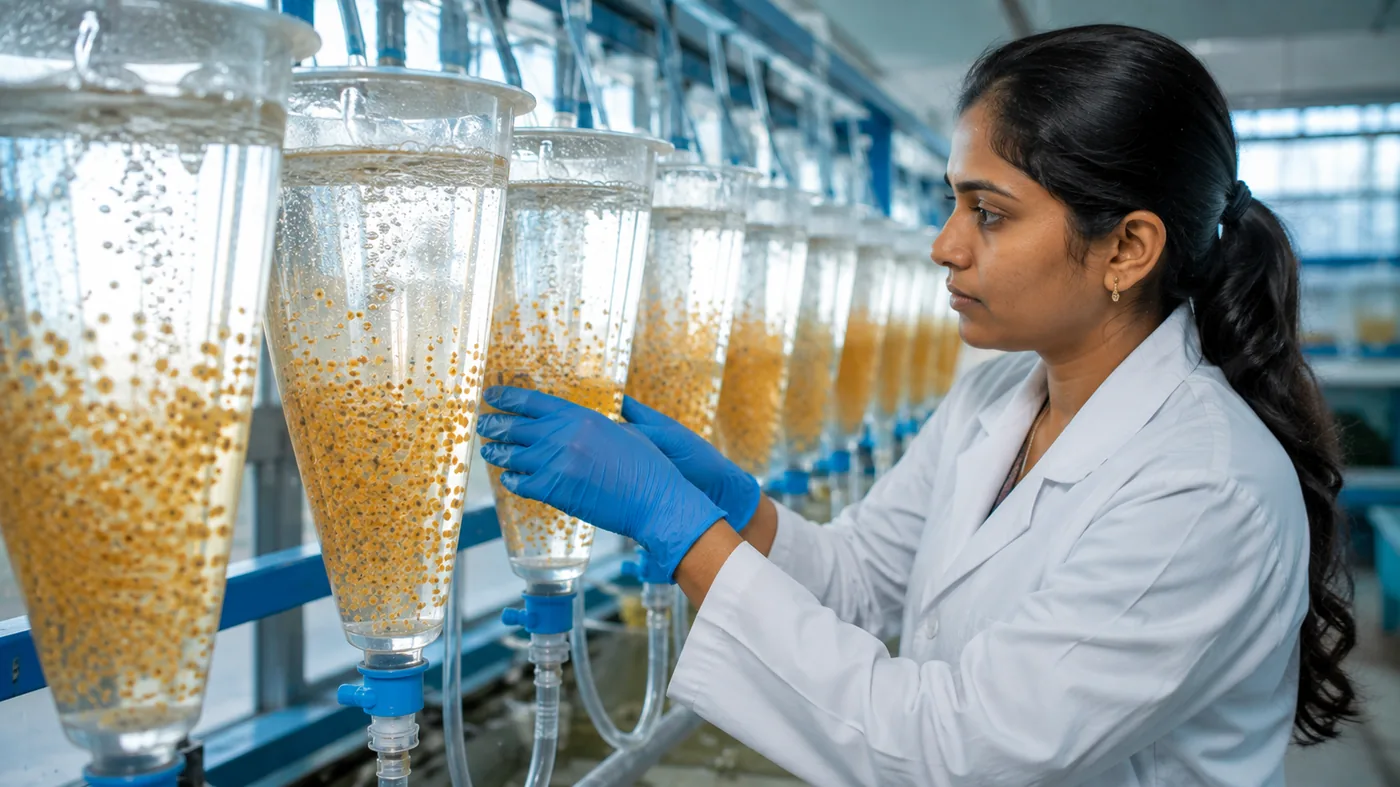
3. Artificial Incubation in Acrylic Zuger Conical Jars
Eggs collected at Stages I, II, and III must be incubated artificially in a controlled hatchery environment:
- Acrylic Zuger Conical Jars: Transfer eggs to clear cylindrical-conical acrylic hatching jars (Zuger jars, volume 10 to 15 liters). Water is introduced from the bottom cone through a central pipe, creating a gentle, continuous upward hydraulic fluidization that keeps the eggs in suspension without abrasive friction.
- Water Flow Dynamics: Maintain water flow rate strictly at 3.0 to 4.5 liters per minute per jar. If flow is too low, eggs settle to the bottom and suffocate from localized hypoxia; if flow is too high, mechanical shear forces rupture fragile chorion membranes.
- Water Quality Parameters: Incubation water must be treated with UV irradiation and cartridge filtration (5 microns). Maintain dissolved oxygen > 6.5 ppm, temperature at 28°C to 30°C, and total alkalinity > 100 ppm.
- Antifungal Prophylaxis: To prevent Saprolegnia fungal blooms on unfertilized dead eggs, dose Hydrogen Peroxide (100 ppm) or Formalin (50 ppm) as a 15-minute static bath once daily, flushing completely with clean water afterward.
- Hatching Kinetics: At 29°C, eggs hatch in 48 to 72 hours. The hatched yolk-sac larvae swim upward and spill over the jar collection weir into adjacent fiberglass nursery troughs, where they absorb their yolk sacs over the subsequent 4 days.
Install a fine overflow collection trough with a 60-mesh nylon sock at the top of each Zuger jar battery. As sac-fry absorb their yolks and become phototactic swim-up larvae, they automatically swim toward the surface and spill over into the collection trough without manual net handling.
4. 17α-Methyltestosterone Hormone Preparation & Feed Mixing Protocols
17α-Methyltestosterone is a synthetic steroid hormone that is completely insoluble in water. Proper solvent preparation is mandatory for uniform distribution:
- Chemical Grade: Use only certified analytical or pharmaceutical-grade 17α-Methyltestosterone (purity > 98.5%). Agricultural or veterinary crude grades contain toxic isomers and variable active concentrations that cause treatment failure.
- The Solvent Formulation: Measure exactly 60.0 milligrams (0.060 grams) of 17α-MT powder using an analytical 4-decimal balance. Measure 250 milliliters of 95% to 99% pure Analytical-Grade Ethanol (or pure technical ethyl alcohol). Do not use denatured alcohol, acetone, or isopropyl alcohol, which leave toxic residues in larval tissues. Dissolve the 60 mg of hormone powder completely in the 250 mL of ethanol inside a glass Erlenmeyer flask, swirling gently until the liquid is 100% crystal-clear with zero particulate suspension.
- The Carrier Diet: The vehicle feed must be a high-grade micro-crushed larval diet with a minimum Crude Protein of 45% and lipid content of 8% to 10% (particle size: 100 to 250 microns). The feed must be finely ground and sieved to ensure small swim-up fry can ingest every particle.
- Mixing and Drying SOP: 1. Weigh exactly 1.0 kilogram of the 45% CP micro-feed. 2. Place the feed in a shallow, stainless steel or food-grade plastic tray. 3. Using a fine pneumatic hand sprayer, spray the 250 mL ethanolic hormone solution evenly across the feed while thoroughly mixing and kneading with gloved hands. 4. Spread the moistened feed in a thin layer (under 1 cm depth) on stainless steel drying racks in a dark, clean, well-ventilated room at 25°C–28°C. 5. Allow the ethanol to evaporate completely for 12 to 16 hours. Never expose hormone feed to direct sunlight or temperatures >40°C, as ultraviolet radiation and heat degrade synthetic androgens. 6. Once completely dry, store the prepared hormone feed in airtight, black opaque plastic containers at 4°C in a dedicated refrigerator. Shelf life: 30 days.
Never dry hormone-treated feed using heat guns or electric ovens. Temperatures exceeding 45°C thermal-crack the steroid cyclopentanoperhydrophenanthrene ring, destroying its androgenic biological potency and causing treatment failure.
5. The 21-to-28-Day Nursery Treatment Regime: Schedules & Limnology
Executing the 28-day feeding regime with precision:
- Nursery Tank Infrastructure: Maintain fry in smooth-walled rectangular fiberglass or concrete nursery troughs (dimensions: 3.0m length × 0.8m width × 0.6m depth) equipped with continuous aeration and a central standpipe drain covered with 40-mesh stainless steel screen. Stock swim-up fry at a density of 3,000 to 5,000 fry per square meter of water surface.
- The 8-Meal Daily Schedule: Because larval fish have tiny digestive tracts and rapid gut transit times (under 90 minutes), feeding must be frequent and consistent. Broadcast hormone feed 8 times daily, administered every 90 minutes from 07:00 AM to 17:30 hrs: Week 1: 18% to 20% of total biomass daily; Week 2: 14% to 16% daily; Week 3: 11% to 13% daily; Week 4: 8% to 10% daily.
- Water Quality Maintenance: Maintain water temperature strictly between 28°C and 30°C. Temperature directly controls teleost metabolic rate; at temperatures <26°C, fry consume less feed, leading to sub-therapeutic hormone uptake and sex reversal failure. Siphon tank bottoms twice daily to remove uneaten feed and feces. Perform a 30% to 50% daily water exchange using pre-conditioned, temperature-matched water.
| Treatment Week | Fry Age (Days) | Mean Fry Length (mm) | Feed Particle Size (µm) | Daily Feeding Rate (% Biomass) | Feeding Frequency (Meals/Day) | Optimal Water Temp (°C) | Target Survival (%) |
|---|---|---|---|---|---|---|---|
| Week 1 (Onset) | Day 8 – 14 | 8.5 – 11.0 mm | 100 – 150 µm Micro-Crumble | 18% – 20% Biomass | 8 Meals / Day (Every 90m) | 28.5°C – 29.5°C | > 92% Survival |
| Week 2 (Active Reversal) | Day 15 – 21 | 11.5 – 14.5 mm | 150 – 250 µm Crumble | 14% – 16% Biomass | 8 Meals / Day (Every 90m) | 28.5°C – 29.5°C | > 90% Survival |
| Week 3 (Consolidation) | Day 22 – 28 | 15.0 – 18.5 mm | 250 – 400 µm Crumble | 11% – 13% Biomass | 7 Meals / Day (Every 2h) | 28.0°C – 29.0°C | > 88% Survival |
| Week 4 (Completion) | Day 29 – 35 | 19.0 – 24.0 mm | 400 – 600 µm Mini-Pellet | 8% – 10% Biomass | 6 Meals / Day (Every 2.5h) | 28.0°C – 29.0°C | > 86% Survival |
If hatchery ambient temperatures drop below 26°C during monsoon or winter seasons, install titanium immersion heaters connected to digital thermostats. Maintaining water strictly between 28.5°C and 29.5°C ensures rapid feeding and 99%+ male sex-reversal rates.
6. Quality Assurance: Aceto-Carmine Gonad Squash Microscopy SOP
Before any batch of monosex fingerlings is certified and dispatched to commercial grow-out farmers, hatcheries must execute standard laboratory quality verification:
- The Aceto-Carmine Squash Protocol: At Day 30 post-treatment (when fingerlings reach 20 to 25 mm total length), collect a random representative sample of 100 fingerlings from the batch.
- Dissection Procedure: Euthanize fry in an ice-water slurry. Under a stereo dissecting microscope (20x), pin the fish down, open the abdominal cavity, remove the viscera, and locate the microscopic paired gonadal threads running along the ventral surface of the swim bladder beneath the spine.
- Staining and Mounting: Using fine micro-forceps, excise the gonadal tissue, place it onto a clean glass slide, add two drops of 0.5% Aceto-Carmine stain, and place a coverslip on top. Apply firm, vertical thumb pressure to squash the gonadal tissue into a single-cell layer.
- Microscopic Examination (100x to 400x): Testicular Tissue (Male): Appears as compact, smooth, lobed structures containing uniform spermatogonia with clear, rounded nuclei and distinct seminiferous tubules. Ovarian Tissue (Female): Appears as cellular, granulated tissue containing distinct circular oocytes with dark nucleoli and clear cytoplasmic boundaries.
- The 98% Certification Benchmark: If the aceto-carmine squash confirms >98 males out of 100 examined fish, the batch is certified as 98%+ All-Male Monosex and cleared for commercial grow-out delivery.
Prepare aceto-carmine stain fresh monthly: dissolve 0.5g carmine powder in 100 mL of 45% glacial acetic acid, boil gently under a fume hood for 2 minutes, cool, and filter through Whatman No. 1 paper. Fresh stain delivers sharp nuclear contrast between spermatogonia and developing oocytes.
7. Environmental Biosecurity, Operator Safety & Effluent Treatment
Operating a commercial hormone-treatment facility requires strict biosecurity and environmental safeguards:
- Operator Safety Protocols: 17α-Methyltestosterone is a potent endocrine disruptor that can be absorbed through the skin or inhaled as fine dust. Technicians handling pure hormone powder or mixing feed must wear full Personal Protective Equipment (PPE): nitrile gloves, lab coat, safety eye goggles, and an N95 particle respirator.
- Closed-Loop Effluent Treatment (Zero Hormone Discharge): Discharging untreated wastewater from hormone treatment tanks into public canals or rivers causes severe endocrine disruption in wild aquatic fauna, feminizing or masculinizing non-target fish. Commercial hatcheries must route all treatment tank discharge through a dedicated 3-stage scrubbing system: 1. Granular Activated Carbon (GAC) Adsorption Columns: GAC binds and adsorbs over 99% of dissolved steroid molecules from water. 2. High-Dose Ultraviolet (UV) Oxidation: UV radiation (254 nm at >150 mJ/cm²) photo-catalytically degrades residual steroid ring structures into non-hormonal organic fractions. 3. Sunlight Solarization Settling Pond: Water is held in a shallow retention pond exposed to natural UV sunlight for 7 days before discharge.
Keep a dedicated logbook recording the exact lot number of 17α-MT powder, quantity of feed prepared, dates of treatment onset and completion, and verified aceto-carmine squash results. This documentation is required for State Fisheries Department biosecurity accreditation and MPEDA certification.
Summary Operational Action Checklist
Frequently Asked Questions
Q: Why can tilapia fry larger than 11 mm not be sex-reversed using 17α-Methyltestosterone?
Teleost gonadal differentiation is strictly ontogenetic. In Oreochromis niloticus, primordial germ cells remain undifferentiated and labile only until the fry reaches approximately 9.0 to 11.0 mm total length (Day 10 to 14 post-fertilization). Past 11 mm, endogenous enzymatic cascades initiate ovarian cavity formation and female steroidogenesis in genetic females (XX). Once the primary ovary has begun to form, exogenous androgens cannot reprogram the tissue architecture, resulting in incomplete sex reversal, intersex individuals, or normal functional females that will subsequently breed in grow-out ponds.
Q: Why is pure 95% ethanol required to mix 17α-Methyltestosterone into the feed?
17α-Methyltestosterone is a non-polar steroid molecule that is virtually insoluble in water (solubility < 0.005 g/L). If added directly to water or feed without a solvent, it forms clumped, unabsorbed crystals that pass through the digestive tract without absorption. Pure 95% to 99% ethanol completely dissolves 17α-MT at the molecular level. When sprayed over fine micro-feed, the ethanolic solution penetrates every feed particle uniformly; the alcohol then evaporates completely within 12 hours, leaving an ultra-fine, microscopic coating of pure hormone across 100% of the feed particles.
Q: How does aceto-carmine staining distinguish between male and female tilapia gonads under a microscope?
Aceto-carmine is a nuclear and tissue stain that selectively highlights reproductive cell morphology. When squashed and viewed under 100x to 400x magnification: male testicular tissue appears as compact, smooth, elongated lobes containing uniform clusters of tiny spermatogonia with clear, rounded nuclei and distinct seminiferous tubules. Female ovarian tissue appears distinctly granulated, containing conspicuous, large spherical oocytes surrounded by clear follicular cells and prominent nucleoli. If oocytes are detected in more than 2 out of 100 examined fingerlings, the batch fails the certified monosex threshold.
Q: Is it safe to consume tilapia that were treated with 17α-Methyltestosterone as fry?
Yes, it is 100% safe. 17α-Methyltestosterone is administered exclusively during the first 28 days of the fish's life, when fingerlings weigh less than 0.5 grams. Extensive pharmacokinetic studies validated by the US Food and Drug Administration (FDA) and European Food Safety Authority (EFSA) prove that tilapia metabolize and excrete more than 99% of administered 17α-MT through the liver, kidneys, and bile within 100 hours post-treatment. By the time the fish reaches commercial harvest size (800g at Day 135), exactly zero detectable hormone residues remain in the muscle fillets.
Q: What causes sex-reversal failure (<90% males) even when 60 mg/kg hormone feed was used?
Sex-reversal failure is almost always caused by one of three operational errors: 1) Fry were harvested too late (>11 mm length) and had already begun ovarian differentiation; 2) Water temperature dropped below 26°C during treatment, which suppresses larval appetite and reduces total daily hormone intake below the therapeutic threshold; or 3) The hormone feed was exposed to direct sunlight or temperatures >40°C during drying or storage, which photochemically degrades the steroid hormone molecule into inactive compounds.
AquaSangham Technical Advisory
Finfish Hatchery & Reproductive Genetics Desk
Contributing Senior Technical Writer & Aqua Consultant at AquaSangham.
Recommended Farming Guides
Total Ammonia Nitrogen (TAN) Mass Balance Math: Sizing Biofilters in Commercial RAS
Read Article →Farming TechThe Recirculating Aquaculture System (RAS) Master Guide: Design, Hydraulics & Mass Balance
Read Article →Farming TechIndigenous Magur (Clarias batrachus) Induced Breeding & Nursery Rearing SOPs
Read Article →Get Live Farm Advice on AquaSangham Mobile App
Download India's #1 Aquaculture Super App for real-time market prices, precision tools, and community advice.
Download Free Android App