Executive Summary & Key Takeaways
- Circular concrete tanks with a 2.5% to 4.0% conical inward floor slope create a self-cleaning hydraulic vortex, eliminating anaerobic dead zones and sweeping heavy organic solids continuously into a central drain.
- At biomass densities exceeding 8 to 10 kg/m³, atmospheric blowers fail; sustaining physiological health requires pure industrial oxygen gas injected via pressurized Speece cones to maintain an uninterrupted 7.5 to 8.5 ppm DO floor.
- Autotrophic nitrification destroys 7.14 grams of CaCO3 alkalinity for every 1.0 gram of Total Ammonia Nitrogen (TAN) oxidized; automated continuous dosing of Sodium Bicarbonate is mandatory to prevent lethal pH crashes.
- In heterotrophic Biofloc Technology (BFT), maintain a C:N ratio > 15:1 via organic carbon supplementation and monitor floc volume daily with an Imhoff cone, targeting 15 to 25 mL/L to avoid gill clogging.
- Solid waste must be evacuated within 15 to 30 minutes of excretion using 40–60 micron automated rotary drum filters and Venturi protein skimmers to strip dissolved surfactants before microbial ammonia leaching occurs.
- Biomass fractionation (3-stage partial harvesting at 16–18g, 24–26g, and terminal 32–36g) prevents biomass bottlenecks, triples annual volumetric production, and delivers FCRs between 1.05 and 1.15.
Field Case Study: 12-Tank Ultra-Intensive Indoor Facility Pilot
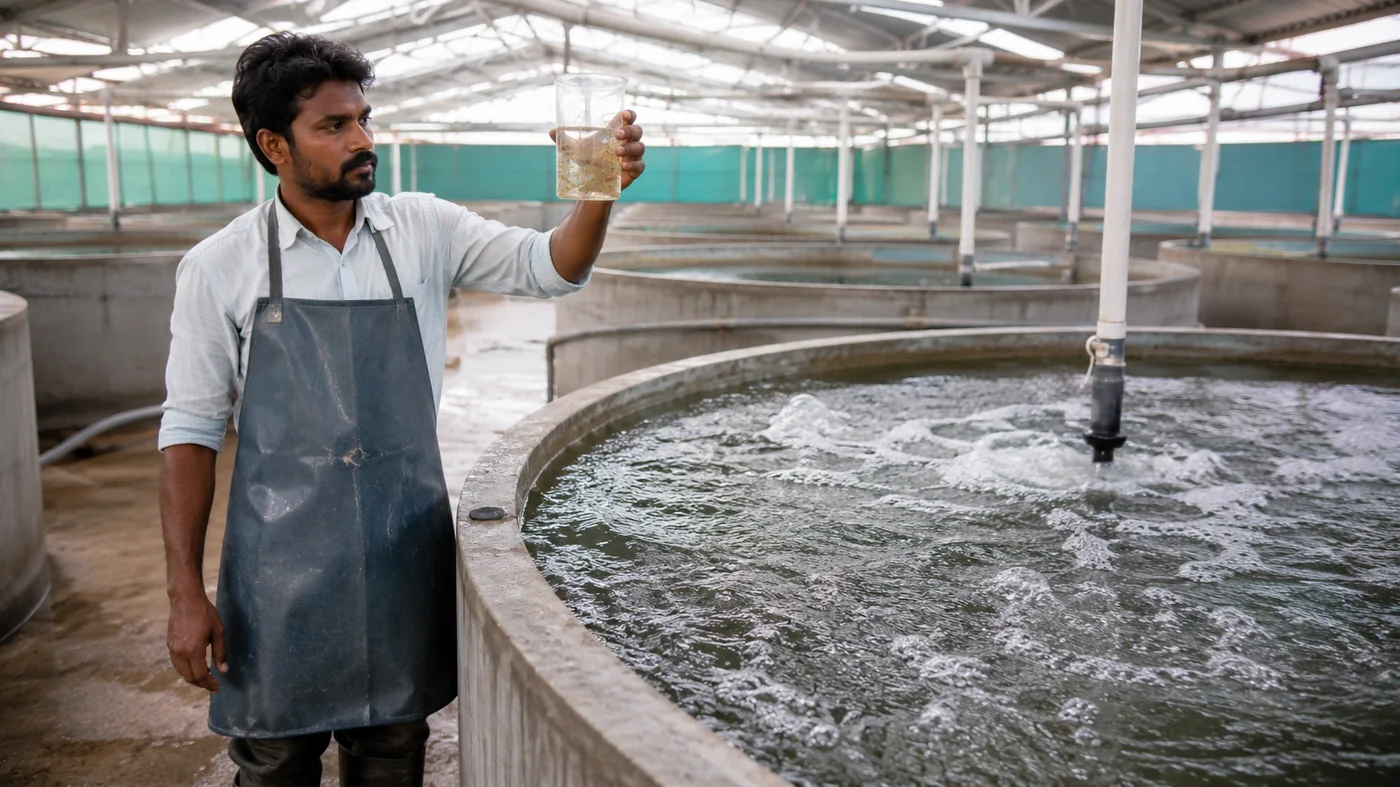
An indoor super-intensive farm operating 12 circular concrete tanks (10-meter diameter, 1.2-meter water depth, 94 m³ volume each) stocked SPF Penaeus vannamei at 380 PL/m³ (approx. 400 juveniles/m³). Operating on a hybrid biofloc-RAS loop with pure oxygen injection cones and micro-screen drum filtration (60 microns), the facility maintained DO at 7.8 ppm and TAN < 0.3 ppm. Utilizing automatic acoustic feeders and molasses carbon dosing (C:N 14:1), the facility executed two partial thinning harvests at DOC 65 (18g) and DOC 78 (25g), with final terminal harvest at DOC 88 (31.2g). Total biomass harvested across the 12 tanks reached 15,560 kg (averaging 1,296 kg/tank or 13.79 kg/m³), generating a net operating profit of ₹38.6 Lakhs in a single 3-month turn with zero environmental discharge.
1. Structural Engineering of Circular Tanks: Hydrodynamics & Coatings
Super-intensive crustacean culture in closed, biosecure circular concrete tanks represents the absolute pinnacle of technological control in global aquaculture. While conventional earthen ponds operate at carrying capacities of 0.4 to 0.8 kg per cubic meter (4 to 8 tons per hectare) and intensive HDPE-lined ponds support 1.2 to 1.8 kg/m³ (12 to 18 tons/ha), circular concrete tank systems routinely sustain standing biomasses of 10.0 to 15.0 kg per cubic meter of water. At an operational water depth of 1.2 meters, this translates to an astonishing harvest equivalent of 120 to 150 metric tons per hectare of floor footprint.
By shifting culture operations indoors or under controlled translucent greenhouse structures, concrete tank systems decouple production from external climatic shocks, seasonal temperature plunges, cyclonic flooding, and airborne viral transmission (WSSV, EHP, and IMNV carried by migratory waterfowl and wild crabs). Water usage is slashed from 20,000–30,000 liters per kilogram of shrimp in open ponds down to less than 200 to 500 liters per kilogram through continuous biological recirculation or biofloc recycling. However, operating at 10 to 15 kg/m³ leaves zero margin for technical error. At a standing biomass of 12 kg/m³ consuming 180 kg of feed daily in a small tank footprint, total biological oxygen demand (BOD) surges exponentially. If aeration fails or dissolved oxygen drops below 5.0 ppm for merely 15 minutes, mass asphyxiation ensues within moments. Furthermore, massive ammonia excretion can drive Total Ammonia Nitrogen (TAN) to toxic extremes within hours unless nitrification kinetics are maintained in rigid thermodynamic equilibrium. This technical blueprint details the comprehensive engineering, limnological, and operational protocols required to design, operate, and profit from commercial concrete tank shrimp systems.
The hydrodynamics of a circular tank are fundamentally superior to rectangular raceways or square tanks. In rectangular systems, water corners form stagnant, anaerobic dead zones where organic feces and uneaten feed accumulate. In a circular concrete tank, water currents follow natural rotational momentum, creating a self-cleaning hydraulic vortex that sweeps heavy solids continuously toward the center:
Tank Geometry and Surface Coating Specifications
Diameter-to-Depth Ratio: Commercial culture tanks are engineered with diameters between 8.0 and 12.0 meters and wall heights of 1.4 to 1.6 meters, maintaining an operational water depth of 1.2 to 1.3 meters (yielding total water volumes of 60 to 145 m³ per tank). Tanks with diameters exceeding 15 meters experience diminished angular velocity near the perimeter, causing solids to settle prematurely.
Bottom Slope and Central Drain Geometry: The reinforced concrete floor is cast with a steep conical inward slope of 2.5% to 4.0% descending toward a central drain sump (80 cm diameter, 40 cm depth). The central drain is fitted with a dual-drain mechanism: a bottom perforated stainless steel screen (10 mm aperture) for continuous solids purge and an external telescoping standpipe that sets the tank water level.
Food-Grade Internal Coatings: Raw cured concrete continuously leaches free calcium hydroxide [Ca(OH)2] into water, driving pH above 9.5 during initial filling. Furthermore, the abrasive crystalline texture of bare concrete abrades the delicate walking pereiopods, pleopods, and rostral spines of benthic shrimp, creating entry points for opportunistic Vibrio infections. Internal concrete surfaces must be coated with three coats of certified non-toxic, food-grade solventless epoxy resin or sprayed with pure polyurea elastomer (minimum 2.0 mm thickness). Polyurea provides a seamless, glass-smooth, non-porous finish that resists high-pressure jet washing and prevents bacterial biofilm anchoring.
| System Parameter | Traditional Earthen Pond | Intensive HDPE Lined Pond | Super-Intensive Concrete Tank RAS |
|---|---|---|---|
| Stocking Density (PL/m³) | 25 – 45 PL/m² (~0.03/L) | 60 – 100 PL/m² (~0.07/L) | 300 – 500 PL/m³ (~0.4/L) |
| Max Standing Biomass | 0.4 – 0.8 kg / m³ | 1.2 – 1.8 kg / m³ | 10.0 – 15.0 kg / m³ |
| Water Usage / kg shrimp | 25,000 – 35,000 Liters | 8,000 – 12,000 Liters | 200 – 500 Liters (Recycled) |
| Dissolved Oxygen Tech | Paddlewheel mechanical surface | Paddlewheel + Venturi aeration | Pure Liquid O2 Speece Cones (>7.5 ppm) |
| Daily Alkalinity Consumption | Buffered by soil minerals | 10 – 15 ppm / day (Moderate) | 25 – 45 ppm / day (High automated buffer) |
| Solid Waste Removal | Accumulates in benthic clay | Central sump siphon (2-3x daily) | Continuous Drum Filter (60µm) + Skimmer |
| Crops per Calendar Year | 1.5 – 2.0 Crops | 2.5 – 3.0 Crops | 4.0 – 5.0 Crops (Indoor climate controlled) |
| Average FCR | 1.35 – 1.55 | 1.18 – 1.25 | 1.05 – 1.15 (Acoustic automated feeding) |
| Pathogen Biosecurity | Low (Open to birds/vectors) | Moderate (Fenced & netted) | Maximum (Enclosed SPF bio-bubble) |
Never fill freshly poured concrete tanks without thorough curing and acid-washing. Cure concrete for 28 days, wash with a 5% muriatic acid solution to neutralize free lime, rinse thoroughly with fresh water, and allow to dry completely before applying the epoxy or polyurea barrier coat.
2. Pure Oxygen Dissolution & Hyper-Aeration Kinetics
In an ultra-intensive tank containing 12 kg/m³ of active shrimp biomass, total system oxygen consumption (respiration of shrimp plus nitrification demand of nitrifying bacteria and biofloc) reaches 450 to 650 mg of dissolved oxygen per kilogram of biomass per hour. For a 100 m³ tank holding 1,200 kg of shrimp, the culture volume consumes 540 to 780 grams of pure oxygen every hour.
- Why Conventional Aeration Fails: Atmospheric air contains only 20.9% oxygen. High-efficiency mechanical blowers or surface aerators injecting atmospheric air encounter severe gas transfer resistance: they can rarely sustain dissolved oxygen above 5.5 to 6.0 ppm against heavy microbial respiration, and the vigorous bubble shear required strips protective cuticular lipids from molting post-larvae.
- Pure Oxygen Injection Dynamics: Concrete tank systems must utilize pure industrial oxygen gas (93% to 99% O2 purity) supplied via cryogenic Liquid Oxygen (LOX) bulk vacuum-insulated evaporators (VIE) or on-site Pressure Swing Adsorption (PSA) oxygen generators.
- Oxygenation Cone (Speece Cone) Technology: Water pumped from the tank recirculation loop is forced downward through a high-pressure inverted conical contact vessel (Speece cone) simultaneously with pure oxygen gas. As the cross-sectional area of the cone expands downward, downward water velocity equals the upward buoyant velocity of the gas bubbles, locking the bubbles in place until 95% to 98% of the oxygen gas dissolves into solution. Oxygen-supersaturated water (containing 25 to 40 ppm DO) is injected back into the tank through tangential floor nozzles, maintaining tank ambient DO at a pristine 7.5 to 8.5 ppm across all hours of day and night.
Install an automated emergency oxygen solenoid valve connected directly to an uninterruptible power supply (UPS) and digital DO optical sensor. If primary recirculation pumps trip or DO falls below 6.0 ppm, the solenoid immediately dumps pure oxygen through micro-diffuser ceramic hoses laid along the tank floor, giving technicians 45 minutes of safety reserve.
3. Water Treatment Loops: Biofloc (BFT) vs. Clear-Water RAS
Commercial operators manage concrete tank systems through one of two biological paradigms, each possessing distinct operational characteristics:
1. Heterotrophic Biofloc Technology (BFT): Organic carbon (sugarcane molasses, wheat flour, or cassava starch) is added to the tank to maintain a Carbon-to-Nitrogen (C:N) ratio > 15:1. Heterotrophic bacteria assimilate toxic ammonium directly into microbial protein, forming suspended biological flocs (aggregates of bacteria, protozoa, microalgae, and detritus).
- Floc Volume Management: Floc concentration is monitored daily using a 1,000 mL Imhoff settling cone. Collect 1,000 mL of tank water and allow it to settle statically for 30 minutes. Target Floc Volume (FV) is maintained strictly between 15 and 25 mL/L. If FV exceeds 30 mL/L, excess flocs clog shrimp gills and consume excessive oxygen; excess biofloc is purged by diverting 10% of tank volume through an external lamella settling clarifier.
2. Clear-Water Recirculating Aquaculture Systems (RAS): Water is continuously circulated through mechanical drum filters and an external Moving Bed Biofilm Reactor (MBBR) containing high-surface-area virgin polypropylene biomedia (e.g., K1/K3 carriers providing 800 to 1,200 m²/m³ of protected surface area). Autotrophic nitrifying bacteria oxidize ammonium to nitrate without adding carbon.
- Advantages: Clear water allows direct visual inspection of shrimp feeding, eliminates microbial gill clogging, and provides unmatched water stability, though capital expenditure for external biofilters is higher.
A hybrid approach works best in concrete tanks: Maintain a light biofloc suspension (FV 10 to 15 mL/L) inside the culture tank to supply natural microbial enzymes and immunostimulants, while routing water through a small external MBBR to handle 60% of the nitrification load without excessive sludge buildup.
4. Nitrification Kinetics, Alkalinity Depletion & pH Buffering
Every kilogram of high-protein shrimp feed consumed produces approximately 35 to 40 grams of Total Ammonia Nitrogen (TAN). In closed tanks, autotrophic nitrification by Ammonia-Oxidizing Bacteria (AOB: Nitrosomonas) and Nitrite-Oxidizing Bacteria (NOB: Nitrobacter / Nitrospira) is the primary engine converting toxic ammonia into non-toxic nitrate:
NH4+ + 1.5 O2 -> NO2- + 2 H+ + H2O + Energy
NO2- + 0.5 O2 -> NO3- + Energy
Overall Stoichiometric Balance: NH4+ + 2 O2 + 2 HCO3- -> NO3- + 2 CO2 + 3 H2O
Chemical Benchmarks & Alkalinity Consumption: Nitrification consumes 4.57 grams of pure dissolved oxygen for every 1.0 gram of TAN oxidized. Furthermore, the oxidation of 1.0 gram of TAN destroys exactly 7.14 grams of Calcium Carbonate (CaCO3) alkalinity as bicarbonate ions are consumed to neutralize produced hydrogen ions.
- Automated pH Buffering SOP: In a 100 m³ tank feeding 25 kg/day, nitrification destroys ~7 kg of alkalinity daily. Unless continuously buffered, water pH will crash below 6.8 within 48 hours, stalling nitrification and causing lethal un-ionized ammonia spikes. Automated peristaltic dosing pumps must continuously inject a saturated solution of Sodium Bicarbonate (NaHCO3) and Sodium Carbonate (Na2CO3) controlled by digital pH probes to keep alkalinity strictly between 140 and 180 ppm as CaCO3 and pH at 7.6 to 7.8.
Never allow pH to drop below 7.2 in intensive nitrifying biofilters. At pH 6.8, the enzymatic activity of Nitrosomonas and Nitrobacter drops by more than 60%, leading to acute toxic Nitrite (NO2-) spikes that suffocate shrimp through methemoglobin-like hemocyanin destruction.
5. Continuous Solid Waste Evacuation & Foam Fractionation
In intensive concrete tanks, solid wastes (shrimp feces, uneaten feed fragments, and shed exoskeletons) must be separated from the water column within 15 to 30 minutes of excretion before mechanical agitation breaks them into colloidal particles that pollute biofilters:
1. Tangential Hydrodynamic Flushing: Recirculated water is injected through vertical manifold pipes fitted with tangential nozzles aligned at 45 degrees to the tank wall. This creates a uniform circular flow velocity of 0.35 to 0.45 m/s near the perimeter, tapering toward the center. This vortex sweeps heavy settleable solids directly into the central drain sump.
2. Rotary Micro-Screen Drum Filtration: Water discharging from the central drain flows by gravity into an automated rotary drum filter fitted with 40 to 60-micron stainless steel or woven polyester mesh screens. As the screen blinds with filtered solids, an optical sensor activates an automated high-pressure backwash bar that sprays solids into a waste collection trough, continuously removing 85% to 92% of suspended solids from the culture water.
3. Venturi Protein Skimming (Foam Fractionation): Fine non-settleable colloidal solids (<30 microns) and dissolved organic surfactants are removed via heavy-duty acrylic or HDPE protein skimmers. A high-efficiency ozone-resistant pump injects fine micro-bubbles (30 to 50 microns) through a Venturi injector. Hydrophobic organic molecules, bacterial endotoxins, and lipid films adhere to the bubble surfaces, rising as a dense brown foam into the collection cup while stripping biological oxygen demand.
Inject trace amounts of ozone (O3 @ 10 to 15 mg per gram of feed fed) into the protein skimmer reaction chamber. Ozone micro-flocculates fine organic colloids, increases skimmer foam extraction efficiency by 40%, and oxidizes refractory humic acids without leaving harmful residual oxidants in the culture tank.
6. Precision Automated Feeding & Acoustic FCR Optimization
At stocking densities of 300 to 450 PL/m³, broadcast feeding by hand is erratic and induces lethal localized water fouling. Precision automated feeding is mandatory:
- Automated Multi-Point Feeders: Deploy two automated vibratory or pneumatic belt feeders per tank, programmed via microprocessors to dispense feed in micro-rations 12 to 18 times over a 24-hour cycle (feeding every 80 to 120 minutes). Frequent micro-feeding ensures that sinking pellets (38% to 42% CP, water stability > 3 hours) are consumed within 20 minutes of broadcast, reducing nutrient leaching by over 30%.
- Acoustic Sensor Feedback: Advanced facilities install passive acoustic hydrophones immersed in the water column. The hydrophone detects the signature 'clicking' sound of shrimp mandibles masticating feed pellets. The feeding computer automatically terminates the feeder cycle once mastication sounds diminish, preventing overfeeding with mathematical precision. Target Feed Conversion Ratio (FCR) is maintained between 1.05 and 1.15.
Deploy two submerged checktrays (60 cm × 60 cm) on opposite sides of the tank floor at the 50% radius point (between perimeter and center). Lift trays 45 minutes post-feeding; if more than 5% feed remains, pause automated feeding timers for one cycle.
7. Biomass Fractionation Harvesting & Financial Economics
The key to economic profitability in concrete tank culture is avoiding terminal biomass bottlenecks. If a tank stocked at 400 PL/m³ is left to grow to 30 grams, standing biomass would reach an unmanageable 12 kg/m³ at DOC 60 and exceed 18 kg/m³ before finish, overwhelming biofilters:
The 3-Stage Partial Cropping Protocol: 1. Stage 1 Harvest (DOC 60–65): Once the cohort reaches 16 to 18 grams and standing biomass approaches 7.5 kg/m³, execute a 35% biomass thinning harvest using a knotless crowd net. Market these animals locally as medium-count fresh head-on shrimp. 2. Stage 2 Harvest (DOC 75–80): When the remaining stock grows to 24 to 26 grams and biomass rebounds to 8.5 kg/m³, harvest another 30% of the population. 3. Terminal Harvest (DOC 88–92): The remaining 35% of the population grows with explosive compensatory speed to premium jumbo export sizes (32 to 36 grams), harvested at an optimal final biomass of 7.0 kg/m³.
- Financial Bottom Line: By fractionating biomass across three harvest windows, the facility triples its volumetric production efficiency, cycling 4 to 5 complete crops per tank annually and delivering net operating margins of 38% to 44% above all operational expenditures.
During partial harvesting, keep oxygen levels elevated above 8.5 ppm and dose Vitamin C (ascorbic acid @ 5 g/m³) into the tank 30 minutes before netting. Crowd netting causes stress-induced molting; hyper-oxygenation and vitamin supplementation prevent post-harvest bacterial infections in the remaining stock.
Summary Operational Action Checklist
Frequently Asked Questions
Q: Why is pure oxygen injection mandatory for concrete tanks when blowers work fine for lined ponds?
In an intensive lined pond, standing biomass rarely exceeds 1.5 to 2.0 kg/m³, which atmospheric blowers and surface aerators can support. However, in an ultra-intensive concrete tank, biomass reaches 10 to 15 kg/m³—nearly ten times higher. At this density, the biological oxygen consumption of shrimp and nitrifying bacteria exceeds 600 mg O2/kg/hour. Atmospheric air contains only 20.9% oxygen, and the physical gas transfer rate through bubbles is too slow to keep pace with demand. Injecting pure oxygen (93%–99% O2) via Speece cones dissolves oxygen at five times higher efficiency, keeping ambient DO safely between 7.5 and 8.5 ppm without turbulent bubble shear that damages shrimp.
Q: How does an operator choose between Heterotrophic Biofloc (BFT) and Clear-Water RAS for concrete tanks?
The choice depends on capital budget and management expertise. Biofloc Technology (BFT) is cheaper to install because it requires fewer external biofilters, relying on added organic carbon (molasses) to turn bacteria into edible flocs that reduce feed costs. However, BFT requires intense aeration to suspend flocs, generates high biological oxygen demand, and carries the risk of gill clogging if floc volume exceeds 25 mL/L. Clear-Water RAS requires higher capital investment for mechanical drum filters and MBBR biological reactors, but offers complete visibility of shrimp, superior water stability, lower oxygen demand in the tank, and easier environmental control.
Q: Why does nitrification crash so quickly in a high-density concrete tank system?
Nitrifying bacteria (Nitrosomonas and Nitrobacter) are autotrophs that consume 7.14 grams of CaCO3 alkalinity for every gram of Total Ammonia Nitrogen (TAN) oxidized. In a concrete tank feeding 25 kg daily, nitrification destroys up to 7 kg of alkalinity every 24 hours. Because concrete tanks have zero soil to buffer water, alkalinity can drop from 150 ppm to zero within two days. When alkalinity falls below 80 ppm and pH drops below 7.0, nitrifying bacteria cease functioning, causing an immediate, lethal accumulation of ammonia and nitrite that can wipe out the population within hours.
Q: How does acoustic automated feeding achieve FCRs as low as 1.05 to 1.15?
Shrimp feed continuously in small bites rather than large meals. Hand feeding three times daily dumps large mounds of pellets that sit in water, leaching water-soluble vitamins, amino acids, and lipids before being consumed. Automated acoustic feeders use hydrophones immersed in the tank to listen to the specific clicking noises of shrimp mandibles masticating pellets. The microprocessor feeds small micro-rations (every 60–90 minutes) only when shrimp are actively eating, instantly cutting off feed when mastication stops. This eliminates uneaten feed, keeps water pristine, and drives FCR down to 1.05–1.15.
Q: What is biomass fractionation and why is it essential for economic viability in concrete tanks?
Biomass fractionation (or partial thinning) is the practice of harvesting portions of the shrimp population at staggered growth intervals. In a tank stocked at 400 PL/m³, if all shrimp were allowed to reach 30 grams, total biomass would exceed 18 kg/m³, overwhelming filtration and suffocating stock. By harvesting 35% of biomass at 16–18 grams (DOC 60) and 30% at 24–26 grams (DOC 75), the standing biomass is kept safely below 8 kg/m³. This provides remaining shrimp with more space, triggering explosive compensatory growth to 32–36 grams by DOC 88, while providing the farm with continuous cash flow and tripling annual tank output.
AquaSangham Technical Advisory
Super-Intensive RAS & Concrete Tank Engineering Desk
Contributing Senior Technical Writer & Aqua Consultant at AquaSangham.
Recommended Farming Guides
Total Ammonia Nitrogen (TAN) Mass Balance Math: Sizing Biofilters in Commercial RAS
Read Article →Farming TechThe Recirculating Aquaculture System (RAS) Master Guide: Design, Hydraulics & Mass Balance
Read Article →Farming TechIndigenous Magur (Clarias batrachus) Induced Breeding & Nursery Rearing SOPs
Read Article →Get Live Farm Advice on AquaSangham Mobile App
Download India's #1 Aquaculture Super App for real-time market prices, precision tools, and community advice.
Download Free Android App