Executive Summary & Key Takeaways
- Inland Saline Groundwater (ISGW) is not diluted seawater; it is an ancient subterranean mineral brine characterized by severe potassium deficits (70%–80%), calcium supersaturation, and inverted Mg:Ca ratios (<0.6:1).
- Raw groundwater emerges completely anoxic (DO < 1.5 ppm), supersaturated with dissolved CO2 (35–80 ppm), and contains dissolved ferrous iron (Fe2+); pumping directly into culture ponds causes instant gill suffocation and gas bubble trauma.
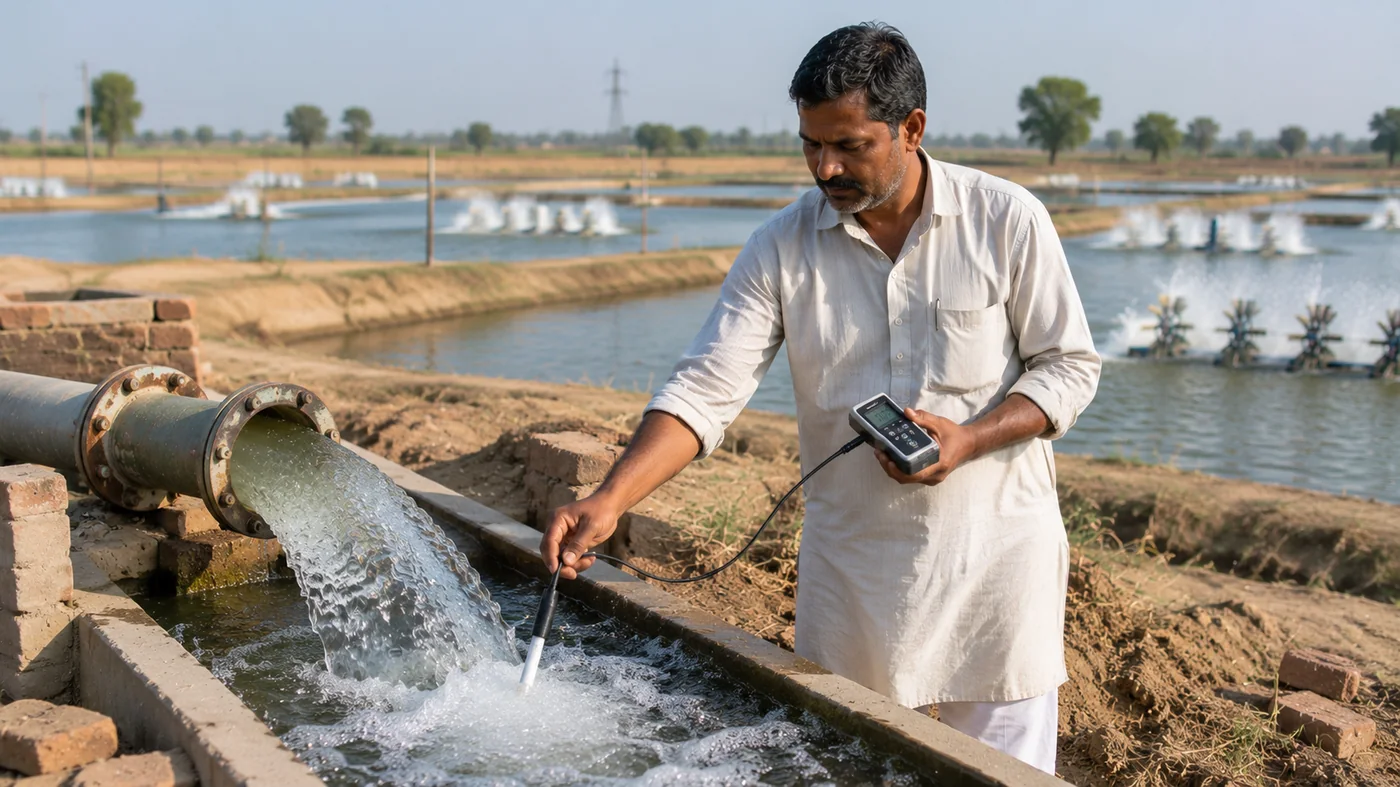
- A 1.8 to 2.2-meter cascaded splash degassing tower fractures the discharge stream into micro-droplets, stripping subterranean gases and elevating dissolved oxygen to >6.5 ppm before pond filling.
- Always test borewell water for specific ions using ICP spectroscopy; calculate stoichiometric additions of Potassium Chloride (KCl) and Magnesium Chloride (MgCl2) to achieve K+ > 12 ppm/ppt and an Mg:Ca ratio > 2.5:1.
- Never apply agricultural limestone (CaCO3) to high-calcium borewell ponds; doing so drives pH above 9.0 and exacerbates magnesium deficiency.
- Protect surrounding agricultural lands from salinization by installing 500-micron virgin HDPE geomembranes, digging perimeter seepage interceptor trenches, and operating zero-discharge recirculation networks.
Field Case Study: 6-Hectare Inland Saline Groundwater Enterprise
An inland shrimp farm in Sirsa, Haryana, utilizing 8.5 ppt subterranean saline groundwater suffered complete mortality in trial ponds due to un-degassed borewell water and severe ionic deficits (K+ tested at only 38 ppm vs 95 ppm required; Ca2+ was 410 ppm while Mg2+ was 260 ppm, yielding an inverted 0.6:1 Mg:Ca ratio). Under AquaSangham engineering advisory, the estate constructed a 2.0-meter cascading splash-board degassing tower to strip subterranean radon, methane, and excess CO2 while elevating DO from 1.5 ppm to 6.8 ppm. The farm dosed Potassium Chloride (KCl) @ 110 kg/ha-meter and Magnesium Chloride (MgCl2) @ 420 kg/ha-meter, restoring the Mg:Ca ratio to 3.2:1 and K+ to 115 ppm. Incorporating a 1.2-hectare lined zero-discharge seepage recovery reservoir to protect surrounding cotton and wheat fields, the farm stocked SPF Vannamei at 55 PL/m². Across 6 ponds, the enterprise harvested 50.4 metric tons of 27.2g shrimp at 108 DOC with an average FCR of 1.19, generating ₹94.5 Lakhs net profit and securing institutional export sales to Delhi-NCR.
1. Geological Origins & Chemistry of Inland Saline Groundwater
The emergence of commercial shrimp aquaculture in the agrarian heartlands of northwestern India—specifically across the semi-arid, salt-affected landscapes of southwest Punjab (Fazilka, Sri Muktsar Sahib, Bathinda, Mansa), southern Haryana (Sirsa, Hisar, Bhiwani, Rohtak), and northern Rajasthan (Churu, Hanumangarh)—is widely celebrated as a transformative blue revolution. Over the past decade, extensive canal irrigation networks (such as the Indira Gandhi Canal and Sirhind Feeder) constructed across regions with poor natural drainage have caused the subterranean water table to rise dramatically. Trapped within ancient, sub-surface lacustrine deposits and marine sediment basins left by the receding Tethys Sea, this shallow groundwater dissolved immense quantities of subterranean mineral salts, rendering hundreds of thousands of hectares of prime agricultural land waterlogged, salinized, and completely unfit for traditional wheat, cotton, or mustard cultivation.
Where conventional agriculture collapsed, commercial mariculture has flourished. By drilling agricultural borewells (tubewells) to tap into this shallow Inland Saline Groundwater (ISGW) at depths of 15 to 40 meters, innovative farmers discovered that Pacific White Shrimp (Penaeus vannamei) could be cultured hundreds of kilometers away from the ocean. Today, inland saline mariculture yields 6.5 to 9.0 metric tons per hectare per crop, turning barren, saline wastelands into agricultural enterprises generating net profits exceeding ₹8 to ₹12 Lakhs per hectare annually.
However, inland saline shrimp culture is fraught with severe, often fatal hydro-chemical challenges. Inland saline groundwater is not simply 'diluted sea water'. It is an ancient, geochemically altered subterranean brine. Unlike oceanic coastal water, which possesses an immutable thermodynamic balance of essential cations and anions, borewell groundwater exhibits radical, dangerous ionic distortions:
- Critical, lethal deficits of Potassium (K+) and Magnesium (Mg2+).
- Massive, toxic supersaturation of Calcium (Ca2+) and Bicarbonates (HCO3-).
- Severe inversion of the natural Magnesium-to-Calcium (Mg:Ca) ratio (frequently falling to 0.5:1, compared to the healthy oceanic ratio of 3.1:1).
- Total absence of dissolved oxygen (DO < 1.5 ppm), accompanied by dissolved subterranean carbon dioxide, methane, radon, and dissolved ferrous iron (Fe2+).
Stocking post-larvae directly into raw, untreated borewell water results in 100% mortality within 24 to 48 hours due to branchial pump failure and rapid asphyxiation. To succeed in inland saline aquaculture, farm operators must become hydro-chemical engineers. This technical master guide provides the complete scientific roadmap for analyzing borewell geochemical profiles, constructing cascaded atmospheric degassing towers, reconstituting tri-cation equilibrium, removing heavy mineral encrustations, and implementing zero-discharge anti-seepage protocols to protect surrounding agricultural lands.
Hydrogeological Profile of Inland Saline Aquifers
1. Ancient Sedimentary Brines: Groundwater salinity in Punjab and Haryana originates from evaporated prehistoric marine basins, resulting in high sulfate and calcium concentrations.
2. Waterlogging Induced Salinity: Unlined irrigation canals continuously recharge shallow aquifers, forcing subterranean salts to within 1.5 to 3.0 meters of the surface.
3. Geochemical Instability: Borewell chemistry fluctuates seasonally; post-monsoon water tables dilute slightly, while hot pre-monsoon summer pumping concentrates dissolved mineral salts.
Drill multiple test borewells at different depths (e.g., 20m, 35m, 50m) across your property. Shallow aquifers frequently have higher salinity and lower heavy metals than deep aquifers, allowing you to select the most physiologically balanced water source for your farm.
2. The Geochemical Anomaly Matrix: ISGW vs. Oceanic Seawater
Inland saline groundwater owes its mineral composition to rock-water interactions, subterranean mineral dissolution, and evaporative concentration over thousands of years. When standard 10 ppt oceanic seawater is compared against 10 ppt inland borewell water from Haryana or Punjab, the geochemical disparities are stark and dangerous:
1. The Potassium Deficit: In 10 ppt coastal seawater, dissolved potassium (K+) naturally measures ~108 ppm. In 10 ppt inland borewell water, potassium levels are typically only 20 to 35 ppm—an alarming 70% to 80% deficit. Because potassium is the primary intracellular cation driving the branchial Na+/K+-ATPase osmoregulatory engine, shrimp stocked in raw ISGW suffer catastrophic intracellular energy collapse and opaque white muscle necrosis within hours.
2. The Calcium Supersaturation Trap: Inland aquifers in northwest India reside in alluvial soils rich in subterranean limestone (CaCO3) and gypsum (CaSO4·2H2O). Consequently, dissolved calcium (Ca2+) frequently exceeds 350 to 500 ppm even at moderate salinities.
3. Inverted Magnesium-to-Calcium (Mg:Ca) Ratio: In healthy ocean water, magnesium exceeds calcium by a ratio of 3.1 to 1 (1,290 ppm Mg to 412 ppm Ca). In raw ISGW, calcium frequently exceeds magnesium by two- to three-fold, resulting in a disastrous Mg:Ca ratio of 0.4:1 to 0.7:1. When calcium dominates over magnesium, calcium ions competitively inhibit magnesium absorption, disrupting cuticular enzyme systems (such as alkaline phosphatase), causing brittle, distorted carapaces, deformed walking legs, and fatal incomplete molting (ecdysis collapse).
4. The Sulfate Dominance Anomaly: While oceanic seawater is dominated by chloride ions (Cl- : SO42- ratio ~ 7.1:1), inland saline groundwater frequently features high concentrations of sulfate ions derived from subterranean gypsum dissolution, lowering the Cl- : SO42- ratio to less than 2:1. Elevated sulfate increases osmoregulatory workload and promotes anaerobic hydrogen sulfide generation in pond sediments.
| Chemical Parameter / Ion | 10 ppt Diluted Seawater | 10 ppt Raw ISGW (Borewell) | Post-Reconstitution Target | Physiological Impact on Shrimp | Chemical Remediation Compound |
|---|---|---|---|---|---|
| Sodium (Na+) | ~ 3,077 ppm | 2,600 – 3,200 ppm | 2,800 – 3,200 ppm | Primary extracellular osmolyte | Naturally balanced |
| Potassium (K+) | ~ 108 ppm | 22 – 38 ppm (75% Deficit) | 110 – 130 ppm | Branchial Na+/K+-ATPase pump engine | Technical Potassium Chloride (KCl) |
| Magnesium (Mg2+) | ~ 368 ppm | 180 – 260 ppm (Deficit) | 750 – 950 ppm | ATP catalytic cofactor & shell hardening | Magnesium Chloride Flakes (MgCl2) |
| Calcium (Ca2+) | ~ 118 ppm | 380 – 520 ppm (Excess) | 350 – 420 ppm | Cuticular matrix structural element | Avoid all liming/gypsum products |
| Mg:Ca Ratio | 3.1 : 1 | 0.45:1 to 0.65:1 (Inverted) | > 2.5 : 1 (Optimal 3.0:1) | Prevents brittle shells & ecdysis death | Fortify with MgCl2 hexahydrate |
| Na:K Ratio | 28 : 1 | 75:1 to 110:1 (Lethal) | < 30 : 1 | Maintains cellular membrane potential | Dose KCl to depress Na:K ratio |
| Cl:SO4 Ratio | 7.1 : 1 | 1.8 : 1 to 2.5 : 1 | > 3.5 : 1 | Controls osmoregulatory workload | Add chloride salts (KCl / MgCl2) |
| Dissolved Oxygen (DO) | 6.5 – 7.5 ppm | < 1.5 ppm (Severe Anoxia) | > 6.5 ppm | Prevents asphyxiation & gill collapse | Cascaded splash-step aeration tower |
| Dissolved CO2 / Fe2+ | CO2 < 5 ppm / Fe 0 ppm | CO2 > 40 ppm / Fe 2–8 ppm | CO2 < 8 ppm / Fe < 0.2 ppm | Prevents acidosis & brown gill clogging | Atmospheric degassing & settling basin |
Never assume two borewells on the same farm have identical chemistry. Borewells drilled merely 300 meters apart often draw from different subterranean strata, with salinity and potassium levels varying by more than 50%. Test every borewell individually.
3. Borewell Head Engineering: Cascaded Splash Degassing & Oxygenation
Raw groundwater drawn from deep borewells is subterranean water that has been cut off from the atmosphere for centuries. It exhibits three lethal physical and chemical characteristics upon emergence:
- Severe Anoxia: Dissolved oxygen in freshly pumped borewell water is typically between 0.5 and 1.8 mg/L—far below the absolute minimum physiological survival threshold of 4.0 mg/L for Penaeus vannamei.
- Dissolved Subterranean Gases: ISGW is supersaturated with dissolved Carbon Dioxide (CO2 ranging from 35 to 80 mg/L), producing an initial water pH of 6.8 to 7.2. Furthermore, deep borewells in agricultural belts often carry dissolved methane, hydrogen sulfide (H2S), and radon gas. Pumping this water directly into ponds suffocates post-larvae and causes gas bubble trauma.
- Dissolved Ferrous Iron (Fe2+): Deep anaerobic groundwater holds iron in the soluble, clear ferrous state (Fe2+). When exposed to air, ferrous iron oxidizes rapidly into insoluble ferric hydroxide [Fe(OH)3], precipitating as a sticky, reddish-brown colloidal sludge that coats shrimp gills, blocking oxygen exchange and causing brown-gill suffocation.
The Cascaded Splash-Board Degassing Architecture: To condition raw borewell water, farms must install an elevated, multi-tiered cascaded degassing structure at the discharge head: 1. Vertical Drop Elevation: The borewell discharge pipe is elevated 1.8 to 2.2 meters above the pond or supply canal water level. 2. Perforated Splash Trays: The discharge stream is directed onto a series of 3 to 4 descending horizontal wooden or fiberglass splash trays fitted with 10 mm perforations and stainless steel wire mesh. 3. Physical Gas Stripping & Aeration: As water cascades over the perforated steps, the hydraulic impact fractures the water column into millions of micro-droplets. This massive air-water contact surface strips dissolved CO2, methane, and volatile sulfides into the atmosphere within seconds, while simultaneously absorbing atmospheric oxygen, elevating dissolved oxygen from 1.0 ppm to > 6.5 ppm before water reaches the delivery channel. 4. Pre-Sedimentation Iron Settling Basin: Water discharging from the cascade must flow through a 24-hour retention settling channel (equipped with baffle curtains) before entering production ponds. This allows oxidized ferric iron [Fe(OH)3] to precipitate as a red floc and settle on the channel bed, ensuring crystal-clear water enters the culture ponds.
Measure water pH immediately at the borewell pipe nozzle and compare it to water collected after the splash cascade. If your degassing tower is functioning properly, water pH will jump from 7.0 to 7.8–8.2 as dissolved acidic carbon dioxide gas is stripped into the air.
4. The Tri-Cation Reconstitution Protocol: Step-by-Step Balancing Math
Once borewell water is degassed, aerated, and stripped of iron, farm technicians must execute the tri-cation reconstitution protocol:
Step 1: Laboratory ICP Cation Profiling: Test pond water for Salinity (ppt), K+ (ppm), Mg2+ (ppm), and Ca2+ (ppm).
Step 2: Establish Target Cation Thresholds: Potassium Target: Minimum 12 to 15 ppm of K+ for every 1.0 ppt of salinity (e.g., at 8.0 ppt salinity, target K+ is 100 to 120 ppm). Magnesium Target: Target an Mg:Ca ratio of at least 3.0:1. If pond water contains 350 ppm Ca2+, the target Mg2+ concentration must be at least 1,050 ppm (350 × 3.0 = 1,050 ppm).
Step 3: Calculate Required Chemical Mass Additions: Potassium Chloride Addition: Required KCl (kg) = [(Target K+ ppm - Current K+ ppm) × Pond Volume (m³) × 1.91] / 1,000. Magnesium Chloride Hexahydrate Addition: Required MgCl2·6H2O (kg) = [(Target Mg2+ ppm - Current Mg2+ ppm) × Pond Volume (m³) × 8.33] / 1,000.
Practical Tip for High-Calcium Borewells: When borewell calcium is excessively high (>400 ppm), raising magnesium to 1,200 ppm requires immense quantities of MgCl2. In such cases, farmers should target an absolute minimum Mg:Ca ratio of 2.0:1 (700 to 800 ppm Mg2+) and compensate by top-dressing daily feed rations with chelated organic magnesium aspartate @ 8 to 10 g/kg feed.
Always re-test pond potassium and magnesium 24 hours post-dosing. In earthen ponds, high-CEC clay soils adsorb up to 20% of applied potassium ions through cation exchange; be prepared to apply a small secondary booster dose to reach your precise target ppm.
5. Managing Iron Precipitation, Turbidity & Aerator Mineral Scaling
Inland saline groundwater carries unique physical maintenance challenges that coastal farmers rarely encounter:
- Ferrous Iron Oxidation & Bio-Fouling: In groundwater containing >2 ppm dissolved iron, oxidized ferric precipitates coat checktrays, pond liners, and aeration equipment with a tenacious rust-colored crust. If iron floc enters culture ponds, shrimp gills become clogged with orange-brown particulate matter, predisposing the animals to opportunistic black-gill Vibrio infections. Prevent this by ensuring all borewell water passes through a baffled settling channel for at least 24 hours prior to pond infill.
- Severe Calcium Carbonate Scaling on Aerators: Because ISGW is supersaturated with calcium and bicarbonate, paddlewheel aerator blades, motor shafts, and checktrays accumulate thick, rock-hard white crusts of calcium carbonate scale within 30 days of operation. This mineral scaling increases aerator weight, imbalances rotating shafts, causes motor overheating, and creates sharp, abrasive edges that injure foraging shrimp. Technicians must inspect aerators monthly, soaking scaled paddlewheel assemblies in a 5% sulfamic acid or diluted muriatic acid bath to dissolve mineral deposits.
Apply a thin coating of food-grade silicone grease or hydrophobic wax to new paddlewheel aerator blades prior to deployment. The hydrophobic surface prevents calcium carbonate crystals from bonding to the plastic, allowing mineral crusts to be rinsed off with a standard garden hose.
6. Environmental Biosecurity: Preventing Agricultural Soil Salinization
Unlike coastal aquaculture, which is bounded by natural tidal waters, inland saline mariculture operates amidst fertile agricultural ecosystems producing cotton, wheat, basmati rice, and horticultural crops. If saline water seeps through earthen pond dykes or leaks into fresh shallow aquifers, it will salinize adjacent agricultural fields, sparking severe regulatory crackdowns and legal conflicts with neighboring farmers:
- Mandatory 500-Micron HDPE Geomembrane Lining: All inland culture ponds and drainage canals should be lined with 500 to 750-micron UV-stabilized HDPE geomembranes to establish a zero-seepage barrier. If earthen ponds are used, soils must contain a minimum of 35% clay, compacted with heavy vibratory rollers to achieve a hydraulic permeability coefficient < 10^-7 cm/s.
- Perimeter Drainage & Interceptor Cut-Off Trenches: Excavate a 2.5-meter-deep interceptor trench along the entire farm boundary separating the shrimp estate from neighboring farmlands. Submersible drainage pumps installed in sump pits along the trench capture any lateral subsurface seepage, pumping the brackish water back into the farm reservoir.
- Zero-Discharge Recirculation: Never discharge saline harvest water into public irrigation drains or freshwater canals. Construct dedicated effluent treatment reservoirs (ETP) where harvest water is settled, biologically treated, and stored for reuse in the subsequent crop cycle, or routed to lined solar evaporation pans where commercial salt can be harvested.
Install four shallow observation piezometer wells (depth 4 meters) along the outer perimeter boundary of your farm. Test the electrical conductivity of groundwater in these piezometer wells monthly; if conductivity rises, it provides an immediate early warning of dyke seepage before neighboring crops are affected.
7. North Indian Seasonal Crop Scheduling & Inland Farm Economics
Northwestern India experiences extreme continental climatic swings: scorching summer temperatures exceeding 46°C in May and June, followed by severe winter cold waves with night temperatures dropping below 4°C in December and January. Penaeus vannamei ceases feeding at temperatures below 18°C and suffers lethal hypothermic mortality below 12°C:
- The Production Calendar: Inland farmers must operate within a strict 7-to-8-month operational window spanning from late March to early November.
- Single Long Crop vs Two Fast Crops: Protocol A (Two Fast Crops): Stock Crop 1 in late March (DOC 85, harvest mid-June at 22g), followed immediately by Crop 2 stocked in early July (DOC 90, harvest late October at 26g). Protocol B (One High-Biomass Crop): Stock in mid-April and culture for 115 to 125 DOC, harvesting jumbo 32 to 36g export-grade shrimp in August.
- The Inland Fresh Market Premium: Inland farmers in Punjab and Haryana enjoy a massive logistical advantage: proximity to high-consumption metropolitan markets (Delhi NCR, Ludhiana, Chandigarh, Jaipur, Amritsar). By marketing harvest as fresh, chilled, chemical-free head-on shrimp delivered within 4 hours of netting, inland farmers command farmgate prices of ₹420 to ₹480/kg—a ₹50 to ₹80/kg premium over coastal export-factory rates, ensuring superior annual net returns.
Time your final harvest before Diwali in late October or early November. Domestic consumer demand in north Indian metropolitan hubs surges during festive periods, while pond water temperatures begin to drop sharply below 22°C by mid-November.
Summary Operational Action Checklist
Frequently Asked Questions
Q: Why is raw inland saline borewell water lethal to shrimp even if the salinity is 10 ppt?
Raw inland saline groundwater (ISGW) is an ancient subterranean mineral brine that lacks the biological equilibrium of coastal seawater. First, it emerges completely anoxic (dissolved oxygen < 1.5 ppm) and supersaturated with toxic dissolved carbon dioxide (CO2 > 40 ppm), methane, and dissolved ferrous iron (Fe2+), which suffocates shrimp within minutes. Second, ISGW has severe ionic imbalances: it is typically 70% to 80% deficient in essential Potassium (K+) and Magnesium (Mg2+), while containing massive excess Calcium (Ca2+). Without adequate potassium and magnesium to power branchial Na+/K+-ATPase pumps, shrimp suffer acute osmotic shock, opaque white muscle necrosis, and fatal molt failure.
Q: How does a cascaded splash degassing tower make subterranean groundwater safe for aquaculture?
A cascaded splash tower is a gravity-fed aeration structure where borewell water drops 1.8 to 2.2 meters over a series of 3 to 4 perforated splash trays or wooden baffles. The hydraulic impact shatters the water stream into millions of fine droplets, maximizing air-water contact. This physical stripping process instantly out-gasses volatile subterranean gases (carbon dioxide, methane, radon, and traces of hydrogen sulfide) into the atmosphere, causing water pH to stabilize between 7.8 and 8.2. Simultaneously, water absorbs atmospheric oxygen, boosting DO from under 1.5 ppm to over 6.5 ppm before water reaches delivery channels.
Q: Why should inland farmers in Punjab and Haryana avoid using agricultural lime or dolomite?
In coastal aquaculture, agricultural limestone (CaCO3) and dolomite are routinely applied to buffer soft water. However, inland saline groundwater in Punjab and Haryana is already supersaturated with dissolved calcium (Ca2+ frequently exceeds 350 to 500 ppm) and bicarbonate alkalinity derived from subterranean gypsum and kankar limestone strata. Adding more lime does not dissolve; instead, it precipitates as chalky white sediment, drives water pH above 9.0 (triggering acute toxic unionized ammonia spikes), and severely worsens the inverted Mg:Ca ratio, causing brittle shells and molt failure.
Q: How can shrimp farmers prevent their saline borewells from ruining neighboring agricultural crops?
Farmers must implement strict environmental engineering: 1) Line all culture ponds and supply canals with 500 to 750-micron virgin HDPE geomembranes to eliminate downward and lateral seepage, 2) Excavate a 2.5-meter-deep interceptor drainage trench along the farm boundary to capture any subsurface seepage, returning captured water to reservoirs, 3) Maintain a strict zero-discharge policy, recycling harvest water through dedicated effluent settling basins rather than discharging into public canal drains, and 4) Monitor peripheral observation piezometer wells monthly for salinity leaks.
Q: What is the optimal annual production calendar for shrimp farming in northern India?
Northern India experiences extreme continental climates with scorching summers (>45°C in June) and severe winter cold waves (<5°C in December). Penaeus vannamei stops feeding below 18°C and dies below 12°C. The viable culture window is 7 to 8 months, spanning from late March to early November. Farmers either run two fast crop cycles (Crop 1: late March to mid-June, harvest at 22g; Crop 2: early July to late October, harvest at 26g) or one high-density single crop cultured for 120 DOC to harvest jumbo 32–36g shrimp in August. Ponds must be fully harvested and drained before the onset of cold winter winds in mid-November.
AquaSangham Technical Advisory
Hydrogeology & Inland Saline Mariculture Desk
Contributing Senior Technical Writer & Aqua Consultant at AquaSangham.
Recommended Farming Guides
Total Ammonia Nitrogen (TAN) Mass Balance Math: Sizing Biofilters in Commercial RAS
Read Article →Farming TechThe Recirculating Aquaculture System (RAS) Master Guide: Design, Hydraulics & Mass Balance
Read Article →Farming TechIndigenous Magur (Clarias batrachus) Induced Breeding & Nursery Rearing SOPs
Read Article →Get Live Farm Advice on AquaSangham Mobile App
Download India's #1 Aquaculture Super App for real-time market prices, precision tools, and community advice.
Download Free Android App