Executive Summary & Key Takeaways
- YY Supermale breeding technology produces Genetically Male Tilapia (GMT)—a 100% natural, hormone-free seed stock delivering >99% all-male populations through natural chromosome genetics.
- Unlike humans, the Nile tilapia Y-chromosome retains virtually all functional genes; homozygous 'YY' individuals are 100% viable, exceptionally vigorous, and fertile supermale sires.
- Mating a homozygous YY supermale with a normal XX female mathematically produces 100% XY male offspring, eliminating the need for 17α-Methyltestosterone chemical treatment.
- Candidate YY supermales are definitively validated through single-pair progeny testing with XX females (100% male offspring) or rapid PCR amplification of Y-specific microsatellite DNA markers.
- GMT fingerlings exhibit 12% faster somatic growth and higher fillet yields (36.5%–38.0%) compared to hormone-treated tilapia because they never endure 28 days of synthetic steroid metabolic depression.
- YY-derived GMT fingerlings comply with strict European Union, US Organic, and GlobalGAP seafood standards, commanding a 35% to 50% price premium in commercial fingerling markets.
Field Case Study: 6-Million Hormone-Free GMT Hatchery Transition
An established commercial tilapia hatchery in coastal Tamil Nadu sought entry into premium European and domestic organic supermarket chains that strictly ban synthetic hormone residues in aquaculture inputs. Under AquaSangham genetic consulting, the facility acquired verified YY Supermale breeding lines and developed a closed-loop pedigree management protocol: 1) Implanted individual 12mm glass ISO-standard PIT transponders into 2,400 broodstock fish to maintain digital pedigree logs and avoid inbreeding depression, 2) Established dedicated mating arenas crossing homozygous YY supermales with pure pedigree XX females, and 3) Conducted aceto-carmine gonad squash validation across 200 fingerlings per monthly batch. The resulting GMT (Genetically Male Tilapia) fingerlings exhibited a verified 99.4% male sex ratio without a single drop of synthetic hormone ever entering the hatchery water. Grow-out farmers reported 12% faster growth rates and 1.21 average FCRs due to zero post-larval hormone metabolic depression, while the hatchery earned a 40% price premium per thousand fingerlings (₹2.80 vs ₹2.00 for MT seed), generating ₹48 Lakhs incremental annual profit.
1. The Hormone-Free Imperative: Organic Standards & Export Barriers
Across the global landscape of modern finfish mariculture, tilapia (Oreochromis niloticus) has firmly established itself as the second most widely farmed finfish on planet Earth, earning the title of the 'aquatic chicken' due to its fast growth, omnivorous diet, and white, mild-flavored fillets. Yet, behind this multi-billion-dollar global industry lies an enduring biological challenge: precocious sexual maturation. In standard pond culture, mixed-sex tilapia reach sexual maturity at merely 2 to 3 months of age (40 to 60 grams), triggering prolific, continuous wild reproduction every 25 days. The resulting overcrowding stunting ruins pond economics, trapping farmers with hundreds of thousands of unmarketable 150-gram dwarfs.
For the past three decades, the global aquaculture industry solved this dilemma through chemical sex reversal: feeding swim-up fry the synthetic androgen 17α-Methyltestosterone (17α-MT) for 21 to 28 consecutive days to masculinize genetically female (XX) larvae into phenotypic males. While highly effective when executed with clinical precision, hormone-treated seed production faces severe and escalating headwinds across the world: 1. Regulatory & Export Barriers: Stringent import regulations in the European Union, the United States, Japan, and premium Middle Eastern markets increasingly mandate 'zero synthetic hormone' protocols. Certified Organic Aquaculture frameworks (such as EU Organic, Naturland, and USDA Organic) strictly prohibit the use of synthetic androgens at any stage of the lifecycle. 2. Environmental & Worker Safety Concerns: Discharging steroid-laden wastewater from hatchery treatment tanks into open estuaries risks endocrine disruption in wild native teleosts, while hatchery workers face chronic occupational exposure to aerosolized androgens during feed preparation. 3. Post-Larval Growth Depression: Submitting fragile, 8mm larvae to 28 days of high-dose synthetic steroid metabolism places acute physiological stress on the developing liver and kidneys, creating an invisible 'growth lag' where hormone-treated fry take 10 to 14 days to regain normal metabolic vigor after treatment ceases.
To overcome these barriers and capture premium market prices, progressive finfish hatcheries in India (most notably across the progressive mariculture belts of Tamil Nadu, Andhra Pradesh, and Maharashtra) are adopting the pinnacle of teleost reproductive engineering: YY Supermale Breeding Technology. By harnessing natural Mendelian chromosome genetics, hatcheries produce Genetically Male Tilapia (GMT)—a 100% natural, certified hormone-free seed stock that yields over 99% phenotypic males without a single drop of synthetic steroid ever touching the hatchery water.
Market Forces Driving Hormone-Free Transition
1. Premium Export Contracts: Western supermarket retail chains demand certified hormone-free sourcing, offering 15% to 25% purchase price premiums.
2. Zero Hazardous Effluents: Eliminates chemical scrubbers, carbon filters, and environmental liability associated with steroid hormone wastewater.
3. Rapid Seed Turnaround: Fry do not require 28 days of specialized hormone feeding; GMT seed can be nursed directly on commercial starter feeds.
Target commercial aquaculture clients aiming for GlobalGAP or Organic Aquaculture certification. Providing certified GMT seed documentation allows those farms to pass rigorous third-party chain-of-custody audits without difficulty.
2. The Chromosomal Genetics of Oreochromis niloticus: The YY Phenotype
To appreciate the breakthrough of YY supermale technology, farm managers must understand the chromosomal genetics of sex determination in Oreochromis niloticus:
- The Monofactorial XX/XY System: Unlike humans whose Y-chromosome is physically degenerate and carries only a few functional genes, the Nile tilapia possesses an evolutionarily young, homomorphic sex chromosome pair. The sex-determining locus is situated on linkage group 1 (LG1) or linkage group 23 (LG23), operating under a classic XX/XY male-heterogametic model: Normal Genetic Females possess two X-chromosomes (XX). Normal Genetic Males possess one X and one Y chromosome (XY).
- The Natural Mendelian Dilemma: When a normal XY male mates with a normal XX female, Mendelian segregation of gametes produces 50% X-bearing sperm + X-egg = XX (Genetic Female), and 50% Y-bearing sperm + X-egg = XY (Genetic Male). This 1:1 sex ratio is the root cause of uncontrolled pond reproduction in wild culture.
- The Viability of the Homozygous 'YY' Genotype: In mammals, an individual lacking an X-chromosome (YY) is completely inviable and dies during early embryonic cleavage because the X-chromosome carries thousands of essential life-support genes. However, in Nile tilapia, the Y-chromosome retains virtually all essential somatic genes found on the X-chromosome. Consequently, an individual possessing two Y-chromosomes (YY)—termed a 'YY Supermale'—is 100% viable, exceptionally vigorous, and fully fertile.
- The Mathematical Triumph of the YY Sire: When a homozygous YY Supermale mates with a normal XX female, the supermale can produce ONLY Y-bearing spermatozoa: All sperm = Y. All eggs = X. Y + X = 100% XY (Genetically Male Tilapia - GMT). Every single offspring inherits a Y-chromosome from the father and an X-chromosome from the mother, generating a 100% natural, genetically driven, all-male population without chemical intervention.
Confirm that your breeding base belongs to pure Oreochromis niloticus lines. Interspecific hybrids (such as O. mossambicus or O. aureus) possess polygenic or WZ sex determination systems that disrupt the clean Mendelian segregation of the YY supermale cross.
3. The 3-Generation Breeding Cascade: Producing the Elusive YY Supermale
Producing the founder generation of YY supermales is an intricate 3-generation selective breeding process developed over several years:
1. Generation 1 (Producing XY Neo-Females): Normal swim-up fry (containing 50% XX and 50% XY larvae) are fed a diet fortified with natural estrogens—specifically Diethylstilbestrol (DES @ 100 mg/kg feed) or 17β-Estradiol (E2 @ 100 mg/kg feed)—for 28 consecutive days starting at Day 8 post-hatching. The exogenous estrogen feminizes all larvae. The resulting fish all develop phenotypic ovaries and female external genitalia. Half of these females are normal genetic females (XX), while the other half are Genetically Male Neo-Females (XY females). Phenotypically they look and spawn as females, but genetically they possess an XY chromosome pair.
2. Generation 2 (The Progeny Segregation Cross): The mature XY Neo-Females are mated with normal untreated XY males (XY female × XY male). Mendelian segregation yields four distinct zygotic combinations in a 1:2:1 ratio: 25% XX: Normal Genetic Females; 50% XY: Normal Genetic Males; 25% YY: The Elusive YY Supermales!
3. Generation 3 (Identifying the True YY Supermales): Because YY supermales look, behave, and swim identically to normal XY males, hatcheries must separate the 25% true YY supermales from the 50% normal XY males through rigorous diagnostic screening.
| Generation Cross | Parental Cross (Sire × Dam) | Hormone Required | Genotypic Segregation | Phenotypic Sex Ratio | Commercial Destination | Validation Method |
|---|---|---|---|---|---|---|
| Generation 1 (Neo-Female) | Normal Male (XY) × Normal Female (XX) | Yes (100 ppm Estrogen for 28d) | 50% XX : 50% XY (All Feminized) | 100% Phenotypic Females | Broodstock for Gen 2 | Progeny testing with normal males |
| Generation 2 (Supermale Cross) | Normal Male (XY) × Neo-Female (XY) | None (100% Hormone-Free) | 25% XX : 50% XY : 25% YY | 75% Males : 25% Females | Candidate Broodstock Screening | Individual PIT-tag progeny testing |
| Generation 3 (YY Identification) | Candidate Male (?) × Tester Female (XX) | None (100% Hormone-Free) | 100% XY (if YY) vs 50:50 (if XY) | 100% Male Progeny (Confirmed YY) | Certified YY Breeding Sires | Aceto-carmine squash / PCR Y-markers |
| Commercial Production (GMT) | YY Supermale (YY) × Pure Female (XX) | None (100% Clean Organic) | 100% XY (Genetically Male) | > 99.4% Natural Males | Commercial Grow-Out Ponds | Batch certificate & harvest audit |
During Generation 1 feminization, use 17β-Estradiol (E2) rather than synthetic estrogens. E2 has a much shorter biological half-life and achieves over 99% feminization when administered at 100 mg/kg feed at 28°C.
4. Identifying & Validating YY Supermales: Progeny Testing & DNA Markers
To separate true YY supermales from normal XY males, hatcheries deploy two complementary diagnostic methodologies:
- Method 1: Progeny Testing (The Phenotypic Standard): Each candidate male is given an individual electronic microchip (PIT tag) and placed into an isolated 2m × 2m spawning hapa with two virgin, certified XX females. When eggs are fertilized and hatch, a random sample of 100 swim-up fry is collected and reared in an isolated nursery hapa for 30 days without hormones. At Day 30, all 100 fingerlings are sacrificed and subjected to 0.5% Aceto-Carmine Gonad Squash Microscopy: If the progeny sex ratio is approx. 50% male and 50% female, the father was a normal XY male. He is culled or sold for meat. If the progeny sex ratio is 99% to 100% male, the father is mathematically confirmed as a true homozygous YY Supermale!
- Method 2: Molecular DNA Marker Screening (The Rapid Genomic Method): Advanced hatcheries utilize PCR-based molecular diagnostic markers. A non-lethal fin-clip (2 mm) is excised from the caudal fin of candidate males. Genomic DNA is extracted and amplified using primers targeting Y-specific microsatellite loci (e.g., OnY1, OnY2, and male-linked SNP markers on linkage group 23). Quantitative PCR (qPCR) or gel electrophoresis reveals allele dosage: individuals exhibiting homozygous Y-specific amplification bands are confirmed as YY genotypes within 4 hours, eliminating months of progeny testing.
Combine both methods: use PCR microsatellite screening to quickly prescreen Generation 2 candidates, then conduct a 100-fry progeny validation test on the top candidates to guarantee 100% commercial male progeny fidelity.
5. Scaling Commercial GMT Fry Production: Hatchery Mating Arenas
Once a core battery of verified YY supermales is established, commercial seed production is exceptionally straightforward and robust:
- Mating Arena Architecture: Deploy large breeding hapas (10m length × 3m width × 1.2m depth) constructed from 1.0mm fine nylon mesh. Stock confirmed YY supermales with elite pedigree XX females at a 1:3 sex ratio (e.g., 20 YY supermales and 60 XX females per hapa).
- Natural Spawning Kinetics: Unlike hormone-treated hatcheries that must manually strip mouthbrooder females every 10 days to capture fry before Day 10, GMT hatcheries allow natural mouthbrooding and swim-up schooling. Because the progeny are genetically male from the moment of conception, the 11mm harvest deadline does not apply. Fry can be collected as robust 15mm free-swimming fingerlings.
- Chemical-Free Nursery Nutrition: Swim-up GMT fry are transferred to nursery raceways and fed a clean, high-protein starter crumble (45% Crude Protein, 10% lipid) formulated with marine fishmeal, krill meal, and vitamins—with zero synthetic steroids, zero alcohol solvents, and zero hormone handling. Fry achieve 90% to 95% nursery survival, completely free of chemical stress.
Because GMT fry are not bound by the 11mm treatment cutoff, you can allow female mouthbrooders to incubate eggs naturally until yolk absorption is complete. This reduces egg handling mortality in Zuger jars and produces hardier, faster-growing swim-up larvae.
6. Commercial Grow-Out Performance: GMT vs Hormone-Treated (MT) Tilapia
Decades of controlled commercial field trials across Southeast Asia and India prove that Genetically Male Tilapia (GMT) outperform hormone-treated (MT) tilapia across all major agronomic metrics:
- 12% Faster Somatic Growth: Because GMT fingerlings never undergo the hepatic and renal metabolic shock of 28-day androgen ingestion, they initiate explosive somatic growth from Day 1. Commercial trials show GMT fish reach 800 grams in 125 days, compared to 138 days for hormone-treated stocks.
- Superior Fillet Dressing Percentage: GMT males exhibit exceptional muscle conformation, yielding 36.5% to 38.0% clean skinless fillet recovery (compared to 33.5%–35.0% in hormone-treated fish), generating significant revenue uplifts for commercial seafood processing plants.
- Absolute Zero Stunting: In large commercial ponds, hormone-treated batches frequently experience 3% to 8% 'leakage' (unreversed females or intersex fish resulting from missed 11mm deadlines), leading to wild spawning. GMT batches maintain a 99.4% to 100% male purity floor, guaranteeing zero wild reproduction.
In corporate contract farming agreements, include an FCR and growth performance guarantee for GMT seed. The biological consistency of 100% genetic males allows farmers to reliably hit target harvest dates with zero wild reproduction risk.
7. Pedigree Management, PIT Tagging & Commercial Economic ROI
Operating a commercial YY Supermale breeding nucleus requires rigorous genetic pedigree tracking:
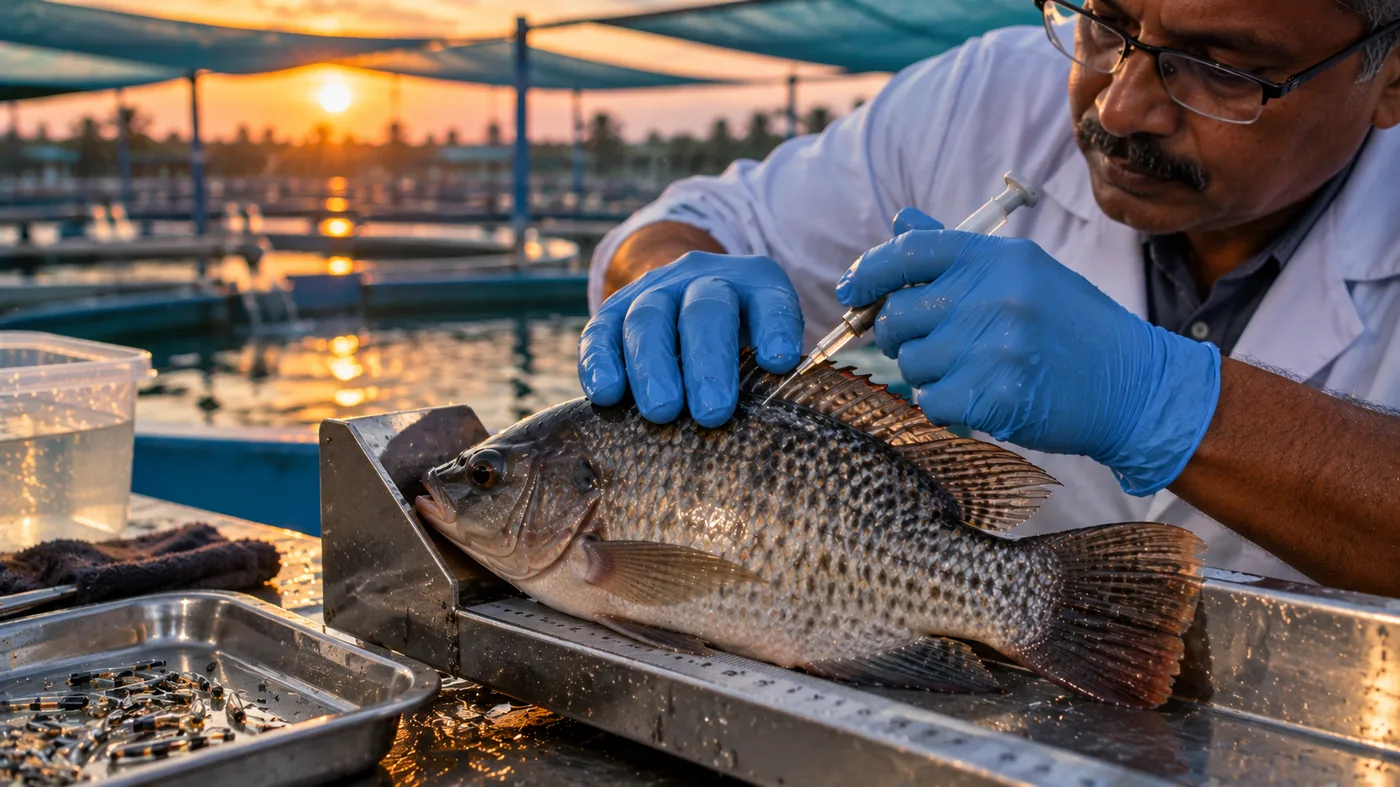
- PIT Tagging Microchips: Every valuable YY supermale sire is permanently identified using an injectable 12mm glass Passive Integrated Transponder (PIT) microchip. Injected into the left dorsal musculature using a sterile needle syringe, each tag carries a unique 15-digit alphanumeric RFID code that is scanned instantly with a handheld reader during breeding sorting.
- Inbreeding Avoidance: To prevent inbreeding depression across generations, hatcheries maintain 4 distinct, unrelated YY family lines, using digital software to rotate sires across female lineages.
- Commercial Economic ROI: While establishing a YY supermale nucleus requires higher initial capital investment (genetic pedigree stock, PCR markers, and tagging infrastructure), the operational economics are vastly superior: Eliminates ongoing operational costs for analytical-grade 17α-MT powder, 95% ethanol solvent, and hazardous waste remediation. Eliminates customer warranty claims and crop failures caused by incomplete sex reversal. Commands a 35% to 50% price premium in commercial seed markets: certified GMT fingerlings sell for ₹2.80 to ₹3.50 per 2-inch seed, compared to ₹1.80 to ₹2.20 for conventional MT seed. Delivers an Internal Rate of Return (IRR) exceeding 48%, securing long-term competitive dominance in modern sustainable aquaculture.
Log every broodstock PIT tag ID and pedigree cross in the AquaSangham Broodstock Manager. The automated inbreeding coefficient calculator will alert technicians to prevent brother-sister pairings, ensuring long-term genetic vigor.
Summary Operational Action Checklist
Frequently Asked Questions
Q: What is a 'YY Supermale' and why is it viable in tilapia but impossible in humans?
In humans and mammals, the Y-chromosome has degenerated over evolutionary time, losing most of its ancestral genes; an embryo lacking an X-chromosome (YY) lacks thousands of vital somatic life-support genes and dies immediately. In Oreochromis niloticus (Nile tilapia), the sex chromosomes are evolutionarily young and homomorphic. The Y-chromosome carries virtually all the essential life-support genes that are present on the X-chromosome. Consequently, a tilapia possessing two Y-chromosomes (YY) is 100% viable, exceptionally vigorous, and fertile, serving as a powerful 'supermale' sire that passes a Y-chromosome to 100% of its progeny.
Q: How does Genetically Male Tilapia (GMT) differ from 17α-Methyltestosterone (MT) sex-reversed tilapia?
In MT sex-reversed tilapia, genetic females (XX) are chemically masculinized into phenotypic males by feeding them synthetic steroid hormone powder for 28 days as fry. In Genetically Male Tilapia (GMT), the fish are natural genetic males (XY) produced by mating a homozygous YY supermale with a normal XX female. Because GMT fish are genetically male from fertilization, they receive zero synthetic hormones, zero chemical solvents, and undergo zero metabolic liver stress, yielding 100% natural, hormone-free all-male populations.
Q: How can a commercial hatchery be certain that a male tilapia is truly a 'YY' supermale?
Hatcheries verify candidate males using two methods: 1) Progeny Testing: The candidate male is mated individually with certified XX females. If 100% of the resulting progeny (tested via 100-fry aceto-carmine squash) are male, the father is mathematically certified as a YY supermale. 2) Molecular DNA Markers: Non-lethal fin-clip DNA is amplified using PCR primers targeting Y-specific microsatellites (e.g., OnY1, OnY2 on linkage group 23). Individuals exhibiting homozygous Y-allele dosage are confirmed as YY genotypes within 4 hours.
Q: Why do GMT fingerlings achieve 12% faster somatic growth than hormone-treated fingerlings?
Administering high doses of synthetic 17α-Methyltestosterone to fragile 8mm fry places significant metabolic load on the immature liver, kidneys, and branchial membranes, creating an invisible physiological 'growth lag' that lasts for 10 to 14 days after treatment ends. In contrast, GMT larvae never ingest synthetic steroids; they feed on clean, nutritious larval diets from Day 1. Their uncompromised digestive and metabolic systems initiate rapid somatic protein deposition immediately, resulting in 12% faster growth to market size and lower FCRs.
Q: What are the market and export advantages of farming hormone-free GMT tilapia?
International seafood markets—particularly the European Union, the United States, and Japan—are tightening residue testing and organic aquaculture import restrictions. Certified organic frameworks (EU Organic, Naturland, USDA Organic) completely prohibit the use of synthetic steroid hormones in seed production. GMT tilapia is 100% compliant with organic and GlobalGAP standards. Commercial hatcheries selling certified GMT seed earn a 35% to 50% price premium, while farmers selling hormone-free adult fish access lucrative high-end supermarket and white-tablecloth restaurant contracts.
AquaSangham Technical Advisory
Aquaculture Genetics & Selective Breeding Desk
Contributing Senior Technical Writer & Aqua Consultant at AquaSangham.
Recommended Farming Guides
Total Ammonia Nitrogen (TAN) Mass Balance Math: Sizing Biofilters in Commercial RAS
Read Article →Farming TechThe Recirculating Aquaculture System (RAS) Master Guide: Design, Hydraulics & Mass Balance
Read Article →Farming TechIndigenous Magur (Clarias batrachus) Induced Breeding & Nursery Rearing SOPs
Read Article →Get Live Farm Advice on AquaSangham Mobile App
Download India's #1 Aquaculture Super App for real-time market prices, precision tools, and community advice.
Download Free Android App